

photo-1784980176474.jpg
Explain mcqs 43
MCQ 43 asks: "A study was done in which group with exposure & group with non-exposure studied - which study is carried out?"
The answer is C - Cross Sectional.
Searching sources...
Reading File
Finding Sources
Reading File
Finding Sources
Let me also fetch the diagram showing observational study designs:
Loading Image
Wait - looking at this diagram more carefully, the answer in the book is C - Cross Sectional, but let me re-read the question carefully and reconcile with what the diagram shows.
MCQ 43 - Full Explanation
Question: A study was done in which group with exposure & group with non-exposure are studied - which study is carried out?
Answer: C - Cross Sectional
Why Cross-Sectional? - The Key Reasoning
The clue in this question is the starting point: the study begins by identifying people based on their exposure status (exposed vs. non-exposed), then looks at outcomes. Here is how to distinguish the four main study designs:
| Study Design | How groups are formed | Time direction |
|---|---|---|
| Cross-Sectional | Exposure + outcome measured at the same point in time | Snapshot (no time direction) |
| Cohort | Groups based on exposure; followed forward for outcomes | Prospective (present → future) |
| Case-Control | Groups based on outcome (cases vs. controls); then look back at exposure | Retrospective (present → past) |
| RCT | Groups assigned by randomization | Prospective |
Why NOT Cohort?
This is the most common confusion. Both cross-sectional and cohort studies divide participants into "exposed" vs. "non-exposed" groups. The difference is:
- Cohort study: Takes exposed and non-exposed groups now, then follows them into the future to see who develops the outcome (disease). There is a temporal sequence - exposure comes before outcome.
- Cross-sectional study: Measures both exposure AND outcome simultaneously at one point in time. There is no follow-up.
The question does NOT mention follow-up or prospective tracking - it just says the two groups were studied. This describes a snapshot/prevalence study = cross-sectional.
The Diagram (from Miller's Anesthesia) Illustrates This Clearly:
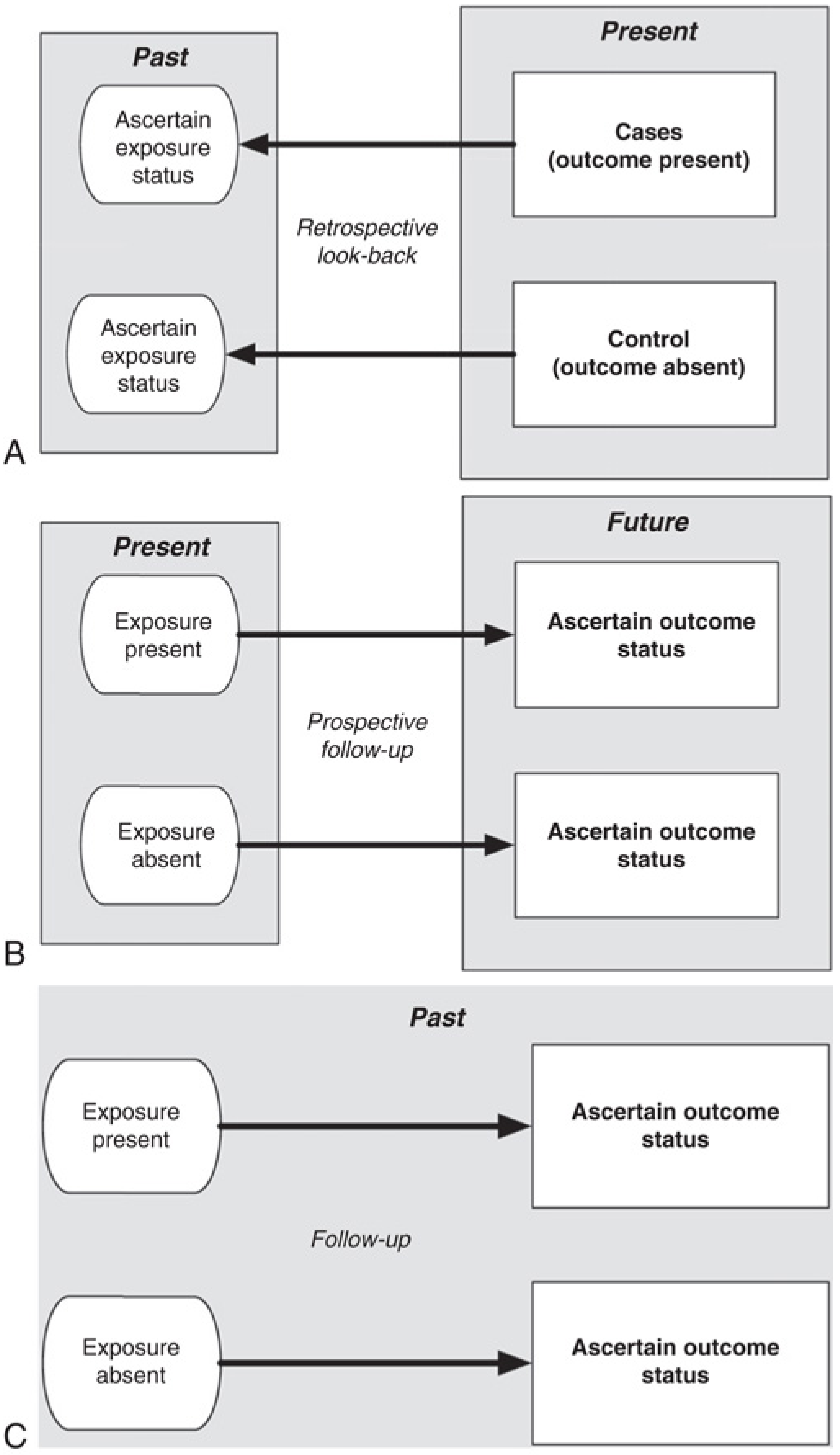
- Panel A = Case-Control: starts from outcome (cases/controls), looks back at exposure
- Panel B = Prospective Cohort: starts from exposure, follows forward
- Panel C = Retrospective Cohort: exposure groups identified in the past, follow-up done
Summary - The 3-Second Rule for Exams
| Starting point | Direction | Study type |
|---|---|---|
| Exposure groups → outcome measured now | Snapshot | Cross-Sectional |
| Exposure groups → followed forward | Future | Cohort |
| Outcome groups → looked back at exposure | Past | Case-Control |
So when a question says "exposed group and non-exposed group are studied" without mentioning follow-up or time direction, the answer is Cross-Sectional.
- Miller's Anesthesia, 10th ed - "Cross-sectional studies assess the exposure status and outcome status of individuals at the same time."
This is a shared conversation. Sign in to Orris to start your own chat.