
Diagnosis protocol of cushing syndrome and explain the steps and their results.
Reading File
Finding Sources
Finding Sources
Searching PubMed
"Cushing Syndrome"[MeSH Terms] AND diagnosis
Searching the Web
Cushing syndrome diagnosis guideline screening tests dexamethasone late night salivary cortisol official
Reading File
Finding Sources
Reading Web Page
https://www.endocrine.org/clinical-practice-guidelines/diagn…
Diagnostic protocol for Cushing syndrome
Cushing syndrome means persistent endogenous cortisol excess. The diagnostic sequence is:
1. Suspect clinically and exclude exogenous steroid exposure
→ 2. Prove hypercortisolism with screening tests
→ 3. Confirm with a second abnormal test
→ 4. Measure ACTH to classify the cause
→ 5. Localize the source with targeted imaging and, if needed, inferior petrosal sinus sampling (IPSS).
→ 2. Prove hypercortisolism with screening tests
→ 3. Confirm with a second abnormal test
→ 4. Measure ACTH to classify the cause
→ 5. Localize the source with targeted imaging and, if needed, inferior petrosal sinus sampling (IPSS).
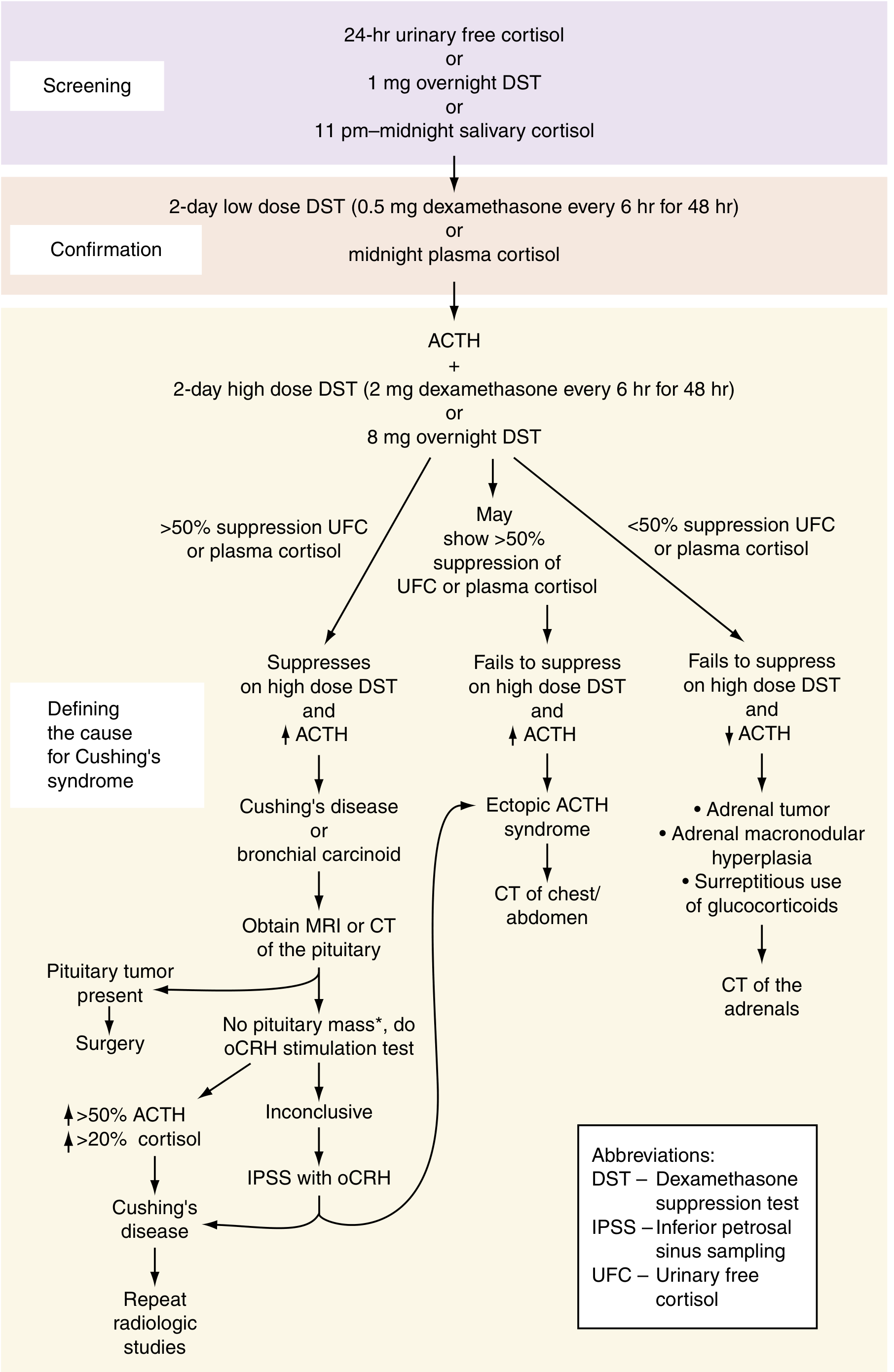
Adapted diagnostic flowchart. Source: Henry's Clinical Diagnosis and Management by Laboratory Methods, p. 477.
Step 0: Confirm this is a patient who should be tested
Test patients with discriminatory features such as:
- Easy bruising, wide reddish-purple striae, facial plethora
- Proximal muscle weakness
- Unexplained osteoporosis or fractures at a young age
- New or difficult-to-control hypertension or diabetes
- Menstrual irregularity, hirsutism, reduced libido
- Growth failure with weight gain in children
- Adrenal incidentaloma with suggestive features
First exclude exogenous glucocorticoids: oral prednisolone, dexamethasone, injections, inhalers, potent topical preparations, herbal or skin-lightening products, and sometimes drug interactions. This is the commonest cause of Cushingoid appearance.
Also consider conditions that can cause physiological hypercortisolism or pseudo-Cushing states: alcohol use disorder, severe depression/anxiety, poorly controlled diabetes, obesity, acute illness, and pregnancy.
Step 1: Screen for endogenous cortisol excess
Use one of the following first-line tests, usually repeating the test or using a second different test if the result is abnormal. The Endocrine Society guideline supports late-night salivary cortisol, 24-hour urinary free cortisol, or low-dose dexamethasone suppression testing as initial tests (guideline resource).
A. 1-mg overnight dexamethasone suppression test
Method
- Give dexamethasone 1 mg orally at 11 PM to midnight.
- Measure serum cortisol at 8 to 9 AM the next day.
Normal result
- Morning cortisol < 1.8 micrograms/dL (< 50 nmol/L)
- This indicates normal suppression and makes Cushing syndrome unlikely.
Abnormal result
- Morning cortisol ≥ 1.8 micrograms/dL
- This is failure of suppression and suggests possible Cushing syndrome, but it must be confirmed with another test.
Important false-positive causes
- Poor dexamethasone absorption or non-adherence
- Drugs that increase dexamethasone metabolism: phenytoin, phenobarbital, carbamazepine, rifampicin
- Estrogen therapy or oral contraceptive use can raise cortisol-binding globulin and total serum cortisol
- Depression, alcohol excess, obesity, acute illness
The lower cutoff of 1.8 micrograms/dL is highly sensitive but less specific.
Henry's Clinical Diagnosis and Management by Laboratory Methods, p. 477.
Henry's Clinical Diagnosis and Management by Laboratory Methods, p. 477.
B. Late-night salivary cortisol, preferably two samples
Method
- Collect saliva at 11 PM to midnight, on two separate nights.
- The patient should avoid smoking, eating, and brushing teeth shortly before collection.
Principle
Normal cortisol secretion has a circadian rhythm, with very low cortisol around midnight. Cushing syndrome causes loss of this late-night cortisol nadir.
Normal result
- Low late-night salivary cortisol, within the assay-specific reference range.
Abnormal result
- Elevated late-night salivary cortisol on two occasions supports Cushing syndrome.
Best use
- Convenient outpatient test.
- Particularly useful if cyclic Cushing syndrome is suspected, because it can be repeated during symptomatic periods.
Limitations
- Shift work, irregular sleep, acute stress, smoking, oral bleeding, and incorrect collection can give misleading results.
C. 24-hour urinary free cortisol, preferably two collections
Method
- Collect all urine for 24 hours, ideally on two separate days.
- Urinary creatinine should be checked to assess completeness of collection.
Normal result
- Urinary free cortisol within the laboratory reference range.
Abnormal result
- Urinary free cortisol above the assay's upper limit of normal suggests hypercortisolism.
- A value more than four times the upper limit of normal is strongly supportive of Cushing syndrome.
Limitations
- Incomplete collection causes falsely low values.
- Renal impairment, especially GFR below 30 mL/minute, may cause falsely low urinary cortisol.
- Mild elevation may occur in obesity, alcohol excess, depression, pregnancy, and poorly controlled diabetes.
Henry's Clinical Diagnosis and Management by Laboratory Methods, p. 477.
Tests that should not be used alone for screening
- Random serum cortisol
- Single morning cortisol
- Random ACTH
- Urinary 17-ketosteroids
- CT or MRI before biochemical confirmation
Cortisol secretion is pulsatile and variable. A normal random cortisol does not exclude Cushing syndrome.
Step 2: Confirm endogenous Cushing syndrome
| Screening outcome | Interpretation and next action |
|---|---|
| Two normal tests and low clinical suspicion | Cushing syndrome is unlikely. |
| Two normal tests but high suspicion, especially possible cyclic disease | Repeat testing during symptomatic periods, especially late-night salivary cortisol or urinary free cortisol. |
| One abnormal test | Repeat it or perform another first-line test. Review drugs, alcohol use, depression, obesity, renal function, sleep pattern, and collection method. |
| Two concordantly abnormal tests | Endogenous Cushing syndrome is likely. Proceed to plasma ACTH. |
| Discordant results | Refer to an endocrinologist; consider cyclic Cushing syndrome, pseudo-Cushing state, or assay/test interference. |
Step 3: Measure plasma ACTH to determine whether cortisol excess is ACTH-dependent
Obtain a morning plasma ACTH after hypercortisolism is confirmed.
| ACTH result | Interpretation | Likely causes | Next step |
|---|---|---|---|
| Low or suppressed | ACTH-independent Cushing syndrome | Adrenal cortisol-producing adenoma, adrenal carcinoma, bilateral adrenal nodular disease | CT or MRI of adrenal glands |
| Normal or high, not suppressed | ACTH-dependent Cushing syndrome | Pituitary ACTH adenoma, called Cushing disease; ectopic ACTH secretion; rarely ectopic CRH | Pituitary MRI, then IPSS if required |
A. ACTH-independent Cushing syndrome
Expected findings
- High cortisol
- Low ACTH because cortisol suppresses pituitary ACTH secretion
Imaging
- Thin-section CT or MRI of the adrenal glands.
Possible results
- Unilateral adrenal mass: adrenal adenoma or carcinoma, assessed using imaging appearance and hormone profile.
- Bilateral nodularity or enlargement: bilateral adrenal hyperplasia/nodular disease.
- Normal-appearing glands: seek specialist assessment, since imaging alone does not prove the source.
B. ACTH-dependent Cushing syndrome
Expected findings
- High cortisol
- ACTH normal or high
The two key causes are:
- Pituitary ACTH-secreting adenoma, called Cushing disease, approximately the commonest endogenous cause.
- Ectopic ACTH secretion, often from a neuroendocrine tumor, small-cell lung cancer, bronchial carcinoid, thymic carcinoid, or pancreatic neuroendocrine tumor.
Step 4: Pituitary MRI
Perform gadolinium-enhanced pituitary MRI in ACTH-dependent disease.
| MRI result | Meaning | Next step |
|---|---|---|
| Clear pituitary lesion, usually at least 6 mm, with compatible biochemistry | Supports Cushing disease | Multidisciplinary endocrine/neurosurgical assessment |
| MRI normal or lesion smaller than 6 mm | MRI cannot distinguish a small incidental lesion from a true ACTH adenoma | Inferior petrosal sinus sampling |
| Imaging and clinical findings suggest ectopic source | Consider chest and abdominal imaging | Search for ectopic ACTH-producing tumor |
A pituitary incidentaloma can occur in people without Cushing disease. Therefore, do not assume every pituitary lesion is the ACTH source.
Step 5: Inferior petrosal sinus sampling, IPSS
Indication: confirmed ACTH-dependent Cushing syndrome when pituitary MRI is negative, equivocal, or shows a small lesion.
Method
- Catheters are inserted through the femoral veins into both inferior petrosal sinuses, which drain the pituitary.
- ACTH is measured simultaneously in right and left petrosal sinus samples and peripheral blood.
- CRH or desmopressin stimulation may be used.
Interpretation
| Result | Interpretation |
|---|---|
| Central-to-peripheral ACTH ratio > 2 before stimulation | Favors pituitary ACTH secretion, ie, Cushing disease |
| Ratio > 3 after CRH stimulation | Favors pituitary ACTH secretion |
| No central ACTH gradient | Suggests ectopic ACTH secretion |
IPSS differentiates pituitary from ectopic ACTH secretion. It does not reliably locate the side of a pituitary microadenoma.
Goldman-Cecil Medicine International Edition, section on Excess ACTH.
Goldman-Cecil Medicine International Edition, section on Excess ACTH.
Older dynamic tests: how to interpret them
High-dose dexamethasone suppression test
Traditional principle: pituitary corticotroph adenomas often retain some glucocorticoid feedback sensitivity, whereas ectopic ACTH tumors generally do not.
| Result | Traditional interpretation |
|---|---|
| Cortisol suppresses substantially, often by about 50% or more | Favors Cushing disease |
| No meaningful suppression | Favors ectopic ACTH syndrome or adrenal cortisol excess |
Important limitation: this test is not sufficiently accurate to be used alone for source localization. IPSS is preferred when the pituitary versus ectopic distinction is uncertain.
CRH or desmopressin stimulation
| Result | Interpretation |
|---|---|
| Rise in ACTH and cortisol after CRH or desmopressin | More consistent with pituitary Cushing disease |
| Little or no response | More consistent with ectopic ACTH secretion |
These tests are adjuncts. A 2024 systematic review found desmopressin testing may assist differential diagnosis, but test performance and protocols vary, so it does not replace IPSS when definitive localization is needed (systematic review, PMID 38352712).
Simplified examination algorithm
Clinical suspicion of Cushing syndrome
        ↓
Exclude exogenous glucocorticoid exposure and pseudo-Cushing conditions
        ↓
Screen with one of:
  - 1 mg overnight dexamethasone suppression test
  - Late-night salivary cortisol x 2
  - 24-hour urinary free cortisol x 2
        ↓
Two abnormal results?
   ├─ No: repeat / investigate cyclic Cushing or pseudo-Cushing
   └─ Yes: measure plasma ACTH
              ↓
      ACTH low                     ACTH normal/high
        ↓                                  ↓
 Adrenal CT/MRI                    Pituitary MRI
        ↓                                  ↓
 Adrenal cause?                 MRI equivocal or <6 mm?
                                           ↓
                                         IPSS
                                  ┌────────┴────────┐
                             Central gradient    No gradient
                                  ↓                 ↓
                          Pituitary Cushing      Ectopic ACTH search
                           disease likely
This workup should be supervised by an endocrinologist, particularly if tests are discordant, cyclic Cushing syndrome is suspected, or IPSS is being considered.
This is a shared conversation. Sign in to Orris to start your own chat.