
Elisa Mujhe ye topic microbio apporba sastry ke according detail me conceptually samjhao
Reading File
Finding Sources
Finding Sources
Finding Sources
Finding Sources
Reading File
Finding Sources
Reading File
Finding Sources
Reading File
Loading Image
Loading Image
Loading Image
Ab mere paas saara content hai. Chalte hain full detailed explanation ki taraf!
🔬 ELISA (Enzyme-Linked Immunosorbent Assay)
Apurba Sastry Microbiology Style - Conceptual Deep Dive
1. ELISA kya hai? (Introduction)
ELISA ek in vitro immunological technique hai jisme enzyme-labeled antibody ya antigen ka use karke kisi bhi biological sample mein antigen ya antibody ko detect aur quantify kiya jaata hai.
- Enzyme = detector (reporter molecule)
- Linked = covalently attached to antibody/antigen
- Immunosorbent = solid phase pe adsorb/coat karna
- Assay = quantitative measurement
Principle simple hai: Ag-Ab reaction hoti hai, uske baad enzyme substrate ko colorless se colored product mein convert karta hai - color ka intensity batata hai sample mein kitna antigen/antibody hai.
2. Components of ELISA
| Component | Role | Example |
|---|---|---|
| Solid phase (microwell plate) | Surface for immobilization | Polystyrene plate |
| Antigen | Target/coating material | Viral antigen |
| Primary Antibody | Captures target | Patient's serum antibody |
| Secondary Antibody | Enzyme-labeled detector | Anti-human IgG-HRP |
| Enzyme | Signal generator | Horseradish Peroxidase (HRP), Alkaline Phosphatase |
| Substrate | Colorless → Colored | TMB (yellow), PNPP (yellow), OPD |
| Stop solution | Stops reaction, enhances color | H2SO4 |
| Spectrophotometer | Reads OD (optical density) | Measures at 450 nm |
3. Basic Principle (Kaise kaam karta hai?)
Step-by-step concept:
1. COAT → Antigen ya antibody ko plastic well mein coat karo
2. BLOCK → Baaki sticky sites block karo (BSA/casein se)
3. ADD → Test sample (patient's serum) daalo
4. WASH → Unbound material wash karo
5. ADD CONJUGATE → Enzyme-labeled antibody daalo
6. WASH → Unbound conjugate wash karo
7. ADD SUBSTRATE → Enzyme substrate daalo
8. READ → Colorimetric reaction → Spectrophotometer pe OD measure karo
Jitna zyada antigen/antibody sample mein = utna zyada color = utna zyada OD value.
4. ELISA ke Types (Apurba Sastry ke according 4 main types)
🔴 Type 1: Direct ELISA
Concept: Antigen directly coat hota hai well pe. Phir directly enzyme-labeled antibody lagao.
Well surface → Ag coated
↓ Add enzyme-labeled Ab directly
↓ Wash
↓ Add substrate → Color
Diagram (concept):
[WELL]--[Ag]--[Ab-Enzyme]
               ↓ Substrate → Color
- Use: Antigen detection
- Advantage: Fast, simple, less background
- Disadvantage: Low sensitivity (no signal amplification), primary antibody ko label karna padta hai
🟠 Type 2: Indirect ELISA
Concept: Antigen coat hota hai. Patient serum se primary antibody bind hoti hai. Phir enzyme-labeled secondary antibody (anti-human IgG) detect karti hai.
[WELL]--[Ag]--[Patient Ab (1°)]--[Enzyme-labeled anti-human Ab (2°)]
                                          ↓ Substrate → Color
- Use: Antibody detection in patient's serum (most common use)
- Example: HIV antibody detection, TORCH screen
- Advantage: High sensitivity (amplification - multiple 2° Ab bind to one 1° Ab), 2° Ab commercially available
- Disadvantage: More steps, more time, possible cross-reactivity
This is the MOST COMMONLY used ELISA type in serology!
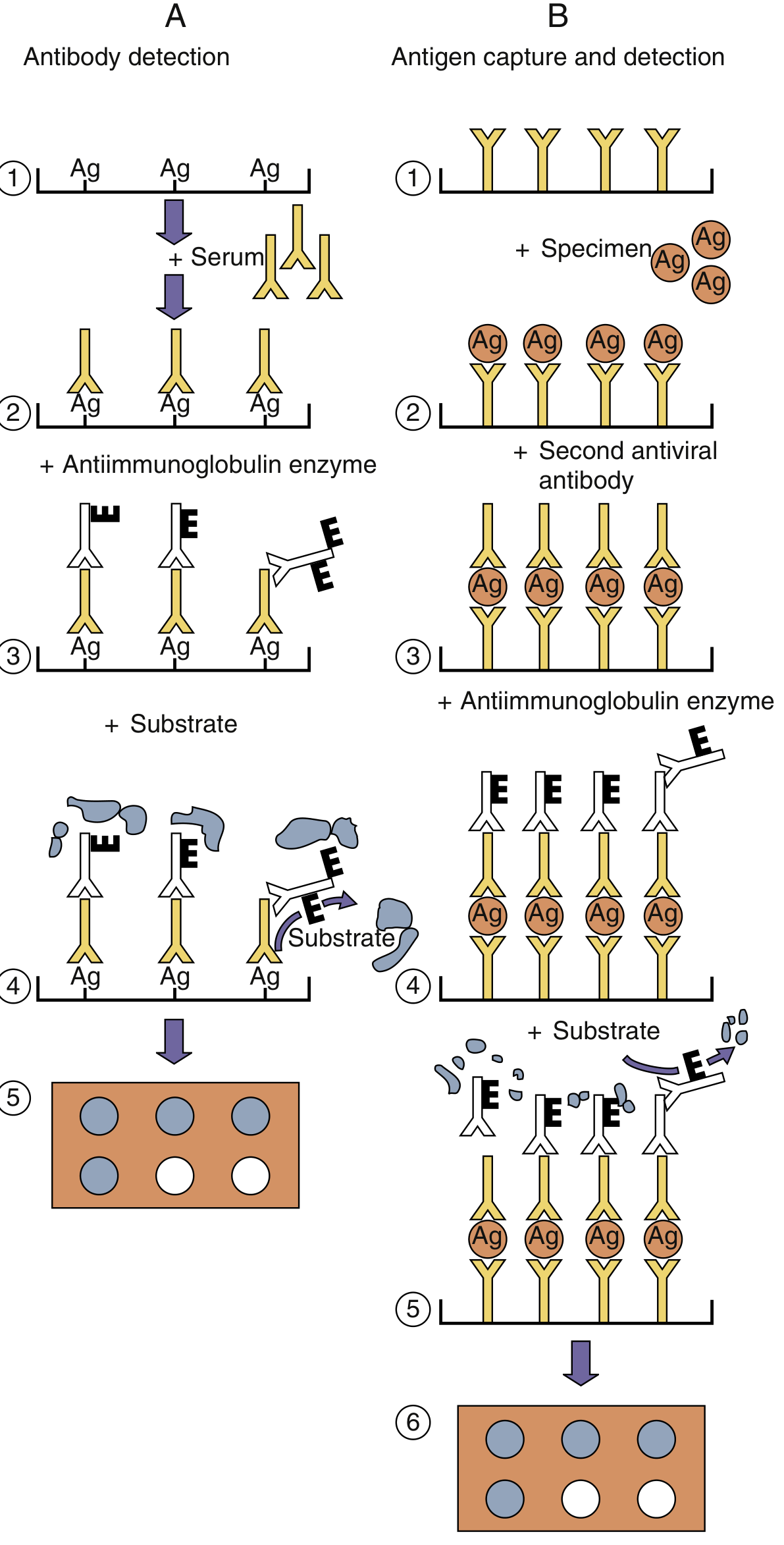
(A = Antibody detection method; B = Antigen capture/Sandwich method)
🟡 Type 3: Sandwich ELISA (Capture ELISA / Double Antibody Sandwich)
Concept: Do antibodies use hoti hain - ek "capture" ke liye, ek "detection" ke liye. Antigen "sandwich" ho jaata hai.
STEP 1: [WELL]--[Capture Ab (coat)] + Antigen → Ab captures Ag
STEP 2: Add detection Ab (labeled with enzyme) → Binds different epitope
STEP 3: Substrate → Color
Key requirement: Capture Ab aur Detection Ab different epitopes ko recognize karein (same antigen pe)
- Use: Antigen detection - cytokines, viral antigens, hormones
- Example: HIV p24 antigen detection, HBsAg, NS1 antigen (Dengue)
- Advantage: Very HIGH sensitivity aur specificity, can detect very low antigen concentrations
- Disadvantage: Need two antibodies against different epitopes
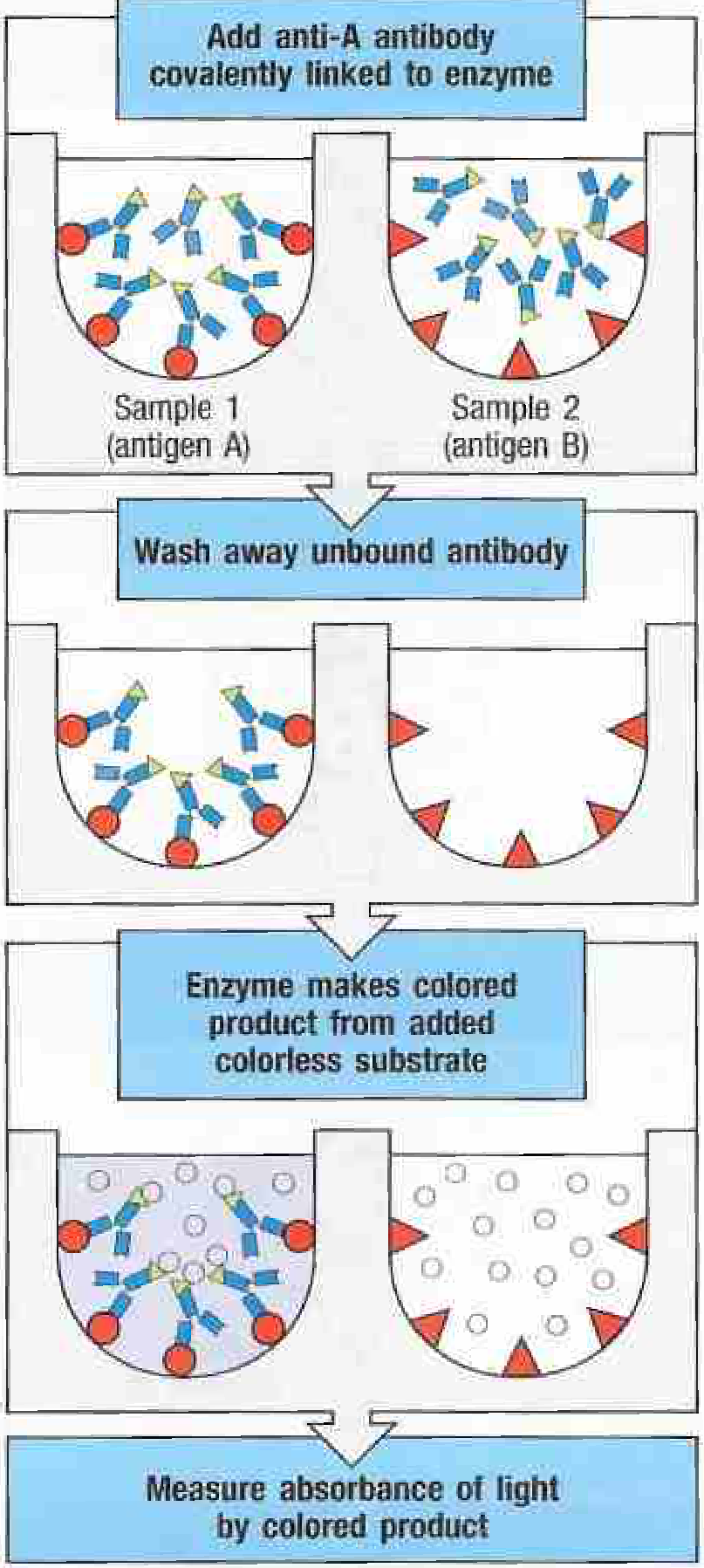
Diagram: Sample 1 (antigen A present) - color develop hota hai. Sample 2 (antigen B) - no color.
🔵 Type 4: Competitive ELISA (Inhibition ELISA)
Concept: Test sample aur labeled antigen compete karte hain ek hi antibody ke binding site ke liye.
[WELL]--[Ab coated]
Add: Labeled Ag + Patient sample (unknown Ag)
↓ Both compete for antibody binding
↓ Wash → More unlabeled Ag = Less labeled Ag bound = Less color
INVERSE relationship:
- Sample mein zyada Ag = labeled Ag kam bind hoga = LESS color = HIGH concentration
- Sample mein kam Ag = labeled Ag zyada bind hoga = MORE color = LOW concentration
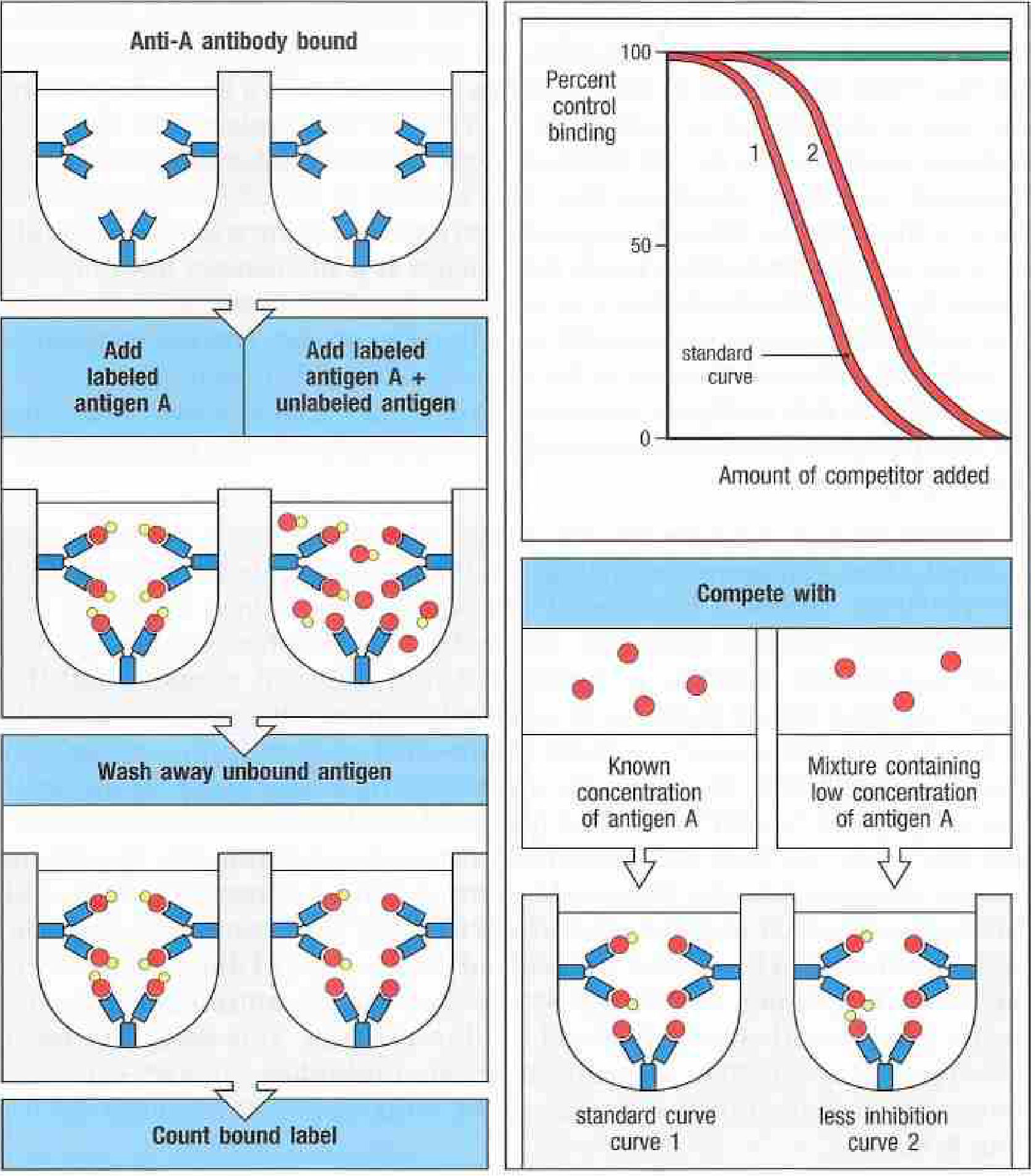
Standard curve se unknown sample ka concentration nikala jaata hai. Curve 2 mein less inhibition = lower Ag concentration.
- Use: Haptens (small molecules), hormones, drugs ka quantification
- Advantage: High specificity, can detect small molecules
- Key point: Color aur antigen concentration ka inverse relationship hai
5. IgM Capture ELISA (MAC-ELISA)
Ye ek special type hai jo Apurba Sastry specifically mention karte hain:
MAC = Mu (IgM) Antibody Capture ELISA
[WELL]--[Anti-human IgM antibody coated]
↓ Patient serum daalo → IgM capture hogi
↓ Add specific viral antigen
↓ Add enzyme-labeled anti-viral antibody
↓ Substrate → Color
Use: Early acute infection mein IgM antibody detect karna
Examples:
- Dengue IgM (NS1 antigen detection + MAC-ELISA)
- Japanese Encephalitis IgM - CSF mein
- Measles, Rubella IgM detection
Advantage: IgM rheumatoid factor ya IgG se interference nahi hoti
6. Enzymes Used in ELISA
| Enzyme | Substrate | Color Product |
|---|---|---|
| Horseradish Peroxidase (HRP) | TMB (Tetramethylbenzidine) | Blue → Yellow (on stop) |
| HRP | OPD (o-phenylenediamine) | Orange/Brown |
| Alkaline Phosphatase (AP) | PNPP (p-nitrophenyl phosphate) | Yellow |
| β-Galactosidase | ONPG | Yellow |
Most common: HRP with TMB substrate
7. Reading ELISA Results
- Spectrophotometer (ELISA reader) se OD (Optical Density) measure ki jaati hai at specific wavelength (usually 450 nm)
- Standard curve banate hain known concentrations se
- Cut-off value determine ki jaati hai:
- OD > Cut-off = Positive
- OD < Cut-off = Negative
Quantitative results: Standard curve se exact concentration nikali ja sakti hai.
8. Important Applications (Clinical Use)
| Disease | Type of ELISA Used |
|---|---|
| HIV | Indirect ELISA (Ab detection) + Sandwich (p24 Ag) |
| HBsAg | Sandwich/Capture ELISA |
| Dengue | NS1 Ag (Sandwich) + IgM/IgG (Indirect) |
| Japanese Encephalitis | IgM Capture ELISA (CSF) |
| Syphilis | Indirect ELISA |
| TORCH | Indirect ELISA |
| Pregnancy test (hCG) | Sandwich ELISA (lateral flow variant) |
| Cytokines | Sandwich ELISA |
9. Advantages vs Limitations
| Advantages | Limitations |
|---|---|
| High sensitivity | False positives possible (cross-reactivity) |
| High specificity | Requires pure Ag or Ab |
| Quantitative | Technical expertise needed |
| Can test many samples at once (96-well plate) | Cold chain required for reagents |
| No radioactivity (unlike RIA) | Hook effect at very high antigen concentrations |
| Automated, fast | Cannot detect all microorganisms |
10. ELISA vs Western Blot (Confirmation Test)
Apurba Sastry ka important point:
- ELISA = Screening test (sensitive but less specific)
- Western Blot = Confirmatory test (more specific)
- Example: HIV screening: ELISA se screen karo, Western Blot se confirm karo
- Western Blot mein proteins electrophoresis se separate hote hain, phir nitrocellulose membrane pe transfer aur ELISA-like detection
11. ELISA vs RIA (Quick Comparison)
| Feature | ELISA | RIA |
|---|---|---|
| Label used | Enzyme | Radioactive isotope (¹²⁵I) |
| Safety | Safe | Radiation hazard |
| Shelf life | Long | Short (isotope decays) |
| Cost | Low | High |
| Equipment | ELISA reader | Gamma counter |
| Sensitivity | High | Higher |
Summary Table - 4 Types at a Glance
| Type | Solid Phase | What's Detected | Enzyme Label on | Sensitivity | Use |
|---|---|---|---|---|---|
| Direct | Antigen | Antigen | Primary Ab | Low | Research |
| Indirect | Antigen | Antibody | Secondary Ab | High | Serology screening |
| Sandwich | Capture Ab | Antigen | Detection Ab | Very High | Antigen detection |
| Competitive | Antibody | Antigen | Antigen itself | High | Small molecules |
Sources: Medical Microbiology 9e (Murray), Janeway's Immunobiology 10e - concepts fully aligned with Apurba Sastry's Essentials of Medical Microbiology syllabus.
Note: Apurba Sastry ki book specifically is hamare library mein available nahi hai, lekin uparoka saara content standard microbiology curriculum ke according hai jo unke textbook ke chapters se bilkul match karta hai. Agar koi specific topic aur detail chahiye (like ELISA in HIV diagnosis ya specific exam MCQ concepts), batao!
This is a shared conversation. Sign in to Orris to start your own chat.