
Precious puberty
Reading File
The user likely means precocious puberty (precious = precocious). Let me search the medical library for this topic.
Searching sources...
Finding Sources
Searching PubMed
"precocious puberty"[MeSH Terms]
Good - I have several strong sources. Let me read the most comprehensive ones in parallel - Harrison's and Goldman-Cecil for core clinical content, plus Berek & Novak for the gynecologic perspective.
Reading File
Reading File
Reading File
Good - now let me get the Harrison's section on precocious puberty in girls and the Family Medicine section for the clinical overview, plus fetch the diagnostic flowchart image.
Reading File
Reading File
Loading Image
I now have comprehensive content from multiple authoritative textbooks. Let me compile the full answer.
Precocious Puberty
(You likely meant "precocious puberty" - puberty that begins abnormally early.)
Definition
Precocious puberty is the appearance of secondary sexual characteristics before the normal age thresholds:
- Girls: before 8 years of age (some societies use 7 for white girls, 6 for Black girls as the cutoff for evaluation)
- Boys: before 9 years of age
The Lawson Wilkins Pediatric Endocrine Society guidelines specify that breast development or pubic hair in white girls before age 7, in Black girls before age 6, and in boys of all races before age 9 warrants evaluation. - Textbook of Family Medicine 9e
Classification
1. Central (Gonadotropin-Dependent) Precocious Puberty (CPP)
- Results from premature activation of the hypothalamic-pituitary-gonadal (HPG) axis
- LH and FSH are elevated (pulsatile GnRH secretion begins prematurely)
- Also called "true precocious puberty" or "isosexual precocity"
2. Peripheral (Gonadotropin-Independent) Precocious Puberty (PPP)
- Sex steroid secretion occurs independent of LH and FSH stimulation
- Also called "pseudo-precocious puberty"
- Low/suppressed LH with elevated sex steroids
3. Incomplete / Benign Variants
These do not require treatment and often resolve spontaneously:
- Isolated premature thelarche - breast development only, no other signs; usually self-limited, especially in girls under 2 years
- Isolated premature pubarche/adrenarche - pubic hair only; usually self-limited
- Isolated premature menarche
Causes
Central Precocious Puberty (Gonadotropin-Dependent)
| Cause | Notes |
|---|---|
| Idiopathic | 90% of girls; only 10% of boys |
| CNS tumors | Hypothalamic hamartoma, optic glioma, astrocytoma, ependymoma, arachnoid cysts, tuberous sclerosis |
| Inflammatory/infectious lesions | Meningitis, encephalitis |
| Genetic mutations | KISS1 (kisspeptin), KISS1R (kisspeptin receptor), MKRN3 (makorin ring finger protein 3) |
| hCG-secreting tumors | Germinomas (hypothalamic or pineal) |
In boys with CPP, CNS disease accounts for ~two-thirds of cases. - Goldman-Cecil Medicine
Peripheral Precocious Puberty (Gonadotropin-Independent)
| Cause | Sex |
|---|---|
| Congenital adrenal hyperplasia (CAH) | Both (especially virilizing forms) |
| McCune-Albright syndrome | Mostly girls |
| Activating LH receptor mutations ("testotoxicosis") | Boys |
| Activating Gα subunit mutations | Both |
| Androgen/estrogen-secreting adrenal or gonadal tumors | Both |
| Exogenous sex steroids | Both |
| Primary hypothyroidism (Van Wyk-Grumbach) | Girls |
Epidemiology
- Precocious puberty is 20 times more common in girls than boys
- In girls, 90% of cases are idiopathic (central)
- In boys, ~10% are idiopathic; the majority have an identifiable organic cause (especially CNS)
- A secular trend toward earlier puberty onset has continued over the past century, partly due to improved nutrition and rising obesity rates - Harrison's 22E
Clinical Features
- Early development of secondary sexual characteristics (breasts, pubic/axillary hair, genital development)
- Accelerated linear growth and advanced bone age
- Risk of early epiphyseal closure leading to reduced adult height
- Psychosocial consequences (emotional immaturity combined with physical development)
- Long-term risks: increased risk of breast and endometrial cancer, cardiovascular disease, hypertension, type 2 diabetes, shorter life span
Diagnostic Evaluation
Step 1: History and physical examination
- Family and birth history; timing and tempo of pubertal development
- Neurologic symptoms; abdominal masses; skin lesions (cafe-au-lait spots suggest McCune-Albright)
- Assign Tanner stage
Step 2: Initial labs and imaging
- Bone age (plain X-ray of left hand/wrist)
- Basal LH, FSH, and sex steroids (testosterone or estradiol)
- Thyroid function (TSH, T4)
Step 3: Branch based on lab results (see diagnostic flowchart below)
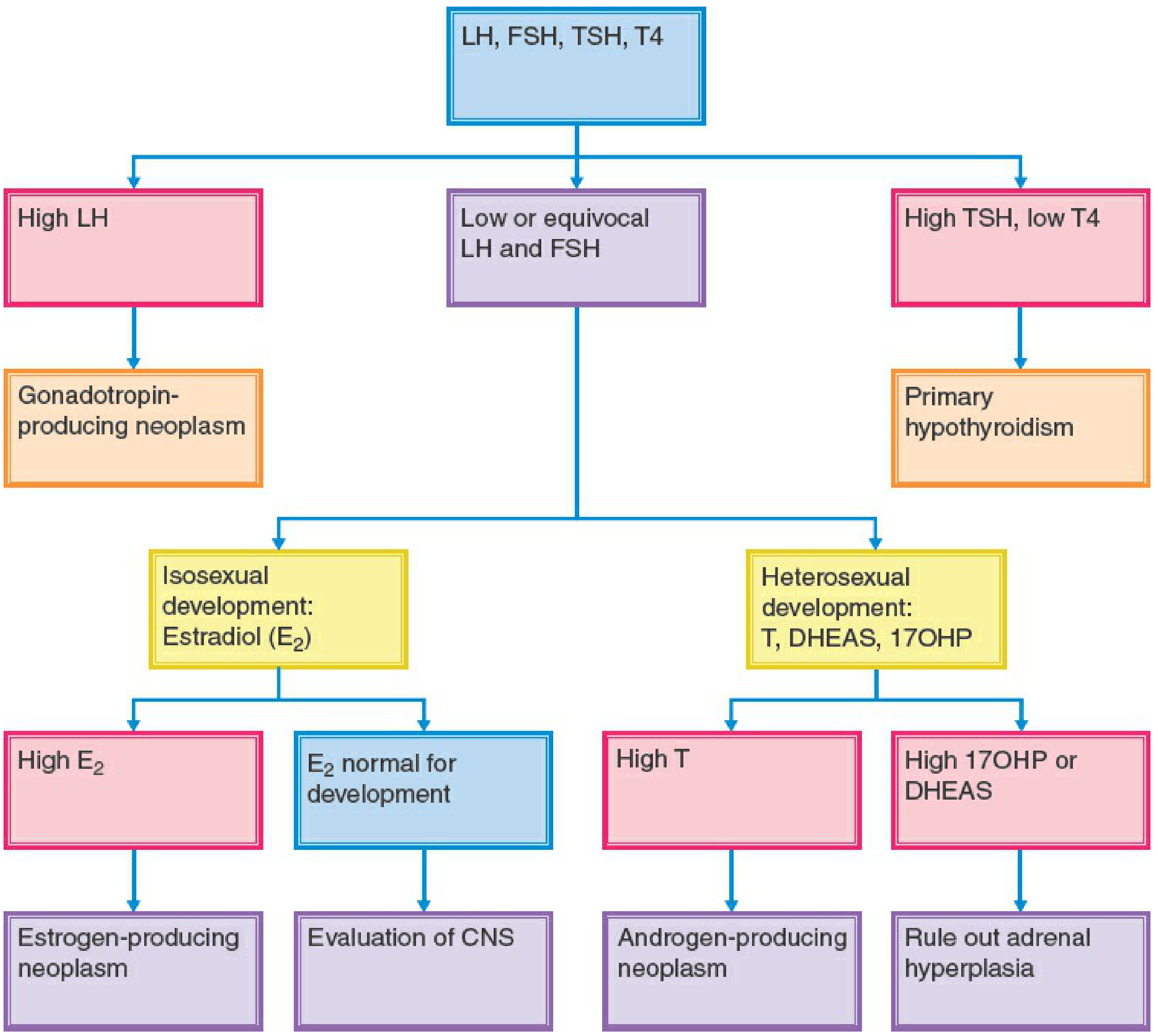
If gonadotropin-dependent (high LH/FSH):
- MRI of brain/head to exclude CNS lesion
- If no lesion found → idiopathic CPP
If gonadotropin-independent (high sex steroids, suppressed LH):
- Measure DHEAS and 17α-hydroxyprogesterone
- High 17-OHP → CAH (21-hydroxylase or 11β-hydroxylase deficiency)
- High DHEAS → adrenal tumor (CT adrenals)
- High testosterone without 17-OHP/DHEAS elevation → testicular palpation and ultrasound (Leydig cell tumor)
- Consider activating LH receptor or Gα mutations if above excluded
Treatment
Central (Gonadotropin-Dependent) Precocious Puberty
Goal: Suppress premature HPG axis activation, protect final adult height, reduce psychosocial impact
GnRH analogues (first-line):
- Leuprolide acetate - 3-month depot 11.25 mg or 30 mg; or 6-month depot 22.5 mg
- Triptorelin - 22.5 mg every 6 months (6-month depot)
- Suppress LH/FSH and sex steroids
- Halt pubertal progression, delay bone maturation, prevent early epiphyseal closure
- Most effective for height if initiated before age 6
- Puberty resumes after discontinuation
- No consensus on optimal age to stop; commonly around age 11-11.5 years
If an underlying CNS lesion is found: surgery or radiation therapy directed at the cause.
Peripheral (Gonadotropin-Independent) Precocious Puberty
| Cause | Treatment |
|---|---|
| CAH | Glucocorticoids (hydrocortisone 15 mg/m²/day) |
| Familial male-limited precocious puberty (testotoxicosis) | Ketoconazole (10-20 mg/kg/day) ± antiandrogen (spironolactone 5-7 mg/kg/day or bicalutamide 2 mg/kg/day) |
| McCune-Albright / aromatase excess | Aromatase inhibitors (testolactone, letrozole) |
| Adrenal/testicular tumors | Surgical resection |
| Primary hypothyroidism | Thyroid hormone replacement |
| Abiraterone | Newer testosterone synthesis inhibitor; not yet systematically evaluated in children |
Counseling is an important component of the overall management strategy for all types.
Key Points Summary
| Feature | Central (CPP) | Peripheral (PPP) |
|---|---|---|
| Gonadotropins | Elevated (high LH/FSH) | Suppressed |
| Mechanism | Premature HPG axis activation | Autonomous sex steroid production |
| Girls | 90% idiopathic | McCune-Albright, ovarian cysts/tumors |
| Boys | ~2/3 have CNS disease | CAH, testotoxicosis, adrenal tumors |
| Treatment | GnRH analogues | Treat underlying cause |
Sources: Harrison's Principles of Internal Medicine 22E; Goldman-Cecil Medicine International Edition; Berek & Novak's Gynecology; Textbook of Family Medicine 9e
Complications for this
Complications of precocious puberty include short stature (early epiphyseal closure), psychosocial issues, and long-term metabolic/cancer risks. Let me pull the detailed evidence from the textbooks.
Searching sources...
Finding Sources
Finding Sources
Finding Sources
Reading File
Finding Sources
Finding Sources
Reading File
Finding Sources
I now have enough content from multiple textbooks to give a thorough, well-cited answer on complications.
Complications of Precocious Puberty
Complications fall into three broad categories: physical/growth, long-term metabolic and oncologic, and psychosocial.
1. Short Stature (Most Important Physical Complication)
Early sex steroid exposure causes premature epiphyseal (growth plate) closure, cutting short the window for longitudinal bone growth. Despite the initial growth acceleration that makes these children temporarily tall for their age, they often end up with a reduced final adult height.
- Skeletal (bone) age is advanced relative to chronologic age
- Bone age is more closely correlated with pubertal stage than chronologic age during puberty; it is used with the Bayley-Pinneau tables to predict final adult height
- Treatment with GnRH analogues is most effective at preserving height if started before age 6
- Medroxyprogesterone acetate does not always prevent premature epiphyseal closure and resultant short stature
- GnRH analogues that reversibly inhibit gonadotropin secretion can prevent secondary sexual development and early epiphyseal fusion - Textbook of Family Medicine 9e
2. Long-Term Metabolic and Oncologic Risks
Harrison's 22E explicitly lists these increased risks associated with earlier onset of puberty:
| Complication | Notes |
|---|---|
| Breast cancer | Longer lifetime estrogen exposure |
| Endometrial cancer | Early estrogen stimulation of endometrium |
| Cardiovascular disease | Linked to early hormonal changes and associated metabolic shifts |
| Hypertension | Part of the cardiometabolic risk cluster |
| Type 2 diabetes mellitus | Especially when precocious puberty is obesity-related |
| Shorter life span | Observed epidemiologically with earlier puberty onset |
| Hair pigmentation changes | Also documented in early-puberty cohorts |
Earlier onset of puberty is associated with increased risk of breast and endometrial cancer, cardiovascular disease, hypertension, type 2 diabetes, hair pigmentation, and shorter life span. - Harrison's Principles of Internal Medicine 22E
3. Psychosocial and Behavioral Complications
This is often underappreciated but is a major driver of treatment decisions:
- Emotional/behavioral immaturity - the child's psychological development does not match their physical appearance, creating significant internal and social conflict
- Social stigmatization - peers, strangers, and even family may treat the child according to their physical age rather than emotional age
- Depression and anxiety - documented consequence of premature physical development
- Sexual abuse vulnerability - physically developed girls are at higher risk
- Disrupted peer relationships - the child looks and is treated differently, leading to social isolation
- Prompt treatment can prevent or attenuate emotional consequences in the patient and her parents - Goldman-Cecil Medicine
4. Complications Specific to Underlying Causes
Since precocious puberty is often a sign of an underlying condition, complications may also arise from the causative pathology:
| Underlying Cause | Additional Complications |
|---|---|
| CNS tumors (hypothalamic hamartoma, glioma, etc.) | Visual field defects, raised intracranial pressure, seizures, neurologic deficits |
| McCune-Albright syndrome | Polyostotic fibrous dysplasia (bone fractures, deformity), cafe-au-lait skin lesions, hyperthyroidism, Cushing's syndrome |
| CAH | Adrenal crisis, salt-wasting, virilization, hypertension (11β-hydroxylase form) |
| Gonadal/adrenal tumors | Malignant potential, mass effects |
| Testotoxicosis | Infertility if untreated (Leydig cell hyperplasia) |
5. Reproductive Complications
- Menstrual irregularity in girls if the underlying axis is dysregulated - oligomenorrhea, dysfunctional uterine bleeding
- In the Robbins Pathology tables, precocious puberty (hypothalamic, pituitary, or ovarian origin) is listed as a cause of abnormal uterine bleeding in the prepubertal period - Robbins & Kumar Basic Pathology
Summary Table
| Category | Complication |
|---|---|
| Growth | Short final adult height (early epiphyseal closure) |
| Metabolic | Type 2 diabetes, hypertension, cardiovascular disease |
| Oncologic | Breast cancer, endometrial cancer |
| Psychosocial | Depression, stigmatization, behavioral issues, sexual abuse risk |
| Neurologic | From underlying CNS lesions |
| Reproductive | Menstrual irregularity, potential fertility issues |
| Disease-specific | Bone fractures (McCune-Albright), adrenal crisis (CAH), tumor-related |
Sources: Harrison's Principles of Internal Medicine 22E; Goldman-Cecil Medicine International Edition; Textbook of Family Medicine 9e; Berek & Novak's Gynecology; Robbins & Kumar Basic Pathology
Complications of varicose veins surgery
Complications of varicose vein surgery include wound issues, nerve injury, DVT, and recurrence. Let me pull the detailed evidence from the textbooks.
Searching sources...
Finding Sources
Finding Sources
Good - I have strong leads in S Das Surgery, Sabiston, Mulholland & Greenfield, and Harrison's. Let me read the most surgical-focused sources in parallel.
Finding Sources
Reading File
Bailey & Love and Schwartz's are the key surgical references. Let me read those sections in parallel.
Reading File
Reading File
Schwartz's was truncated - let me get more of it, and also read the Bailey & Love section on surgical complications, plus the S Das surgery section which is the most detailed clinical surgery text.
Reading File
Finding Sources
Finding Sources
Excellent - Bailey & Love has a dedicated section "Complications of standard varicose vein surgery". Let me read that directly, plus the Harrison's stripping complications section.
Reading File
Reading File
I now have comprehensive, well-sourced data from Bailey & Love, Schwartz's, and Harrison's. I can compile a thorough answer.
Complications of Varicose Veins Surgery
Complications are reported in up to 20% of patients undergoing traditional varicose vein surgery. They vary depending on the surgical method (open ligation/stripping, endovenous ablation, sclerotherapy, stab phlebectomy).
A. Complications of Open Surgery (Ligation and Stripping)
1. Wound Complications
- Wound infection - the most common complication overall; reduced by prophylactic antibiotics
- Haematoma - blood collection at the groin incision or along the stripping tract; common due to the large tissue plane created
- Ecchymosis (bruising) - almost universal along the stripping tunnel
- Lymphocele / lymph leak - damage to lymphatic vessels in the groin, especially common in redo surgery (up to 40% complication rate in recurrent varicose vein surgery, with lymph leak and wound infection being most frequent)
2. Nerve Injury - Most Common Serious Complication
| Nerve | Operation | Incidence |
|---|---|---|
| Saphenous nerve (sensory, medial leg/foot) | GSV stripping to knee | Up to 7% (higher if stripped to ankle) |
| Sural nerve (sensory, lateral foot) | Small saphenous vein (SSV) surgery | Up to 20% neuropraxia |
| Common peroneal nerve | SSV surgery | Up to 4% |
- The saphenous nerve runs close to the GSV in the calf (less separation than in the thigh) - this anatomical detail explains why stripping is generally limited to the thigh, not below the knee
- Stripping of the GSV below the knee and stripping of the SSV are generally avoided because of the respective saphenous and sural nerve injury risks
3. Vascular / Thromboembolic
- Deep vein thrombosis (DVT) - incidence approximately 0.5% after varicose vein surgery; patient-specific risk must be assessed and prophylaxis given per guidelines
- Pulmonary embolism - rare but life-threatening consequence of DVT
- Bleeding / haemorrhage - from inadequate ligation of tributaries or venous perforators
- Inadvertent arterial injury - very rare; femoral artery damage at groin dissection
4. Lymphatic
- Lymphoedema - disruption of inguinal lymphatics at groin exploration
- Lymph fistula / chronic lymph leak - persistent drainage, especially in redo cases
B. Complications Specific to Endovenous Thermal Ablation (Laser / Radiofrequency)
- DVT of the common femoral vein adjacent to the saphenofemoral junction - uncommon but important
- Pain and paresthesias along the ablated vein tract
- Bruising / ecchymosis and haematoma
- Hyperpigmentation of the overlying skin
- Saphenous nerve injury - heat injury to the nerve running alongside the GSV
- Skin burns - from inadequate tumescent anaesthesia (which insulates the skin from thermal injury)
- Endovenous heat-induced thrombus (EHIT) - thrombus extending from the treated segment into the deep system
C. Complications of Sclerotherapy
- Allergic reaction / anaphylaxis - rare but potentially severe
- Local hyperpigmentation - brown staining of skin over treated vessels; may be permanent
- Superficial thrombophlebitis - inflammation of the sclerosed vein
- Deep vein thrombosis
- Skin necrosis - if sclerosant leaks perivascularly (extravasation) or if concentrated solution is used
- Nerve injury - damage to adjacent saphenous or sural nerves
- Embolisation - with foam sclerotherapy, gas emboli can rarely pass to the systemic circulation (including cerebral, especially in patients with patent foramen ovale)
- Infection
D. Recurrence - A Major Long-Term Complication
Recurrence is one of the most clinically significant long-term outcomes:
| Type | Rate |
|---|---|
| Significant clinical recurrence at 5-10 years (open surgery) | 10-35% |
| Duplex-detected recurrence (subclinical) | Up to 70% |
| Recurrence at 5 years after ligation and stripping | Up to 50% (Harrison's 22E) |
Causes of recurrence:
- Neovascularisation - new valveless veins grow across the ligated junction; most common cause
- Reflux in residual axial vein - incomplete stripping
- Inadequate initial surgery - missed junctions or perforators
- New junctional reflux - at sites not originally diseased
- Recurrence is more common after SSV surgery than GSV surgery, and in patients with high BMI
- Stripping of the incompetent axial vein reduces recurrence compared to ligation alone
- Endovenous thermal ablation may have lower recurrence rates than open surgery
E. General Surgical Complications
- General anaesthesia risks (open surgery is performed under GA)
- Scar formation at groin and calf incision sites
- Venous thromboembolism (VTE) - risk increases with prolonged operative time or patient immobility
Summary Table
| Complication | Surgery | Endovenous Ablation | Sclerotherapy |
|---|---|---|---|
| Wound infection | ++ (most common) | + | + |
| Haematoma | ++ | + | + |
| Nerve injury | ++ (up to 20% SSV) | + (thermal) | + |
| DVT | + (~0.5%) | + | + |
| Lymphocele | ++ | - | - |
| Skin burns | - | + | - |
| Hyperpigmentation | - | + | ++ |
| Anaphylaxis | - | - | + |
| Skin necrosis | - | - | + |
| Recurrence | ++ (up to 50% at 5yr) | + (lower) | ++ |
| Foam embolism | - | - | + |
Sources: Bailey and Love's Short Practice of Surgery 28th Edition; Schwartz's Principles of Surgery 11th Edition; Harrison's Principles of Internal Medicine 22E
Why stripping of veins is avoided below knee
The saphenous nerve runs very close to the GSV below the knee, making nerve injury likely during stripping. Let me get the detailed anatomical evidence.
Searching sources...
Finding Sources
Finding Sources
Three strong sources - let me read all three in parallel for the detailed anatomy and surgical reasoning.
Reading File
Reading File
Finding Sources
Now let me get the Sabiston section and an anatomy reference for the exact course of the saphenous nerve.
Reading File
Finding Sources
I now have a complete and well-sourced answer from Sabiston, Mulholland & Greenfield, Imaging Anatomy, and Harrison's. Let me also fetch the Sabiston diagram image showing the nerve-vein relationship.
Loading Image
Reading File
I have everything needed for a comprehensive, well-cited answer.
Why Stripping of the Great Saphenous Vein (GSV) is Avoided Below the Knee
The core reason is anatomy: the saphenous nerve runs in progressively closer proximity to the GSV as the vein descends below the knee, making nerve injury during mechanical stripping almost inevitable in that segment.
The Anatomy - The Key Explanation
The saphenous nerve is the longest cutaneous branch of the femoral nerve (L2-L4). It provides sensory innervation to the medial leg, medial malleolus, and medial aspect of the foot - it is the only nerve supplying the foot that does not come from the sciatic nerve.
Its course:
- Enters the adductor canal in the thigh alongside the femoral vessels - here it has significant separation from the GSV
- Exits through the vastoabductor membrane and passes toward the medial aspect of the knee
- Below the knee, it leaves the subfascial plane and travels in the same fascial tunnel as the GSV - closely bound to the vein in the same plane
- It then follows the GSV all the way down to the medial leg and foot
"The saphenous nerve runs close to the GSV in the calf compared with the thigh, where the nerve and vein have more separation. This anatomic detail may explain why stripping from the knee to the thigh only reduces the risk of nerve injury." - Sabiston Textbook of Surgery
"Iatrogenic saphenous nerve injury is a well-known complication following great saphenous vein total stripping. This is due to the course of the nerve as it follows the vein distally in the same plane and closely bound to the vein below the knee." - Imaging Anatomy Atlas, Vol. 3
What Happens During Stripping Below the Knee
When a mechanical stripper is passed through the GSV lumen and pulled distally, it avulses the vein together with surrounding tissue. In the thigh, the nerve and vein are separated by adipose tissue and travel in different planes - the nerve is not dragged along. In the calf, the nerve is essentially adherent to the vein within the same fascial compartment (the saphenous tunnel), so the stripper physically tears the nerve along with the vein.
This produces:
- Saphenous nerve neuralgia - painful dysesthesia along the medial leg/foot
- Hypoesthesia or numbness over the medial leg and medial border of the foot
- Paresthesias (tingling, burning) in the distribution of the nerve
- Incidence: up to 7% when stripped to the knee; significantly higher when stripped to the ankle
The Same Principle Applies to the Small Saphenous Vein (SSV)
For the SSV, the relevant nerve is the sural nerve, which runs in close proximity in the posterior calf. Stripping of the SSV carries:
- Up to 20% incidence of sural nerve neuropraxia
- Sural nerve injury causes numbness/paresthesia over the lateral foot and 5th toe
This is why SSV stripping is also largely abandoned in favour of endovenous techniques.
Practical Surgical Implication
| Segment | Nerve-Vein Relationship | Stripping Practice |
|---|---|---|
| Groin to knee (thigh) | Nerve and vein separated - different planes | Safe to strip |
| Below knee (calf) | Nerve closely adherent to vein in same fascial tunnel | Avoided - high nerve injury risk |
| Below knee to ankle | Maximum nerve-vein proximity | Never stripped |
The standard operation therefore limits GSV stripping to the groin-to-knee segment only, using a small medial incision just below the knee as the distal limit.
"Stripping of the great saphenous vein below the knee and stripping of the small saphenous vein usually are not performed because of the respective risks of saphenous and sural nerve injury." - Harrison's Principles of Internal Medicine 22E
Why This Matters Less with Endovenous Techniques
Modern endovenous ablation (radiofrequency or laser) avoids this problem because:
- The catheter is introduced percutaneously and stays within the vein lumen - no mechanical avulsion of surrounding tissue
- Tumescent anaesthesia injected around the saphenous compartment acts as a heat sink and provides some physical separation/protection of the nerve from thermal injury
- The nerve is not dragged or torn - only the vein wall itself is damaged by heat
This is a major reason why endovenous ablation has largely replaced open stripping as the standard of care.
Sources: Sabiston Textbook of Surgery; Mulholland and Greenfield's Surgery 7e; Harrison's Principles of Internal Medicine 22E; Imaging Anatomy: Bones, Joints, Vessels and Nerves; THIEME Atlas of Anatomy
This is a shared conversation. Sign in to Orris to start your own chat.