
5H and 5Ts in hypotension Mayocardial infraction etc
I'll look up the 5H's and 5T's (reversible causes of cardiac arrest/hemodynamic instability) and myocardial infarction from the medical library right away.
Searching sources...
Reading File
Finding Sources
Finding Sources
Finding Sources
Reading File
Reading File
Finding Sources
Reading File
Reading File
Reading File
Loading Image
I now have comprehensive textbook content. Here is the full answer:
The 5 H's and 5 T's - Reversible Causes of Cardiac Arrest / Hypotension
The 5 H's and 5 T's are a mnemonic taught in ACLS to rapidly identify and correct treatable causes of cardiac arrest (especially PEA/asystole) and hemodynamic instability. Every resuscitation should include a systematic search for these.
The 5 H's
| Cause | Key Clues | Treatment |
|---|---|---|
| Hypovolemia / Hemorrhage | Blood/fluid loss, FAST positive, GI bleeding | IV fluids, blood products, hemostasis |
| Hypoxia | Incorrect airway placement, misplaced ETT, low SpO2 | Verify airway position, oxygenation, assisted ventilation |
| Hydrogen ion (Acidosis) | Prolonged arrest, poor CPR quality, ABG showing low pH | Hyperventilation, NaHCO3 1-1.5 mEq/kg for severe cases, optimize CPR |
| Hypo/Hyperkalemia | Renal failure, dialysis patient, AV fistula, ECG changes | Hyperkalemia: CaCl2, NaHCO3, insulin/glucose; Hypokalemia: IV KCl replacement |
| Hypothermia | Low core temperature (rectal temp), cold exposure | Warm blankets, warm IV fluids, peritoneal/thoracic lavage, VA-ECMO |
Note on Acidosis: Sodium bicarbonate is NOT routinely given - current evidence does not support routine use. It is only considered for severe, prolonged metabolic acidosis. Giving it increases CO2 production, so ventilation must be increased.
The 5 T's
| Cause | Key Clues | Treatment |
|---|---|---|
| Tablets (Drug Overdose) | History of ingestion, wide QRS (TCA), bradycardia (beta-blocker) | TCA: IV NaHCO3; beta-blocker/CCB: high-dose insulin + lipid emulsion; Local anesthetic: lipid emulsion |
| Cardiac Tamponade | Jugular venous distension, muffled heart sounds, JVD, bedside echo (fluid around heart) | Pericardiocentesis (emergent); thoracotomy/pericardiotomy (definitive) |
| Tension Pneumothorax | Unequal breath sounds, tracheal deviation, worsening after intubation | Immediate needle thoracostomy, then tube thoracostomy |
| Coronary Thrombosis (Acute MI) | Ischemic ECG changes, STEMI, hyperdynamic LV on echo | PCI, thrombolytics if PCI unavailable (especially in peri-arrest STEMI) |
| Thrombosis (Pulmonary Embolism) | Risk factors for DVT/PE, right heart strain on echo, massive PE | Thrombolytics (tPA), VA-ECMO bridge, surgical embolectomy |
PEA Management Algorithm
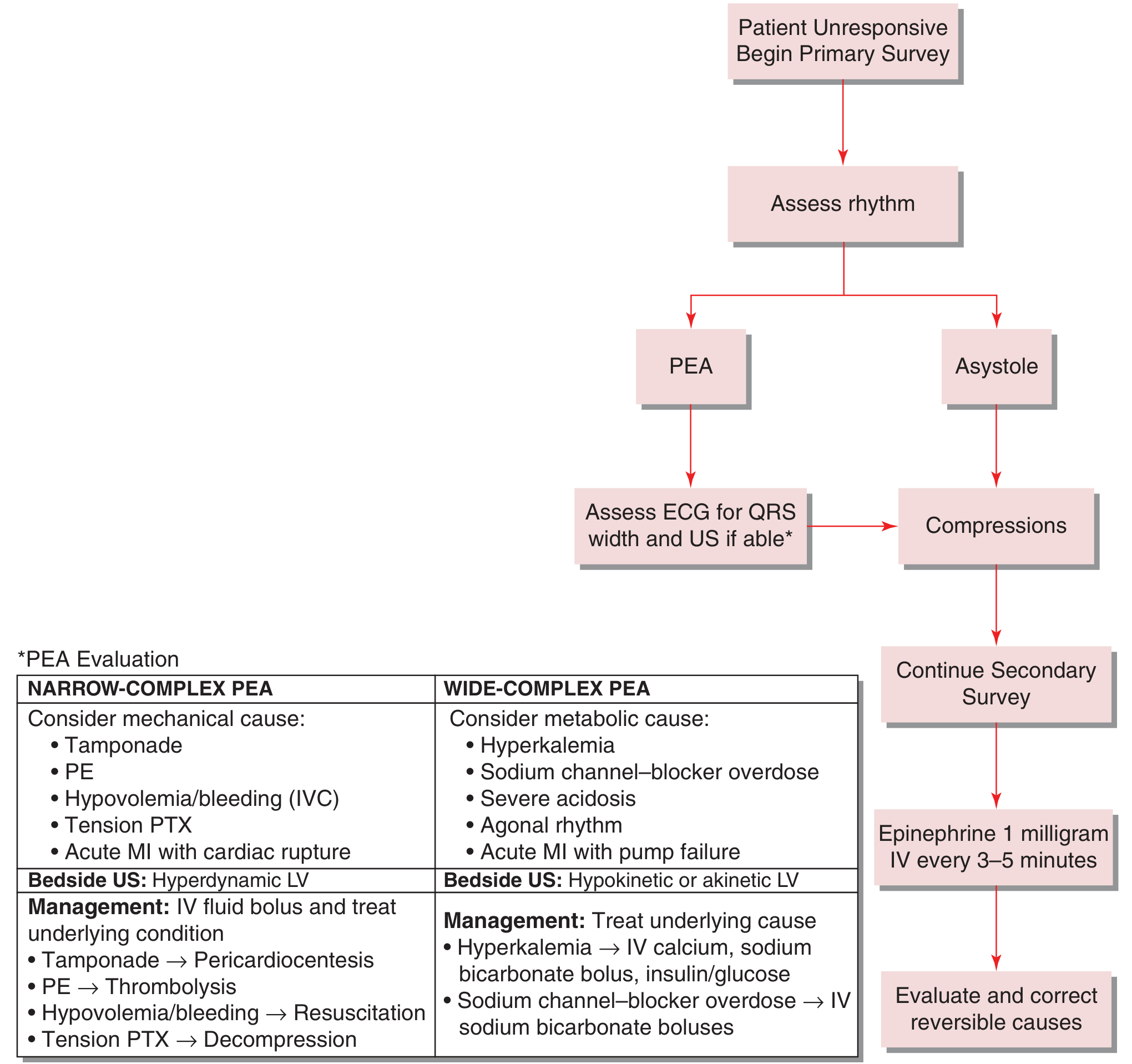
From Tintinalli's Emergency Medicine - PEA/Asystole management algorithm
A key bedside skill is using QRS width on ECG + point-of-care ultrasound to narrow your differential:
- Narrow-complex PEA - think mechanical causes: tamponade, PE, hypovolemia/bleeding (collapsed IVC), tension pneumothorax, acute MI with cardiac rupture. Echo shows a hyperdynamic LV.
- Wide-complex PEA - think metabolic causes: hyperkalemia, sodium channel-blocker overdose, severe acidosis, acute MI with pump failure. Echo shows a hypokinetic/akinetic LV.
Myocardial Infarction as a Cause of Hypotension - Cardiogenic Shock
Acute MI is one of the most common reversible causes of cardiac arrest and is a major cause of cardiogenic shock. The key points:
Recognition
Patients present with hypotension, weak/rapid pulse, tachypnea, cool and clammy skin. Look for ST changes, Q waves, or new LBBB on ECG.
Management of Cardiogenic Shock from MI
1. Vasopressors (to maintain perfusion pressure)
- Norepinephrine (0.02-1.0 mcg/kg/min) - preferred first-line. Acts mainly as a vasoconstrictor with mild inotropy, increases coronary flow, and is superior to dopamine.
- Dopamine (inotrope at 3-10 mcg/kg/min; vasopressor at 10-20 mcg/kg/min) - second line; associated with more arrhythmias.
- Epinephrine (0.05-2 mcg/kg/min) - associated with more refractory shock and metabolic derangement vs. norepinephrine.
- Vasopressin (0.02-0.04 U/min) - for catecholamine-refractory shock.
2. Inotropes (if tissue perfusion inadequate despite vasopressors)
- Dobutamine (2.5-20 mcg/kg/min) - selective beta-1 agonist, improves contractility. First choice if SBP >90 mmHg, but may worsen hypotension.
- Milrinone (0.125-0.75 mcg/kg/min, no loading dose) - PDE inhibitor, fewer arrhythmias, long half-life, can cause hypotension. Equivalent to dobutamine in cardiogenic shock.
3. Revascularization - the cornerstone of therapy
- Rapid PCI is the only intervention consistently proven to reduce mortality in cardiogenic shock from MI.
- Best outcomes when PCI is within 6 hours of symptom onset, but benefit extends up to 18 hours after shock onset.
- In multivessel disease: stent the culprit lesion only (not immediate multivessel PCI).
- Thrombolytics can be used if PCI is not available.
4. Mechanical support
- IABP (Intra-aortic balloon pump): reduces afterload and augments diastolic pressure. Despite hemodynamic rationale, randomized trials show no mortality benefit with IABP in cardiogenic shock with early revascularization.
- LVAD/ECMO: for patients refractory to IABP and vasopressors.
Special consideration: Right Ventricular Infarction
RV infarction is an important cause of hypotension after MI that is easily missed. It causes hypotension in the absence of left heart failure. Treatment differs - these patients are preload dependent; give IV fluids, avoid diuretics and vasodilators. This is why nitroglycerin can precipitate severe hypotension in RV infarction.
Sources:
- Tintinalli's Emergency Medicine, Differential Diagnoses of Cardiac Arrest chapter
- Rosen's Emergency Medicine, Pulseless Electrical Activity chapter
- Goldman-Cecil Medicine, Cardiogenic Shock Complicating Acute MI chapter
- Fuster and Hurst's The Heart, 15th Ed., ACLS algorithm chapter
This is a shared conversation. Sign in to Orris to start your own chat.