
Detailed note on autoclaving marks10
Reading File
Finding Sources
Searching PubMed
autoclave sterilization
Searching the Web
CDC steam sterilization autoclave temperature pressure time healthcare
Reading File
Autoclaving
Autoclaving is a method of steam sterilization under pressure. It destroys all microorganisms, including bacterial spores, and is widely used for sterilizing culture media, dressings, surgical instruments, glassware, linen, and laboratory waste.
Principle
Autoclaving uses saturated steam under pressure. Steam condenses on the cooler surface of the articles, releases latent heat, and causes irreversible denaturation and coagulation of microbial proteins and enzymes.
Moist heat is more effective than dry heat because water molecules facilitate protein denaturation. Pressure itself does not kill microorganisms. Its role is to raise the boiling point of water so that steam can reach a higher temperature. CDC guidance identifies steam, pressure, temperature, and exposure time as the key parameters.
Standard conditions
| Temperature | Pressure | Holding time | Use |
|---|---|---|---|
| 121°C | 15 psi above atmospheric pressure | 15 minutes | Standard cycle for media, dressings, glassware, etc. |
| 134°C | About 30 psi | 3 minutes | Rapid or flash cycle, mainly for unwrapped metal instruments in selected situations |
The holding time begins only after the desired temperature and pressure have been achieved throughout the load. For wrapped healthcare supplies, CDC recognizes at least 30 minutes at 121°C in gravity-displacement units or 4 minutes at 132°C in prevacuum units. CDC steam parameters
Construction of an autoclave
An autoclave is essentially a pressure cooker with:
- Strong metal chamber for articles to be sterilized
- Lid or door with locking arrangement to make the chamber airtight
- Pressure gauge to indicate pressure inside
- Safety valve to prevent excess pressure
- Steam release/exhaust valve for removal of air and steam
- Heating element or boiler to generate steam
- Perforated basket or shelves for placing articles
- Thermometer or temperature sensor to monitor temperature
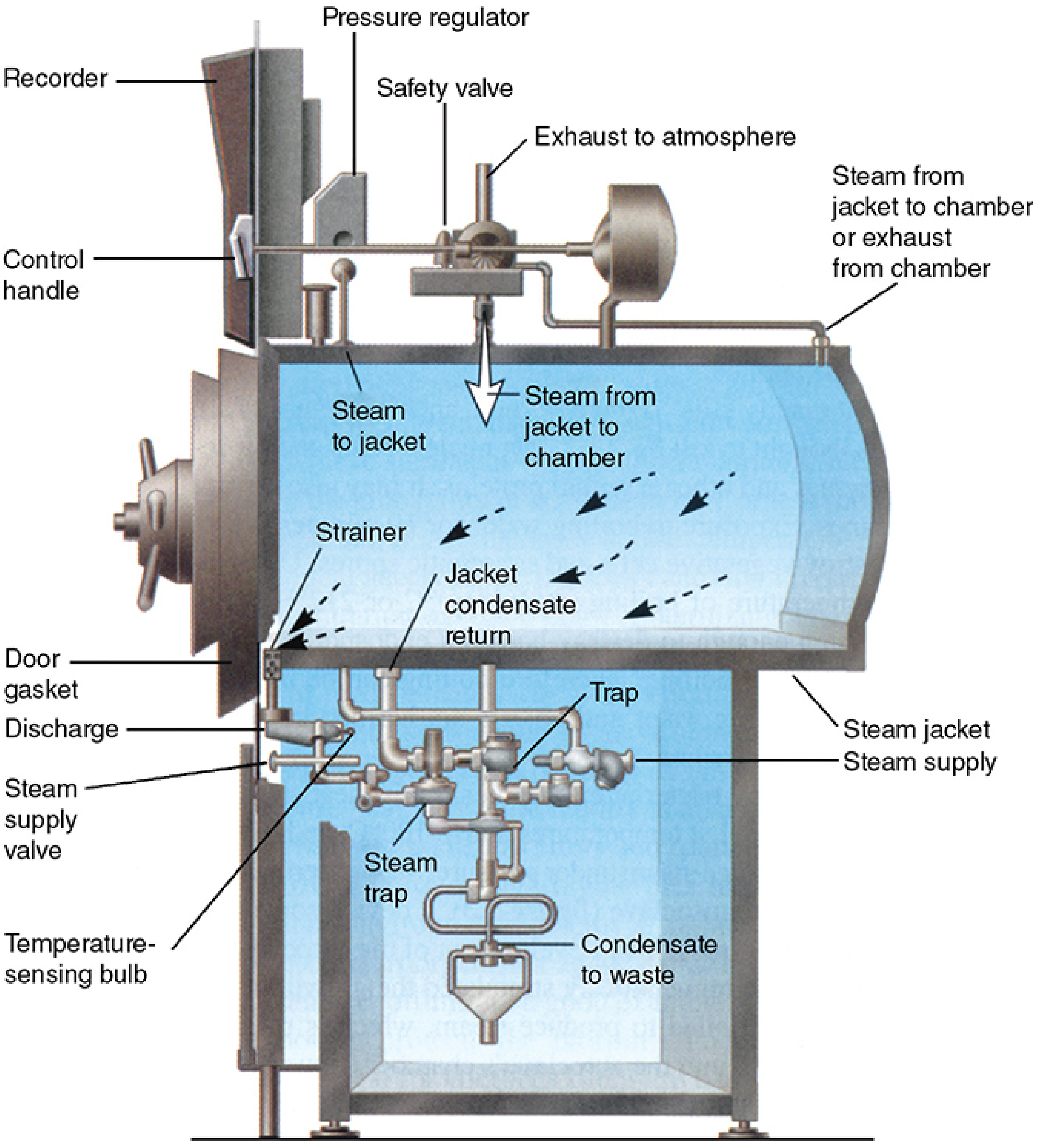
Figure: simple downward-displacement autoclave.
Types
-
Gravity displacement autoclave
- Steam enters from the top and pushes air downward and out through an outlet at the bottom.
- Commonly used in laboratories.
- Usually operates at 121°C for 15 minutes or longer depending on the load.
-
Pre-vacuum or high-vacuum autoclave
- Air is removed by a vacuum pump before steam enters.
- Gives better steam penetration and more uniform sterilization.
- Requires less exposure time, commonly 132-134°C for about 3-4 minutes.
Procedure
- Clean articles before sterilization to remove organic material.
- Pack articles loosely so steam can circulate freely.
- Add sufficient water to the chamber, if required.
- Load the autoclave without overpacking.
- Close the lid, keeping the air outlet open initially.
- Heat until steam escapes freely, ensuring removal of air.
- Close the outlet and allow pressure to rise to 15 psi and temperature to 121°C.
- Maintain these conditions for 15 minutes.
- Switch off heating and allow pressure to fall to zero naturally.
- Open the door slowly and remove items only after drying and cooling.
Importance of air removal
Air must be removed because it lowers the temperature achieved at a given pressure and prevents direct contact of saturated steam with articles. Residual air can lead to incomplete sterilization. Effective autoclaving depends on air removal, saturated steam, and steam access to all parts of the load. Sherris & Ryan's Medical Microbiology, Eighth Edition, p. 105-106.
Uses
- Culture media and aqueous solutions
- Glassware and metal instruments
- Surgical dressings, linen, and rubber goods that tolerate heat
- Contaminated laboratory materials and biomedical waste
- Certain reusable medical devices compatible with steam
Items not suitable for autoclaving
- Heat-sensitive plastics
- Electronic equipment
- Powders, oils, fats, and petroleum products
- Sharp instruments if repeated steam exposure damages them
- Lensed instruments and many endoscopes
- Heat-labile materials, which may require ethylene oxide or other low-temperature sterilization methods
Monitoring of sterilization
Sterilization should be checked by:
- Mechanical indicators: time, temperature, and pressure readings.
- Chemical indicators: autoclave tape, indicator strips, and integrator strips. Color change indicates exposure to the cycle but does not alone prove sterility.
- Biological indicators: spores of Geobacillus stearothermophilus. These are the most reliable indicators for steam sterilization. No growth after incubation indicates an effective cycle.
Advantages
- Reliable and rapid method of sterilization
- Kills spores as well as vegetative organisms
- Non-toxic and leaves no chemical residue
- Economical and easy to operate
- Suitable for many hospital and laboratory articles
Disadvantages
- Unsuitable for heat-sensitive materials
- Can corrode or blunt some metal instruments over repeated cycles
- Cannot sterilize oils, powders, and certain plastics
- Improper packing, inadequate air removal, or overloading can cause failure
Conclusion
Autoclaving is the most commonly used moist-heat method of sterilization. It works through saturated steam at high temperature, usually 121°C at 15 psi for 15 minutes, causing protein denaturation and destruction of all microorganisms including spores. Proper air removal, steam penetration, appropriate loading, and biological monitoring are necessary for successful sterilization.
This is a shared conversation. Sign in to Orris to start your own chat.