
Schobers test
Schober's test is a clinical measure of lumbar spine flexion. You mark a point at the level of the posterior superior iliac spines (roughly S1), then measure 10 cm above and 5 cm below that point (total 15 cm segment). The patient then bends forward maximally, and the distance between the two marks is re-measured. Normally the distance increases to at least 20 cm (a gain of at least 5 cm). Less than 20 cm suggests restricted lumbar flexion, as seen in ankylosing spondylitis or other inflammatory/degenerative spinal conditions.
Searching sources...
Reading File
Searching the Web
Schober's test lumbar spine flexion clinical technique interpretation
Finding Sources
Reading Web Page
https://www.physio-pedia.com/Schober_Test
Good - found relevant content in two textbooks. Let me read those sections.
Reading File
Reading File
There's a diagram in the textbook. Let me fetch it along with the image from the spinal exam section.
Loading Image
Here is a complete breakdown of Schober's test, sourced from textbook content:
Schober's Test (Lumbar Flexion Test)
Purpose
Schober's test quantifies lumbar spine range of motion in flexion. It is most commonly used to detect and monitor restricted spinal mobility, especially in ankylosing spondylitis (AS) and other spondyloarthropathies.
Technique
Original Schober's method:
- Patient stands erect.
- Identify and mark the S1 spinous process (at the level of the posterior superior iliac spines / sacral dimples).
- Mark a second point 10 cm above S1 on the midline.
- Ask the patient to bend maximally forward (knees straight).
- Re-measure the distance between the two marks.
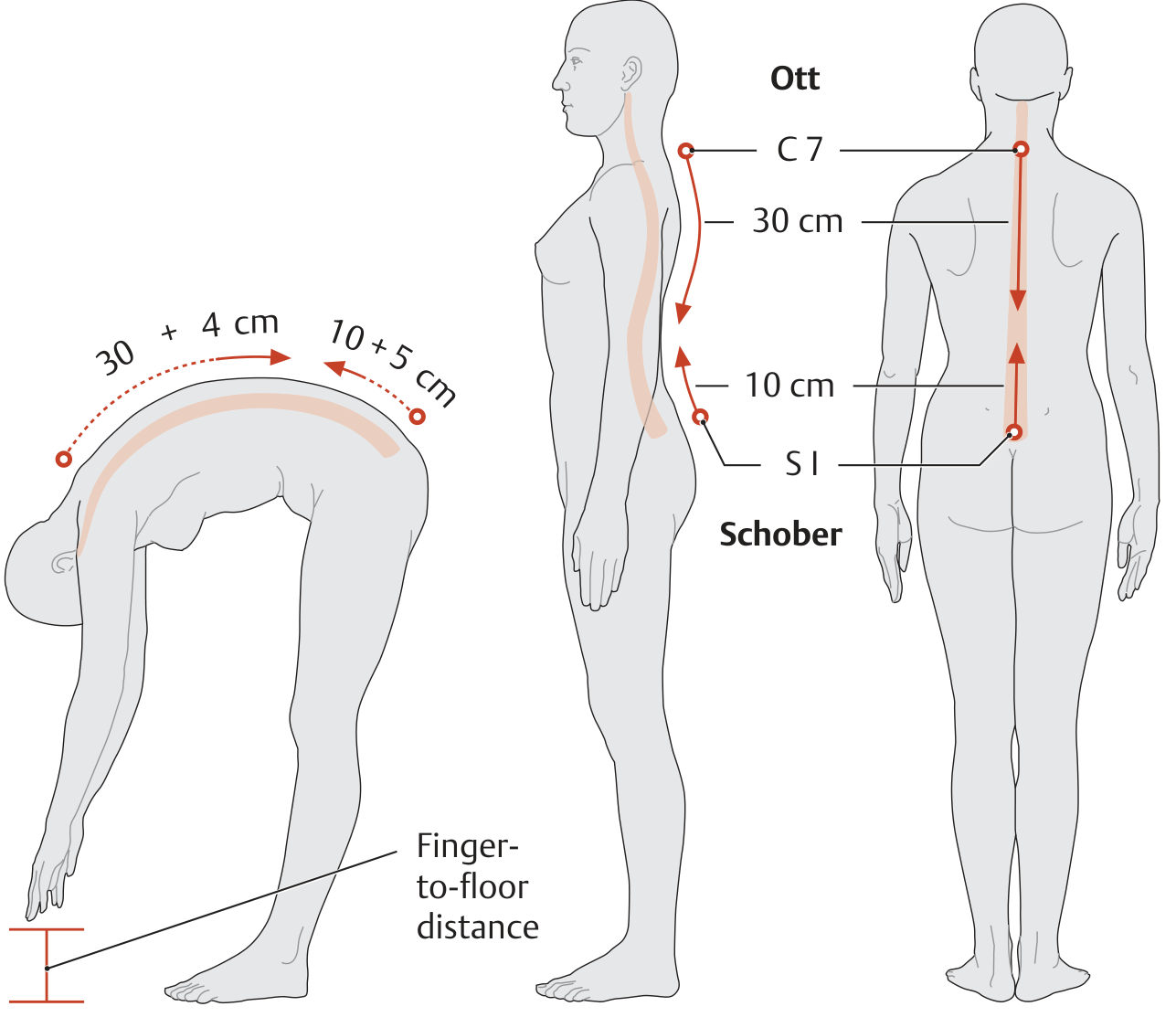
Normal finding: The distance increases from 10 cm to approximately 15 cm (a gain of ~5 cm), because lumbar flexion stretches the overlying skin.
"When the patient bends as far forward as possible, the distance between the two skin markings will increase to approximately 15 (10 + 5) cm (range of motion of the lumbar spine)." - THIEME Atlas of Anatomy
Modified Schober's Test
The most widely used clinical version. Landmarks are:
- Mark the midpoint between the two posterior superior iliac spines (PSIS) - roughly at S1.
- Measure 10 cm above and 5 cm below this point (total 15 cm span).
- Patient bends forward maximally.
- Normal: distance increases to >20 cm (gain of >5 cm from the original 15 cm baseline).
- Abnormal: less than 20 cm total, or less than 5 cm of increase, suggests restricted lumbar flexion.
The Washington Manual states: "spinal forward flexion using modified Schober's test (normal is >5 cm)"
Ott's Test (Thoracic equivalent)
Performed concurrently to assess thoracic spine flexion:
- Mark the C7 vertebra prominens, then measure 30 cm below it.
- On full forward flexion, this distance normally increases by up to 4 cm (from 30 to 34 cm).
- Restricted increase suggests reduced thoracic mobility.
Illustration
Interpretation Summary
| Result | Interpretation |
|---|---|
| Increase >5 cm (modified) | Normal lumbar flexion |
| Increase <5 cm | Restricted lumbar flexion - may suggest AS, degenerative disc disease, or other spinal pathology |
| Combined with Ott's test | Differentiates lumbar vs. thoracic restriction |
Finger-to-Floor Distance (FFD)
An alternative/supplement to Schober's test - measures the smallest distance from fingertip to floor when bending forward with knees extended. Less specific (hip flexibility also contributes) but quick to perform.
Clinical Context
In the spondyloarthropathies workup, Schober's test is part of a broader axial assessment that includes:
- Modified Schober's (lumbar flexion)
- Lateral flexion (middle fingertip to floor distance)
- Occiput-to-wall distance (cervical involvement; normal = 0 cm)
- Chest expansion (normal >2.5 cm) - assesses thoracic involvement
Sources: THIEME Atlas of General Anatomy and Musculoskeletal System, p. 146; The Washington Manual of Medical Therapeutics, p. 953
This is a shared conversation. Sign in to Orris to start your own chat.