
Treatment of non ossifying Fibroma in proximal tibia
I'll read the medical library skill first, then research this topic in parallel.
Reading File
Now let me search the medical library and PubMed in parallel for comprehensive information on non-ossifying fibroma treatment.
Finding Sources
Finding Sources
Searching PubMed
"non-ossifying fibroma" treatment
Good results. Now let me read the key textbook sections and get the PubMed abstracts in parallel.
Reading File
Finding Sources
Reading Article
PMID: 41010632
Reading Article
PMID: 35882354
Now let me get more treatment-specific content from the orthopaedics textbooks and the full NOF section.
Reading File
Finding Sources
Finding Sources
Let me now search for the Campbell's and Miller's orthopaedics treatment sections specifically.
Finding Sources
Finding Sources
Reading Article
PMID: 42030226
Let me get the Miller's and Campbell's content on NOF treatment, and also fetch the NOF radiograph image for the user.
Finding Sources
Reading File
Loading Image
I now have sufficient information to provide a comprehensive answer. Let me compile everything.
Non-Ossifying Fibroma (NOF) of the Proximal Tibia - Treatment
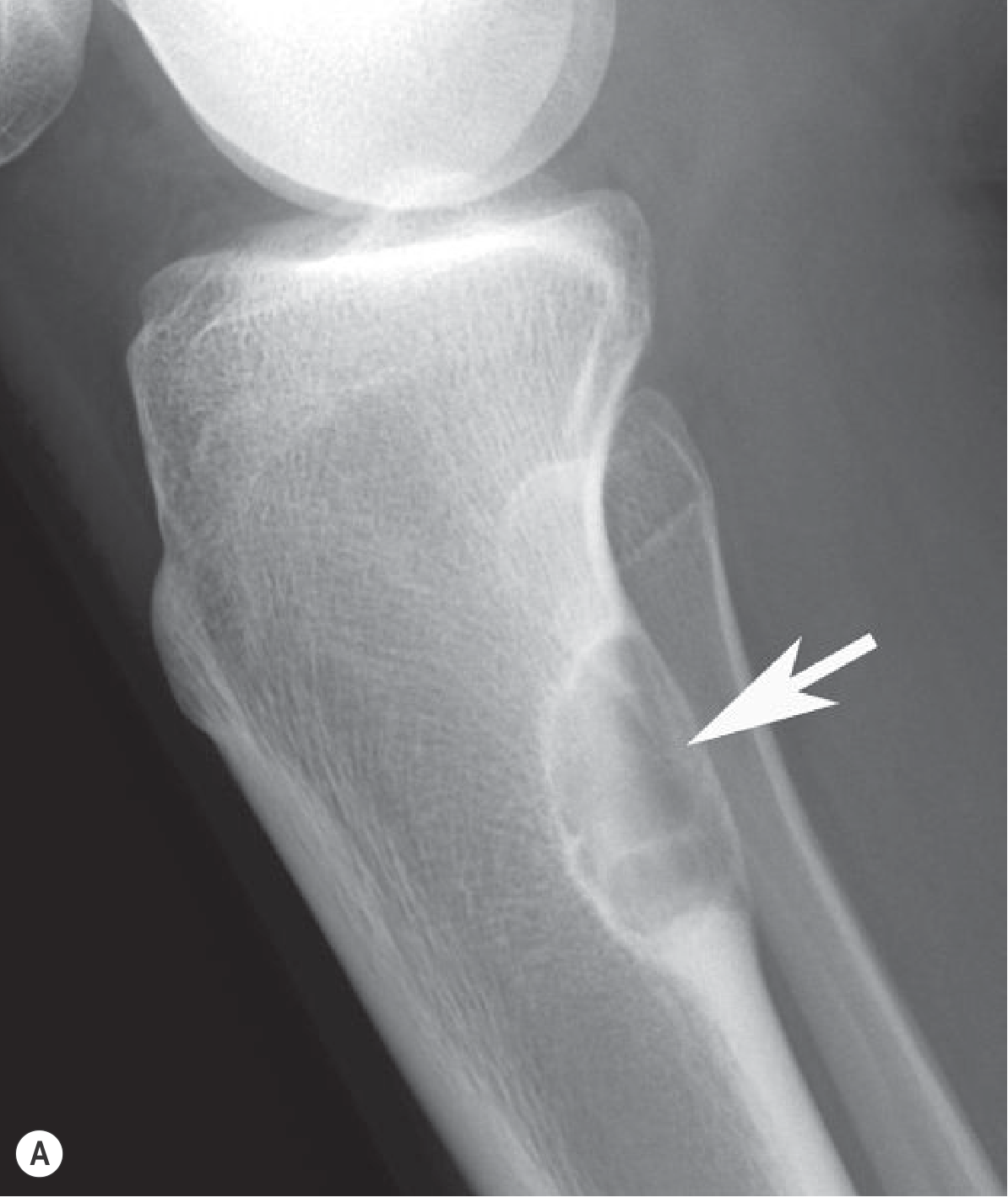
Lateral radiograph of the proximal tibia showing a NOF - a lobular lesion centred on the posterior cortex (arrow):
Overview
NOF (also called fibrous cortical defect when small) is the most common benign bone tumor in children and adolescents. It is a benign, self-limiting fibrohistiocytic lesion. The proximal tibia, along with the distal femur, is the most common site. The key principle governing treatment is that the vast majority of NOFs do not require any intervention - they involute spontaneously.
1. Observation (Watchful Waiting) - First-Line
Most NOFs in the proximal tibia require no treatment. Criteria for observation alone:
- Asymptomatic lesion discovered incidentally
- Small lesion (typically <33 mm or occupying <50% of bone diameter)
- Intact cortex with no fracture risk
- Classic radiographic appearance (lobular lytic lesion with sclerotic rim, no periosteal reaction, no soft tissue mass)
- Skeletally immature patient (spontaneous involution expected with skeletal maturation)
Follow-up: Periodic plain radiographs every 6-12 months to confirm radiological resolution. Lesions typically ossify and resolve over years.
"NOF can usually be diagnosed radiologically, in which case biopsy is unnecessary." - Grainger & Allison's Diagnostic Radiology
2. Indications for Surgical Treatment
Surgery is indicated when one or more of the following are present:
| Indication | Details |
|---|---|
| Large lesion size | >33 mm or involving >50% of the cortical diameter |
| Cortical compromise | Thinning, erosion, or breach of the cortex |
| High fracture risk | Biomechanically at-risk location (proximal tibia is a weight-bearing bone) |
| Pathological fracture | Either after fracture or impending fracture |
| Symptomatic (pain) | Especially stress fracture-related pain at the proximal tibia |
| Skeletal maturity | No prospect of spontaneous regression in adults |
| Diagnostic uncertainty | Atypical imaging features (biopsy + surgery) |
The proximal tibia is particularly relevant because it is a major weight-bearing segment - larger lesions here carry a higher risk of pathological fracture than equivalent-sized lesions in non-weight-bearing locations.
3. Surgical Options
a) Curettage + Bone Grafting (Standard Surgical Treatment)
- Extended curettage is the procedure of choice for most surgical cases
- The cavity is filled with autograft, allograft, or synthetic bone substitutes
- Provides structural support and stimulates osseous healing
- Recurrence after adequate curettage is rare
b) Curettage + PMMA Bone Cement + Prophylactic Fixation
- Used for large lesions with cortical breach or in skeletally mature patients
- Polymethylmethacrylate (PMMA) cement provides immediate mechanical stability
- Combined with prophylactic plate fixation (locking plate along the proximal tibia) when fracture risk is high
- Allows early weight-bearing post-operatively
- A 2026 case report (Zhao et al., AJCR, PMID 42030226) documented this approach in a 28-year-old with a 55x34 mm NOF of the proximal tibia with cortical breach - extended curettage + PMMA + prophylactic plating resulted in union without recurrence at 2 months
c) Prophylactic Fixation Alone (Less Common)
- In rare cases of impending fracture with intact surrounding bone, prophylactic intramedullary nailing or plating may be done without curettage
4. Management of Pathological Fracture Through NOF
When a fracture occurs through a confirmed NOF at the proximal tibia:
- If imaging is unambiguous for NOF (classic radiographic appearance), conservative fracture management (cast immobilization) can be considered - the fracture often heals and the NOF may resolve spontaneously
- If imaging is atypical or the lesion appears aggressive, MRI with contrast + biopsy must be performed before any fracture treatment to exclude malignancy
- For large cavitary lesions post-fracture, curettage + bone graft + internal fixation is preferred
"If the radiological diagnosis is unambiguous, e.g., a juvenile bone cyst (JBC) or a non-ossifying fibroma (NOF), conservative treatment of the fracture can be considered, depending on the location." - Pathological Fractures in Benign Bone Lesions, Z Orthop Unfall, 2024 (PMID 35882354)
5. Special Considerations for Proximal Tibia NOF
- Stress fractures are more common with proximal tibial NOF than other sites - pain at this location with a known NOF should prompt MRI to assess for stress fracture
- Jaffe-Campanacci syndrome (multiple NOFs + café-au-lait spots) - lesions may be more numerous and larger; surgical thresholds remain the same but surveillance is more intensive
- NF1 association: NOF in neurofibromatosis patients may present in adults without spontaneous resolution - a lower threshold for surgery is appropriate
- Secretory NOF: Rare cases cause vitamin D-resistant rickets/osteomalacia through FGF-23 secretion - resection of the lesion is the only cure
Summary Algorithm
NOF diagnosed (proximal tibia)
         |
    +---------+--------+
    |                  |
 Asymptomatic        Symptomatic / Large / Fracture risk
 Small (<33mm)              |
 Intact cortex         +-------+--------+
    |                  |                |
 Observation     Pathological      No fracture yet
 (radiological   fracture              |
  follow-up)          |           Curettage + bone graft
                 Classic NOF     ± PMMA ± plate fixation
                 on imaging?
                 Yes: conservative
                 No: biopsy first
Key References
- Grainger & Allison's Diagnostic Radiology - NOF section (proximal tibia radiograph and MRI features)
- Spodeck D et al. "Pathological Fractures in Benign Bone Lesions." Z Orthop Unfall 2024 (PMID 35882354)
- Zhao Z et al. "Diagnostic and Treatment Strategies for Adult Non-Ossifying Fibromas." Am J Case Rep 2026 (PMID 42030226)
- Walker K et al. "Non-Ossifying Fibromas: A 2025 Review." J Clin Med 2025 (PMID 41010632)
This is a shared conversation. Sign in to Orris to start your own chat.