
Alcohol distribution in fat and females
Alcohol has a lower volume of distribution in people with higher body fat and in females - both groups have less total body water, so the same dose produces higher blood alcohol concentrations.
Searching sources...
Reading File
Finding Sources
Finding Sources
Finding Sources
Finding Sources
Good - I have several relevant textbook sources. Let me read the key passages now.
Reading File
Reading File
Reading File
Reading File
Loading Image
I now have all the key information from authoritative textbooks. Here is the full answer:
Alcohol (Ethanol) Distribution: Body Fat and Females
The Core Principle: Ethanol Distributes in Body Water
Ethanol is a small, water-soluble molecule. Its volume of distribution (Vd) approximates total body water, typically 0.5-0.7 L/kg. Because ethanol distributes almost exclusively into body water (not fat), the proportion of fat in the body directly affects blood alcohol concentration (BAC) for any given dose.
- Katzung's Basic and Clinical Pharmacology, 16th Ed., p. 622
- Henry's Clinical Diagnosis and Management by Laboratory Methods
Why Fat Matters
Fat tissue contains very little water. A person with a higher percentage of body fat has proportionally less total body water relative to their body weight. Since ethanol distributes only into the aqueous compartment:
- The same amount of alcohol is diluted into a smaller effective volume
- This results in a higher BAC for the same dose compared to a lean individual of equal body weight
In practical terms: two people of identical weight but different body compositions will reach different BAC levels after drinking the same amount, with the one who has more body fat reaching a higher concentration.
Why Females Reach Higher Blood Alcohol Levels
Women achieve higher peak alcohol concentrations than men after an equivalent oral dose for two key reasons:
1. Lower total body water content
Women have a greater percentage of body fat and less total body water than men of the same weight. Ethanol's Vd is therefore smaller in women:
| Sex | Widmark's Vd (rho, L/kg) |
|---|---|
| Males | 0.68 |
| Females | 0.55 |
This ~19% difference in Vd directly translates to proportionally higher BAC in females for the same intake. (Tietz Textbook of Laboratory Medicine, 7th Ed.)
2. Reduced first-pass metabolism
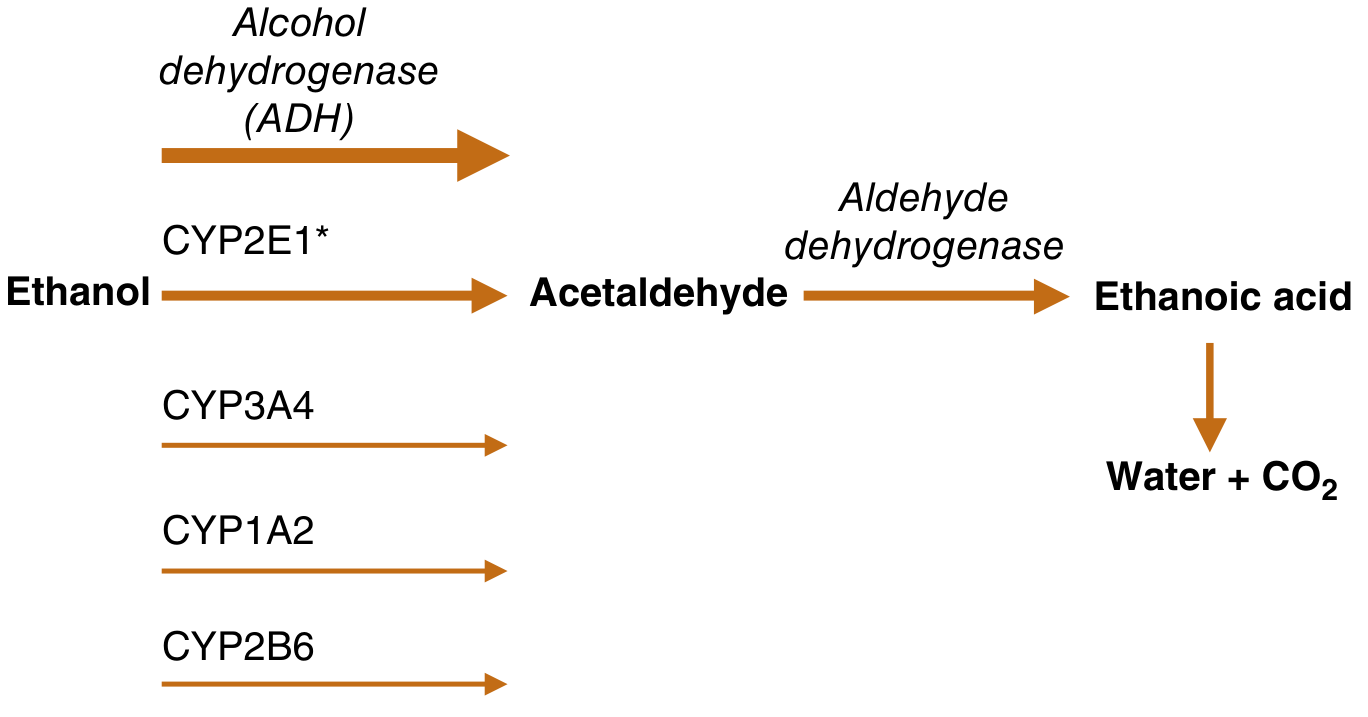
Women have lower gastric alcohol dehydrogenase (ADH) activity than men. This means less ethanol is metabolized in the stomach before it reaches systemic circulation, resulting in greater bioavailability.
The Maudsley Prescribing Guidelines state:
"The volume of distribution is smaller in women and the elderly where plasma levels of alcohol will be higher than in young males for a given intake of alcohol."
The Widmark Formula (Practical Application)
Dr. Erik Widmark's formula captures these sex-based differences explicitly:
BAC estimation:
$$N = W \cdot \rho \cdot [C_t + \beta \cdot t] ;/; (d \cdot Z)$$
Where:
- W = body weight (kg)
- ρ (rho) = Vd - 0.68 for males, 0.55 for females (L/kg)
- Ct = blood alcohol concentration (kg/L)
- β = elimination rate (~0.15 g/L/h)
- d = specific gravity of alcohol (0.8)
- Z = ethanol per standard drink (15 mL)
The lower ρ value for females mathematically produces a higher predicted BAC from the same number of drinks, weight for weight. - Tietz Textbook of Laboratory Medicine, 7th Ed.
Alcohol Metabolism Pathway
Summary Table
| Factor | Effect on BAC | Mechanism |
|---|---|---|
| High body fat % | Increases BAC | Less total body water = smaller Vd for ethanol |
| Female sex | Increases BAC | Lower body water (Vd 0.55 vs 0.68 L/kg) + reduced gastric ADH first-pass metabolism |
| Elderly | Increases BAC | Progressive reduction in total body water |
| Food in stomach | Delays peak BAC (does not reduce total) | Slows gastric emptying, delays absorption |
Clinical Implications
- Women develop alcohol-related liver disease and other complications at lower doses and shorter durations of drinking than men, partly due to this pharmacokinetic difference.
- Dosing of certain drugs with narrow therapeutic indices should account for sex and body composition.
- Forensic BAC estimation (retrograde extrapolation) must use sex-appropriate Vd values to be valid.
Mellanby effect
The Mellanby effect describes the observation that behavioral impairment from alcohol is greater at a given BAC when the BAC is rising (ascending limb) than when it is falling (descending limb) - i.e., the brain is more sensitive to alcohol on the way up than on the way down.
Searching sources...
Finding Sources
Searching the Web
Mellanby effect alcohol tolerance ascending descending BAC pharmacology
Reading File
Reading File
Reading File
I have comprehensive textbook coverage. Here is the full answer:
The Mellanby Effect
Definition
The Mellanby effect is a form of acute tolerance to alcohol, first described by Sir Edward Mellanby in 1919. It states that:
For any given blood alcohol concentration (BAC), the degree of behavioral and CNS impairment is greater on the ascending (rising) limb of the BAC curve than on the descending (falling) limb.
In other words, the brain adapts to alcohol within the same drinking session - a person is more impaired while their BAC is climbing than they are at the identical BAC level while sobering up.
- DiMaio's Forensic Pathology, 3rd Ed., p. 496
- Kaplan & Sadock's Synopsis of Psychiatry
The BAC Curve: Ascending vs. Descending Limbs
BAC
 ▲
 │         ● Peak BAC
 │        /  \
 │       /    \
 │      /      \
 │     /        \
 │    /          \
 │───────────────────→ Time
    Rising     Falling
    (more       (less
   impaired)   impaired)
At the same point X on the Y-axis, the person is more impaired when approaching that point from below (rising) than when passing through it from above (falling).
Mechanism
The Mellanby effect is a manifestation of rapid, within-session neuroadaptation. The proposed mechanisms include:
-
GABA-A receptor desensitization - during the ascending limb, ethanol potentiates GABA-A receptors. The brain begins to downregulate/desensitize these receptors within the same drinking session. By the time BAC is falling, the receptors are less responsive to the same ethanol concentration.
-
NMDA receptor upregulation - ethanol inhibits NMDA (glutamate) receptors acutely. Compensatory upregulation begins rapidly, partially offsetting the effect during the descent.
-
General homeostatic counter-regulation - the brain initiates negative feedback loops against the depressant effects, and these are partially in place by the descending limb.
Kaplan & Sadock's Comprehensive Textbook of Psychiatry explicitly frames this as: "acute tolerance that results in more clinical effects when serum levels are increasing than when they are decreasing." - p. 9773
What Functions Are Affected
The Mellanby effect has been demonstrated across multiple domains:
| Domain | Effect |
|---|---|
| Subjective intoxication | Person feels less drunk at same BAC on the way down |
| Willingness to drive | Increases on the descending limb (dangerous) |
| Maze performance | Improves on descending limb |
| Arithmetic ability | Improves on descending limb |
| Reaction time | Improves on descending limb |
| Coordination (peg board) | Improves on descending limb |
Why the Rate of Absorption Matters
Because impairment is greatest on the ascending limb, how fast BAC rises directly affects the intensity of intoxication. Faster absorption (empty stomach, rapid drinking, higher-proof beverages) produces a steeper ascent and therefore more pronounced impairment for the same total dose. Kaplan & Sadock note: "the rate of absorption bears directly on the intoxication response."
Forensic and Clinical Significance
-
DUI law - A person breathalysed on the descending limb may appear less impaired than they were at the same BAC hours earlier. This is relevant for retrograde extrapolation evidence in court.
-
Risk of dangerous behavior - On the descending limb, the driver/pedestrian feels more capable (subjective improvement) but still has measurable impairment - a particularly dangerous combination, as willingness to drive increases precisely when the person feels "better."
-
Cross-tolerance - The Mellanby effect generalizes to other GABA-A agonists (barbiturates, benzodiazepines). Tolerance within a session to one drug can carry over to another acting at the same receptor - Kaplan & Sadock's Comprehensive Textbook of Psychiatry, p. 9773.
-
Chronic alcoholics - Individuals with chronic alcohol use disorder show a markedly amplified form of this effect: they can appear superficially sober at BAC levels (e.g., 0.15 g/dL) that would cause significant overt intoxication in a naive drinker, though physiological impairment (reflexes, visual acuity, memory, judgment) persists regardless - DiMaio's Forensic Pathology, 3rd Ed.
Key Points Summary
- Described in 1919 by Sir Edward Mellanby
- Greater impairment at the same BAC on the rising curve vs. the falling curve
- Mechanism: rapid GABA-A receptor desensitization and NMDA counter-regulation within a single session
- Subjective feeling of improvement on the descent paradoxically increases risk-taking (e.g., driving)
- Relevant to forensic BAC interpretation, DUI cases, and retrograde extrapolation
- A specific example of acute (within-session) tolerance, distinct from chronic tolerance
This is a shared conversation. Sign in to Orris to start your own chat.