
Stem cell / Hematopoitic stem cells in tissue homeostasis and human disease based on Robbins for md pathology exam highly repeated question
Reading File
Finding Sources
Finding Sources
Searching PubMed
"stem cells" AND "tissue homeostasis"
Searching the Web
Robbins Basic Pathology stem cells tissue homeostasis human disease
Finding Sources
Finding Sources
Searching Images
diagram hematopoietic stem cell hierarchy myeloid lymphoid differentiation bone marrow niche
Reading File
Reading File
Reading File
Reading File
Reading File
Reading File
Finding Sources
Finding Sources
Stem cells and hematopoietic stem cells in tissue homeostasis and human disease
Robbins-based MD Pathology exam answer
Definition
Stem cells are undifferentiated cells with two defining properties:
- Self-renewal: ability to produce daughter cells that retain stem-cell identity.
- Differentiation: ability to produce mature specialized cells.
In normal tissues, homeostasis reflects a balance among stem-cell self-renewal, differentiation, proliferation of progeny, and death of terminally differentiated cells. Robbins, Cotran & Kumar Pathologic Basis of Disease, p. 42.
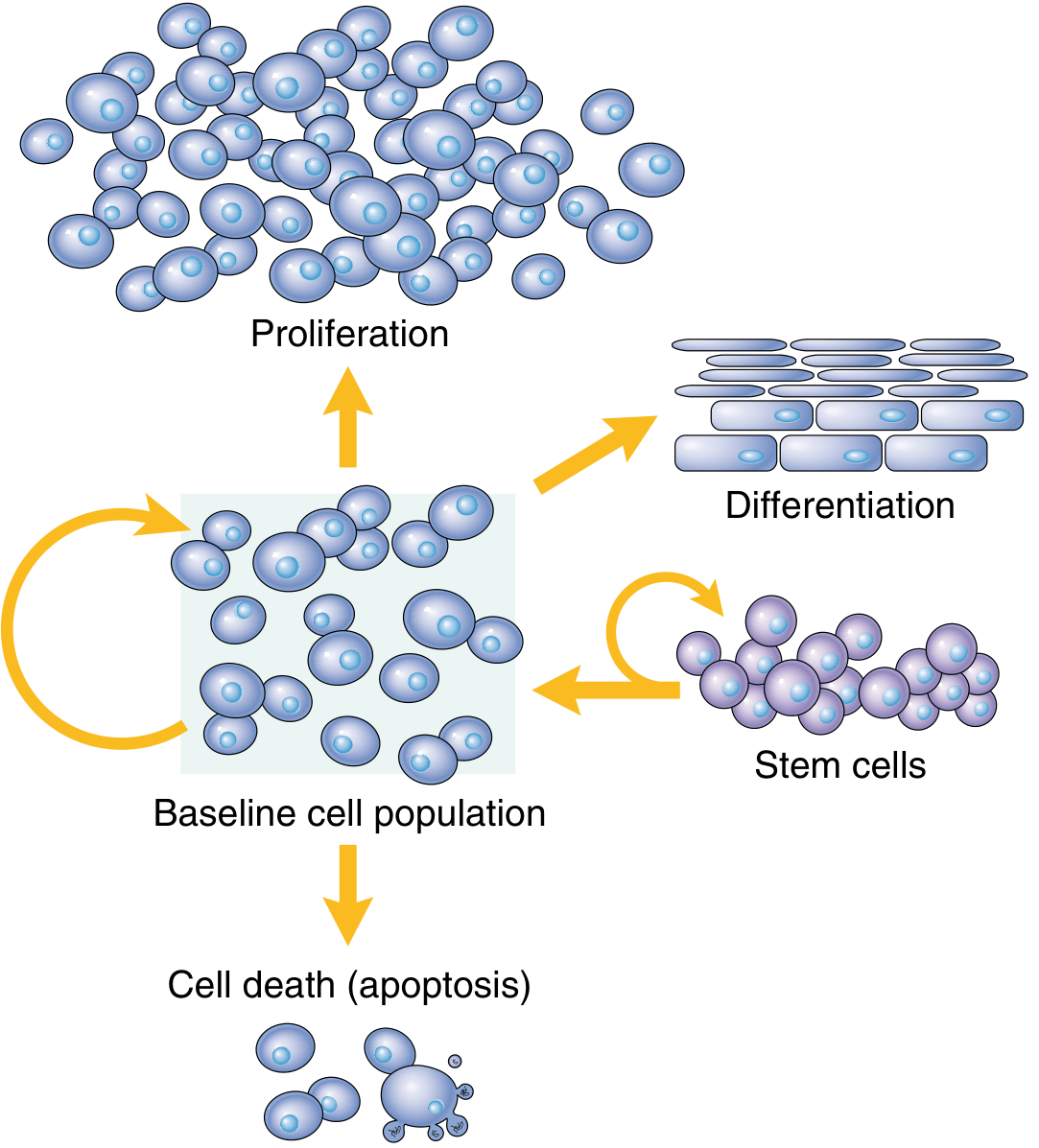
1. Types of stem cells
| Type | Source/potential | Main role |
|---|---|---|
| Embryonic stem cells | Inner cell mass of blastocyst; pluripotent, capable of forming derivatives of all three germ layers | Development |
| Adult or tissue stem cells | Present in developed organs; usually multipotent or lineage-restricted | Tissue maintenance and repair |
| Induced pluripotent stem cells | Mature somatic cells experimentally reprogrammed to pluripotency | Disease modelling and regenerative medicine |
| Cancer stem cells | Stem-like malignant cells within tumors | Tumor persistence, relapse, therapeutic resistance |
Embryonic stem cells have extensive self-renewal capacity; adult stem cells have a more restricted lineage potential and generally generate the cells normally present in their tissue of origin. Robbins, Cotran & Kumar Pathologic Basis of Disease, pp. 42-43.
2. Stem-cell divisions
A. Asymmetric division
One stem cell produces:
- One daughter that remains a stem cell
- One daughter that differentiates through progenitor stages into mature cells
Importance: Maintains a stable stem-cell pool while continually supplying mature cells.
B. Symmetric division
Both daughter cells retain stem-cell properties.
Importance: Expands the stem-cell population:
- During embryogenesis
- After severe injury
- During bone marrow recovery after myeloablative chemotherapy
Robbins, Cotran & Kumar Pathologic Basis of Disease, p. 43.
3. Stem-cell niche
A stem-cell niche is the specialized local microenvironment that maintains and regulates stem cells.
Functions of the niche
- Keeps stem cells in a quiescent, protected state when demand is low
- Controls self-renewal versus differentiation
- Provides signals through stromal cells, extracellular matrix, cytokines, growth factors, and cell-cell adhesion
- Protects stem cells from injury and inappropriate proliferation
Examples
- Bone marrow: hematopoietic stem cells are concentrated in perivascular niches
- Intestinal epithelium: stem cells lie in the crypts
- Skin: hair follicle bulge region
- Cornea: limbus
- Brain: subventricular zone
Robbins, Cotran & Kumar Pathologic Basis of Disease, p. 43.
Hematopoietic stem cells
4. Definition and properties of HSCs
Hematopoietic stem cells (HSCs) are rare, multipotent adult stem cells primarily located in bone marrow. They continuously replenish all circulating blood cells lost through senescence, apoptosis, consumption, or injury.
Essential properties
- Long-term self-renewal
- Multipotency
- Capacity to repopulate the entire hematopoietic system
- Predominantly quiescent at baseline
- Respond to marrow stress, bleeding, infection, and cytotoxic injury
- Mobilizable into peripheral blood by colony-stimulating factors
HSCs can be isolated from bone marrow or mobilized peripheral blood, and can repopulate marrow after chemotherapy. Robbins, Cotran & Kumar Pathologic Basis of Disease, p. 43.
5. Hematopoietic hierarchy
Hematopoietic stem cell
        ↓
Multipotent progenitor
        ↓
 ┌──────────────────────────────┐
 ↓                              ↓
Common myeloid progenitor      Common lymphoid progenitor
 ↓                              ↓
Erythrocytes                   B lymphocytes
Megakaryocytes → Platelets     T lymphocytes
Granulocytes                   NK cells
Monocytes → Macrophages
Thus, a single HSC ultimately sustains production of:
- Erythrocytes
- Platelets
- Neutrophils, eosinophils, basophils
- Monocytes/macrophages
- B lymphocytes
- T lymphocytes
- Natural killer cells
6. Role of HSCs in tissue homeostasis
HSCs are the prototype of adult stem cells required for a continuously dividing, labile tissue.
Why are HSCs essential?
Blood cells have limited life spans:
- Neutrophils are short-lived
- Platelets survive approximately 7-10 days
- Erythrocytes survive approximately 120 days
- Many immune cells are consumed during immune responses
Therefore, blood-cell homeostasis requires continuous production from HSCs and progenitor cells.
Regulation
Hematopoiesis is controlled by:
- Bone marrow niche and stromal support
- Cell-cell interactions and extracellular matrix
- Cytokines and growth factors, including erythropoietin, thrombopoietin, G-CSF, GM-CSF, IL-3 and others
- Feedback from peripheral blood-cell demand
In injury or stress
Following hemorrhage, infection, inflammation, chemotherapy, or marrow ablation:
- HSCs enter the cell cycle
- Symmetric division expands the stem-cell pool
- Progenitors rapidly proliferate
- Production of the required blood lineage increases
7. Stem cells in tissue repair and regeneration
Tissues are classified according to proliferative capacity:
A. Labile tissues
Cells continuously divide and are continually replaced by stem cells.
Examples
- Bone marrow hematopoietic cells
- Skin and oral epithelium
- Gastrointestinal epithelium
- Cervix, vagina, uterus, fallopian tubes
- Ductal epithelium of exocrine organs
- Transitional epithelium of urinary tract
These tissues regenerate well if their stem-cell pool and supporting stromal framework are intact.
B. Stable tissues
Normally quiescent, but can re-enter the cell cycle after injury.
Examples: liver, kidney, pancreas, fibroblasts, endothelial cells and smooth muscle cells.
C. Permanent tissues
Terminally differentiated cells with negligible regenerative capacity.
Examples: neurons and cardiac myocytes. Repair is mainly by scar formation. Skeletal muscle has limited repair through satellite cells.
Robbins, Cotran & Kumar Pathologic Basis of Disease, pp. 120-121.
HSCs in human disease
8. Bone-marrow failure and aplastic anemia
Aplastic anemia is chronic primary hematopoietic failure causing:
- Anemia
- Neutropenia
- Thrombocytopenia
It results from destruction, suppression, or intrinsic failure of HSCs.
Pathogenesis
-
Immune-mediated stem-cell suppression
- Most common mechanism
- Activated T cells suppress or destroy marrow progenitors/HSCs
-
Direct toxic or radiation injury
- Chemotherapy
- Benzene
- Ionizing radiation
- Some drugs, including chloramphenicol in idiosyncratic cases
-
Viral-associated marrow failure
- Hepatitis-associated aplastic anemia
- Other viral infections may be implicated
-
Inherited stem-cell defects
- Fanconi anemia
- Telomerase defects
Loss of HSCs produces a hypocellular fatty marrow and peripheral pancytopenia. Robbins, Cotran & Kumar Pathologic Basis of Disease, pp. 615-616.
9. Myeloid neoplasms and leukemia
Mutations acquired in HSCs or early progenitors can generate a clone with abnormal proliferation, survival, or differentiation.
Important consequences
- Acute myeloid leukemia (AML): maturation block with accumulation of blasts
- Myelodysplastic neoplasms (MDS): ineffective hematopoiesis, cytopenias, dysplasia, and risk of AML transformation
- Myeloproliferative neoplasms (MPNs): excessive production of one or more myeloid lineages
- Chronic myeloid leukemia (CML): classically arises in a transformed multipotent hematopoietic stem cell, explaining involvement of multiple myeloid lineages and sometimes lymphoid cells
High-yield concept
A mutation in an HSC affects many descendant lineages, whereas a mutation in a committed progenitor has a narrower lineage distribution.
10. Clonal hematopoiesis
With aging, mutated HSC clones may expand even when blood counts are normal. This is called clonal hematopoiesis.
Significance
- Precursor state for myeloid neoplasms and other hematologic malignancies
- More frequent with increasing age
- Associated with cardiovascular disease and chronic inflammatory disorders
- Often involves mutations in epigenetic regulatory genes, such as TET2 and DNMT3A
Robbins, Cotran & Kumar Pathologic Basis of Disease, pp. 560-561.
11. Cancer stem cells
The cancer stem-cell concept proposes that a subset of tumor cells has the capacity for:
- Self-renewal
- Long-term tumor maintenance
- Production of more differentiated malignant progeny
- Tumor recurrence after treatment
Origin
Cancer stem cells may arise by:
- Transformation of a normal tissue stem cell, such as HSCs in CML.
- Acquisition of stem-cell properties by a differentiated or progenitor cell, such as granulocytic progenitors in acute promyelocytic leukemia.
Clinical relevance
Cancer stem cells may resist chemotherapy because they:
- Divide slowly or remain quiescent
- Express drug-resistance proteins such as MDR1
- Can survive treatment and regenerate the tumor
Therefore, eradication of the tumor stem-cell compartment is considered necessary for durable cure. Robbins, Cotran & Kumar Pathologic Basis of Disease, pp. 288-289.
12. Hematopoietic stem-cell transplantation
HSC transplantation restores hematopoiesis after marrow destruction or replacement.
Sources
- Bone marrow
- Mobilized peripheral blood
- Umbilical cord blood
Types
| Type | Source | Typical use |
|---|---|---|
| Autologous HSCT | Patient's own HSCs collected before high-dose therapy | Lymphoma, multiple myeloma |
| Allogeneic HSCT | HSCs from HLA-matched donor | Leukemias, aplastic anemia, inherited marrow failure, immunodeficiency |
Uses
- Leukemia and lymphoma
- Multiple myeloma
- Severe aplastic anemia
- Inherited marrow-failure syndromes
- Hemoglobinopathies, such as sickle-cell disease and thalassemia
- Primary immunodeficiencies
Major complications of allogeneic HSCT
- Graft-versus-host disease
- Graft rejection or failure
- Opportunistic infections
- Conditioning-related tissue injury
- Relapse of underlying malignancy
13. Regenerative medicine
Stem cells can theoretically be:
- Isolated
- Expanded in culture
- Differentiated into desired cell types
- Transplanted to restore damaged tissues
HSC transplantation is the established clinical example of successful stem-cell therapy. Mesenchymal stem cells, found in bone marrow and adipose tissue, may differentiate into stromal tissues such as bone, cartilage, adipose tissue, and muscle, and are being explored in regenerative applications. Robbins, Cotran & Kumar Pathologic Basis of Disease, pp. 43-44.
Limitations
- Difficulty directing differentiation accurately
- Limited engraftment and long-term survival
- Immune rejection
- Risk of genetic instability or tumor formation
- Ethical issues for embryonic stem cells
5-mark short note: last-minute answer
Hematopoietic stem cells are rare multipotent stem cells in bone marrow that maintain lifelong production of all formed elements of blood. Their key features are self-renewal, multipotency, quiescence, and residence in specialized perivascular bone-marrow niches. Through asymmetric division, one daughter remains an HSC while the other differentiates through myeloid and lymphoid progenitors into mature blood cells. During stress, such as marrow ablation, symmetric division expands the HSC pool.
HSC dysfunction causes marrow failure and pancytopenia, as in aplastic anemia caused by immune injury, drugs, toxins, radiation, viral infection, or inherited disorders such as Fanconi anemia and telomerase defects. Acquired mutations in HSCs can cause clonal hematopoiesis, MDS, AML, MPNs, and CML. HSC transplantation can restore marrow function in hematologic malignancies, marrow-failure states, hemoglobinopathies, and immunodeficiency disorders.
One-line conclusion: HSCs are essential for blood-cell homeostasis, marrow regeneration, and immune competence; their depletion causes marrow failure, while their malignant transformation underlies many hematologic cancers.
This is a shared conversation. Sign in to Orris to start your own chat.