
Phrynoderma case sheet
Reading File
Phrynoderma is a nutritional deficiency disorder causing follicular hyperkeratosis, classically associated with Vitamin A deficiency but also linked to B-complex and essential fatty acid deficiencies. Let me build a full case sheet from the medical library.
Searching sources...
Finding Sources
Finding Sources
Searching PubMed
phrynoderma follicular hyperkeratosis nutritional deficiency
Good - I have three strong textbook sources. Let me read all of them in parallel.
Reading File
Reading File
Reading File
Now let me get the rest of the Andrews' text (histology, diagnosis, treatment) and fetch the clinical image:
Reading File
Loading Image
Loading Image
I now have comprehensive information from three authoritative dermatology textbooks plus clinical images. Here is the complete Phrynoderma case sheet:
PHRYNODERMA - CLINICAL CASE SHEET
1. DEFINITION & ETYMOLOGY
Phrynoderma (Greek: phrynos = toad + derma = skin) is a nutritional deficiency disorder characterized by follicular hyperkeratosis producing a "toad-skin" appearance. It was first described by Lucius Nicholas in 1933 when he observed hyperkeratotic folliculitis with night blindness and xerophthalmia in East African workers.
2. ETIOLOGY & PATHOGENESIS
Although classically attributed solely to Vitamin A deficiency (VAD), phrynoderma is most accurately a disorder of multiple nutritional deficiencies:
| Deficiency | Role |
|---|---|
| Vitamin A (retinol) | Primary; required for normal keratinization of mucosal and skin surfaces |
| B-complex vitamins | Contributing deficiency |
| Vitamin C | Can mimic phrynoderma (also causes follicular hyperkeratosis) |
| Vitamin E | Contributing deficiency |
| Essential Fatty Acids (EFAs) | Contributing deficiency |
| Protein-Energy Malnutrition (PEM) | General malnutrition state |
Mechanism: Vitamin A is required for normal keratinization of mucosal and skin surfaces. Deficiency leads to abnormal keratinization, squamous metaplasia of glandular epithelia, and follicular plugging.
Vitamin A sources: Retinyl esters in milk, fish oil, liver, and eggs; carotenoids in plants.
3. EPIDEMIOLOGY & RISK FACTORS
- Common in children in the developing world (where VAD is prevalent)
- Rare in developed countries - seen in specific settings:
- Intestinal malabsorption (bariatric surgery, Crohn disease, IBD, celiac disease)
- Pancreatic insufficiency
- Cystic fibrosis
- Liver disease
- Anorexia nervosa / fad diets
- Long-term parenteral nutrition without adequate supplementation
4. CLINICAL FEATURES
Skin Lesions
Two morphological types of follicular papules:
| Type | Size | Description |
|---|---|---|
| Small papules | 1-2 mm | Closely resemble keratosis pilaris |
| Large, diagnostic papules | 2-6 mm | Crateriform, filled with central keratotic plug - may simulate a perforating disorder |
Individual lesion morphology:
- Firm, pigmented (skin-colored to hyperpigmented) acuminate papules
- Central intrafollicular keratotic plug projecting as a horny spine
- Leaves a pit when expressed
- Usually asymptomatic
- Surrounding and arising from pilosebaceous follicles
Distribution (sequential spread):
- Starts: anterolateral thighs / posterolateral upper arms (elbows in 84% in one study)
- Spreads to: extensor surfaces of upper and lower extremities, shoulders
- Then: abdomen, back, buttocks
- Finally: face and posterior neck
Spared areas: Hands, feet, axillary/anogenital regions, midline trunk (occasionally)
Additional cutaneous features:
- Generalized dryness (xerosis) and fine scaling
- Hyperpigmentation
- On face: resembles acne (large comedones) but differs by dryness of skin
- Large dome-shaped nodules on elbows and knees with surrounding red/brown rim
- Hair casts may be seen
Clinical Images
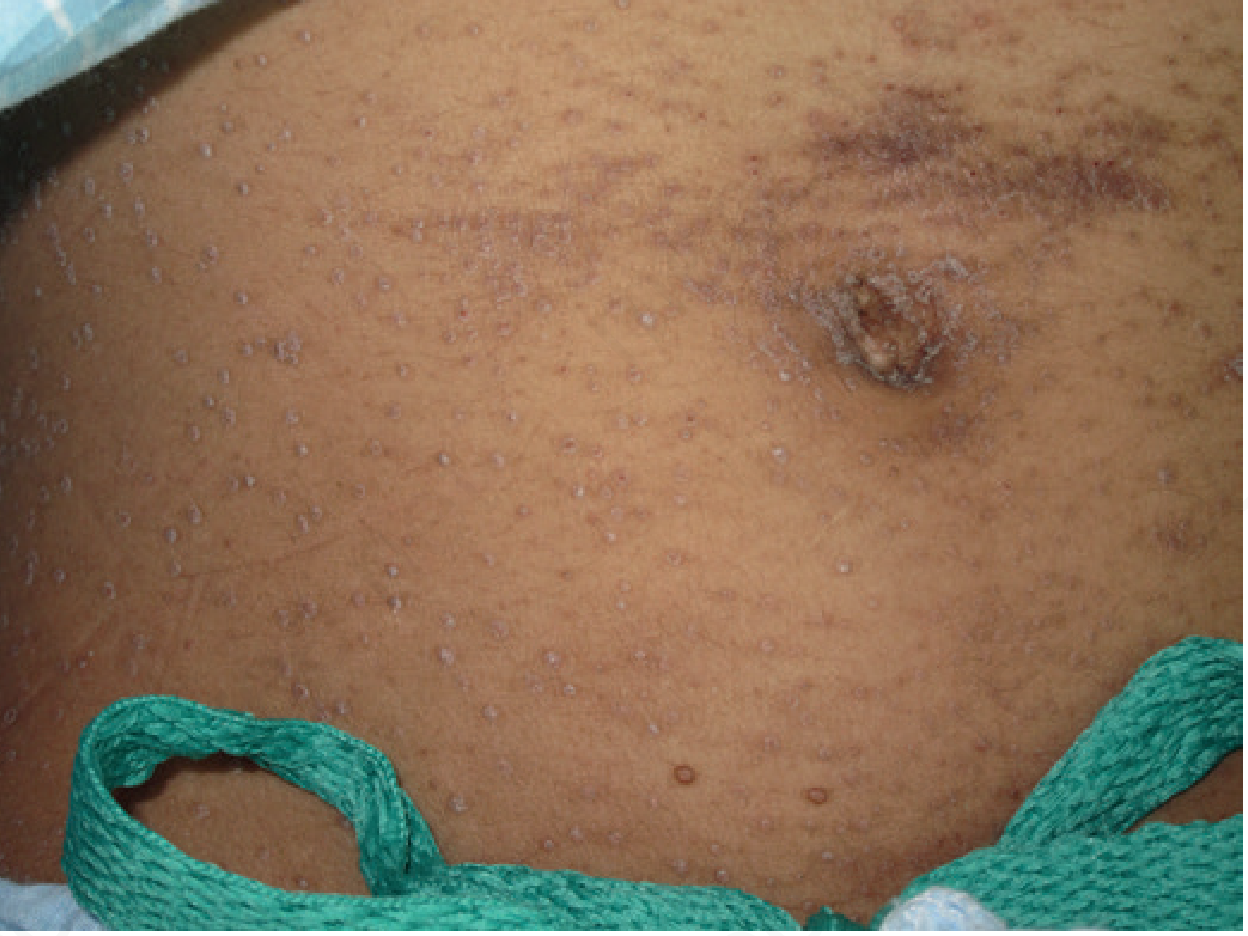
Phrynoderma: follicular hyperkeratotic papules on the abdomen in a patient with IBD (Andrews' Diseases of the Skin)
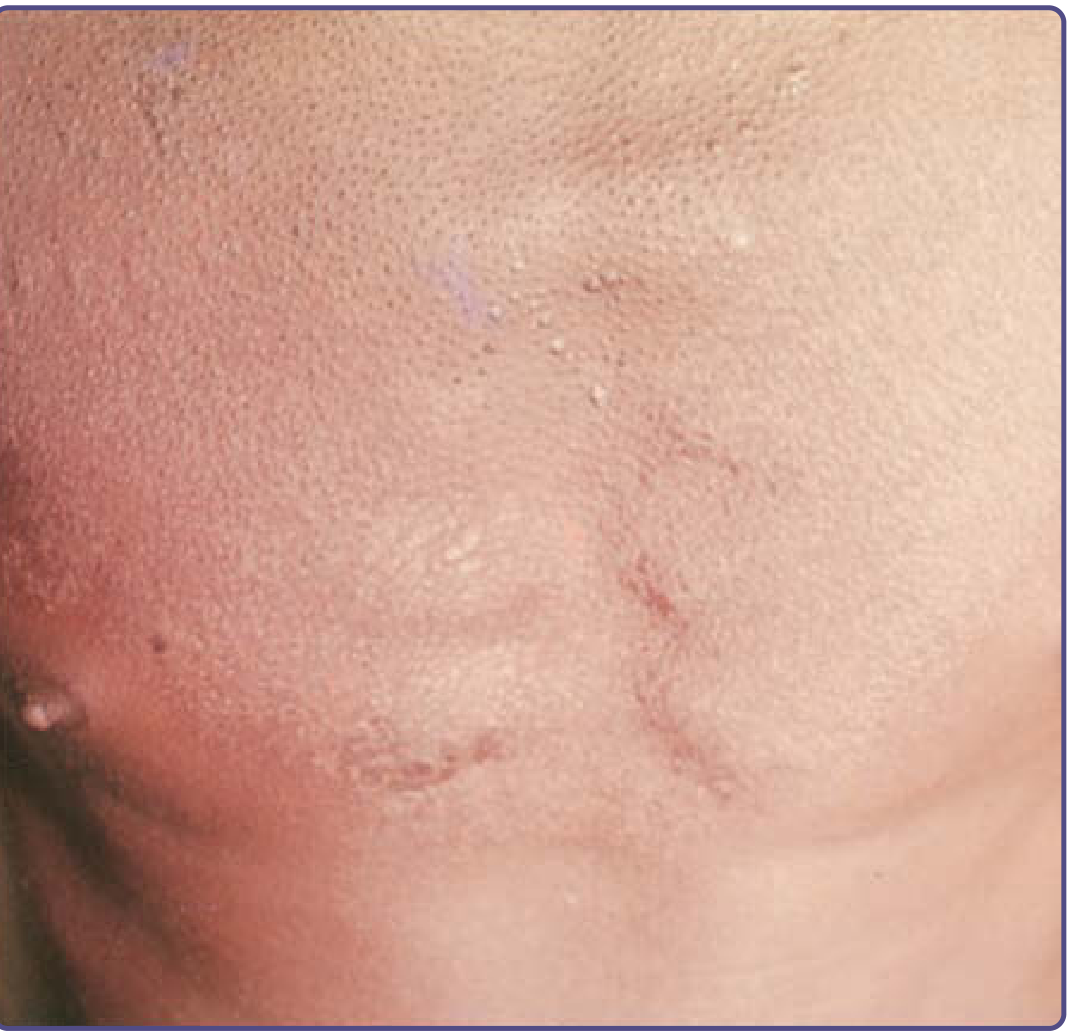
Typical perifollicular hyperkeratosis of the chest in a Tanzanian adult male (Fitzpatrick's Dermatology)
5. OCULAR FEATURES (Vitamin A Deficiency)
Eye findings in VAD are prominent and often pathognomonic:
| Finding | Notes |
|---|---|
| Nyctalopia (night blindness) | Earliest finding - delayed dark adaptation |
| Xerophthalmia | Dryness of the conjunctiva |
| Bitot spots | Triangular, well-defined white spots on conjunctiva lateral to cornea; apex toward canthus |
| Xerosis cornae | Corneal dryness |
| Keratomalacia | Severe - corneal ulceration/necrosis; major cause of blindness in developing world children |
6. OTHER SYSTEMIC FEATURES
- Squamous metaplasia of salivary glands and nasal/oral mucosa: xerostomia, hyposmia, hypogeusia
- Laryngeal, bronchial, vaginal mucosal involvement
- Mild VAD: xerosis and scaling
- Severe VAD: deep skin fissuring (dermomalacia)
- Increased mortality risk from diarrhea and pneumonia (especially in measles) - VAD impairs gut and lung epithelial integrity
7. HISTOPATHOLOGY
| Finding | Details |
|---|---|
| Hyperkeratosis | Prominent |
| Follicular plugging | Horny plugs in upper hair follicle |
| Coiled hairs | In upper portion of follicle |
| Sebaceous gland atrophy | Severe |
| Eccrine sweat gland metaplasia | Squamous metaplasia of secretory cells |
| Perifollicular granulomas | If follicles rupture |
Note: The "deficiency dermatitis" histologic findings (seen in zinc, EFA, amino acid deficiencies) are NOT features of Vitamin A or Vitamin C deficiency.
8. DIFFERENTIAL DIAGNOSIS
| Condition | Distinguishing Features |
|---|---|
| Keratosis pilaris | No nutritional deficiency; smaller papules; no systemic features |
| Lichen spinulosus | Grouped plaques; usually children; no nutritional deficiency |
| Scurvy (Vitamin C deficiency) | Prominent perifollicular hemorrhage; gingival disease; bleeding tendency |
| Keratosis follicularis (Darier disease) | Genetic; greasy papules; mucous membrane involvement; nail changes |
| Keratosis follicularis spinulosa decalvans | Genodermatosis; scarring alopecia |
| Keratosis circumscripta | Age 3-5 yrs; Africans; well-circumscribed grouped folliculocentric papules on elbows/knees |
| Follicular ichthyosis | Early childhood onset; head and neck predominant |
| Lichen scrofulosorum | Associated with TB; perifollicular granulomas; responds to anti-TB therapy |
| Follicular atopic dermatitis | Atopic background; pruritus; IgE elevation |
| Pityriasis rubra pilaris (juvenile) | Orange-red hue; palmoplantar keratoderma |
| Perforating disorder | Distinguished histologically |
9. INVESTIGATIONS
| Investigation | Relevance | Normal Values |
|---|---|---|
| Serum retinol (Vitamin A) | Confirms VAD; primary test | 20-50 mcg/dL |
| Deficiency | < 20 mcg/dL (< 0.70 μmol/L) | |
| Relative Dose-Response (RDR) test | Oral retinoil glucuronide given; ≥20% rise in serum retinoic acid indicates low liver VA reserves | Newer adjunctive test |
| Serum B-complex vitamins | Assess co-existing deficiencies | - |
| Serum Vitamin C, E | Assess co-existing deficiencies | - |
| Serum EFA levels | If malabsorption suspected | - |
| CBC, serum proteins | Assess nutritional status overall | - |
| Liver function tests | Rule out hepatic malabsorption | - |
| Skin biopsy | Confirms histologic pattern when diagnosis uncertain | - |
10. TREATMENT
Definitive Treatment
- Oral Vitamin A: 100,000 IU/day for 2-3 days, followed by recommended daily requirement
- Since phrynoderma is multifactorial, replace all deficiencies simultaneously (vitamins A, B-complex, C, E, EFAs) - this leads to rapid improvement
Recommended Daily Allowances (Vitamin A)
| Population | RDA |
|---|---|
| Adult females | 700 mcg retinol equivalents |
| Adult males | 900 mcg retinol equivalents |
| Children with measles | 200,000 IU/day x 2 days (also prevents blindness) |
Monitoring
- Serum retinol levels monitored to assess adequacy and avoid toxicity
- Vitamin A toxicity risk: doses as low as 25,000 IU/day in adults with hepatic compromise
Topical Measures (adjunctive)
- Emollients and keratolytics for xerosis and scaling
- Topical retinoids (supportive)
11. PROGNOSIS
- Excellent with correction of nutritional deficiencies
- Skin lesions resolve rapidly with supplementation
- Ocular complications (keratomalacia, blindness) are largely irreversible if not treated early
- Underlying malabsorptive disorder must be addressed to prevent recurrence
12. KEY POINTS FOR EXAMINATION
- Phrynoderma = "toad skin" - follicular hyperkeratosis from nutritional deficiency
- Most common cause: Vitamin A deficiency, but usually multiple deficiencies (A, B, C, E, EFAs)
- Earliest ocular sign of VAD: nyctalopia (night blindness / delayed dark adaptation)
- Pathognomonic eye sign: Bitot spots (triangular conjunctival plaques)
- Earliest skin site: anterolateral thighs and posterolateral upper arms
- Histology: follicular hyperkeratosis + sebaceous gland atrophy + squamous metaplasia of eccrine glands
- Treatment: Vitamin A 100,000 IU/day x 2-3 days + correct all deficiencies
- Distinguish from scurvy: scurvy has perifollicular hemorrhage; phrynoderma does not
- Rare in developed countries - look for malabsorption syndromes as underlying cause
Sources: Andrews' Diseases of the Skin, 12e | Fitzpatrick's Dermatology, 9e | Dermatology 2-Volume Set, 5e (Bolonia)
This is a shared conversation. Sign in to Orris to start your own chat.