
Can both B cell And T helper cell activate each other ?
Reading File
Finding Sources
Finding Sources
Reading File
Reading File
Reading File
Finding Sources
Finding Sources
Reading File
Loading Image
Finding Sources
I now have comprehensive information to answer this question thoroughly. Let me compile the answer.
Yes — B cells and T helper cells activate each other. This is a bidirectional, reciprocal relationship.
Here's how each direction works:
1. T Helper Cell → Activates B Cell
This is the dominant, well-known direction. A B cell cannot mount a full antibody response to protein antigens (thymus-dependent antigens) without T helper cell signals.
How it works:
-
Antigen capture by BCR: The B cell's surface immunoglobulin (BCR) binds antigen, internalizes it, and processes it into peptides. These peptides are displayed on MHC class II molecules on the B cell surface.
-
T cell recognition: A T follicular helper (T_FH) cell whose TCR is specific for that peptide:MHC II complex binds to the B cell — this is called cognate interaction (or linked recognition).
-
Signal 1 — Contact signals:
- CD40L (CD154) on the T_FH cell binds CD40 on the B cell
- This activates both the canonical NFκB pathway (via IKK) and non-canonical NFκB pathway (via NIK), inducing pro-survival genes like Mcl-1 and Bcl-2
-
Signal 2 — Cytokines from T_FH:
- IL-21 → activates STAT3 → enhances B cell proliferation and plasma cell/memory B cell differentiation
- IL-4 → promotes IgE isotype switching
- IFN-γ, TGF-β, IL-6 → regulate antibody isotype switching and differentiation
Outcome: B cell proliferates, enters germinal center, and differentiates into plasma cells or memory B cells.
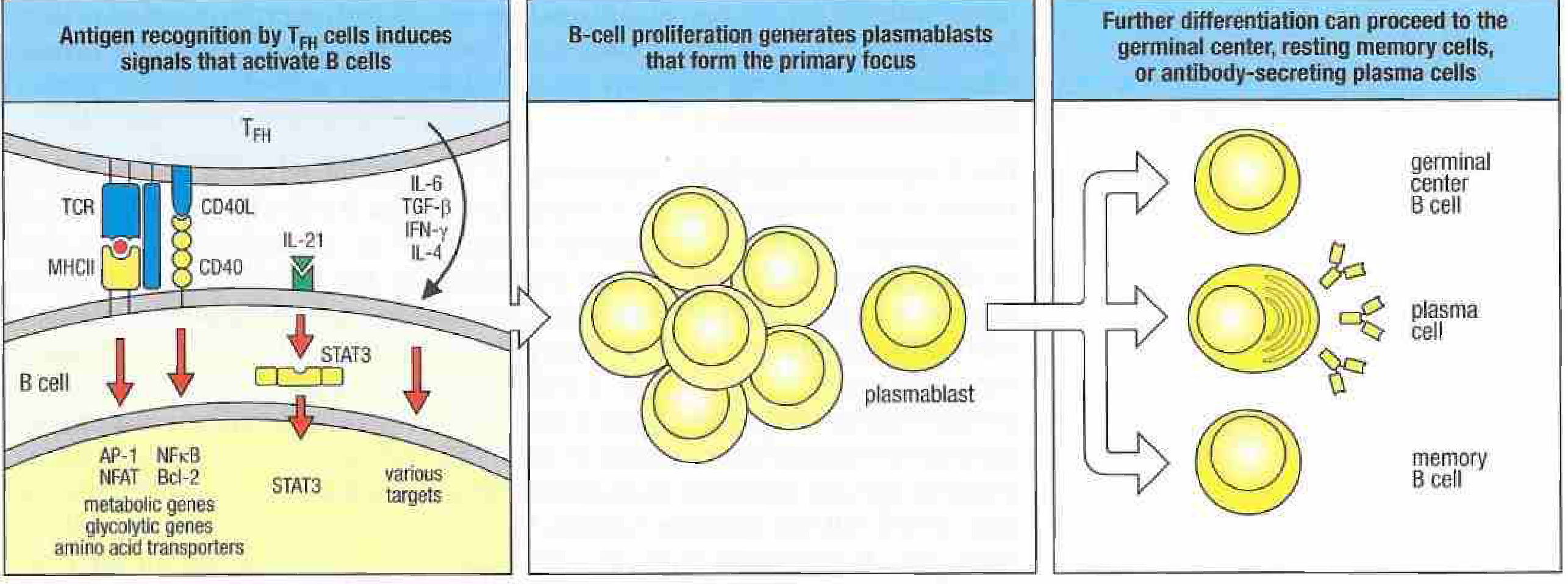
2. B Cell → Activates T Helper Cell
Yes — B cells can function as antigen-presenting cells (APCs) and activate T helper cells, especially during the later phases of a response.
How it works:
-
Antigen internalization: The BCR captures antigen with high efficiency (due to specific receptor-mediated uptake), internalizes it, and processes it.
-
Peptide presentation: Processed peptide fragments are displayed on MHC class II molecules on the B cell surface.
-
T cell activation: When a T helper cell's TCR recognizes the peptide:MHC II complex on the B cell surface, the B cell delivers:
- Signal 1 via peptide:MHC II → TCR engagement
- Co-stimulatory signals via B7 (CD80/CD86) → CD28 on T cell (especially in germinal centers)
-
Result: The T cell becomes further activated or sustained, enabling it to continue providing help to B cells — completing the feedback loop.
"When these activated T_FH cells encounter their cognate peptide presented on B cells, the T cells in turn provide specific signals that help B cells to generate antibodies" — Janeway's Immunobiology 10e
The Full Mutual Activation Loop (Summary)
| Step | Who acts | Signal | What happens |
|---|---|---|---|
| 1 | B cell | Presents peptide:MHC II to T_FH | Activates/sustains T_FH cell |
| 2 | T_FH cell | CD40L→CD40 + cytokines (IL-21, IL-4…) | Activates B cell survival, proliferation, differentiation |
| 3 | B cell | Enters germinal center | Affinity maturation, isotype switching, plasma/memory cell formation |
Key Concept: Linked Recognition
Both cells must recognize different epitopes on the same antigen (or same complex). The T cell sees a processed peptide from the antigen; the B cell sees a native conformational epitope on the same molecule. This ensures specificity and prevents spurious activation.
Source: Janeway's Immunobiology 10e, Sections 10-1 and 10-2 (pp. 426–428)
This is a shared conversation. Sign in to Orris to start your own chat.