
24 year patient with feve for 4 days how to manage
Reading File
A 24-year-old with 4 days of fever is a broad clinical scenario. Let me search the medical library while also checking for relevant content.
Searching sources...
Finding Sources
Finding Sources
Searching the Web
fever 4 days young adult evaluation management clinical approach 2024
Let me get more specific textbook content on fever management in adults.
Reading File
Finding Sources
Finding Sources
Good, I have solid clinical content. Let me read more of the Rosen's EM section for the full management approach, and also get the diagnostic workup details.
Reading File
Finding Sources
Reading File
Reading File
I now have excellent content from Rosen's EM and Harrison's. Let me fetch the clinical flowchart image from Rosen's for visual guidance, and read a bit more for the treatment/disposition section.
Reading File
Loading Image
I now have comprehensive information from Rosen's Emergency Medicine and Harrison's. Here is a complete, structured answer.
Management of Fever for 4 Days in a 24-Year-Old
Step 1 - First Priority: Rule Out Life-Threatening Causes
In a young, otherwise healthy adult, the first task is to exclude immediately dangerous conditions:
- Sepsis / septic shock - check vitals (HR, BP, RR, SpO2, temp). A heart rate rises ~10 bpm per 0.55°C (1°F) rise in temperature.
- Bacterial meningitis / meningococcemia - look for nuchal rigidity, photophobia, petechial rash, altered sensorium.
- Systemic MRSA infection - especially if skin findings or recent close contact with infected persons.
Most common causes in this age group: self-limited viral illness, localized bacterial infections. The challenge is identifying the rare life-threatening illness.
- Rosen's Emergency Medicine, p. 124
Step 2 - History (Focus Points)
| Element | What to Elicit |
|---|---|
| Fever pattern | Onset, duration (4 days here), magnitude, pattern (e.g., quotidian = malaria) |
| Localizing symptoms | Cough, dysuria, sore throat, rash, diarrhea, abdominal pain, headache |
| Travel history | Malaria, dengue, typhoid (enteric fever), chikungunya if endemic region |
| Exposures | Sick contacts, animal contact, tick bites, sexual history (STI, PID) |
| Medications | Recent antibiotics or antipyretics (can mask fever) |
| Immunization status | Influenza, COVID-19 vaccination |
| Past medical/surgical history | Prosthetic valves, indwelling devices = endocarditis risk |
Step 3 - Physical Examination
Perform a systematic head-to-toe exam:
- Head/Neck: Pharyngitis, tonsillar exudate, otitis media, sinusitis, dental abscess, lymphadenopathy, nuchal rigidity
- Chest: Bronchial breath sounds, crackles (pneumonia), pericardial rub (pericarditis)
- Heart: New murmur (endocarditis)
- Abdomen: Tenderness, guarding, rebound - appendicitis, cholecystitis, pyelonephritis
- Genitourinary: Urethral discharge (STI), flank pain/CVA tenderness (pyelonephritis)
- Skin: Rash, petechiae, pustules, cellulitis, soft tissue abscess, palmar/plantar lesions (Janeway lesions/Osler nodes)
- Rosen's Emergency Medicine, p. 125-126
Step 4 - Ancillary Testing (Directed by H&P)
First-line (if no obvious source):
- CBC with differential - WBC elevated in bacterial infection (limited sensitivity/specificity alone)
- Urinalysis + urine culture - most useful screen; UTI/pyelonephritis is common
- Chest X-ray - if any respiratory symptoms or no clear source
- Blood cultures x2 - if systemically unwell or source unclear
Depending on history/exam findings:
- Malaria rapid test/thick smear (if travel to endemic area)
- Dengue NS1 antigen / IgM (if travel, thrombocytopenia)
- Throat swab / rapid strep test (if pharyngitis)
- COVID-19 antigen/PCR
- Influenza rapid antigen test
- Liver function tests, LFT + serology (if jaundice, hepatomegaly)
- CRP / ESR / Procalcitonin (for bacterial vs. viral differentiation)
- STI screen (HIV, syphilis, gonorrhea/chlamydia NAAT) if clinically appropriate
Step 5 - Management Algorithm
The flowchart below from Rosen's Emergency Medicine outlines the approach for a stable adult with acute febrile illness:
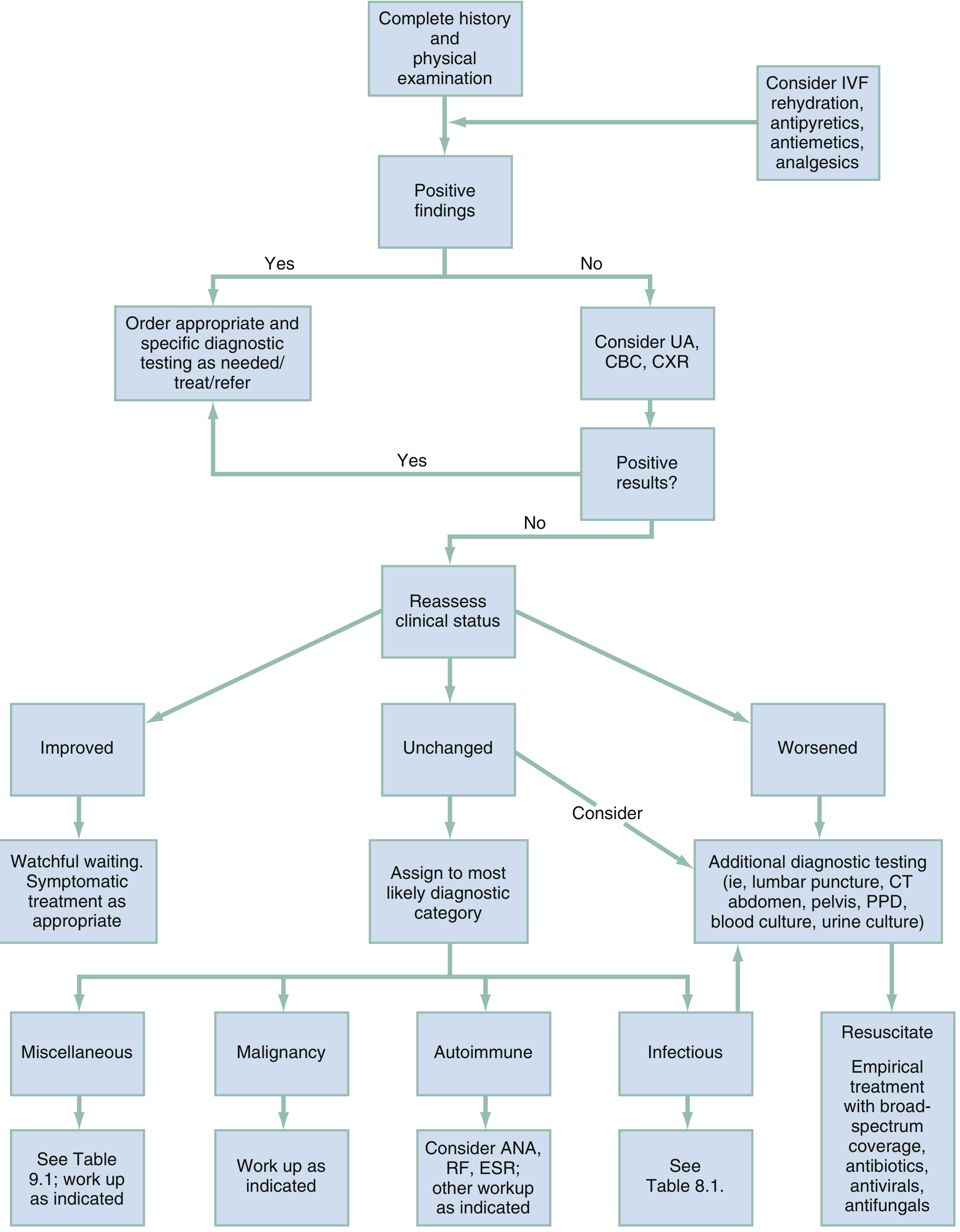
Simplified pathway:
- History + physical → positive findings → directed tests → treat cause
- No localizing findings → screen with UA, CBC, CXR
- If tests positive → treat specific cause
- If tests negative → reassess:
- Improved → watchful waiting, symptomatic Rx
- Unchanged → assign most likely diagnostic category (infectious, autoimmune, malignancy, misc.)
- Worsened → aggressive workup (LP, CT abdomen, blood/urine cultures) + empirical broad-spectrum antibiotics
Step 6 - Symptomatic Treatment (Fever Control)
Antipyretics:
- Paracetamol (acetaminophen) 500-1000 mg oral every 4-6 hours - preferred first-line; unlike aspirin/NSAIDs, does not adversely affect platelets or the GI tract. - Harrison's Principles of Internal Medicine 22E, p. (Ch. Fever)
- Ibuprofen 400-600 mg every 6-8 hours with food - alternative NSAID; equally effective but avoid if renal disease, peptic ulcer, or dehydration
- Aspirin: avoid (GI/platelet effects)
- Do NOT use glucocorticoids empirically for fever unless specific indication (autoimmune, autoinflammatory disease)
Supportive care:
- Adequate oral hydration (fever increases insensible losses)
- IV fluids if vomiting or poor oral intake
- Anti-emetics if nausea/vomiting present
- Rest
Step 7 - Causal (Definitive) Treatment
| Likely Diagnosis | Treatment |
|---|---|
| Viral URTI / influenza | Supportive; oseltamivir if within 48h of influenza onset and at-risk |
| COVID-19 | Supportive; antivirals (nirmatrelvir/ritonavir) if high risk |
| Streptococcal pharyngitis | Amoxicillin 500 mg TDS x 10 days |
| Urinary tract infection | Based on culture; empiric co-trimoxazole or nitrofurantoin for uncomplicated UTI |
| Pyelonephritis | Ciprofloxacin 500 mg BD x 7 days or ceftriaxone IV if severe |
| Community-acquired pneumonia | Amoxicillin-clavulanate ± azithromycin |
| Dengue fever | Supportive only; no antivirals; monitor platelets |
| Malaria (P. falciparum) | Artemisinin-based combination therapy (ACT) - admit if severe |
| Typhoid (enteric fever) | Azithromycin or ciprofloxacin (or ceftriaxone IV) |
Step 8 - Disposition Decision
| Criteria | Action |
|---|---|
| Young, healthy, localized bacterial infection, able to take oral medications | Outpatient oral antibiotics + close follow-up |
| Systemic viral illness, tolerating oral fluids after ED treatment | Outpatient with return precautions |
| High fever with no source, appearing unwell, immunocompromised | Admit for observation and IV antibiotics |
| Unstable vitals, signs of sepsis/meningitis | Urgent resuscitation + ICU-level care |
| - Rosen's Emergency Medicine, p. 127-128 |
Red Flags Requiring Immediate Escalation
Admit and escalate care urgently if any of these are present:
- Altered consciousness / confusion
- Non-blanching petechial/purpuric rash (meningococcemia)
- Neck stiffness + photophobia (meningitis)
- HR >120, BP <90/60, RR >25 (sepsis criteria)
- SpO2 <94% on room air
- Inability to maintain oral intake / severe dehydration
- Immunosuppressed (HIV, on chemotherapy, steroids)
- Fever >39.5°C unresponsive to antipyretics
This is a shared conversation. Sign in to Orris to start your own chat.