
Describe the basic principles of techniques used in toxicological laboratory namely TLC, GLC, ASS, HPLC and Breath Alcohol Analyzer.
Reading File
Now let me search the medical library for all five techniques simultaneously.
Finding Sources
Finding Sources
Finding Sources
Finding Sources
Finding Sources
Finding Sources
Finding Sources
Finding Sources
The key source is "The Essentials of Forensic Medicine and Toxicology 36th edition" and "P C Dikshit Textbook". Let me read those sections now.
Reading File
Reading File
Now let me read the detailed TLC, GLC, AAS, HPLC and Breath Alcohol sections from the Forensic Medicine textbook:
Reading File
Reading File
Reading File
I need to find the AAS and Breath Alcohol Analyzer sections. Let me search for them:
Finding Sources
Finding Sources
Let me read the AAS section from the Forensic textbook and also the Tietz overview, plus search for breath alcohol analyzer content:
Reading File
Reading File
Searching the Web
breath alcohol analyzer principle toxicology laboratory Intoxilyzer infrared spectroscopy
I now have comprehensive information from all sources. Let me also fetch the TLC diagram image to include it:
Loading Image
Loading Image
I now have all the information needed for a comprehensive, well-structured answer. Let me compile it.
Toxicological Laboratory Techniques: TLC, GLC, AAS, HPLC, and Breath Alcohol Analyzer
Sources: The Essentials of Forensic Medicine and Toxicology, 36th ed. (2026); P.C. Dikshit Textbook of Forensic Medicine and Toxicology; Tietz Textbook of Laboratory Medicine, 7th ed.
1. Thin-Layer Chromatography (TLC)
Basic Principle
TLC is a technique for separating the components of a mixture by applying them over a thin layer of adsorbent material coated on a glass plate. It is based on the differential migration of compounds between a stationary phase (the adsorbent layer - usually silica gel) and a mobile phase (an organic solvent).
Procedure
- A concentrated sample extract and known standard drug solutions are applied as small spots at the baseline (origin) at the bottom of the TLC plate.
- The plate is placed in a closed developing chamber where the solvent (mobile phase) travels upward by capillary action, carrying compounds with it.
- Compounds separate based on their different affinities for the stationary vs. mobile phases - those more attracted to the mobile phase travel further.
- After development, the plate is sprayed or dipped in specific reagents to produce visible colored spots.
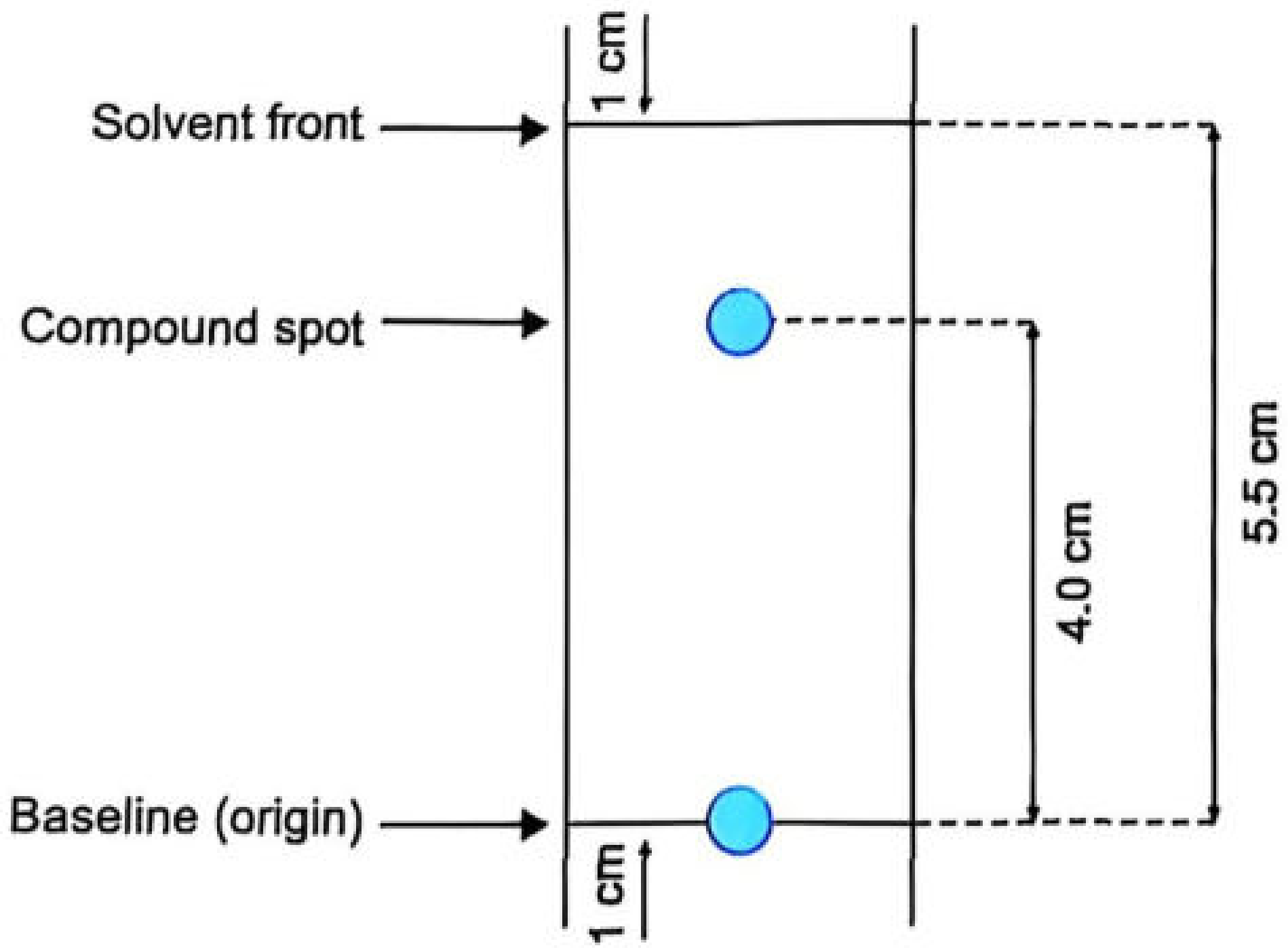
Identification - The Rf Value
The key parameter is the Retardation Factor (Rf):
Rf = Distance traveled by compound / Distance traveled by solvent front
If a compound from the sample migrates the same distance and reacts similarly to a reference standard when sprayed, a tentative identification can be made. This must be confirmed with further chemical or analytical testing.
Sensitivity and Applications
- TLC is 10 to 100 times more sensitive than traditional chemical methods.
- Widely used to screen for alkaloids, barbiturates, opiates, and other drugs of abuse.
- It detects volatile poisons, medicines, pesticides, and metabolites.
- The toxicologist chooses reagents based on the chemical properties of the compound being tested.
2. Gas-Liquid Chromatography (GLC)
Basic Principle
GLC (a subtype of gas chromatography) separates compounds in a vaporized sample based on their partitioning between a mobile gas phase (carrier gas such as nitrogen or helium) and a liquid stationary phase coating the inside of a column.
Instrument Components (as shown in the schematic diagram below)
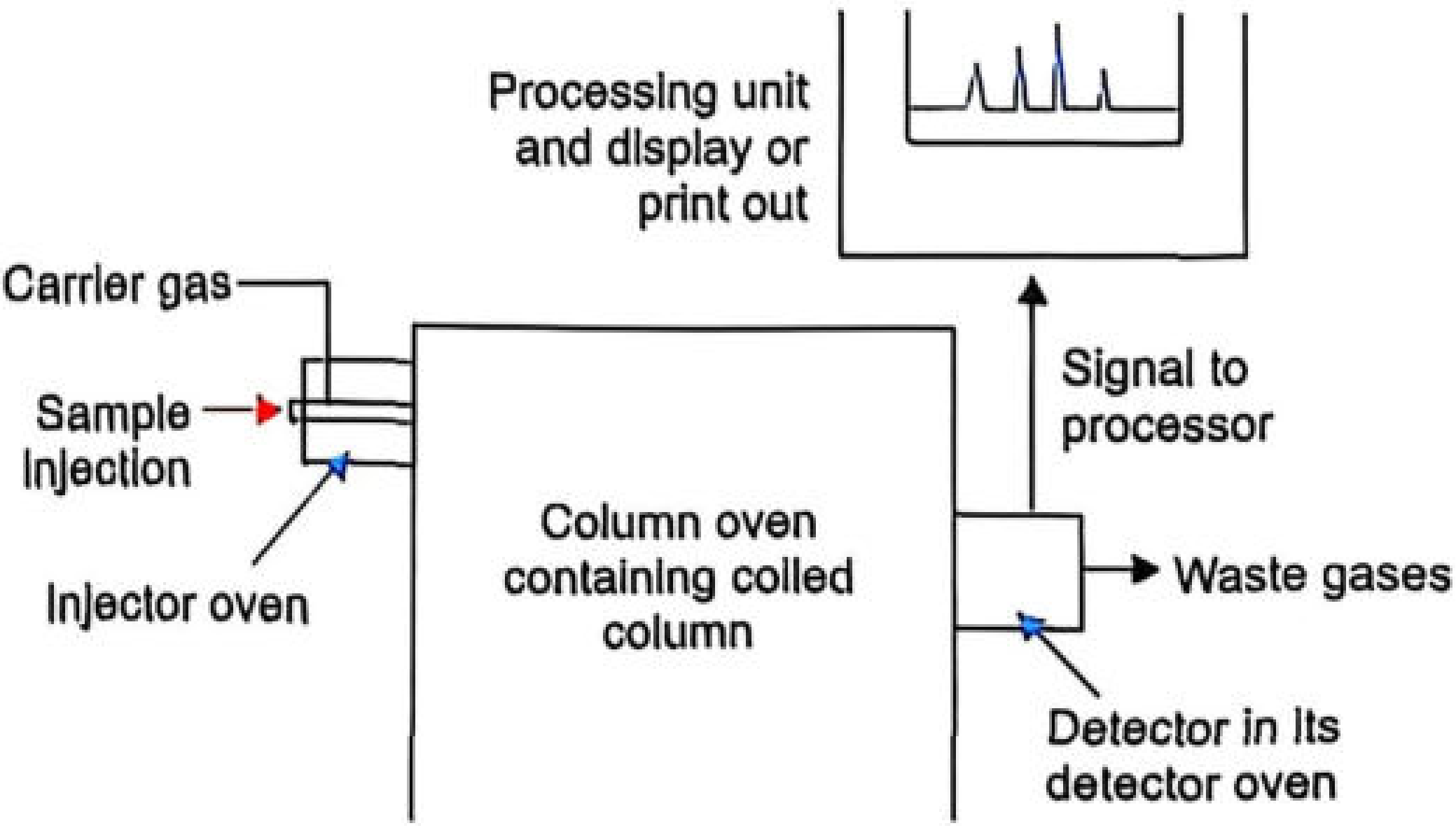
- Carrier gas supply - inert gas (N₂, He, Ar) as mobile phase
- Injector/injector oven - where the sample is vaporized and introduced
- Column oven containing a coiled column (packed or capillary) - where separation occurs
- Detector in its own oven - measures compounds as they elute
- Processing unit - records and displays the chromatogram (peaks)
Mechanism of Separation
The vaporized sample is swept through the column by the carrier gas. Compounds with higher affinity for the liquid stationary phase spend more time in the column and elute later (longer retention time). Separation is influenced by the column temperature, carrier gas flow rate, and the nature of the stationary liquid phase.
Detectors used: ECD (electron capture detector), NPD (nitrogen-phosphorus detector), FPD (flame photometric detector), and MSD (mass-selective detector). Capillary columns have largely replaced packed columns due to their higher resolving power.
Applications in Toxicology
- Particularly preferred for analysis of volatile and thermostable compounds: pesticides, organic solvents, alcohols, chlorinated hydrocarbons.
- Can screen a wide range of basic drugs including alkaloids.
- Quantitative analysis requires prior sample preparation to isolate the drug and avoid interference.
- Produces a characteristic chromatogram with peaks at specific retention times for identification and quantification.
3. Atomic Absorption Spectroscopy (AAS)
Basic Principle
AAS is based on the fact that free atoms in the ground state absorb light at specific wavelengths characteristic of that element. When a metallic element is vaporized by high temperature (flame or graphite furnace), the free atoms absorb electromagnetic radiation from a light source (a hollow cathode lamp specific to that element). The amount of light absorbed is proportional to the concentration of the element in the sample (Beer-Lambert Law).
Instrument Components
- Hollow cathode lamp - emits characteristic radiation for the specific metal being analyzed
- Atomizer - flame (flame AAS) or graphite furnace (flameless/FAAS) that converts the sample into free atoms
- Monochromator - selects the specific absorption wavelength
- Detector (photomultiplier tube) - measures the transmitted light and calculates absorbance
Flameless AAS (FAAS / Graphite Furnace AAS)
In flameless AAS, the sample is deposited in a graphite furnace and vaporized electrically. This method is far more sensitive than flame AAS, capable of detecting trace amounts at the nanogram/picogram level.
Toxicological Applications
AAS is the gold standard for detecting heavy metals and trace elements in biological samples:
- Lead (Pb) - blood lead levels in occupational/environmental toxicology
- Arsenic, Mercury, Cadmium, Antimony, Barium, Copper
- In forensic firearm residue analysis: AAS detects antimony, barium, and lead from primer residues, and copper from cartridge cases/bullet jackets. Hand swabs from suspects are analyzed to determine whether a person has fired a gun.
- Can identify bullet holes in clothing and tissues, determine range of fire, and trace common origin of bullet fragments.
4. High-Performance Liquid Chromatography (HPLC)
Basic Principle
HPLC is an advanced form of column chromatography (developed by Kirkland and Huber in 1969) that separates organic compounds based on their differential partitioning between a liquid mobile phase (eluent) and a solid stationary phase (column packing material). It is also called high-pressure, high-resolution, or high-speed liquid chromatography.
Key Feature over GLC: HPLC does not require vaporization of the sample - it can analyze thermally unstable, non-volatile, and polar compounds that GC cannot handle.
Instrument Components
- Eluent reservoir - holds the solvent (mobile phase)
- High-pressure pump - forces the liquid through at pressures up to 6,000-9,000 psi
- Injector - introduces the sample into the mobile phase stream
- Stainless-steel column - packed with small particles (usually ≤10 μm) for high resolution
- Detector - UV/Vis absorbance, photodiode array (PDA), fluorescence, or mass spectrometry
- Recorder/integrator - produces the chromatogram
Mechanism
The sample is carried by the high-pressure eluent through the tightly-packed column. Compounds separate due to differences in their affinity for the stationary phase vs. the mobile phase. The most common mode is reverse-phase HPLC where the stationary phase is non-polar (C18) and the mobile phase is polar.
Applications in Forensic Toxicology
HPLC is highly specific and sensitive and is now a standard tool in forensic toxicology laboratories:
- Screening, identification, and quantification of heroin, LSD, amphetamines, cannabis, tricyclic antidepressants, barbiturates
- Detection of pesticide residues in blood, tissues, and drinks (e.g., organophosphates in contaminated drinking water)
- Analysis of snake venom, plant poisons, herbicides, and insecticides
- Ideal for drugs that are thermally labile (cannot withstand GLC conditions)
5. Breath Alcohol Analyzer (Breathalyzer)
Basic Principle
The breath alcohol analyzer measures blood alcohol concentration (BAC) indirectly by analyzing ethanol vapor in exhaled alveolar air. The device relies on the physiological principle that at body temperature, ethanol equilibrates between blood and alveolar air in a predictable ratio of approximately 2,100:1 (i.e., 2,100 mL of alveolar air contains the same amount of alcohol as 1 mL of blood - the partition ratio).
There are three main detection technologies used in modern breathalyzers:
(a) Infrared (IR) Spectroscopy (most common evidentiary instruments)
- An infrared beam is projected through the captured breath sample in a chamber.
- Ethanol molecules absorb infrared radiation at characteristic wavelengths (primarily 3.4 μm, corresponding to the C-H bond stretch).
- The amount of IR absorbed is proportional to the ethanol concentration (Beer-Lambert Law).
- Modern devices (e.g., Intoxilyzer 5000/8000/9000) use multiple wavelength filters (3.36, 3.4, 3.47, 3.52, and 3.8 μm) to differentiate ethanol from interferents like acetone, acetaldehyde, and toluene in exhaled air.
- The 3.4 μm wavelength detects alcohol; the 3.47 μm wavelength identifies interfering substances; a reference wavelength (3.9 μm) ensures baseline correction.
(b) Electrochemical Fuel Cell
- Exhaled ethanol is oxidized to acetic acid at the anode of a fuel cell:
CH₃CH₂OH + H₂O → CH₃COOH + 4H⁺ + 4e⁻
- The electric current generated is directly proportional to the amount of ethanol - measured as BAC.
- Fuel cell sensors are very stable, require calibration only every ~6 months, and are commonly used in roadside screening devices.
(c) Color-based (historical - Breathalyzer original)
- Based on oxidation of ethanol by potassium dichromate in acidic solution; the orange dichromate changes to green chromic ion in proportion to ethanol concentration. Largely obsolete.
Medicolegal Significance
A BAC ≥ 30 mg/100 mL (0.03%) is the legal limit for driving in India under the Motor Vehicles Act. Breath analyzers allow rapid, non-invasive, field-deployable testing with results that are admissible as legal evidence when performed on calibrated evidentiary instruments.
Summary Table
| Technique | Phase System | Detection | Primary Toxicological Use |
|---|---|---|---|
| TLC | Solid stationary / liquid mobile | Colored spots (Rf values) | Drug screening, alkaloids, poisons |
| GLC | Liquid stationary / gas mobile | ECD, NPD, FPD, MSD | Volatile compounds, pesticides, alcohols |
| AAS | Atomic absorption of element-specific light | Photomultiplier | Heavy metals (Pb, As, Hg, Sb) |
| HPLC | Solid stationary / liquid mobile (high pressure) | UV/PDA/fluorescence/MS | Non-volatile drugs, pesticides, venom |
| Breath Alcohol Analyzer | Alveolar air analysis | IR spectroscopy / fuel cell | Blood alcohol estimation |
This is a shared conversation. Sign in to Orris to start your own chat.