
rashes and itching around neck in a 32yr old male who is working in engine room and sweat a lot
Reading File
Now let me search the medical library and web in parallel for this occupational/sweat-related rash presentation.
Finding Sources
Finding Sources
Finding Sources
Searching the Web
rash itching neck excessive sweating engine room worker occupational skin condition
Good results. Let me now read the relevant sections in parallel.
Reading File
Reading File
Reading File
Finding Sources
Now let me get more specific content on miliaria in adults, treatment, and also search for images.
Finding Sources
Finding Sources
Searching Images
miliaria rubra heat rash neck prickly heat
Reading File
Finding Sources
I now have comprehensive information. Let me compile the full clinical answer.
Rash & Itching Around the Neck — Hot/Sweaty Occupational Setting
A 32-year-old male working in an engine room (high heat, high humidity, profuse sweating) with a neck rash and pruritus has a fairly characteristic presentation. The most likely diagnosis is Miliaria rubra (Prickly Heat), with secondary fungal infection (intertrigo/tinea) as a close differential.
Most Likely Diagnosis: Miliaria Rubra (Prickly Heat)
Pathophysiology
Blockage of eccrine sweat ducts by keratin debris from macerated stratum corneum causes sweat to leak into the surrounding dermis → localized inflammatory response. As the obstructed ducts dilate and rupture, superficial vesicles form.
Key trigger in this patient: Chronic heat exposure, occlusive/tight clothing, and profuse sweating in the engine room — exactly the predisposing conditions.
Clinical Features
- Maculopapular, pruritic, erythematous rash
- Commonly occurs in clothed areas and skin folds — the neck fold is a classic site
- Small erythematous papules and pustules
- Predominant symptom: pruritus
"Prickly heat (miliaria rubra, lichen tropicus) is a maculopapular, pruritic, erythematous rash that commonly occurs in clothed areas. Blockage of the sweat pores by debris from macerated stratum corneum causes inflammation in the sweat ducts." — Harrison's Principles of Internal Medicine, 22E
Types of Miliaria (severity spectrum)
| Type | Depth | Appearance |
|---|---|---|
| Miliaria crystallina | Stratum corneum | Tiny clear vesicles, no inflammation |
| Miliaria rubra ← most likely here | Epidermis | Erythematous papules/pustules, pruritic |
| Miliaria profunda | Dermis | Flesh-colored papules, after chronic heat exposure |
Differential Diagnoses
1. Tinea Corporis (Ringworm)
- Dermatophyte infection (commonly T. rubrum) affecting neck, trunk
- Sharply demarcated, annular scaling plaques with central clearing — classic "ringworm"
- Advancing scaling border; mild pruritus
- Occupational/recreational exposure to contaminated clothing/equipment is a known risk
- KOH prep shows branching hyphae
- Tintinalli's Emergency Medicine
2. Intertrigo with Candidal Superinfection
- Skin fold maceration from chronic sweat → Candida overgrowth
- Bright red, moist, macerated plaques with satellite papules/pustules at the neck folds
- More common with occlusive clothing
3. Contact Dermatitis
- Allergic or irritant reaction to clothing, oils, grease (engine room exposure), metals (neckwear/ID tags)
- Pruritic, erythematous, may have vesicles; corresponds to contact area
4. Seborrheic Dermatitis
- Greasy, yellowish scaling patches; affects neck and hairline
- Aggravated by heat and sweat
Clinical Image — Miliaria (Prickly Heat)
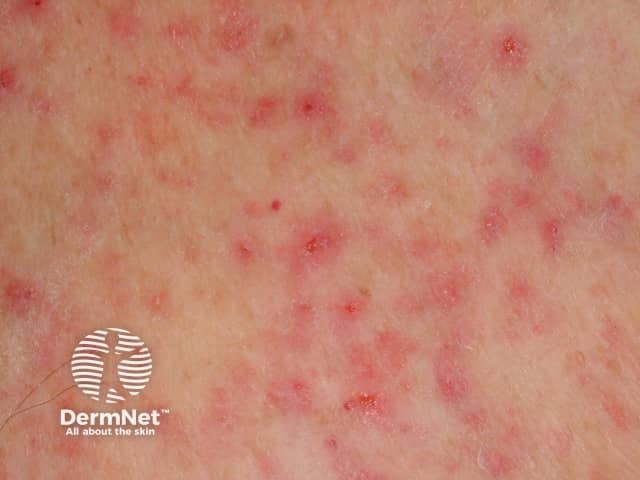
Miliaria rubra: dense erythematous papules with superficial vesiculation, characteristic of sweat duct obstruction in hot/humid conditions.
Management
Non-pharmacological (First-line)
- Remove from hot environment — move to cooler area; rash resolves when heat/sweating is reduced
- Loose, breathable, clean clothing — avoid tight collars, synthetic fabrics
- Cool water baths/showers — reduce skin temperature and maceration
- Air conditioning or fan use during rest periods
Pharmacological
| Agent | Use |
|---|---|
| Antihistamines (e.g., cetirizine, loratadine) | Relieve pruritus |
| 1% Salicylic acid applied TID (local areas) | Reduces keratin plugging — caution: avoid large surface area to prevent salicylate toxicity |
| Chlorhexidine (light cream/lotion) | Antimicrobial; provides relief from secondary bacterial colonization |
| Mild topical corticosteroid (short course) | If significant inflammation |
"In addition to antihistamines, chlorhexidine in a light cream or lotion provides some relief. In adults, localized areas may benefit from 1% salicylic acid TID... Clothing with breathable fabric should be clean and loose fitting, and activities or environments that induce diaphoresis should be avoided." — Harrison's Principles of Internal Medicine, 22E
If Fungal Superinfection / Tinea Suspected
- Topical antifungal (clotrimazole, miconazole, terbinafine) — apply twice daily, extend 3 cm beyond lesion margin, treat for at least 4 weeks
- Oral antifungal (terbinafine, fluconazole) if widespread or follicular involvement
Occupational Advice
- Work modifications: rotate to cooler areas if possible, take cooling breaks
- Protective measures: wear moisture-wicking, breathable neck coverings; avoid tight shirt collars
- Consider pre-work cooling (cool shower before shift)
- Keep neck area dry — patting dry after sweating is key
- Avoid applying greasy/oily substances to the area (motor oils can clog pores further)
Sources: Harrison's Principles of Internal Medicine 22E (2025), p. 3817 | Tintinalli's Emergency Medicine, p. 1680 | Textbook of Family Medicine 9E
This is a shared conversation. Sign in to Orris to start your own chat.