
Malaria medicine
Reading File
The query is broad — "malaria medicine" could mean several things. Let me clarify before diving deep.
Asking for Preferences
What aspect of malaria medicine are you interested in?
Finding Sources
Finding Sources
Searching the Web
antimalarial drugs 2025 WHO guidelines treatment
Now let me read the key textbook sections — Katzung (major antimalarial drugs), Goodman & Gilman (classification + mechanisms), and Harrison's (clinical treatment) in parallel.
Reading File
Reading File
Reading File
I have rich content from three major sources. Let me also fetch the chemical structures image and the Harrison's treatment table section.
Loading Image
Reading File
I now have comprehensive content from Harrison's 22e, Goodman & Gilman, and Katzung's pharmacology. Here is a thorough overview of malaria medicines:
Antimalarial Drugs — A Comprehensive Overview
The Malarial Parasite Life Cycle & Drug Targets
No single antimalarial drug kills sporozoites (the infecting form injected by mosquitoes), so chemoprophylaxis only prevents symptomatic disease — it does not prevent infection. Because no drug hits all parasite stages simultaneously, combinations are often required for complete parasite elimination.
Drugs fall into three functional groups (Goodman & Gilman's):
- Blood-stage schizonticidals only — artemisinins, chloroquine, mefloquine, quinine/quinidine, pyrimethamine, sulfadoxine, tetracyclines. These treat/prevent symptomatic malaria but cannot clear liver hypnozoites.
- Liver + blood-stage actives — atovaquone + proguanil (Malarone). Because they kill primary liver stages of P. falciparum, post-exposure prophylaxis can stop sooner (only a few days after leaving the endemic area).
- Hypnozoite-active (radical cure) — primaquine and tafenoquine (8-aminoquinolines). These are the only agents that eradicate dormant liver stages (hypnozoites) of P. vivax and P. ovale responsible for relapses.
Drug Classification Table
(from Katzung's Basic & Clinical Pharmacology, 16th Ed.)
| Drug | Chemical Class | Primary Use |
|---|---|---|
| Chloroquine | 4-Aminoquinoline | Treatment & prophylaxis where parasites remain sensitive |
| Amodiaquine | 4-Aminoquinoline | Some chloroquine-resistant P. falciparum; fixed combo with artesunate |
| Piperaquine | Bisquinoline | P. falciparum in fixed combo with dihydroartemisinin (DHA-PPQ) |
| Quinine | Quinoline methanol | Oral/IV treatment of P. falciparum (severe disease; often + doxycycline) |
| Mefloquine | Quinoline methanol | Prophylaxis & treatment of P. falciparum |
| Primaquine | 8-Aminoquinoline | Radical cure of P. vivax/P. ovale; terminal prophylaxis |
| Tafenoquine | 8-Aminoquinoline | Radical cure of P. vivax; once-dose alternative to 14-day primaquine |
| Sulfadoxine-pyrimethamine (SP/Fansidar) | Folate antagonist combo | Some chloroquine-resistant P. falciparum; intermittent preventive therapy (IPT) in pregnancy |
| Atovaquone-proguanil (Malarone) | Quinone + folate antagonist | Treatment & prophylaxis of P. falciparum |
| Doxycycline | Tetracycline | Treatment (with quinine) of P. falciparum; prophylaxis |
| Lumefantrine | Amyl alcohol | Fixed combo with artemether (Coartem/AL) — most widely used ACT |
| Artemisinins (artesunate, artemether, dihydroartemisinin) | Sesquiterpene lactone endoperoxides | First-line treatment of P. falciparum; IV artesunate for severe disease |
| Pyronaridine | Mannich base acridine | Fixed combo with artesunate (Pyramax) |
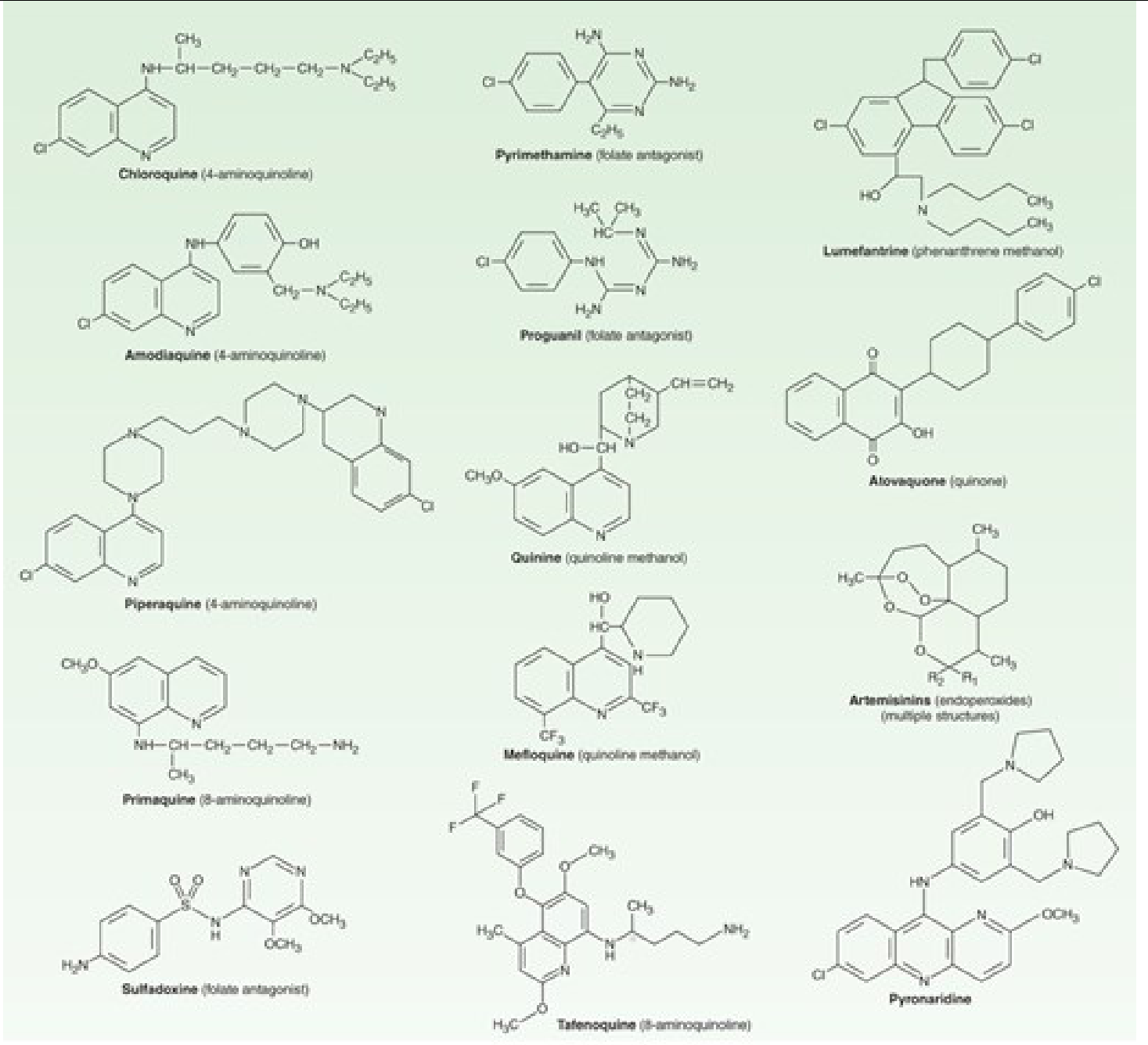
Drug Mechanisms
Artemisinins
Free-radical generation after endoperoxide bond cleavage → damage to parasite proteins and membranes. Artemisinin and derivatives are the fastest-acting antimalarials, with a half-life of ~1 hour (artesunate). They are 10-fold more potent in vivo than other drugs and show no cross-resistance with older agents, making them the cornerstone of modern malaria therapy — Harrison's Principles of Internal Medicine 22e.
Chloroquine / Aminoquinolines
Accumulate in the parasite's digestive vacuole → inhibit heme polymerization → toxic free heme accumulates → parasite death. Resistance in P. falciparum is mediated by the Pfcrt transporter mutation, which pumps chloroquine out of the vacuole.
Artemisinins + Partner Drugs (ACTs)
Artemisinin rapidly reduces parasite biomass; the slower-eliminated partner drug (lumefantrine, piperaquine, amodiaquine, etc.) eliminates residual parasites and provides prolonged protection. This two-drug strategy also provides mutual protection against the emergence of resistance.
Atovaquone-Proguanil (Malarone)
Atovaquone blocks the mitochondrial electron transport chain (cytochrome bc1 complex); proguanil (activated to cycloguanil) inhibits dihydrofolate reductase (DHFR). The combination acts synergistically.
Primaquine / Tafenoquine
Mechanism not fully elucidated; likely involves oxidative stress in the parasite. Critical warning: Both cause dose-dependent hemolysis in patients with G6PD deficiency — G6PD testing is mandatory before use.
WHO-Recommended Treatment (Harrison's 22e, 2025)
Uncomplicated P. falciparum (and P. knowlesi)
Artemisinin-based combination therapy (ACT) is WHO first-line:
- Artemether-lumefantrine (AL / Coartem) — most widely used globally
- Artesunate-amodiaquine (ASAQ)
- Dihydroartemisinin-piperaquine (DHA-PPQ)
- Artesunate-mefloquine (ASMQ)
- Artesunate-pyronaridine (Pyramax)
Uncomplicated P. vivax, P. ovale, P. malariae
- Chloroquine remains effective in most areas
- Add primaquine (14 days) or tafenoquine (single dose) for radical cure of P. vivax/P. ovale to prevent relapses
Severe / Complicated Malaria
- IV artesunate is the treatment of choice worldwide (superior to IV quinine in trials)
- If artesunate unavailable: IV artemether preferred over quinine
- After 24 h of parenteral treatment and clinical improvement, switch to full-course oral ACT
Chemoprophylaxis
| Regimen | Coverage | Notes |
|---|---|---|
| Atovaquone-proguanil | All areas including chloroquine-resistant zones | Start 1–2 days before, stop 7 days after; short post-exposure window |
| Doxycycline | All areas including multidrug-resistant zones | Start 1–2 days before, stop 4 weeks after |
| Mefloquine | Chloroquine-resistant areas | Start 2–3 weeks before, stop 4 weeks after; neuropsychiatric side effects |
| Chloroquine | Only in chloroquine-sensitive areas (now very limited) | Start 1–2 weeks before, stop 4 weeks after |
| Primaquine | All species including hypnozoites | Requires G6PD testing |
Non-drug measures (insecticide-treated bed nets, repellents, protective clothing) are essential alongside any drug prophylaxis — no chemoprophylactic regimen is fully protective.
Resistance: A Growing Crisis
Harrison's 22e highlights a critical emerging problem:
- Artemisinin resistance in P. falciparum (driven by Pfkelch13 mutations) emerged in Southeast Asia (Greater Mekong Subregion) in the late 2000s and has now spread to East Africa.
- This is accompanied by resistance to partner drugs (piperaquine, mefloquine) in some areas.
- Proposed solution: Triple ACTs combining two slowly eliminated partner drugs for mutual protection.
- Falsified/substandard antimalarials on shelves in Asia and Africa are also a significant cause of treatment failures.
Key Drug Toxicities at a Glance
| Drug | Major Adverse Effects |
|---|---|
| Chloroquine | Retinopathy (long-term), QTc prolongation, pruritus (in Africans) |
| Quinine/Quinidine | Cinchonism (tinnitus, headache), hypoglycemia, QTc prolongation |
| Mefloquine | Neuropsychiatric effects (nightmares, psychosis), QTc prolongation |
| Primaquine/Tafenoquine | Hemolytic anemia in G6PD deficiency |
| Atovaquone-proguanil | GI disturbance; teratogenic potential of proguanil — avoid in first trimester |
| Artemisinins | Generally well tolerated; rare neurotoxicity at very high doses |
| Doxycycline | Photosensitivity, GI upset, esophagitis; contraindicated in pregnancy/children <8 yr |
Special Populations
- Pregnancy: Falciparum malaria is especially dangerous (hypoglycemia, pulmonary edema, fetal loss). ACTs are the recommended treatment; SP is used for intermittent preventive therapy in pregnancy (IPTp). Primaquine/tafenoquine are contraindicated in pregnancy.
- Children: Most malaria deaths (~600,000/yr) occur in African children. ACTs are first-line; IV artesunate for severe disease; dosing is weight-based.
- G6PD-deficient patients: Must avoid primaquine and tafenoquine without careful testing and risk assessment.
Sources: Harrison's Principles of Internal Medicine 22e (2025) | Goodman & Gilman's Pharmacological Basis of Therapeutics | Katzung's Basic & Clinical Pharmacology, 16th Ed. | WHO Guidelines for Malaria, August 2025
This is a shared conversation. Sign in to Orris to start your own chat.