
Anterior triangle of neck
Reading File
Finding Sources
Searching the Web
anterior triangle of neck anatomy boundaries contents
Reading File
Reading File
Loading Image
Reading File
Reading File
Reading File
Now I have enough from Gray's Anatomy for Students to give a thorough answer. Let me also read the vessels section I passed through:
Reading File
I now have comprehensive information to write a detailed answer. Here it is:
Anterior Triangle of the Neck
(Gray's Anatomy for Students, pp. 1145-1162)
Overview and Boundaries
The anterior triangle of the neck is a region on the front of the neck defined by three borders:
| Border | Structure |
|---|---|
| Lateral | Anterior border of the sternocleidomastoid (SCM) |
| Superior | Inferior border of the mandible |
| Medial | Midline of the neck |
The apex points inferiorly toward the jugular notch of the sternum.
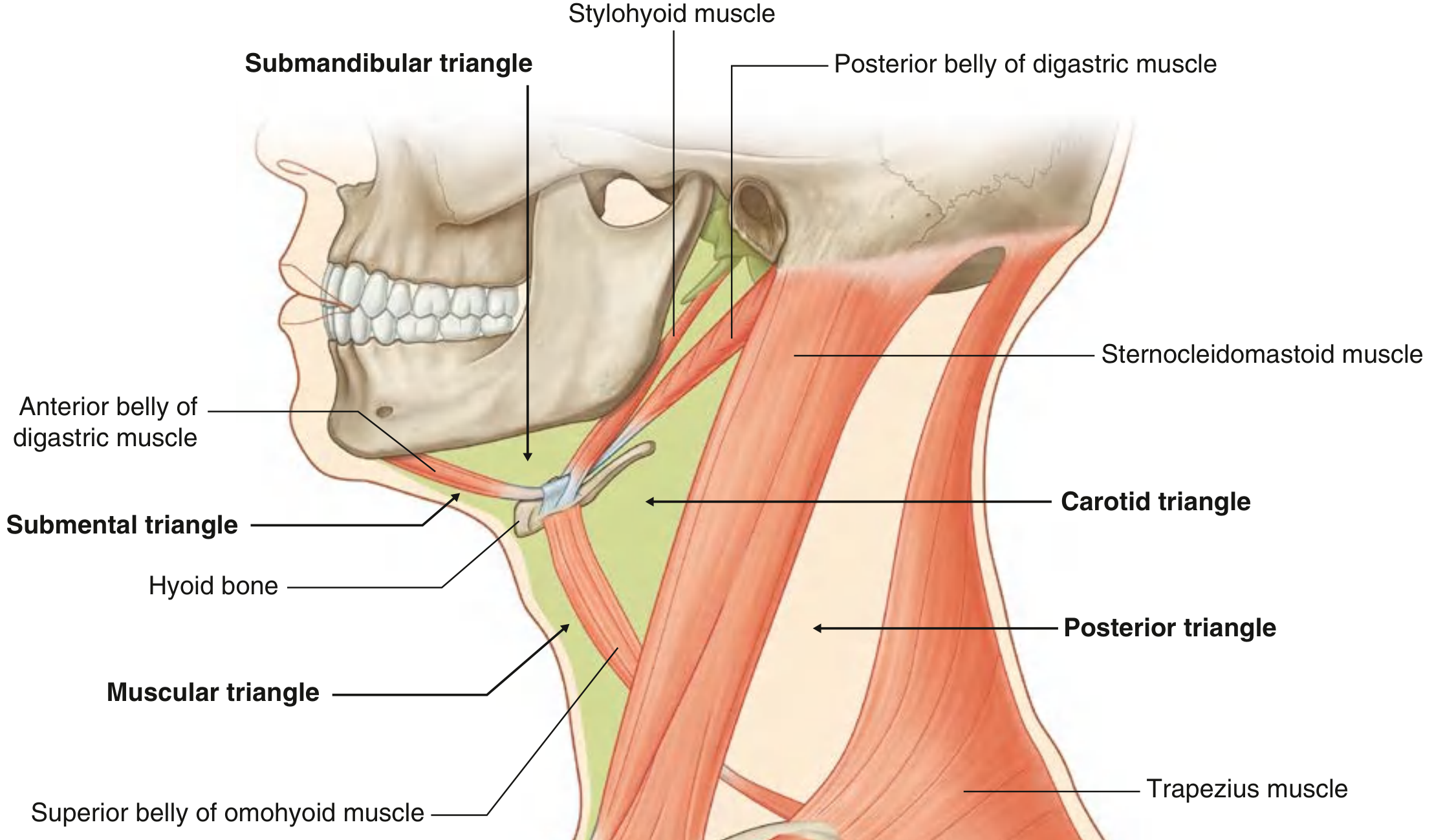
Subdivisions
The anterior triangle is divided into four smaller triangles by the digastric muscle and the superior belly of the omohyoid:
1. Submental Triangle (unpaired, single)
- Boundaries: Body of hyoid bone (inferiorly), anterior belly of digastric on each side (laterally), mandibular symphysis (superiorly)
- Contents: Submental lymph nodes; tributaries forming the anterior jugular vein
- Floor: Mylohyoid muscles and their median raphe
2. Submandibular Triangle (paired)
- Boundaries: Lower border of mandible (superiorly), anterior belly of digastric (anteroinferiorly), posterior belly of digastric + stylohyoid (posteroinferiorly)
- Floor: Anteriorly - mylohyoid; posteriorly - hyoglossus; most posteriorly - middle constrictor of pharynx
- Contents:
- Submandibular gland (the key content)
- Submandibular lymph nodes
- Hypoglossal nerve [CN XII]
- Mylohyoid nerve and vessels
- Facial artery and vein
- (In the posterior part): External carotid artery, internal carotid artery, internal jugular vein, vagus nerve
3. Carotid Triangle (paired)
- Boundaries: Posterior belly of digastric + stylohyoid (superiorly), superior belly of omohyoid (anteroinferiorly), anterior border of SCM (posteriorly)
- Contents: The most clinically important triangle, containing:
- Common carotid artery - bifurcates here into internal and external carotid arteries at the level of the superior border of the thyroid cartilage
- Carotid sinus - dilation at the bifurcation; monitors blood pressure; innervated by CN IX
- Carotid body - at the bifurcation; detects blood oxygen content; innervated by CN IX and X
- Internal jugular vein
- Vagus nerve [CN X] - in the carotid sheath, between internal jugular vein and carotid arteries
- Hypoglossal nerve [CN XII]
- Accessory nerve [CN XI]
- Ansa cervicalis (superior and inferior roots)
- Transverse cervical nerve
- External carotid artery branches: superior thyroid, lingual, facial, ascending pharyngeal, occipital
4. Muscular Triangle (paired)
- Boundaries: Midline of neck (medially), superior belly of omohyoid (laterally), anterior border of SCM (posterolaterally), hyoid bone (superiorly)
- Contents: Strap muscles (infrahyoid), thyroid gland, parathyroid glands, trachea, pharynx/larynx
Muscles of the Anterior Triangle
Muscles are grouped relative to the hyoid bone:
Suprahyoid Muscles (raise the hyoid; related to submental and submandibular triangles)
| Muscle | Origin | Insertion | Nerve | Action |
|---|---|---|---|---|
| Stylohyoid | Base of styloid process | Body of hyoid | Facial [VII] | Elevates & retracts hyoid |
| Digastric (anterior belly) | Digastric fossa of mandible | Intermediate tendon | Mylohyoid nerve (V3) | Depresses mandible; elevates hyoid |
| Digastric (posterior belly) | Mastoid notch | Intermediate tendon | Facial [VII] | Retracts hyoid |
| Mylohyoid | Mylohyoid line of mandible | Hyoid body & median raphe | Mylohyoid nerve (V3) | Elevates hyoid & floor of mouth |
| Geniohyoid | Inferior mental spine of mandible | Body of hyoid | C1 via CN XII | Protracts hyoid; depresses mandible |
Infrahyoid Muscles (strap muscles - depress the hyoid; related to muscular triangle)
| Muscle | Origin | Insertion | Nerve | Action |
|---|---|---|---|---|
| Sternohyoid | Posterior sternoclavicular joint / manubrium | Body of hyoid | Ansa cervicalis (C1-C3) | Depresses hyoid |
| Omohyoid (superior belly) | Intermediate tendon | Body of hyoid | Ansa cervicalis (C1-C3) | Depresses/fixes hyoid |
| Thyrohyoid | Oblique line of thyroid cartilage | Greater horn & body of hyoid | C1 via CN XII | Depresses hyoid; elevates larynx |
| Sternothyroid | Posterior manubrium | Oblique line of thyroid cartilage | Ansa cervicalis (C1-C3) | Depresses larynx |
Arteries
Common carotid artery: Ascends in the carotid sheath (no branches in the neck), bifurcates in the carotid triangle at the level of the superior edge of the thyroid cartilage.
External carotid artery - branches (mnemonic: SAL OPP MM):
| Branch | Supplies |
|---|---|
| Superior thyroid artery | Thyroid gland, thyrohyoid muscle, larynx |
| Ascending pharyngeal artery | Pharynx |
| Lingual artery | Tongue |
| Facial artery | Face |
| Occipital artery | Posterior scalp |
| Posterior auricular artery | Ear, scalp |
| Maxillary artery | Deep face (terminal branch) |
| Superficial temporal artery | Temporal region (terminal branch) |
Internal carotid artery: Gives off no branches in the neck; enters the skull via the carotid canal.
Veins
- Internal jugular vein (IJV): Descends in the carotid sheath; the major venous drainage of the head and neck.
- Common facial vein: Drains into the IJV at the level of the hyoid bone.
- Anterior jugular vein: Runs in the submental and muscular triangles; communicates across the midline via the jugular venous arch above the suprasternal notch.
- Jugular venous pulse (JVP): Observed in the IJV; clinically reflects right heart function and venous pressure.
Nerves
Cranial Nerves
| Nerve | Relevance to Anterior Triangle |
|---|---|
| Facial [VII] | Innervates posterior belly of digastric, stylohyoid, platysma |
| Glossopharyngeal [IX] | Passes between internal and external carotid arteries; innervates stylopharyngeus; supplies carotid sinus; sensory to pharynx |
| Vagus [X] | Descends in carotid sheath; gives motor branch to pharynx, superior laryngeal nerve (external + internal branches), branch to carotid body |
| Accessory [XI] | Passes through the region |
| Hypoglossal [XII] | Passes forward deep to posterior belly of digastric and stylohyoid, loops under the occipital artery, crosses the carotid arteries to reach the tongue |
Spinal Nerve Branches (Cervical Plexus)
- Ansa cervicalis (C1-C3): A loop formed by the superior root (C1, travels with CN XII) and inferior root (C2-C3); innervates all infrahyoid muscles except thyrohyoid
- Transverse cervical nerve (C2-C3): Sensory to the anterior neck skin
Visceral Contents (Muscular Triangle)
Thyroid Gland
- Lies in the visceral compartment (pretracheal fascia), deep to the strap muscles
- Two lateral lobes + isthmus (crosses 2nd-3rd tracheal rings)
- A pyramidal lobe may extend superiorly in ~50% of people
- Blood supply: Superior thyroid artery (from external carotid) and inferior thyroid artery (from thyrocervical trunk of subclavian)
- Venous drainage: Superior and middle thyroid veins to IJV; inferior thyroid veins to brachiocephalic vein
- Lymphatics drain to deep cervical nodes
- Development: arises from foramen caecum of tongue; descends via thyroglossal duct; remnants may form thyroglossal cysts or ectopic thyroid tissue
Parathyroid Glands
- Usually 4 glands on the posterior surface of thyroid (2 superior, 2 inferior)
- Develop from 3rd and 4th pharyngeal pouches
- Superior parathyroids are more constant in position; inferior ones are more variable (may be ectopic in the mediastinum)
- Blood supply: inferior thyroid artery
Summary Table - Structures by Subdivision
| Subdivision | Key Contents |
|---|---|
| Submental | Submental lymph nodes, anterior jugular vein tributaries |
| Submandibular | Submandibular gland & nodes, CN XII, mylohyoid nerve, facial artery & vein |
| Carotid | Common/internal/external carotid aa., IJV, CN IX/X/XI/XII, ansa cervicalis |
| Muscular | Strap muscles, thyroid & parathyroid glands, trachea, pharynx/larynx |
Clinical Points
- Carotid endarterectomy and carotid artery ligation are performed via the carotid triangle, with care to protect CN IX, X, XI, XII and ansa cervicalis.
- Carotid sinus massage (used in SVT) stimulates baroreceptors in the carotid sinus; pressure transmitted via CN IX to the vagal nuclei.
- Thyroglossal duct cysts present as midline neck swellings that move on swallowing and on tongue protrusion (they are attached to the hyoid bone).
- Submandibular gland excision risks the marginal mandibular branch of CN VII (runs deep to platysma near the gland) and CN XII.
- Central venous catheter placement in the IJV is performed within the carotid triangle; the tip should rest at the junction of the superior vena cava and right atrium.
- Ansa cervicalis is used surgically as a source of reinnervation for laryngeal muscles (nerve-to-larynx reinnervation procedures).
This is a shared conversation. Sign in to Orris to start your own chat.