
Homeostasis physiology mbbs 1st year
I'll start by reading the medical library skill, then search for homeostasis content.
Reading File
Now let me search the library for homeostasis content in parallel:
Finding Sources
Finding Sources
Let me search more specifically for physiology textbooks and homeostasis/feedback control topics:
Finding Sources
Finding Sources
Excellent! Four physiology textbooks are available. Let me search for homeostasis headings across all of them:
Finding Sources
Finding Sources
Now let me read the key homeostasis sections from Guyton & Hall and Ganong simultaneously:
Reading File
Reading File
Reading File
Now let me read more content - positive feedback from Costanzo, and the Guyton control systems section:
Reading File
Reading File
Let me fetch the key diagrams and read Guyton's control systems section:
Reading File
Loading Image
Loading Image
Excellent! I have rich content from Guyton, Ganong, and Costanzo. Let me read the Guyton control systems section more fully:
Reading File
I now have comprehensive material to deliver a thorough MBBS 1st year-level answer. Let me fetch one more key diagram and compile the answer:
Loading Image
I now have all the content needed for a complete, textbook-quality MBBS 1st year answer. Here is the full compiled response:
Homeostasis - Physiology (MBBS 1st Year)
1. Definition
Homeostasis is the maintenance of stable conditions in the internal environment of the body, despite changes in the external environment or internal demands.
The term was coined by Walter Cannon (American physiologist) in 1929. It derives from the Greek words homoios (same) and stasis (standing still). Homeostasis is a dynamic, not static, process - it continuously adjusts body functions to maintain internal stability.
"Homeostasis is a dynamic, rather than static, process that is continually adjusting the body's functions to maintain internal stability despite the challenges of daily life."
- Guyton and Hall Textbook of Medical Physiology
2. Internal Environment (Milieu Intérieur)
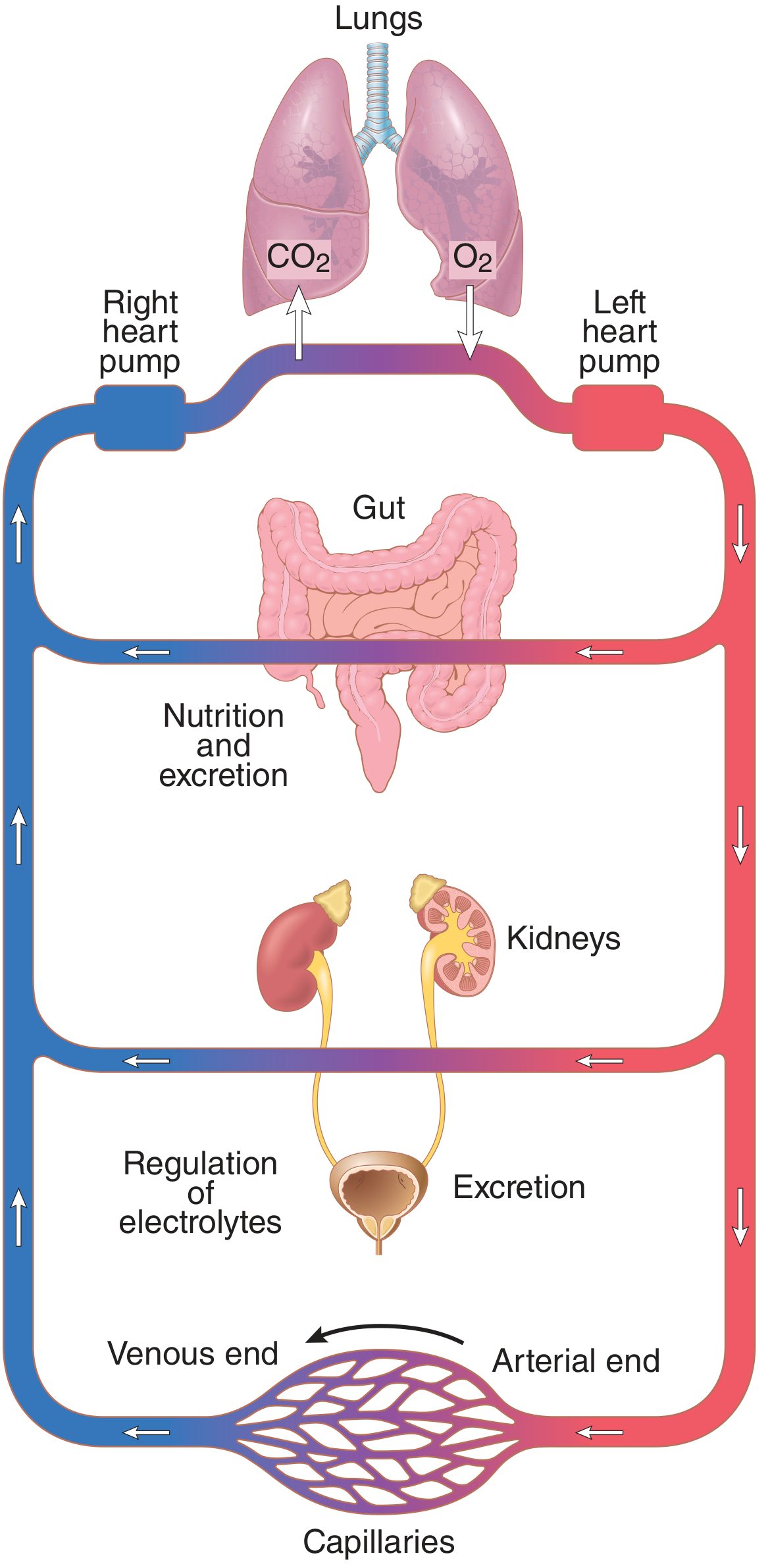
The concept of the internal environment was originally proposed by Claude Bernard (French physiologist, 19th century). He recognized that the body's cells live not in the external environment, but in the extracellular fluid that bathes them.
The internal environment = extracellular fluid (ECF), which includes:
- Plasma (in blood vessels)
- Interstitial fluid (between tissue cells)
- Cerebrospinal fluid, lymph, joint fluid (special compartments)
The circulatory system continuously mixes and transports ECF throughout the body, ensuring that cells everywhere receive nutrients and have waste removed. As shown below:
3. Levels of Homeostasis
Homeostasis operates at all levels of organization:
| Level | Example |
|---|---|
| Molecular/Genetic | DNA replication, gene expression control |
| Cellular | Membrane potential, protein synthesis |
| Tissue/Organ | Liver controlling blood glucose |
| Whole Body | Blood pressure regulation by the cardiovascular system |
4. Components of a Homeostatic Control System
Every homeostatic mechanism has three essential components:
| Component | Role | Example |
|---|---|---|
| Sensor/Receptor | Detects deviation from normal | Baroreceptors in carotid sinus/aortic arch |
| Control center/Integrator | Compares input with set point; generates error signal | Vasomotor center in brain medulla |
| Effector | Produces a response to correct the deviation | Heart, blood vessels |
The set point is the normal/optimal value around which the variable is regulated. When the actual value deviates from the set point, an error signal is generated, triggering a corrective response.
5. Feedback Control Mechanisms
A. Negative Feedback (Most Common)
Negative feedback is the cornerstone of homeostasis. In negative feedback, the response to a disturbance acts to oppose or reverse that disturbance, bringing the variable back toward its set point. It is self-limiting and stabilizing.
Classic example - Baroreceptor reflex (blood pressure regulation):
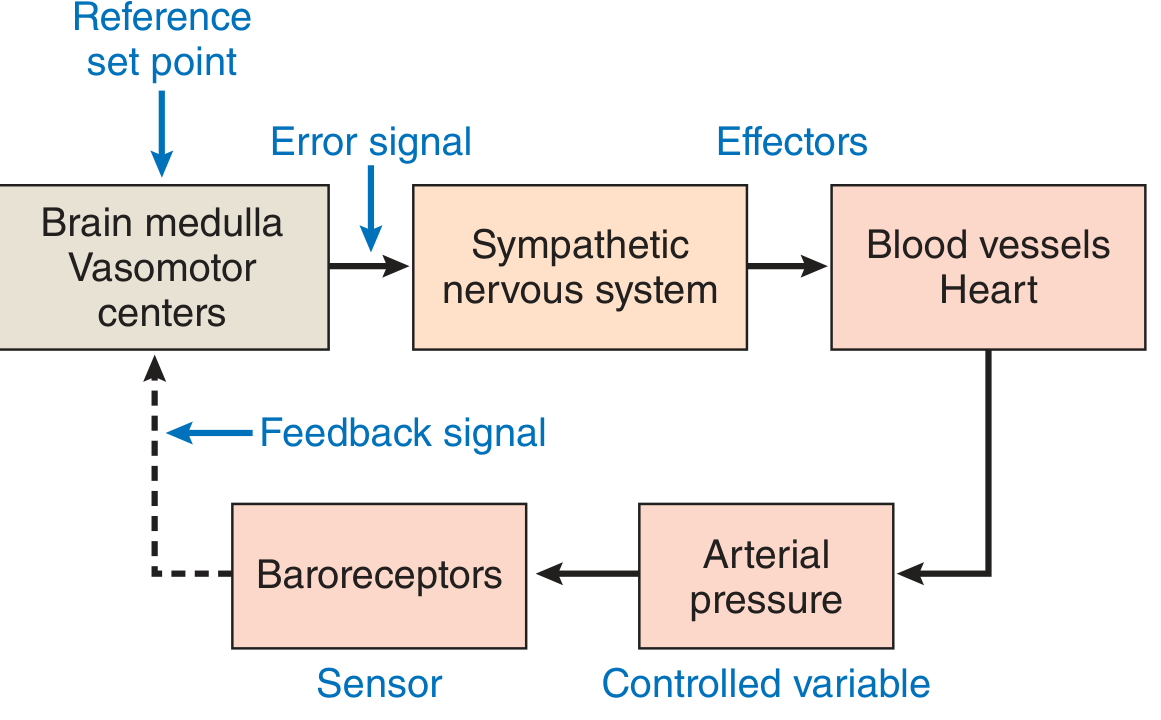
- BP rises → Baroreceptors (carotid sinus, aortic arch) stretch → Send signals to vasomotor center in medulla
- Medulla inhibits sympathetic activity → Vasodilation + decreased heart pumping
- BP falls back toward normal
- Conversely, if BP falls → baroreceptors less stretched → vasomotor center more active → vasoconstriction + increased cardiac output → BP rises back to normal
Other examples of negative feedback:
| Variable | Sensor | Effector | Response |
|---|---|---|---|
| Blood glucose | Pancreatic beta cells | Insulin secretion | Lowers glucose |
| Body temperature | Thermoreceptors (hypothalamus, skin) | Sweat glands, cutaneous vessels | Dissipates heat |
| Blood O₂ / CO₂ | Peripheral/central chemoreceptors | Respiratory muscles | Adjusts breathing |
| Blood Ca²⁺ | Parathyroid chief cells | PTH secretion | Mobilizes Ca²⁺ |
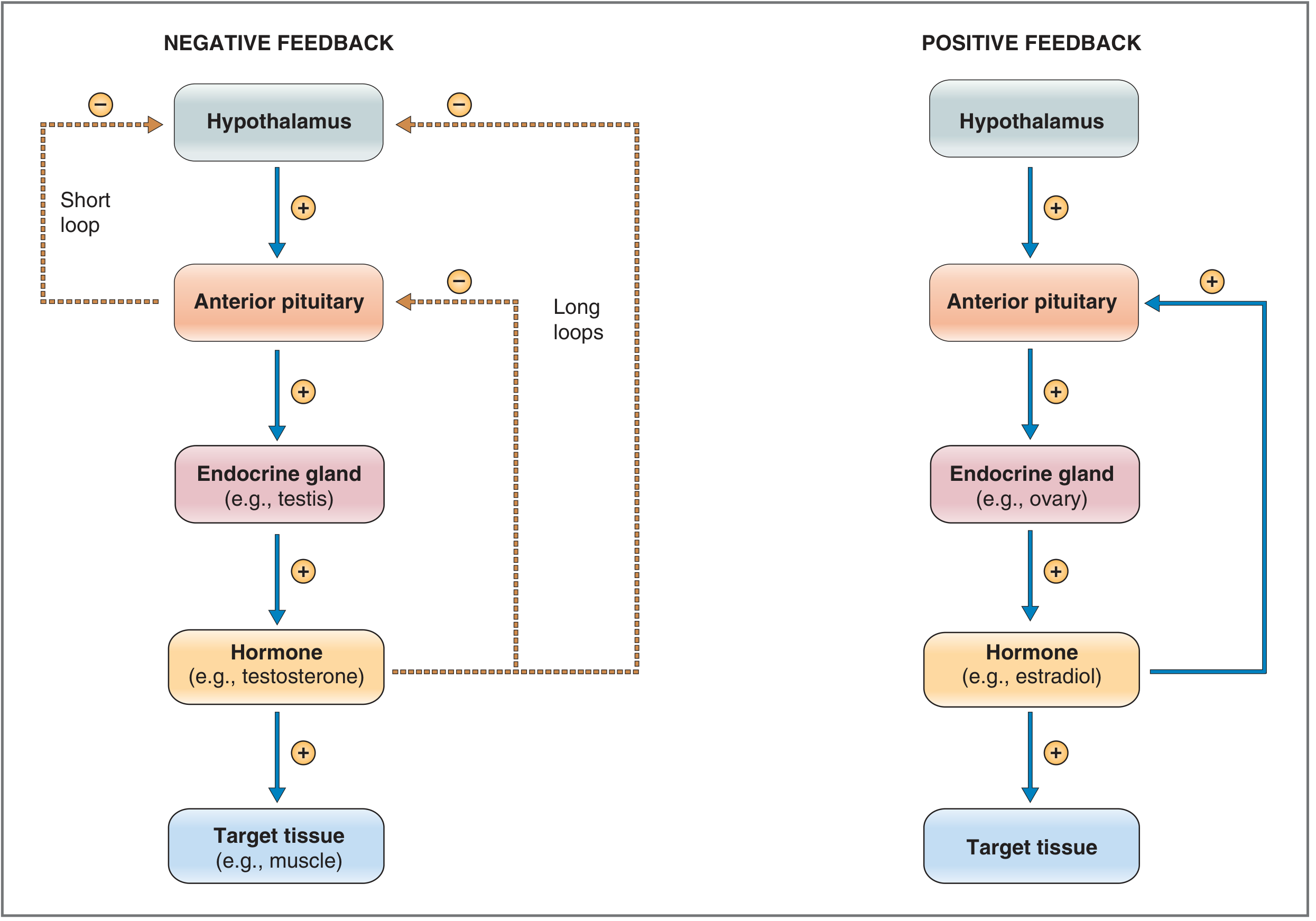
Endocrine negative feedback loops:
In the HPG/HPA/HPT axes:
- Long-loop feedback: Peripheral hormone (e.g., testosterone) feeds back on both pituitary and hypothalamus to inhibit secretion
- Short-loop feedback: Anterior pituitary hormone feeds back on hypothalamus only
- Ultrashort-loop feedback: Hypothalamic hormone inhibits its own secretion (autocrine)
B. Positive Feedback (Uncommon)
In positive feedback, the response amplifies the original stimulus rather than opposing it. This is self-augmenting and leads to an explosive or all-or-nothing event. It is inherently unstable and therefore rare in biological systems.
Examples:
| Example | Mechanism |
|---|---|
| Action potential upstroke | Depolarization opens Na⁺ channels → Na⁺ entry → more depolarization → more Na⁺ entry → explosive upstroke |
| LH surge at mid-cycle | Rising estrogen → stimulates FSH/LH release → FSH/LH cause more estrogen secretion → further amplification → ovulation |
| Parturition (labor) | Cervical dilation → oxytocin secretion (posterior pituitary) → uterine contraction → more cervical dilation → delivery of fetus |
| Blood clotting (coagulation cascade) | Clotting factors amplify each other - terminates once clot formed |
Positive feedback is self-limiting in the sense that it terminates once the biological event occurs (ovulation, delivery, action potential repolarization).
C. Feed-Forward Control
This is a less commonly asked but important concept - the body anticipates a disturbance and acts before it actually occurs.
Example: When you see food (before actually eating), salivary/gastric secretions increase in anticipation of digestion. This reduces the lag time of the homeostatic response.
6. Gain of a Control System
Gain measures how effectively a control system corrects a disturbance:
Gain = (Correction made) / (Remaining error)
A high gain = very powerful correction (small deviation tolerated). Example: blood pressure control has a gain of approximately 1-2 for short-term baroreceptor control, but much higher for long-term renal pressure regulation.
7. Parameters Maintained by Homeostasis
| Parameter | Normal Range | Regulated by |
|---|---|---|
| Blood pH (H⁺) | 7.35 - 7.45 | Lungs (CO₂), Kidneys (HCO₃⁻), Buffers |
| Blood glucose | 70 - 110 mg/dL | Insulin/Glucagon (pancreas), Liver |
| Body temperature | 36.5 - 37.5°C | Hypothalamus, Sweat glands, Shivering |
| Arterial BP | ~120/80 mmHg | Baroreceptors, RAAS, ADH |
| Blood sodium | 135 - 145 mEq/L | Kidneys, Aldosterone, ADH |
| Blood calcium | 8.5 - 10.5 mg/dL | PTH, Calcitonin, Vitamin D |
| Blood O₂ (PaO₂) | 80 - 100 mmHg | Chemoreceptors, Respiratory center |
Note: Blood H⁺ is regulated with extreme precision (variations < 5 nanomoles/L), while Na⁺ can vary by a few millimoles/L. Still, both are tightly controlled relative to their normal values. (Guyton & Hall)
8. Organ Systems Maintaining Homeostasis
Each organ system makes a specific contribution:
| Organ System | Homeostatic Function |
|---|---|
| Lungs | Supply O₂, remove CO₂; regulate blood pH |
| Kidneys | Regulate H⁺, Na⁺, K⁺, PO₄³⁻, water balance |
| Liver | Regulate glucose, protein, fat metabolism; detoxification |
| GI tract | Absorb nutrients; eliminate waste |
| Heart & Circulation | Transport O₂, nutrients, hormones, waste products |
| Hypothalamus | Integration of temperature, osmolality, hunger, hormonal axes |
| Autonomic Nervous System | Rapid adjustment of heart rate, BP, GI motility, glandular secretions |
| Endocrine System | Slower, sustained hormonal regulation of metabolism, growth, reproduction |
| Immune System | Defend against pathogens; maintain integrity of internal environment |
9. Homeostatic Imbalance and Disease
Disease can be viewed as a state of disrupted homeostasis. However, even in disease, the body continues to compensate:
| Disease | Homeostatic Failure |
|---|---|
| Type 1 Diabetes | Loss of insulin → failure of blood glucose regulation |
| Hypertension | Resetting of baroreceptor set point at higher level |
| Heart failure | Failure to maintain cardiac output; compensatory fluid retention |
| Dehydration | Failure to maintain blood volume and osmolality |
| Hyperthermia/Heat stroke | Loss of thermoregulatory sweating → temperature spirals upward |
| Renal failure | Loss of electrolyte, acid-base, and fluid homeostasis |
From Ganong's Review: "Diseases such as type I diabetes, dehydration, hyperthermia, or hypothermia, heart failure, and hypertension are examples of the consequence of homeostatic imbalance."
10. Key Differences: Negative vs Positive Feedback
| Feature | Negative Feedback | Positive Feedback |
|---|---|---|
| Effect on stimulus | Opposes/reverses it | Amplifies it |
| Stability | Stabilizing | Destabilizing (until event completes) |
| Frequency | Very common | Rare |
| Result | Variable returns to normal | Explosive, all-or-nothing event |
| Examples | BP, blood glucose, temperature | Action potential, LH surge, parturition |
11. Key Exam Points (Summary)
- Term coined by Walter Cannon, 1929; concept of internal environment by Claude Bernard
- Homeostasis is dynamic, not static
- Three components: Sensor → Control center → Effector
- Negative feedback is the dominant mechanism - corrects deviations
- Positive feedback is rare - amplifies a response to produce a sudden, explosive event
- Blood pH is the most tightly regulated variable
- The hypothalamus is the master integrator of homeostasis in the CNS
- Diseases represent homeostatic failure or compensation that has gone beyond normal limits
Sources:
- Guyton and Hall Textbook of Medical Physiology - Chapter 1 (Homeostasis and Control Systems)
- Ganong's Review of Medical Physiology, 26th Edition - Chapter 13 (ANS and Homeostasis)
- Costanzo Physiology, 7th Edition - Chapter 9 (Feedback Mechanisms in Endocrine Systems)
This is a shared conversation. Sign in to Orris to start your own chat.