
Hemoglobin degradation & Jaundice biochemistry
Reading File
Now I'll run parallel searches across headings and paragraphs for both topics:
Finding Sources
Finding Sources
Finding Sources
Excellent. Now I'll read the most relevant sources in parallel — the biochemistry textbook for heme degradation, Harrison's for bilirubin metabolism, and Schwartz's/Sleisenger's for jaundice classification:
Reading File
Reading File
Reading File
Excellent content. Now let me fetch the key diagrams and read more about the inherited hyperbilirubinemias and urobilinogen pathway:
Loading Image
Loading Image
Loading Image
Reading File
Now let me get the Harrison's content on inherited hyperbilirubinemias and the Schwartz's content on posthepatic jaundice:
Reading File
Reading File
Finding Sources
Now let me get the Robbins pathology content on hereditary hyperbilirubinemias and the Harrison's content on jaundice/urobilinogen:
Reading File
Reading File
I now have comprehensive content from multiple authoritative sources. Let me compile the complete answer:
Hemoglobin Degradation & Jaundice Biochemistry
1. Overview of Heme Degradation
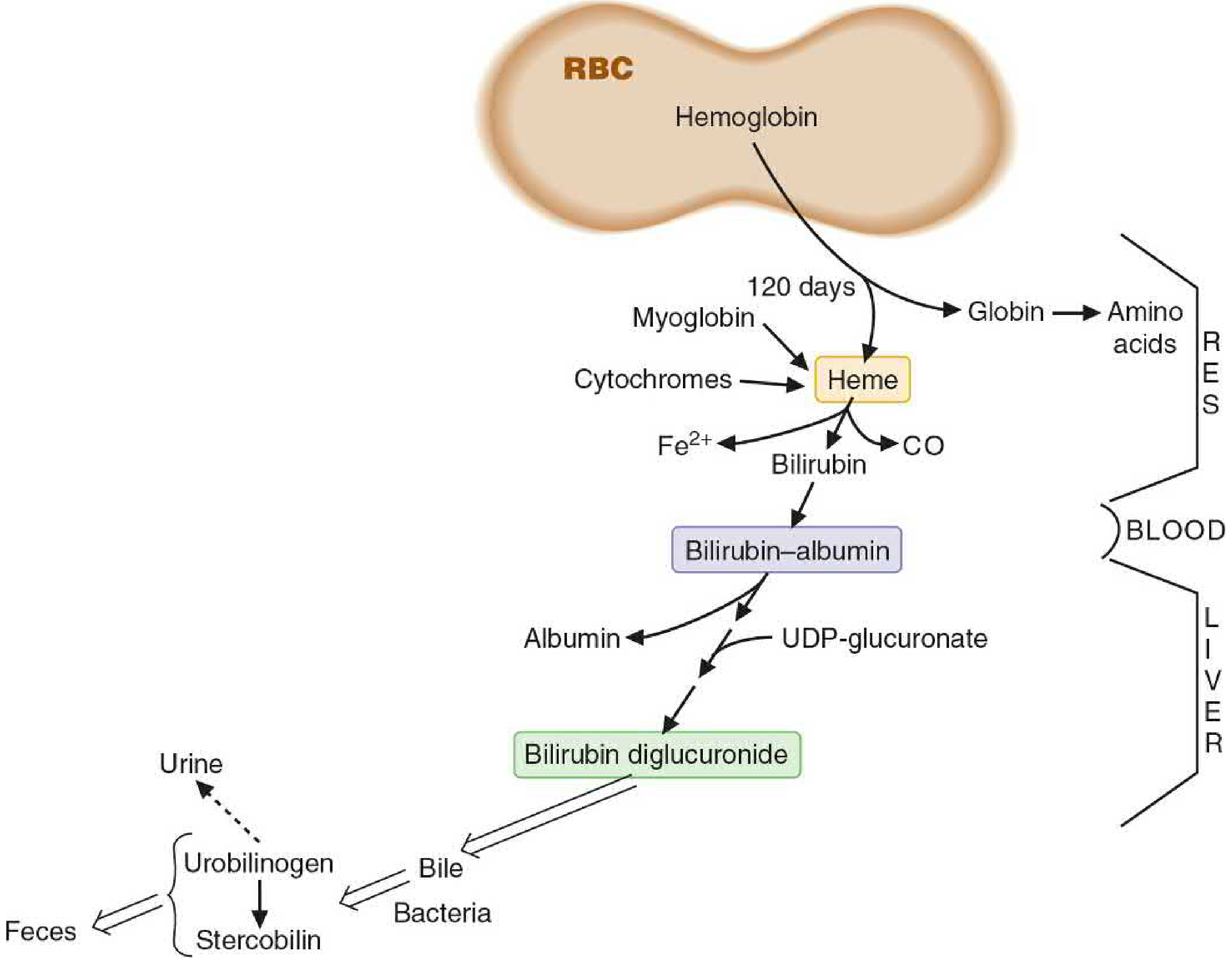
Overview of heme degradation — Basic Medical Biochemistry: A Clinical Approach, 6e
2. Step-by-Step Heme Catabolism
Step 1 — RBC Senescence & Phagocytosis
Red blood cells survive ~120 days. Senescent RBCs are phagocytosed by macrophages of the reticuloendothelial system (RES) — primarily in the spleen, liver (Kupffer cells), and bone marrow.
- 70–90% of bilirubin derives from hemoglobin of aging RBCs
- The remaining ~10–30% comes from myoglobin, cytochromes P450, and other heme-containing proteins (ineffective erythropoiesis also contributes)
Step 2 — Globin & Iron Separation
Within the macrophage:
- Globin chains are proteolyzed → free amino acids (recycled)
- Iron (Fe²⁺) is released and returned to the body's iron stores (ferritin / transferrin)
Step 3 — Heme → Biliverdin → Bilirubin
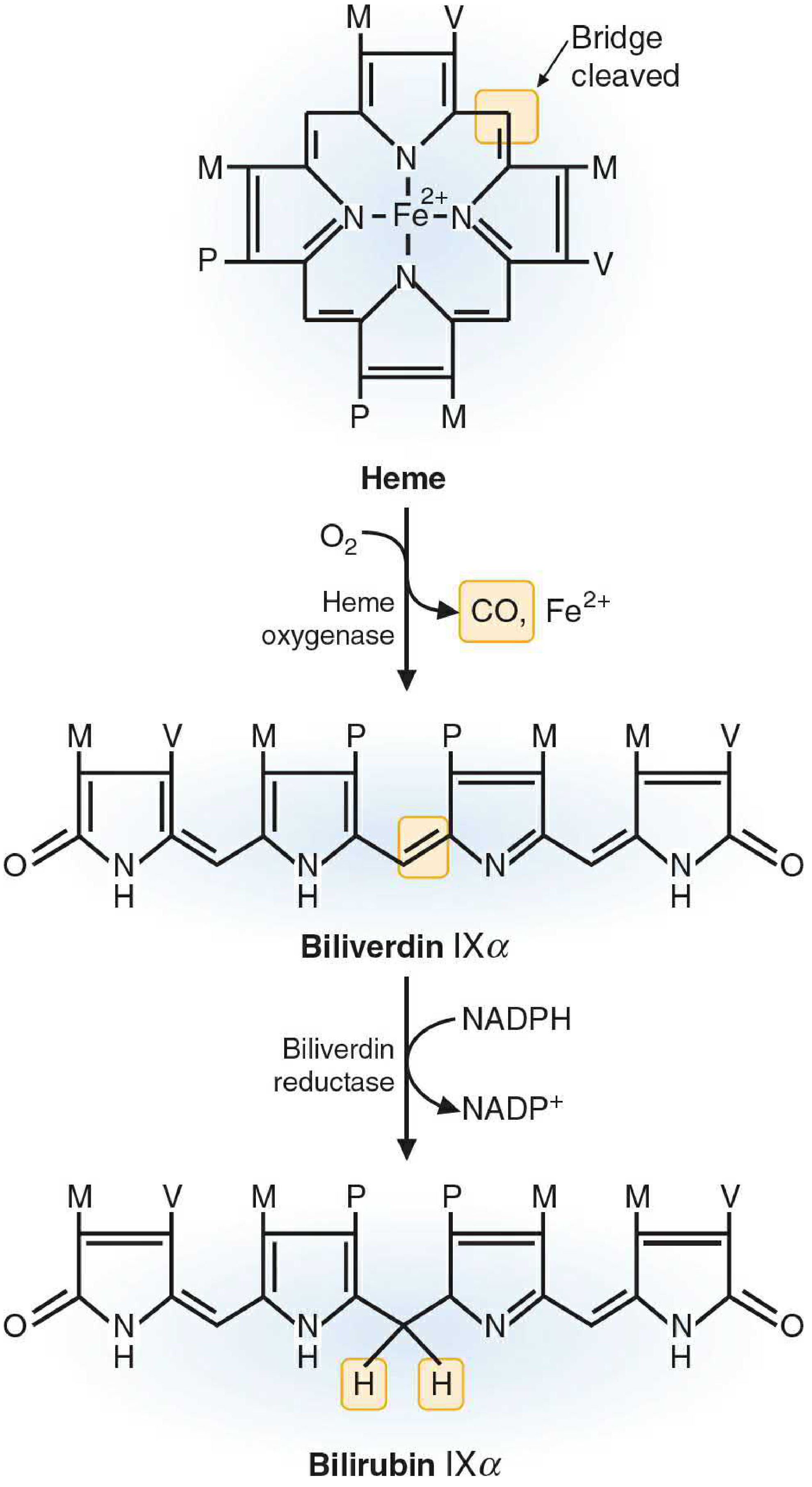
Conversion of heme to bilirubin — Basic Medical Biochemistry: A Clinical Approach, 6e
| Reaction | Enzyme | Co-factors | Product |
|---|---|---|---|
| Heme → Biliverdin IXα | Heme oxygenase | O₂, NADPH | Biliverdin + CO + Fe²⁺ |
| Biliverdin → Bilirubin IXα | Biliverdin reductase | NADPH → NADP⁺ | Bilirubin (unconjugated) |
- A methylene bridge in the porphyrin ring is oxidatively cleaved, releasing carbon monoxide (CO) — a clinically measurable marker of hemolysis
- Bilirubin IXα is the predominant isomer produced in humans
Step 4 — Transport in Blood (Unconjugated Bilirubin)
- Bilirubin is water-insoluble (lipophilic) due to extensive internal hydrogen bonding
- Transported in plasma tightly bound to albumin (non-covalently)
- Cannot be filtered at the glomerulus in this form → absent from normal urine
- Van den Bergh test: indirect-reacting (requires methanol to disrupt H-bonds before diazo reaction)
3. Hepatic Processing
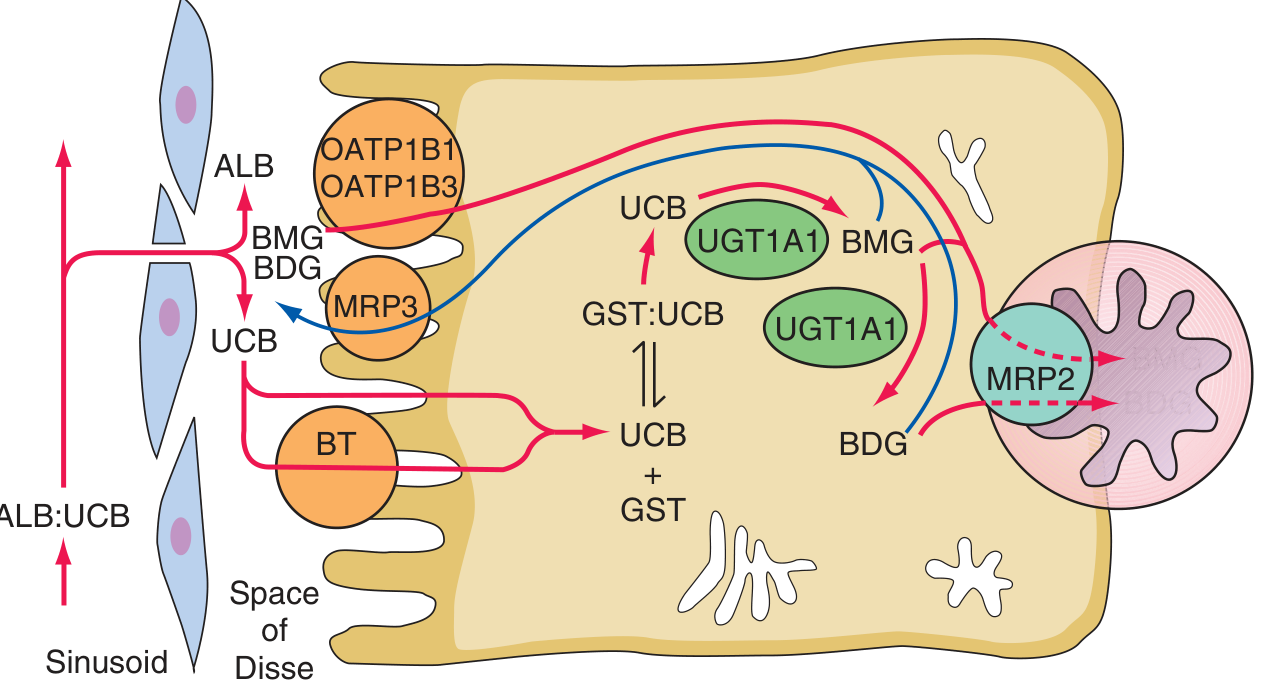
Hepatocellular bilirubin transport — Harrison's Principles of Internal Medicine 22E
Four steps at the hepatocyte level:
| Step | Process | Key Molecules |
|---|---|---|
| 1 | Uptake | Carrier-mediated (OATP1B1, OATP1B3, proposed BT transporter) |
| 2 | Intracellular binding | Glutathione-S-transferases (ligandins) keep bilirubin in solution |
| 3 | Conjugation | UGT1A1 (bilirubin-UDP-glucuronosyltransferase) adds 1–2 glucuronic acid moieties using UDP-glucuronate → bilirubin mono- and diglucuronide |
| 4 | Biliary excretion | MRP2 (ABCC2) transports conjugated bilirubin across the canalicular membrane into bile |
Conjugation disrupts internal H-bonds → bilirubin becomes water-soluble → directly reactive on Van den Bergh (direct bilirubin). Conjugation is obligatory for biliary excretion.
A fraction of conjugated bilirubin is returned to portal circulation by MRP3 (sinusoidal efflux) → reuptake via OATP1B1/OATP1B3 (important in Rotor syndrome pathogenesis).
4. Intestinal Fate & Enterohepatic Circulation
- Bilirubin diglucuronide passes through the gut without mucosal reabsorption
- Intestinal bacteria deconjugate and reduce bilirubin → urobilinogen (colorless)
- Urobilinogen fate:
- Most → oxidized to stercobilin → excreted in feces (gives stool its brown color)
- ~20% reabsorbed (enterohepatic circulation) → re-excreted by liver
- Small amount enters systemic circulation → filtered by kidneys → urobilin in urine (normal trace amounts)
Clinical note: Conjugated bilirubin can appear in urine (bilirubinuria) because it is small enough for glomerular filtration — unlike unconjugated bilirubin.
5. Jaundice — Definition & Threshold
Jaundice = yellowish staining of skin, sclera, and mucous membranes by bilirubin. Clinically detectable when serum bilirubin rises above 2.5–3 mg/dL (normal < 1.0 mg/dL total). — Schwartz's Principles of Surgery, 11e
6. Classification of Jaundice (Prehepatic / Intrahepatic / Posthepatic)
A. Prehepatic (Hemolytic) Jaundice
Mechanism: Excess heme production overwhelms hepatic conjugation capacity
- Bilirubin type: Unconjugated (indirect) hyperbilirubinemia
- Hemolysis alone rarely causes serum bilirubin > 4 mg/dL (bone marrow can sustain only ~8× increase in RBC production; higher levels imply hepatic dysfunction)
- No bilirubinuria (UCB too tightly albumin-bound)
- Urine urobilinogen: ↑↑ (more bilirubin delivered to gut → more urobilinogen formed)
- Stool color: dark (stercobilin ↑)
Causes:
- Hereditary: Sickle cell disease, hereditary spherocytosis, G6PD deficiency, thalassemia
- Acquired immune: Autoimmune hemolytic anemia (Coombs +)
- Acquired non-immune: Drug-induced RBC damage, mechanical hemolysis (prosthetic heart valves), microangiopathic hemolytic anemia, infections (malaria)
- Ineffective erythropoiesis: Thalassemia major, megaloblastic anemia, porphyria
B. Intrahepatic Jaundice
Mechanism: Failure of conjugation or intracellular transport within hepatocytes
Unconjugated type (conjugation defect):
| Disorder | Defect | Severity |
|---|---|---|
| Physiologic jaundice of newborn | Immature UGT1A1 (adult levels at 3–4 months) | Mild, resolves spontaneously |
| Breast milk jaundice | Bilirubin-deconjugating enzymes in breast milk | Mild |
| Gilbert syndrome | ↓ UGT1A1 activity (~30% of normal); promoter region mutation (TATAA box) | Benign; bilirubin rises with fasting/stress; 4–7% of population |
| Crigler-Najjar type I | Complete absence of UGT1A1 | Fatal without liver transplant; kernicterus |
| Crigler-Najjar type II (Arias) | Residual UGT1A1 activity | Responsive to phenobarbital |
Conjugated type (secretion/excretion defect):
| Disorder | Defect | Feature |
|---|---|---|
| Dubin-Johnson syndrome | MRP2 mutation → impaired canalicular export | Black liver (melanin-like pigment deposition); AR; benign |
| Rotor syndrome | OATP1B1 + OATP1B3 deficiency → impaired hepatic reuptake of conjugated bilirubin | AR; benign; no liver pigment |
Acquired intrahepatic causes:
- Viral hepatitis, alcoholic hepatitis, cirrhosis
- Drugs (acetaminophen toxicity, OCP, anabolic steroids)
- Sepsis, ischemia/hypoxia
- Autoimmune hepatitis, primary biliary cholangitis, primary sclerosing cholangitis
C. Posthepatic (Obstructive) Jaundice
Mechanism: Obstruction of bile flow at or below the bile ducts
- Bilirubin type: Conjugated (direct) hyperbilirubinemia
- Bilirubinuria: present (dark urine — "Coca-Cola" urine)
- Urine urobilinogen: ↓ or absent (no bilirubin reaching gut)
- Stool color: pale/clay-colored (no stercobilin)
- Alkaline phosphatase + GGT: markedly elevated (cholestatic pattern)
Intrinsic causes: Cholelithiasis (gallstones), choledocholithiasis, cholangiocarcinoma, primary sclerosing cholangitis, benign biliary stricture, disorders of the ampulla of Vater
Extrinsic causes: Carcinoma of the head of the pancreas (classic), chronic pancreatitis, pancreatic pseudocyst
7. Differential Diagnosis Summary Table
| Feature | Prehepatic | Intrahepatic (Unconj.) | Intrahepatic (Conj.) | Posthepatic |
|---|---|---|---|---|
| Bilirubin type | Unconjugated ↑ | Unconjugated ↑ | Conjugated ↑ | Conjugated ↑ |
| Bilirubinuria | ✗ | ✗ | ✓ | ✓ |
| Urine urobilinogen | ↑↑ | ↑ | ↓ | ↓/absent |
| Stool color | Dark | Normal | Pale | Pale/clay |
| ALT/AST | Normal | ↑↑ | ↑ | Normal/↑ |
| ALP/GGT | Normal | ↑ | ↑ | ↑↑↑ |
| Coombs test | ± positive | Negative | Negative | Negative |
8. Special Notes on Bilirubin Measurement
- Van den Bergh reaction (diazo method):
- Direct bilirubin = conjugated (reacts directly with diazo reagent in aqueous)
- Indirect bilirubin = unconjugated (requires methanol to release from albumin)
- Total bilirubin = direct + indirect
- Normal total serum bilirubin: 0.3–1.0 mg/dL (< 0.3 mg/dL direct)
Sources: Basic Medical Biochemistry: A Clinical Approach 6e; Harrison's Principles of Internal Medicine 22E; Schwartz's Principles of Surgery 11e; Robbins, Cotran & Kumar Pathologic Basis of Disease; Sleisenger & Fordtran's Gastrointestinal and Liver Disease
This is a shared conversation. Sign in to Orris to start your own chat.