
Medications used to treat Migrain.
Reading File
Now I'll search the medical library for migraine medications in parallel.
Finding Sources
Finding Sources
Searching PubMed
"migraine"[MeSH Terms] AND "drug therapy"[MeSH Terms]
Good results. Now let me read the key textbook sections in parallel.
Reading File
Reading File
Reading File
Excellent - I have very rich content. Let me now fetch the prophylaxis section and the CGRP antagonists section to complete the picture.
Reading File
Reading File
Searching Images
migraine treatment drugs triptans mechanism diagram
There's a textbook diagram available. Let me fetch it.
Loading Image
I now have comprehensive, well-sourced content to write a detailed answer.
Medications Used to Treat Migraine
Migraine management is divided into two broad strategies: acute (abortive) treatment to stop an attack in progress, and prophylactic (preventive) treatment to reduce the frequency and severity of attacks.
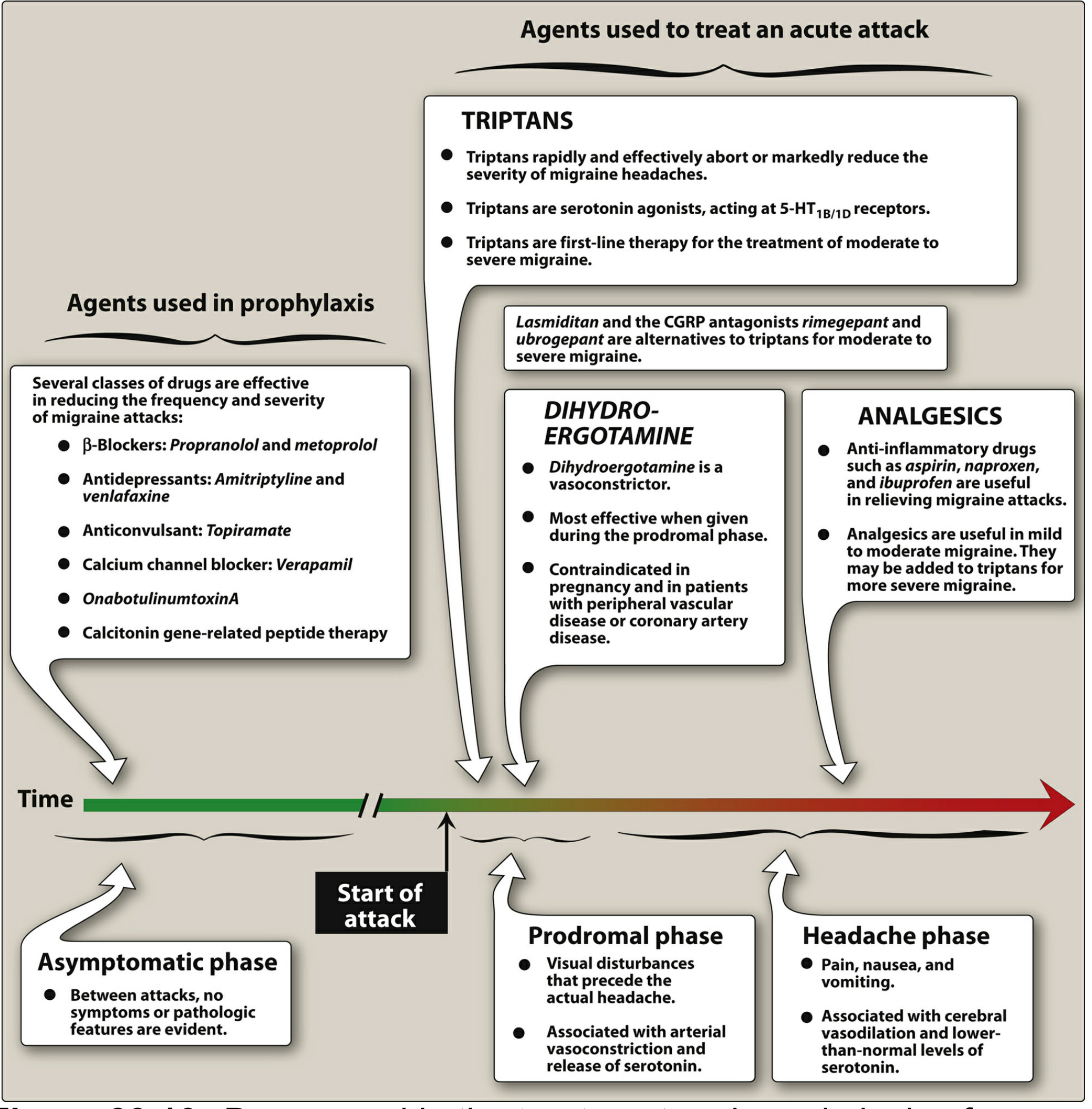
A. Acute (Abortive) Treatment
1. Simple Analgesics and NSAIDs
For mild to moderate attacks, these are the first step:
- Aspirin, ibuprofen, naproxen - anti-inflammatory drugs that relieve migraine pain
- Acetaminophen (paracetamol) - useful when NSAIDs are contraindicated
- Ketorolac (IV/IM) - used in emergency settings
These are effective for mild attacks but carry the risk of medication overuse headache (MOH) if taken too frequently. - Adams and Victor's Principles of Neurology, 12th Ed.
2. Triptans (5-HT1B/1D Agonists) - First-Line for Moderate to Severe Attacks
Triptans abort or markedly reduce migraine severity in about 70% of patients and are the cornerstone of acute migraine therapy. - Lippincott Illustrated Reviews: Pharmacology
Mechanism: Selective agonists at serotonin 5-HT1B/1D receptors → cause cranial vasoconstriction and inhibit release of pro-inflammatory neuropeptides (CGRP, substance P) from trigeminal nerve endings.
| Drug | Available Doses | Routes | Notes |
|---|---|---|---|
| Sumatriptan | 25, 50, 100 mg oral; 6 mg SC; 20 mg nasal | PO, SC, intranasal | Prototype triptan; fastest onset via SC (~20 min) |
| Zolmitriptan | 2.5 mg, 5 mg | PO, nasal spray | Good nasal spray option |
| Rizatriptan | 5 mg, 10 mg | PO | Fast oral onset |
| Almotriptan | 12.5 mg | PO | Low recurrence rate (~23%) |
| Eletriptan | 20 mg, 40 mg | PO | Moderate recurrence |
| Frovatriptan | 2.5 mg | PO | Longest half-life (>24 h); lowest recurrence rate (10-25%) |
| Naratriptan | 1 mg, 2.5 mg | PO | Slower onset, longer duration |
Key points:
- Best taken at the very onset of headache (oral and nasal forms can be taken during the aura; SC form should wait until headache begins)
- If one triptan fails, another may work - individual response varies
- Contraindicated in patients with coronary artery disease, uncontrolled hypertension, or history of stroke/TIA
- Common adverse effects: chest/neck tightness, flushing, dizziness, pressure sensations
3. Ergot Alkaloids
Older but still effective agents, acting at 5-HT1, alpha-adrenergic, and dopamine receptors.
- Ergotamine tartrate - sublingual or oral (often combined with caffeine); most effective early in attack; strict dose limits to avoid dependence and rebound headache
- Dihydroergotamine (DHE) - IV or intranasal; efficacy similar to sumatriptan; contraindicated in pregnancy, peripheral vascular disease, and coronary artery disease
"Older medications such as ergotamine and dihydroergotamine remain as effective as triptans in the management of acute migraine." - Scott-Brown's Otorhinolaryngology
4. Ditans (5-HT1F Agonists) - Newer Class
- Lasmiditan - selective 5-HT1F agonist; reduces trigeminal nerve activation WITHOUT causing vasoconstriction; useful when triptans are contraindicated (e.g., cardiovascular disease)
- Important caution: Classified as a controlled substance; causes significant driving impairment - Lippincott Illustrated Reviews: Pharmacology
5. CGRP Receptor Antagonists (Gepants)
Calcitonin gene-related peptide (CGRP) levels are elevated during acute migraine. Gepants block this pathway without vasoconstriction.
Acute use:
- Ubrogepant - oral; avoid with strong CYP3A4 inhibitors
- Rimegepant - oral; can also be used for prevention (dual indication)
Adverse effects: Nausea and somnolence (low incidence) - Lippincott Illustrated Reviews: Pharmacology
6. Antiemetics (Adjunctive)
Often combined with analgesics or triptans to address nausea/vomiting and enhance drug absorption (migraine slows GI motility):
- Metoclopramide - dopamine antagonist; also has direct antimigraine effect
- Prochlorperazine - dopamine antagonist; effective in ED settings
- Promethazine - antihistamine/antiemetic; given alongside ergotamine
A 2025 systematic review in Annals of Emergency Medicine found dopamine antagonists (metoclopramide, prochlorperazine) among the most effective agents for migraine in the emergency department.
B. Prophylactic (Preventive) Treatment
Indicated when attacks occur ≥2 times per month or are severe/disabling.
Beta-Blockers (Drugs of Choice)
- Propranolol, Metoprolol - first-line preventive agents; mechanism not fully understood
Anticonvulsants
- Topiramate - reduces attack frequency significantly
- Divalproex (valproate) - also effective; used IV in status migrainosus (loading dose 15 mg/kg)
Antidepressants
- Amitriptyline (TCA) - effective even in non-depressed migraineurs
- Venlafaxine (SNRI) - alternative to amitriptyline
Calcium Channel Blockers
- Verapamil - particularly useful in cluster headache variant, also for migraine prevention
OnabotulinumtoxinA (Botox)
- Approved for chronic migraine (≥15 headache days/month); injected into head and neck muscles every 12 weeks
CGRP Pathway (Monoclonal Antibodies) - Newest Class
These are given by monthly or quarterly injection/infusion:
- Erenumab (anti-CGRP receptor)
- Galcanezumab (anti-CGRP ligand)
- Fremanezumab (anti-CGRP ligand)
- Eptinezumab (IV infusion; anti-CGRP ligand)
And oral CGRP antagonists for prevention:
- Rimegepant (dual acute/preventive)
- Atogepant (prevention only)
A 2025 evidence-based guideline in Cephalalgia and a 2024 BMJ network meta-analysis (PMID 39293828) both support triptans as the most effective acute agents, with CGRP-targeting therapies showing strong evidence for prevention.
Summary Table
| Category | Examples | Use |
|---|---|---|
| NSAIDs/Analgesics | Ibuprofen, naproxen, aspirin | Mild-moderate acute attack |
| Triptans | Sumatriptan, rizatriptan, eletriptan | Moderate-severe acute attack (first-line) |
| Ergot alkaloids | Ergotamine, DHE | Acute attack (older agents) |
| Ditans | Lasmiditan | Acute, when triptans contraindicated |
| Gepants (acute) | Ubrogepant, rimegepant | Acute, when triptans contraindicated |
| Antiemetics | Metoclopramide, prochlorperazine | Adjunctive (acute) |
| Beta-blockers | Propranolol, metoprolol | Prevention (first-line) |
| Anticonvulsants | Topiramate, valproate | Prevention |
| Antidepressants | Amitriptyline, venlafaxine | Prevention |
| CCBs | Verapamil | Prevention |
| Botulinum toxin A | OnabotulinumtoxinA | Chronic migraine prevention |
| Anti-CGRP mAbs | Erenumab, galcanezumab, fremanezumab, eptinezumab | Prevention (injectable) |
| Gepants (preventive) | Rimegepant, atogepant | Prevention (oral) |
Sources: Adams and Victor's Principles of Neurology, 12th Ed. | Lippincott Illustrated Reviews: Pharmacology | Bradley and Daroff's Neurology in Clinical Practice | The Washington Manual of Medical Therapeutics
This is a shared conversation. Sign in to Orris to start your own chat.