
Pre synaptic m1 receptors short note
Reading File
Finding Sources
Finding Sources
Searching the Web
presynaptic M1 muscarinic receptors pharmacology function autoreceptor
Reading File
Reading File
Finding Sources
Loading Image
I now have all the information needed for a thorough short note on presynaptic M1 receptors.
Presynaptic M1 Muscarinic Receptors - Short Note
Overview
Muscarinic receptors (M1-M5) are G-protein-coupled receptors activated by acetylcholine (ACh). While M1 receptors are predominantly postsynaptic in the CNS (hippocampus, neocortex, cerebral cortex), they are also found presynaptically in certain tissues and nerve terminals, where they serve as autoreceptors or heteroreceptors modulating neurotransmitter release.
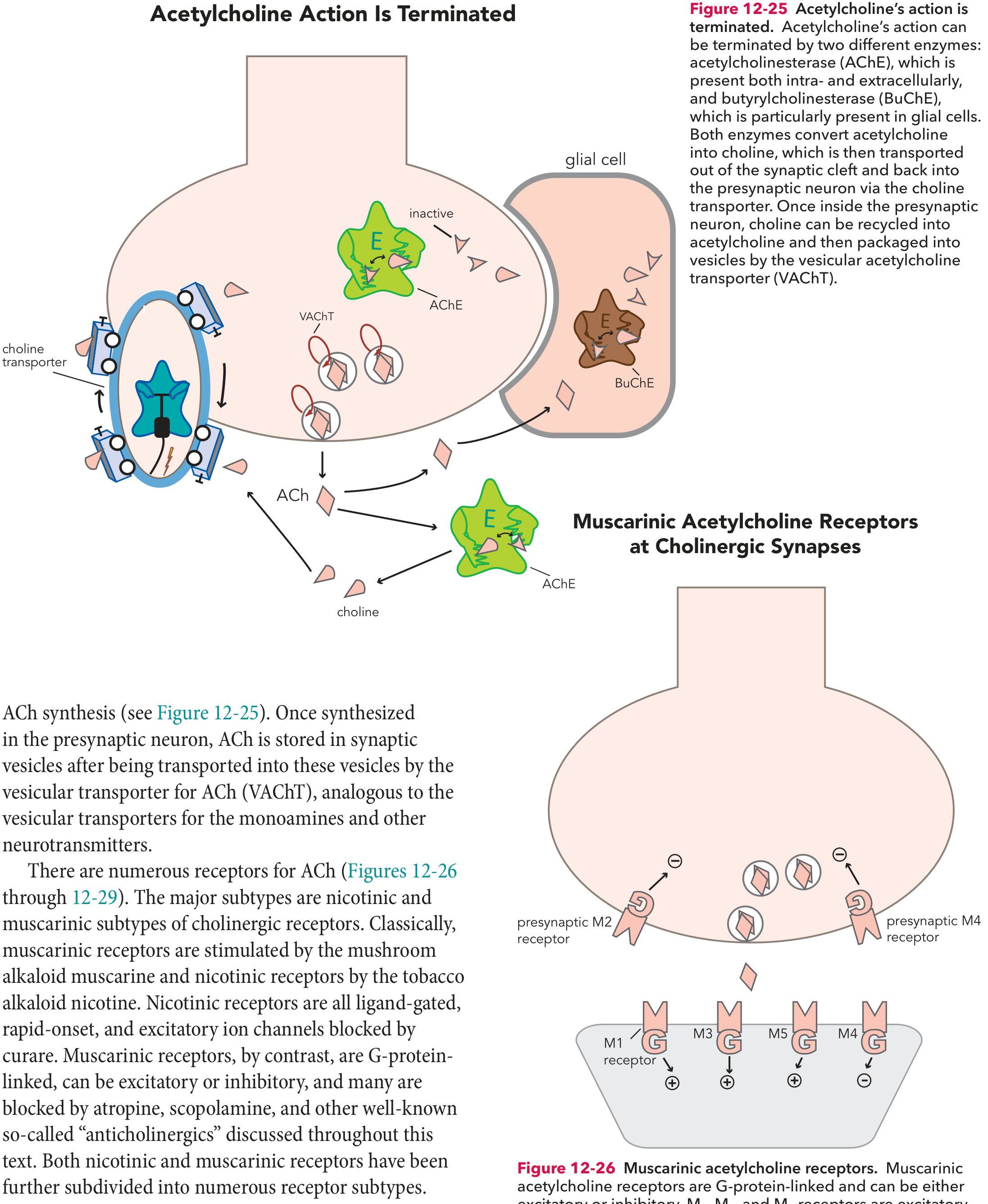
Location of Presynaptic M1 Receptors
1. Cholinergic terminals (Autoreceptors)
- Found on the presynaptic terminals of cholinergic neurons, particularly in the rat basal forebrain and cerebral cortex
- Modulate spontaneous ACh release (Suzuki et al., 1988)
- Blockade of presynaptic M1 receptors increases ACh release in rat cerebral cortex and hippocampus
2. Noradrenergic terminals (Heteroreceptors)
- ACh released during parasympathetic/sympathetic co-release binds to presynaptic M1 receptors on noradrenergic neurons
- This reduces norepinephrine (NE) release by decreasing cAMP via Gi/o coupling
- Seen in blood vessels of erectile tissue and muscle (anticipatory vasodilation)
Signal Transduction
| Parameter | Details |
|---|---|
| G-protein | Primarily Gq/11 (postsynaptic); Gi/o when presynaptic on noradrenergic neurons |
| Effector | Gi/o → inhibits adenylyl cyclase → ↓cAMP → ↓NE release |
| Ion channels | Slow membrane depolarization via inhibition of K+ currents (M-current suppression); also links to PKC and PKA pathways |
| Net effect on neurotransmitter release | Modulation - typically inhibition via indirect ion channel mechanisms |
Key Functions of Presynaptic M1 Receptors
1. Autoreceptor Function (Cholinergic synapses)
- Presynaptic M1 autoreceptors on cholinergic terminals modulate spontaneous ACh release
- In rat basal forebrain: M1 activation modulates ACh release
- In human cerebral cortex: M1 blockade does NOT change ACh release (unlike rat), suggesting species differences - M2 is the dominant presynaptic autoreceptor in humans
2. Heteroreceptor Function (Noradrenergic terminals)
- ACh → presynaptic M1 on noradrenergic neurons → Gi → ↓AC → ↓cAMP → ↓NE release → ↓vasoconstriction
- This mechanism operates during:
- Parasympathetic-induced vasodilation in erectile tissue
- Anticipatory vasodilation in skeletal muscle (sympathetic cholinergic cotransmission)
3. Dopamine Modulation
- In the hippocampus and neocortex, M1 receptors may facilitate dopamine release, contributing to cognitive and attention functions
Distinction: M1 vs M2 as Presynaptic Receptors
| Feature | Presynaptic M1 | Presynaptic M2 |
|---|---|---|
| Primary role | Heteroreceptor on noradrenergic terminals; autoreceptor in some regions | Dominant autoreceptor on cholinergic terminals |
| Brain region | Basal forebrain, cortex, hippocampus | Hippocampus, cerebral cortex (dominant) |
| G-protein | Gq/11 (also Gi in some contexts) | Gi/o (primarily) |
| Effect | Decreases NE release; modulates ACh release | Inhibits further ACh release |
| Species specificity | More prominent in rat than humans | Present in both rat and human cortex |
Note: In the brain, M2 is the primary presynaptic autoreceptor. M1 receptors, though mainly postsynaptic, do have clinically relevant presynaptic roles as heteroreceptors and context-specific autoreceptors.
Clinical Relevance
- Alzheimer's disease: M1 receptors in cortex and hippocampus are reduced; M1 agonists (e.g., xanomeline) are being explored to improve cognition
- Schizophrenia: M1 agonism improves cognition; xanomeline (M4/M1 agonist) shows early efficacy for positive symptoms
- Anticholinergic drugs (e.g., atropine, scopolamine): Blockade of presynaptic M1 heteroreceptors on dopaminergic neurons can alter dopamine release, contributing to cognitive and psychiatric effects
- Autonomic regulation: Presynaptic M1 heteroreceptors in vascular beds participate in fine-tuning sympathovagal balance
Sources:
- Stahl's Essential Psychopharmacology, p. 522 (Fig. 12-26)
- Medical Physiology (Boron & Boulpaep), p. 4044-4057
- Suzuki T et al. (1988). Presynaptic M1 muscarinic receptor modulates spontaneous release of ACh from rat basal forebrain slices. Neurosci Lett, 84(2):209-12
- IUPHAR Guide to Pharmacology - M1 receptor
Pre synaptic m1 receptors short note
I already covered this topic in detail just above. Here is the same short note for your reference:
Presynaptic M1 Muscarinic Receptors - Short Note
Overview
Muscarinic receptors (M1-M5) are G-protein-coupled receptors activated by acetylcholine (ACh). While M1 receptors are predominantly postsynaptic in the CNS (hippocampus, neocortex, cerebral cortex), they are also found presynaptically in certain tissues and nerve terminals, where they serve as autoreceptors or heteroreceptors modulating neurotransmitter release.
Location of Presynaptic M1 Receptors
1. Cholinergic terminals (Autoreceptors)
- Found on presynaptic terminals of cholinergic neurons, particularly in the rat basal forebrain and cerebral cortex
- Modulate spontaneous ACh release
- Blockade of presynaptic M1 receptors increases ACh release in rat cerebral cortex and hippocampus
2. Noradrenergic terminals (Heteroreceptors)
- ACh released during parasympathetic/sympathetic co-release binds to presynaptic M1 receptors on noradrenergic neurons
- Reduces norepinephrine (NE) release by decreasing cAMP via Gi/o coupling
- Seen in blood vessels of erectile tissue and skeletal muscle (anticipatory vasodilation)
Signal Transduction
| Parameter | Details |
|---|---|
| G-protein | Gq/11 (postsynaptic); Gi/o when presynaptic on noradrenergic neurons |
| Effector | Gi/o → inhibits adenylyl cyclase → ↓cAMP → ↓NE release |
| Ion channels | Slow depolarization via inhibition of K+ currents (M-current); also links to PKC and PKA pathways |
| Net effect | Modulation of neurotransmitter release - typically inhibitory via indirect ion channel mechanisms |
Key Functions
1. Autoreceptor Function (Cholinergic synapses)
- Presynaptic M1 autoreceptors on cholinergic terminals modulate spontaneous ACh release
- Species difference: In rats, M1 blockade increases ACh release in cortex/hippocampus; in humans, M2 is the dominant presynaptic autoreceptor and M1 blockade does not significantly change ACh release
2. Heteroreceptor Function (Noradrenergic terminals)
- ACh → presynaptic M1 on noradrenergic neurons → Gi → ↓AC → ↓cAMP → ↓NE release
- Operates during:
- Parasympathetic vasodilation in erectile tissue
- Anticipatory vasodilation in skeletal muscle
3. Dopamine Modulation
- M1 receptors in hippocampus and neocortex may facilitate dopamine release, contributing to cognition and attention
M1 vs M2 as Presynaptic Receptors
| Feature | Presynaptic M1 | Presynaptic M2 |
|---|---|---|
| Primary role | Heteroreceptor on noradrenergic terminals; autoreceptor in some regions | Dominant autoreceptor on cholinergic terminals |
| Brain region | Basal forebrain, cortex, hippocampus | Hippocampus, cerebral cortex |
| G-protein | Gq/11 (also Gi/o contextually) | Gi/o (primarily) |
| Effect | Decreases NE release; modulates ACh release | Inhibits further ACh release |
| Species specificity | More prominent in rats than humans | Present in both rat and human cortex |
Clinical Relevance
- Alzheimer's disease: Loss of cortical/hippocampal M1 receptors; M1 agonists (e.g., xanomeline) being explored to restore cognition
- Schizophrenia: M1/M4 agonism (xanomeline) reduces positive symptoms and improves cognition
- Autonomic regulation: Presynaptic M1 heteroreceptors on vascular noradrenergic terminals help fine-tune sympathovagal balance
- Anticholinergic drugs: Blocking presynaptic M1 heteroreceptors on dopaminergic/noradrenergic terminals alters catecholamine release, contributing to cognitive and psychiatric side effects
Key point to remember: M1 is classically a postsynaptic excitatory receptor (Gq/11). Its presynaptic role as a heteroreceptor on noradrenergic terminals (via Gi/o, inhibiting NE release) is the most pharmacologically tested presynaptic function. M2 remains the principal presynaptic cholinergic autoreceptor in the human brain.
Sources: Stahl's Essential Psychopharmacology, p. 522 | Medical Physiology (Boron & Boulpaep), p. 4044-4057 | Suzuki et al., Neurosci Lett 1988
This is a shared conversation. Sign in to Orris to start your own chat.