
Family Planning Definition, Classification, Intrauterine Device 10 marks
Reading File
Now let me search the medical library for all three topics in parallel.
Finding Sources
Finding Sources
Park's Textbook of Preventive and Social Medicine is the authoritative source here. Let me read the key sections in parallel.
Reading File
Finding Sources
Let me read the main Family Planning section from Park's and search for IUD content specifically.
Reading File
Finding Sources
Finding Sources
Excellent - I found the key sections. Let me now read the core Family Planning definition/classification from Park's block 7 and the IUD section from Berek & Novak's and Park's.
Reading File
Reading File
Excellent content retrieved. Now let me read the classification of contraceptive methods from Park's and more IUD details.
Reading File
Reading File
Now let me get the classification of contraceptive methods from Park's and IUD contraindications/types.
Reading File
Reading File
Now let me get the IUD-specific section from Park's and the contraindications/types from Berek's.
Finding Sources
Reading File
I now have comprehensive content. Let me also fetch the IUD image from Berek's for visual reference.
Loading Image
Finding Sources
I now have all the content needed. Let me compile the comprehensive 10-mark answer.
Family Planning: Definition, Classification, and Intrauterine Device (IUD)
1. Definition of Family Planning
WHO Expert Committee (1971) defined family planning as:
"A way of thinking and living that is adopted voluntarily, upon the basis of knowledge, attitudes and responsible decisions by individuals and couples, in order to promote the health and welfare of the family group and thus contribute effectively to the social development of a country."
A second WHO Expert Committee further defined family planning as practices that help individuals or couples attain certain objectives:
- (a) To avoid unwanted births
- (b) To bring about wanted births
- (c) To regulate the intervals between pregnancies
- (d) To control the time at which births occur in relation to the ages of the parents
- (e) To determine the number of children in the family
The United Nations Conference on Human Rights, Tehran (1968) recognized family planning as a basic human right. The Bucharest Conference (1974) endorsed this, stating: "all couples and individuals have the basic human right to decide freely and responsibly the number and spacing of their children."
Note: Family planning is NOT synonymous with birth control - it is broader. Per a WHO Expert Committee (1970), it includes proper spacing/limitation of births, advice on sterility, sex education, genetic counselling, premarital consultation, screening for reproductive cancers, marriage counselling, and adoption services.
- Park's Textbook of Preventive and Social Medicine, p. 579
2. Classification of Contraceptive Methods
Contraceptive methods are grouped broadly into two classes: Spacing Methods and Terminal Methods.
I. Spacing Methods
| Category | Sub-types / Examples |
|---|---|
| 1. Barrier Methods | (a) Physical - condom, diaphragm, cervical cap |
| (b) Chemical - spermicides | |
| (c) Combined - diaphragm + spermicide | |
| 2. Intra-uterine Devices (IUD) | Copper IUDs, LNG-IUDs (loop/coil) |
| 3. Hormonal Methods | Oral contraceptive pills, injectables, implants, patches |
| 4. Post-conceptional Methods | Emergency contraception, MTP |
| 5. Miscellaneous | Natural family planning (rhythm method, LAM, coitus interruptus) |
II. Terminal Methods
- Male sterilization - vasectomy / non-scalpel vasectomy (NSV)
- Female sterilization - laparoscopic tubal ligation / tubectomy
The present approach in family planning is to provide a "cafeteria choice" - offering all methods so that an individual can choose according to their needs and wishes.
- Park's Textbook of Preventive and Social Medicine, p. 581
3. Intrauterine Device (IUD)
3.1 Definition
An IUD (also called the "loop") is a small device placed inside the uterine cavity to provide long-term, reversible contraception. It is classified under spacing methods of family planning.
3.2 Types of IUDs
IUDs are broadly classified into generations:
| Generation | Type | Examples |
|---|---|---|
| 1st Generation | Inert / non-medicated (plastic) | Lippes Loop, Saf-T-Coil |
| 2nd Generation | Copper-bearing | Copper T 380A (ParaGard), Cu-7, Multiload Cu-375 |
| 3rd Generation | Hormone-releasing (LNG-IUD) | Mirena (52 mg LNG), Kyleena (19.5 mg), Skyla (13.5 mg), Liletta |
Currently available in the US: Copper T380A (ParaGard), two 52-mg LNG-IUDs (Mirena, Liletta), Kyleena (19.5 mg), and Skyla (13.5 mg).
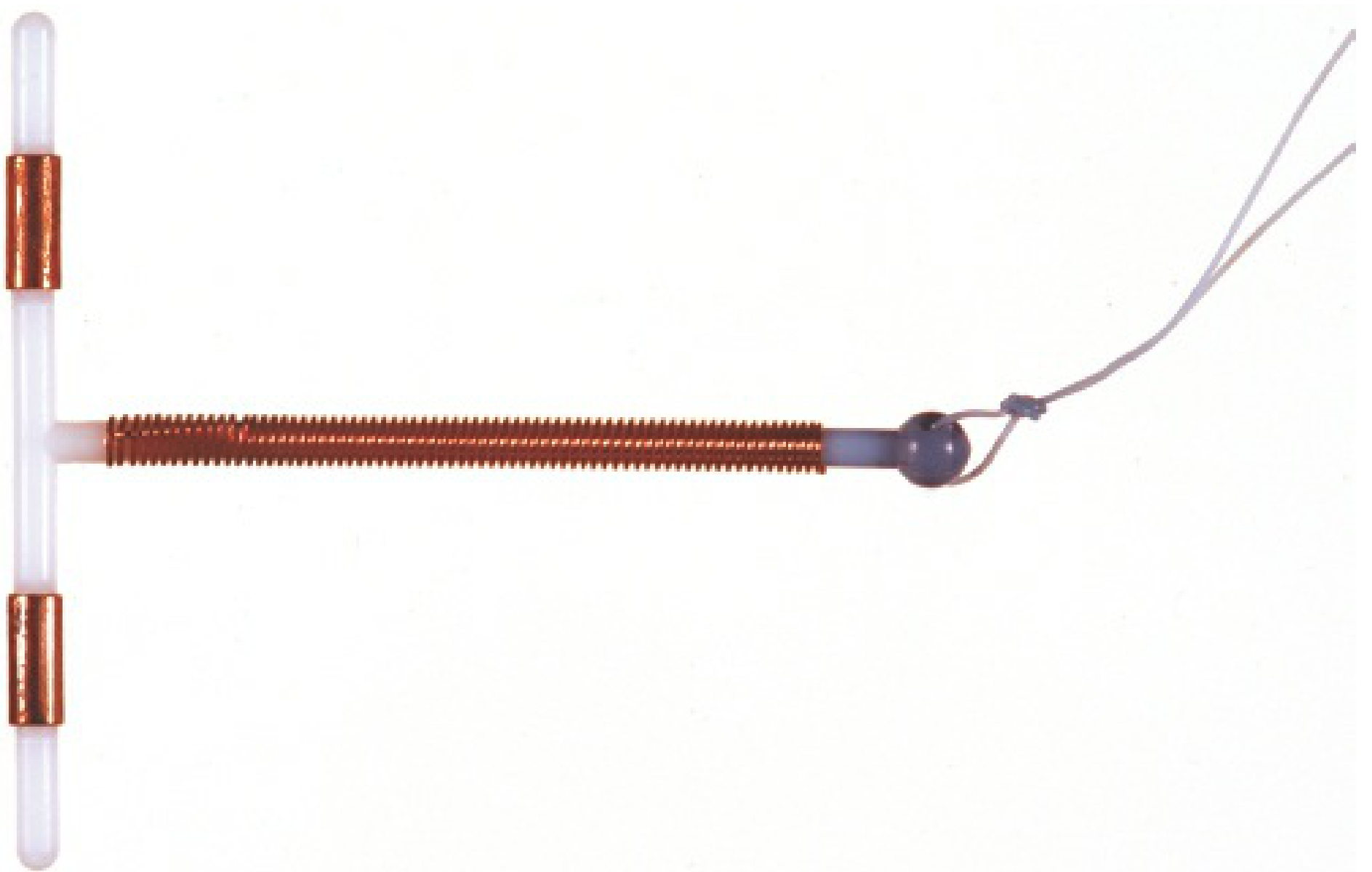
3.3 Mechanism of Action
Copper IUDs:
- Cause the formation of a "biological foam" within the uterine cavity (fibrin, phagocytic cells, proteolytic enzymes)
- Stimulate prostaglandin formation - causing smooth muscle contraction and inflammation
- Copper ions produce an even greater local inflammatory response
- Alter surface morphology of endometrial cells (microvilli of ciliated cells)
- Major alterations in uterine protein composition, preventing sperm passage - primarily prevent fertilization
LNG-IUDs:
- Released levonorgestrel at ~20 µg/day (declining to 10 µg/day by year 5)
- Thickened and scant cervical mucus - prevents sperm penetration
- Endometrial atrophy
- Intrauterine inflammatory response
- About 85% of cycles remain ovulatory
3.4 Efficacy
| Device | Pregnancy Rate |
|---|---|
| Copper T380A | <0.2 per 100 woman-years |
| 52-mg LNG-IUD | <0.2 per 100 woman-years |
| Cumulative (12 years, Copper T380A) | 1.9 per 100 women (no pregnancies after year 8) |
All IUDs provide efficacy equivalent to tubal sterilization.
3.5 Benefits
- Excellent long-term contraception with no continued effort required
- Both copper T380A and LNG-IUDs protect against ectopic pregnancy
- LNG-IUD reduces menstrual bleeding and cramping - used for menorrhagia (alternative to hysterectomy in Europe and UK)
- LNG-IUD effective for endometriosis, adenomyosis, uterine fibroids
- Reduces risk of endometrial cancer
- Fertility returns rapidly after removal (1-year pregnancy rate: 89 per 100 for women <30 years)
3.6 Risks and Complications
Pelvic Inflammatory Disease (PID):
- Risk increased only in the first 20 days after insertion (WHO prospective study)
- Beyond 20 days, PID rate = 1.6 per 1,000 women/year (same as general population)
- Risk is primarily from STI exposure, not IUD itself
- HIV is NOT a contraindication for IUD use
Ectopic Pregnancy:
- IUDs reduce absolute risk of ectopic by preventing most pregnancies
- But if pregnancy occurs with IUD in situ, risk of ectopic is higher (relative risk increased)
Expulsion:
- 36-month cumulative expulsion rate: ~10 per 100 users
- Higher in females aged 14-19 years
- Higher after postplacental insertion (24-27%)
Uterine Perforation:
- Risk: ~1 per 1,000 insertions
- Higher risk when breastfeeding (RR 4.7 vs. non-lactating at ≤36 weeks postdelivery)
3.7 Contraindications (WHO Category 4 - Unacceptable Health Risk)
- Pregnancy
- Puerperal sepsis
- Active PID / purulent cervicitis
- Endometrial or cervical cancer
- Undiagnosed genital bleeding
- Gestational trophoblastic disease (with persistent elevated β-hCG)
- Uterine anomalies / fibroids distorting the endometrial cavity
- Copper-specific: Copper allergy, Wilson's disease
3.8 Insertion Technique (Key Steps)
- Expose cervix with speculum; cleanse with bactericidal (iodine) solution
- Measure uterine cavity with uterine sound - cavity should be ≥6 cm from external os
- Grasp cervix with tenaculum (mandatory to prevent perforation); straighten cervical-uterine angle
- Introduce IUD-loaded inserter through cervical canal
- Release IUD arms at fundus; withdraw inserter; cut strings to ~2 cm from external cervical os
3.9 IUD in Pregnancy
If intrauterine pregnancy is found with IUD in situ and strings visible: remove immediately to prevent septic abortion, premature rupture of membranes, and preterm birth.
- Berek & Novak's Gynecology, pp. 721-728
- Park's Textbook of Preventive and Social Medicine, p. 580
Key Point for 10-Mark Answer: The IUD (specifically Copper T380A and Cu-375) is the most important spacing method in national family planning programs. Couple Protection Rate (CPR) - the percentage of eligible couples protected by an approved family planning method (sterilization, IUD, condom, or oral pills) - is a key indicator; a CPR >60% is needed to achieve NRR = 1.
This is a shared conversation. Sign in to Orris to start your own chat.