
Elderly gentleman, 76 year old , ex Air Force pilot , presents with gradually worsening episodes of sleep walking at night reported by wife , long detailed dreams , wakes up groggy , daytime sleeping , no signs of infection , known case of hypothyroidism on levothyroxine 125 with normal t4 and TSH 6months back , today blood results show Na of 127 and other bloods are normal. Differentials? Is this a medical cause ? Neurological? Or psychological?
Reading File
This is a complex clinical case. Let me search the medical library across all relevant dimensions simultaneously.
Finding Sources
Finding Sources
Finding Sources
Searching PubMed
REM sleep behavior disorder elderly Parkinson prodromal
Good results. Now let me pull deeper content from the key sources.
Reading File
Reading File
Finding Sources
Finding Sources
Excellent data. Let me get the hyponatremia clinical detail and RBD/synucleinopathy information.
Reading File
Reading File
Finding Sources
Finding Sources
I now have very rich data from authoritative sources. Let me fetch one key image and do a PTSD/veteran query and hypothyroidism hyponatremia connection.
Finding Sources
Finding Sources
I now have comprehensive data to construct a thorough, well-sourced answer. Let me also fetch the parasomnia states diagram which is directly relevant.
Loading Image
I now have all the information needed for a thorough, well-sourced answer. Here it is:
Clinical Analysis: 76-Year-Old Ex-Pilot with Nocturnal Behaviours
This is a genuinely complex, multi-domain case. The symptom cluster - nocturnal motor behaviours with vivid detailed dreams, morning grogginess, daytime somnolence, in a 76-year-old male - combined with Na 127 mmol/L and known hypothyroidism creates a rich differential that spans medical, neurological, and (importantly, given his background) psychiatric territory.
The Key Diagnostic Distinction First: RBD vs. NREM Parasomnia (Sleepwalking)
This is the most important question before anything else.
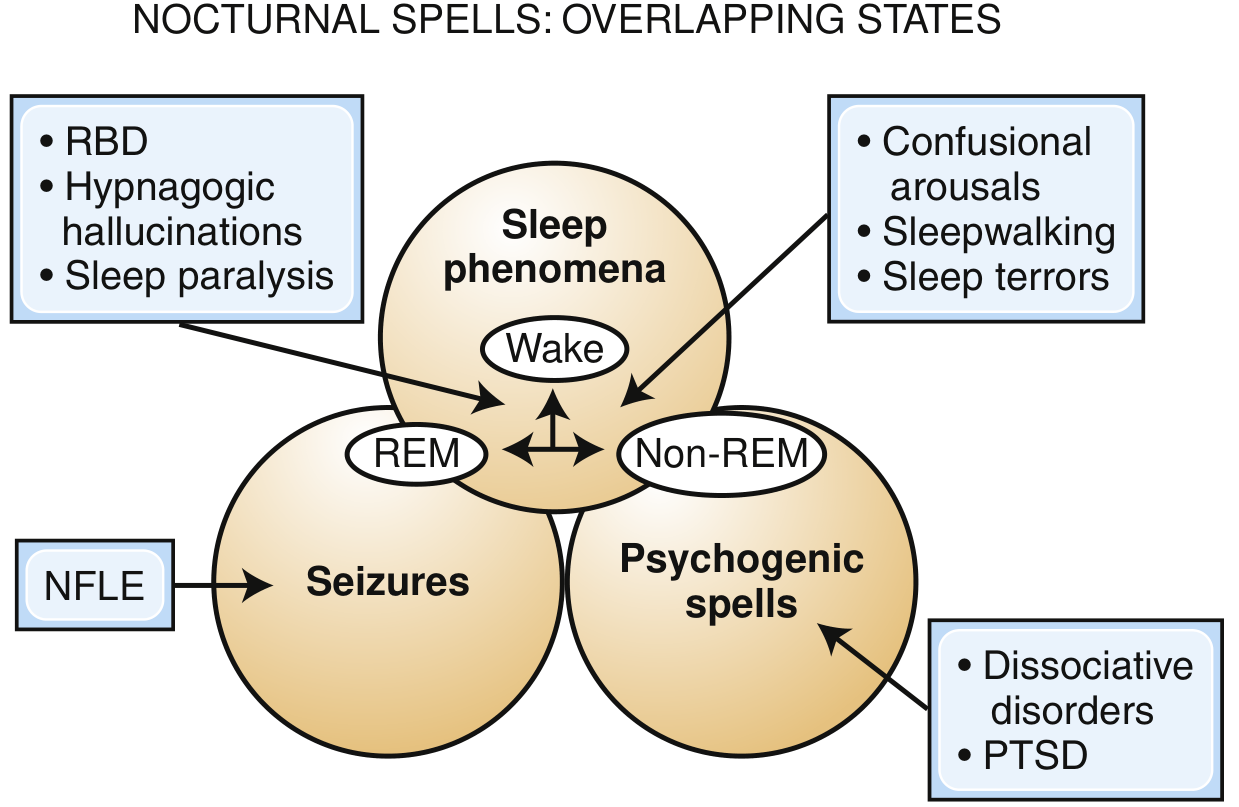
The wife describes what sounds like sleepwalking, but the co-occurrence of long, detailed vivid dreams that the patient likely recalls is a major red flag. True NREM sleepwalking (somnambulism) occurs in the first third of the night, from slow-wave sleep, and is associated with little or no dream recall - the patient is "blank." REM Sleep Behaviour Disorder (RBD) occurs in the latter half of the night, is associated with vivid dream enactment, and the patient can often recall the dream content upon waking.
The distinction matters enormously because RBD in a man over 50 is a neurodegenerative red flag.
| Feature | NREM Sleepwalking | RBD |
|---|---|---|
| Time of night | First third | Latter half |
| Dream recall | None/vague | Vivid, detailed |
| Memory of event | None | Often present |
| Age of onset | Childhood - young adult | >50 years (rare before 50) |
| PSG finding | Arousal from slow-wave | REM without atonia |
| Neurodegenerative link | No | Yes (synucleinopathy) |
- Bradley and Daroff's Neurology in Clinical Practice, p. 2414 - "RBD rarely starts before age 50; it is most often a chronic disorder associated with a synucleinopathy, particularly Lewy body dementia."
- Goldman-Cecil Medicine, p. 3914 - "REM sleep behavior disorder typically begins in late adulthood...patients lose the muscle atonia of REM sleep and thus act out during their dreams...nonstereotypical motor activity is often associated with vivid recall of a dream that correlates with the witnessed behavior."
Differential Diagnoses - Ranked by Priority
1. REM Sleep Behaviour Disorder (RBD) - Prodromal Synucleinopathy [HIGHEST PRIORITY - NEUROLOGICAL]
This is the single most important diagnosis to consider. In the over-50 male presenting with dream-enacting nocturnal behaviours and vivid dream recall:
- ~50% of patients with idiopathic RBD develop a synucleinopathy within 12-14 years of onset - specifically Parkinson disease, Lewy body dementia, or multiple system atrophy. - Principles of Neural Science (Kandel), 6th Ed.
- Lewy body dementia in particular presents with RBD as a core prodromal feature, sometimes years before cognitive decline becomes apparent.
- The morning grogginess and daytime hypersomnia are also characteristic of early Lewy body disease.
- His age (76) and sex (male) are the two strongest demographic risk factors.
- A detailed neurological exam looking for subclinical parkinsonism (masked facies, tremor, bradykinesia, rigidity, postural instability) and subtle cognitive testing are essential now.
- Polysomnography (PSG) with EMG monitoring is the diagnostic gold standard - it will show REM without atonia (RWSA).
Recent literature (PMID: 37598085 - Rev Neurol 2023) further reinforces the link between RBD and Parkinson's disease, and PMID: 38837629 (Psychogeriatrics 2024) highlights how dementia with Lewy bodies can present with psychiatric/sleep features years before the classic dementia phenotype.
2. Hyponatraemia as a Contributor [MEDICAL - IMPORTANT ACUTE MODIFIER]
Na = 127 mmol/L is significant and must not be dismissed. It is below 130 mmol/L, putting it in the symptomatic-risk zone, though above the 120 mmol/L threshold for severe manifestations.
- Morgan and Mikhail's Clinical Anesthesiology, 7e, p. 2159 - "Symptoms of hyponatraemia are primarily neurological...patients with mild to moderate hyponatraemia (Na >125 mEq/L) are frequently asymptomatic. Early symptoms are typically nonspecific: anorexia, nausea, weakness."
- Chronic hyponatraemia at 127 may cause lethargy, confusion, and altered sleep architecture - contributing to the grogginess and daytime somnolence.
- It can lower the seizure threshold and cause abnormal nocturnal movements that are metabolic rather than parasomnic in origin.
- Causes to investigate:
- Hypothyroidism - even with normal T4/TSH 6 months ago, hypothyroidism is a direct cause of normovolemic hypotonic hyponatraemia that mimics SIADH. Goldman-Cecil Medicine explicitly lists this. The TSH needs repeating now.
- SIADH - from CNS cause (early neurodegenerative process, medications), pulmonary pathology, malignancy.
- Medications - if any SSRIs, antidepressants, or other drugs have been added since the thyroid check.
- Adrenal insufficiency (cortisol to exclude).
- Polydipsia.
Critically, hyponatraemia at this level does not explain RBD-type dream enactment - it may amplify symptoms but is not the primary cause of the sleep behaviour. These are likely parallel findings, both requiring investigation.
3. Undertreated Hypothyroidism [MEDICAL]
- Even if TSH was normal 6 months ago, thyroid status can change. Hypothyroidism causes:
- Hyponatraemia (as above) via impaired free-water excretion and SIADH-like state
- Fatigue, daytime somnolence, cognitive blunting
- In severe cases: myxoedema can cause confusion, hypoventilation, and sleep disordered breathing
- Repeat TFTs today is mandatory - do not rely on 6-month-old results when his sodium is 127.
4. Obstructive Sleep Apnea (OSA) [MEDICAL]
- Very common in elderly males, particularly ex-military (higher BMI rates, structural airway changes).
- OSA fragments sleep architecture, increases REM pressure when it eventually occurs, and can trigger RBD-like episodes or unmask underlying RBD.
- Causes daytime somnolence and non-restorative sleep with morning grogginess.
- Epworth Sleepiness Scale + overnight oximetry or polysomnography needed.
5. PTSD with Nightmare Disorder [PSYCHIATRIC/PSYCHOLOGICAL - MUST NOT IGNORE GIVEN HISTORY]
This is the "elephant in the room" for an ex-Air Force pilot. Military aviation carries one of the highest exposure rates for operational trauma, combat stress, and witnessing accidents or casualties.
- PTSD nightmare disorder presents with vivid, recurrent, distressing dreams - often replays of traumatic events - with nocturnal motor arousal, screaming, and complex behaviours.
- The wife's report is classic for both RBD and PTSD - the two cannot be separated on history alone.
- PTSD nightmares, unlike RBD, tend to be stereotyped (same or similar content), emotionally distressing, and associated with waking anxiety, hypervigilance, and avoidance behaviours during the day.
- It is entirely possible this man has had subclinical PTSD for decades that is now surfacing more overtly in his 70s as other neurological reserve diminishes.
- The Kaplan and Sadock's Synopsis of Psychiatry directly places PTSD under "psychogenic spells" that mimic parasomnias (see figure above).
- A careful, sensitive psychiatric history focused on his service history is essential.
6. Nocturnal Frontal Lobe Epilepsy (NFLE) [NEUROLOGICAL]
- Complex nocturnal motor behaviours can represent frontal lobe seizures, which can occur at any age.
- Unlike RBD, NFLE tends to be more stereotyped and brief (seconds to 1-2 minutes).
- Needs consideration if PSG and MRI are non-diagnostic.
- EEG with sleep study can differentiate.
7. Medication-Induced RBD [IATROGENIC]
- His levothyroxine at 125 mcg is unlikely to cause this.
- However, if he is on SSRIs, SNRIs, TCAs, MAOIs, or beta-blockers, these are all known to provoke or worsen RBD by altering REM sleep architecture.
- Goldman-Cecil Medicine - "REM sleep behavior disorder can be provoked by tricyclic antidepressants, monoamine oxidase inhibitors, and serotonin reuptake inhibitors."
- Full medication review is mandatory.
Summary of Causes by Category
| Category | Differential |
|---|---|
| Neurological (primary) | RBD - prodromal synucleinopathy (PD/DLB/MSA), NFLE, early dementia with Lewy bodies |
| Medical (contributing/parallel) | Hyponatraemia (Na 127), undertreated hypothyroidism, OSA, medication-induced RBD |
| Psychiatric/Psychological | PTSD nightmare disorder (ex-military - high prior probability) |
Recommended Immediate Workup
- Repeat TFTs today (TSH, free T4, free T3) - do not rely on 6-month data given Na 127
- Serum cortisol - exclude adrenal insufficiency as cause of hyponatraemia
- Urine sodium and osmolality + serum osmolality - to characterise the hyponatraemia (SIADH vs. hypothyroid vs. other)
- Full medication review - any psychotropics, antidepressants, or new additions since last review?
- Polysomnography (PSG) with full EMG - gold standard; will differentiate RBD (REM without atonia) from NREM parasomnia and OSA
- Neurological examination - motor assessment for subclinical parkinsonism (rigidity, bradykinesia, tremor), cognitive screen (MoCA)
- Psychiatric assessment - structured PTSD screen (PCL-5), sleep interview with the wife present; ask specifically about dreams' content and emotional tone
- Brain MRI (if available) - looking for early structural change, cortical atrophy patterns
- Chest X-ray - exclude pulmonary cause of SIADH, especially in an elderly ex-pilot (occupational exposures)
The Bottom Line
This is most likely a combination of two processes running in parallel: an emerging RBD/prodromal synucleinopathy (the vivid dream enactment, age, sex, and timing are strongly suggestive) alongside a metabolic disturbance from hyponatraemia amplifying the neurological symptoms. His history as a military pilot makes PTSD nightmare disorder a serious parallel consideration that must be addressed sensitively and directly - it is easily missed in stoic, high-functioning veterans who have never disclosed it.
The hyponatraemia at 127 needs a cause identified and corrected regardless of the sleep diagnosis. Hypothyroidism is the single most important cause to exclude first given his known history, even though TFTs were normal 6 months ago.
Do not reassure this patient that this is "just sleepwalking." Referral to both neurology (for PSG and synucleinopathy workup) and liaison psychiatry (for PTSD assessment) is appropriate now.
Can I give a trial of low dose benzodiazepine ?
Short answer: It depends entirely on which diagnosis you're treating - and in this patient, a benzodiazepine trial carries meaningful risks that need to be weighed carefully before prescribing.
Searching sources...
Finding Sources
Finding Sources
Finding Sources
Searching PubMed
clonazepam melatonin REM sleep behavior disorder treatment
Reading File
Reading Article
PMID: 35141811
Reading File
Excellent - very rich data from multiple authoritative sources including a head-to-head RCT. Here is the full answer:
Should You Give a Benzodiazepine Trial?
The Direct Answer
Technically yes - clonazepam is a recognised treatment for RBD - but in this specific patient it should not be your first choice, and if used at all, requires significant caution. The combination of his age (76), unresolved hyponatraemia, probable neurodegenerative prodrome, possible OSA, and possible PTSD creates a risk profile that tilts the decision firmly toward melatonin first.
What the Evidence Says About Benzodiazepines in RBD
Clonazepam and melatonin are both listed as the two standard pharmacological options for RBD, both rated "Suggested" - the same evidence level - in the AASM guidelines. Neither is FDA-approved specifically for RBD.
From Bradley and Daroff's Neurology in Clinical Practice:
| Drug | Dose | Level | Special Considerations |
|---|---|---|---|
| Melatonin | 3-12 mg (regular) or 5-15 mg (sustained release) QHS | Suggested | Effective in alpha-synucleinopathies; safe in memory problems and OSA |
| Clonazepam | 0.25-2.0 mg QHS | Suggested | Use with caution in dementia, gait disorders, or concomitant OSA. Side effects: sedation, motor incoordination, confusion, memory dysfunction |
The RCT by Byun et al. (2023, PMID: 35141811) directly compared clonazepam 0.5 mg vs prolonged-release melatonin 2 mg in confirmed isolated RBD:
- Clonazepam reduced REM-without-atonia (RWA) on PSG more effectively.
- However, clonazepam increased depressive symptoms and daytime sleepiness - which this patient already has.
- Melatonin reduced daytime sleepiness and insomnia without worsening depression.
- Adverse event rates were similar between the two groups.
Goldman-Cecil Medicine states: "For REM sleep behavior disorder, most patients respond well to melatonin (3 to 20 mg) or clonazepam (0.25 to 3 mg)" - placing melatonin first in the listing.
Kaplan and Sadock's Comprehensive Textbook of Psychiatry explicitly warns: "Clonazepam may have a benefit for RBD, but like all long half-life benzodiazepines must be used cautiously in older adults."
Why This Specific Patient Is High Risk for a Benzodiazepine
Work through each active problem:
1. Age 76 - Geriatric pharmacology
Benzodiazepines in the elderly cause disproportionate:
- Fall and hip fracture risk (he is an ambulatory sleepwalker - this is not theoretical)
- Paradoxical disinhibition and worsening nocturnal behaviour
- Cognitive impairment - especially dangerous if early Lewy body dementia is the underlying diagnosis
- Accumulation: clonazepam has a half-life of 18-50 hours; in an elderly man this becomes a 2-3 day accumulating drug
2. Na = 127 mmol/L - Unresolved hyponatraemia
Benzodiazepines can worsen hyponatraemia via multiple mechanisms (ADH stimulation, sedation-related fluid handling). You are adding CNS depressant load to an already metabolically-compromised brain. This needs to be corrected before adding sedating agents.
3. Possible OSA
Clonazepam causes respiratory depression and muscle relaxation - in a patient with undiagnosed OSA this can worsen apnoeic events, desaturations, and paradoxically fragment sleep further. The table in Bradley and Daroff explicitly lists OSA as a contraindication to clonazepam for this reason. If OSA is present, treating it with CPAP may substantially reduce the nocturnal events without any pharmacological risk.
4. Possible prodromal synucleinopathy (DLB/PD)
- Patients with Lewy body dementia are exquisitely sensitive to benzodiazepines and sedating agents - they can precipitate acute neuroleptic-like sensitivity reactions with marked worsening of parkinsonism, severe sedation, and delirium.
- You do not yet have a neurological diagnosis confirmed. Starting a CNS depressant before that workup is complete could muddy the clinical picture significantly.
5. PTSD (if confirmed)
Benzodiazepines are not recommended for PTSD and may worsen it. Current PTSD guidelines (VA/DoD) specifically advise against benzodiazepines because they impair fear extinction, worsen nightmare frequency in the longer term, and carry high addiction potential in this population. If PTSD is the primary driver, a benzo trial would be working against the correct treatment (imagery rehearsal therapy, prazosin for nightmares, trauma-focused CBT).
What to Do Instead
Step 1 - Safety first (no medication needed)
Goldman-Cecil Medicine is explicit - environmental safety measures come before any drug:
- Pad the floor around the bed
- Remove sharp or breakable objects from the bedroom
- Consider a single ground-floor bed
- A sleeping partner should be advised to move away - RBD patients can injure spouses
Step 2 - Fix the reversible causes first
- Correct the hyponatraemia (identify and treat the cause - repeat TFTs now)
- Screen for and treat OSA (overnight oximetry at minimum; CPAP if confirmed)
- Stop any offending drugs (SSRIs, TCAs) if present
Step 3 - Start melatonin, not a benzodiazepine
Melatonin 3-6 mg QHS (titrate to 12 mg if needed) is the better first-line choice in this patient because:
- No respiratory depression - safe if OSA is present
- No falls risk
- No cognitive impairment
- Safe in probable synucleinopathy
- Particularly studied in alpha-synucleinopathy patients (see Bradley and Daroff table above)
- The 2026 meta-analysis (PMID: 40588412) supports melatonin for sleep disturbances in Parkinson's disease specifically
Step 4 - If melatonin fails and RBD is PSG-confirmed
Low-dose clonazepam 0.25-0.5 mg QHS can be trialled with:
- Lowest effective dose
- Falls precautions documented and discussed
- Hyponatraemia corrected first
- OSA excluded or treated
- Cognitive baseline documented
- Regular review - not indefinite prescription
- Explicit discussion with patient and wife about risk
Summary
| Melatonin | Low-dose Clonazepam | |
|---|---|---|
| Efficacy in RBD | Good (clinically) | Slightly better on PSG |
| Falls risk | None | Significant at 76 |
| OSA safety | Safe | Contraindicated if OSA |
| Hyponatraemia | Neutral | Potentially worsening |
| Lewy body sensitivity | Safe | High risk |
| PTSD | Neutral | Contraindicated |
| Daytime sleepiness | Reduces it | Worsens it |
Bottom line: Do not start a benzodiazepine in this man until you have resolved the hyponatraemia, screened for OSA, completed a neurological examination, and considered PTSD. If you need to start something now for safety (violent nocturnal events), melatonin 3-6 mg QHS is the correct first-line choice in a 76-year-old with his constellation of risk factors.
This is a shared conversation. Sign in to Orris to start your own chat.