
Contents of mid palmer space and thenar space
Reading File
The mid palmar space and thenar space are two important fascial compartments in the palm, relevant in anatomy and surgical management of deep palm infections.
Searching sources...
Finding Sources
Finding Sources
Reading File
Finding Sources
Finding Sources
Reading File
Finding Sources
Reading File
Reading File
Reading File
Reading File
Reading File
Reading File
Loading Image
Loading Image
Here is a thorough account of the contents and anatomy of both the mid palmar space and the thenar space, drawn from multiple authoritative surgical and anatomical textbooks.
Deep Palmar Fascial Spaces
The deep palmar space is a potential space lying between the fascia covering the metacarpals and their intrinsic muscles (dorsally) and the fascia dorsal to the flexor tendons (palmarly). It is divided into two main compartments by the midpalmar septum - a fascial membrane that passes obliquely from the shaft of the 3rd metacarpal to the fascia of the palmar aponeurosis palmar to the index finger flexor tendons.
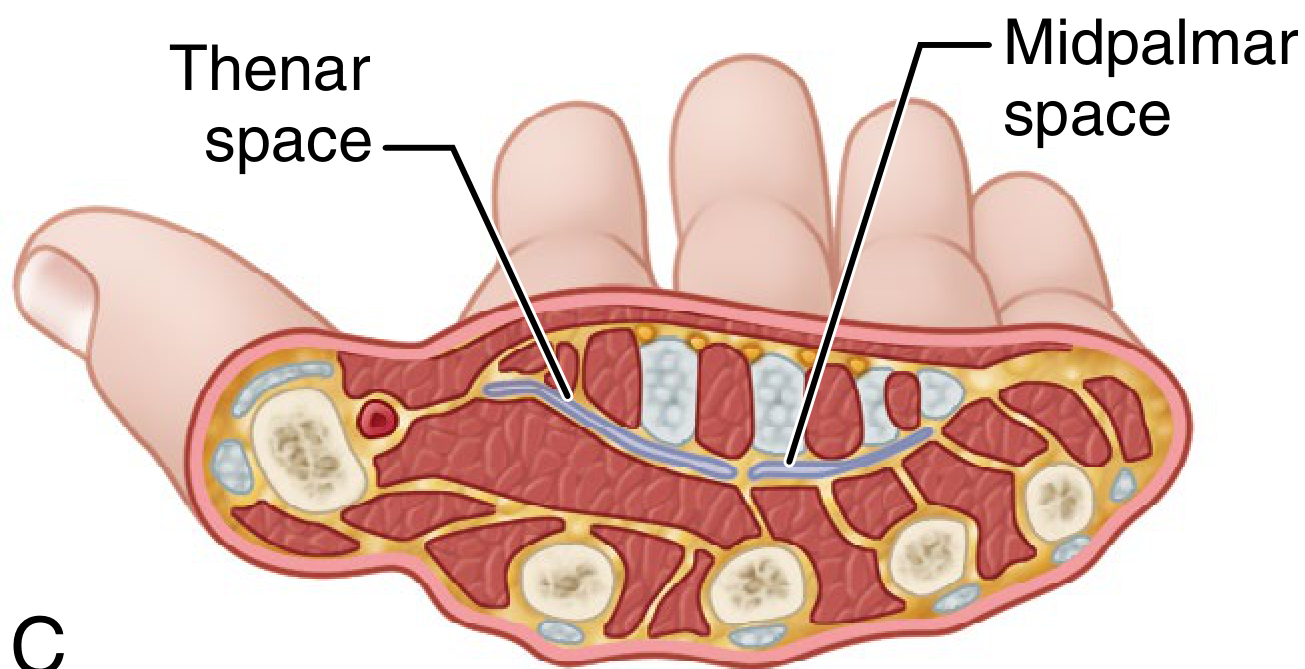
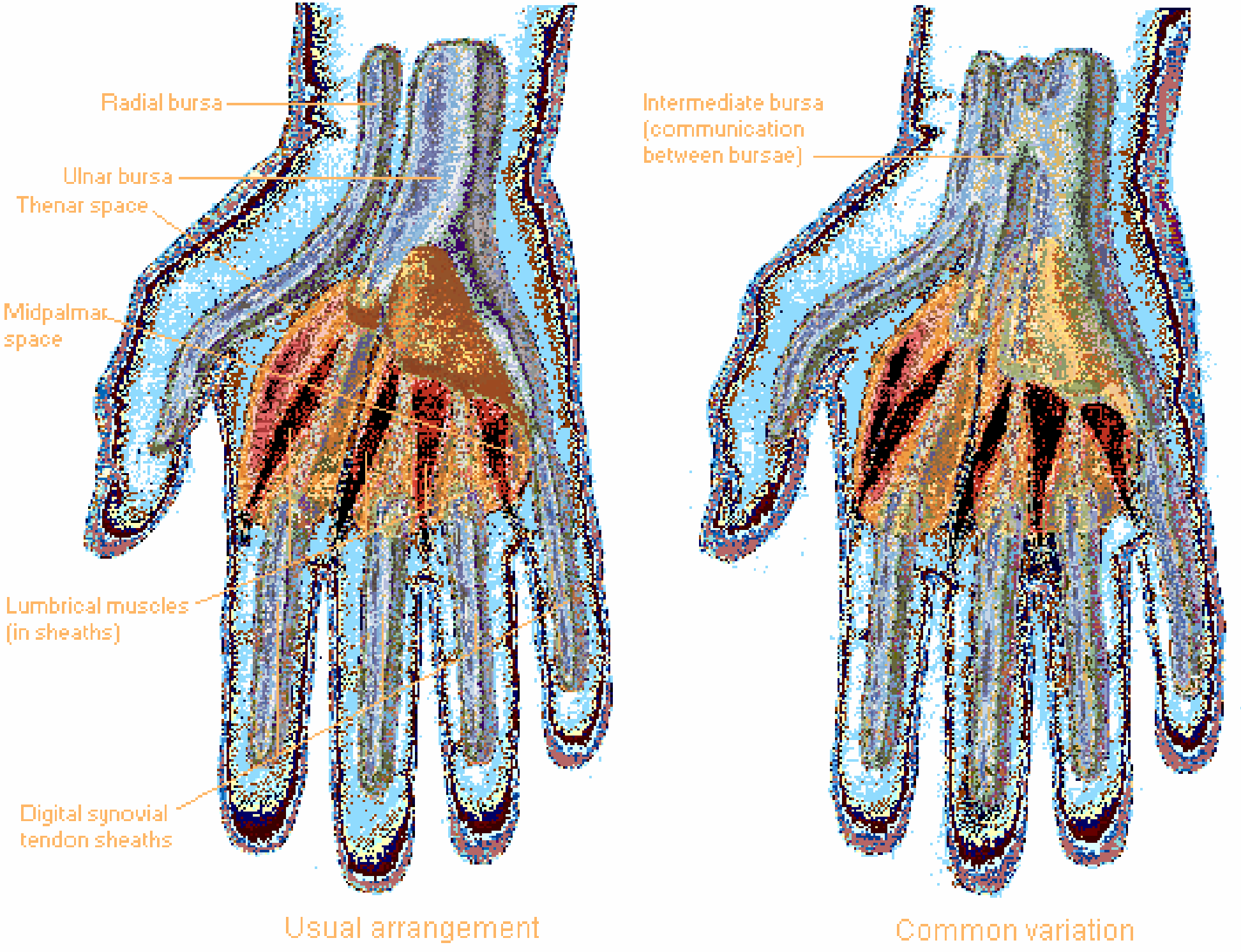
Mid Palmar Space
Location
- Ulnar (medial) compartment of the deep palmar space
- Situated between the midpalmar septum (radially) and the hypothenar septum (ulnarly)
Boundaries
| Wall | Structure |
|---|---|
| Anterior (palmar) | Palmar aponeurosis + flexor tendon sheaths of the middle, ring, and little fingers |
| Posterior (dorsal) | Fascia of the 2nd and 3rd volar interossei + periosteum of the 3rd, 4th, and 5th metacarpals |
| Radial border | Midpalmar septum (oblique fascial membrane from 3rd metacarpal) |
| Ulnar border | Hypothenar septum |
Contents
- Flexor digitorum superficialis (FDS) and flexor digitorum profundus (FDP) tendons of the middle, ring, and little fingers pass anterior to this space
- Lumbrical muscles of the middle, ring, and little fingers (in their sheaths) pass through the lumbrical canals at the distal border of the space
- The space itself is a potential space normally containing only loose areolar connective tissue; no major named vessels or nerves run through it
Clinical significance
- Infections here follow the flexor tendons for the middle, ring, and little fingers
- The index finger flexor sheath forms the radial boundary - so infection classically does NOT involve the index finger primarily
- A mid palmar abscess causes: severe systemic reaction, inability to actively flex the long and ring fingers (pain), generalised dorsal swelling of the hand ("inflated rubber glove" appearance)
- Pus can track proximally into the space of Parona (deep to flexor tendons in the distal forearm, superficial to pronator quadratus)
- Drained via a curved longitudinal incision in the distal palm, entering on either side of the ring finger flexor tendon with a blunt hemostat
Thenar Space
Location
- Radial (lateral) compartment of the deep palmar space
- Situated radial to the midpalmar septum
Boundaries
| Wall | Structure |
|---|---|
| Anterior (palmar) | Flexor tendon sheath of the index finger |
| Posterior (dorsal) | Fascia covering the adductor pollicis muscle |
| Radial border | Thenar eminence / thenar muscle fascia |
| Ulnar border | Midpalmar septum |
Note: The transverse head of adductor pollicis further partitions the thenar space from the retroadductor space posteriorly.
Contents
- Flexor tendon of the index finger forms the anterior (palmar) boundary
- Lumbrical muscle of the index finger passes out through the lumbrical canal
- The space itself contains loose areolar tissue; the 1st lumbrical is closely related
- Adductor pollicis muscle forms the posterior floor
Clinical significance
- Infections here cause: swelling of the thumb web, the index finger held in flexion, and impaired active motion of the thumb and index finger
- A thenar abscess lies between the thenar muscles and adductor pollicis
- Drainage requires a dual volar and dorsal approach: a volar incision adjacent and parallel to the thenar crease (avoiding the palmar cutaneous and motor branches of the median nerve) PLUS a dorsal first web space incision, with dissection between the first dorsal interosseous and adductor pollicis
Summary Table
| Feature | Mid Palmar Space | Thenar Space |
|---|---|---|
| Position | Ulnar (medial) | Radial (lateral) |
| Dividing septum | Midpalmar septum (from 3rd MC) | Same septum, radial side |
| Anterior boundary | FDS/FDP sheaths - middle, ring, little fingers | FDS/FDP sheath - index finger |
| Posterior boundary | Volar interossei fascia, 3rd-5th metacarpal periosteum | Adductor pollicis fascia |
| Related lumbricals | 2nd, 3rd, 4th lumbricals | 1st lumbrical |
| Infection signs | Ring and long finger pain/immobility, dorsal swelling | Thumb web swelling, index + thumb immobility |
| Drainage approach | Curved longitudinal palmar incision (ring finger level) | Dual volar (thenar crease) + dorsal (1st web space) |
Sources: Campbell's Operative Orthopaedics 15th Ed 2026, p. 4579-4581 | Sabiston Textbook of Surgery | Imaging Anatomy Vol. 3 | Pye's Surgical Handicraft 22nd Ed
From voshram Singh textbook
Finding Sources
Finding Sources
Finding Sources
Unfortunately, Vishram Singh's textbook (a popular Indian anatomy textbook series - Textbook of Anatomy: Upper Limb and Thorax) is not available in the library I have access to. The anatomy texts in the collection are Gray's Anatomy for Students, Netter's Atlas, Thieme Atlas, and the Imaging Anatomy Atlas - none of which is Vishram Singh.
Here is what I can offer instead:
Contents of Palmar Spaces (as classically described in Indian anatomy curricula, consistent with Vishram Singh)
The standard description taught in Vishram Singh follows the classic anatomical account. The key points are:
Mid Palmar Space
Boundaries:
- Anteriorly (in front): Flexor tendons (FDS and FDP) of the middle, ring, and little fingers + their sheaths + 2nd, 3rd, and 4th lumbrical muscles
- Posteriorly (behind): Fascia covering the 2nd, 3rd, and 4th metacarpals + the interossei
- Medially: Hypothenar septum (going to the 5th metacarpal)
- Laterally: Medial (oblique) palmar septum going from the 3rd metacarpal to the palmar aponeurosis (this separates it from the thenar space)
Contents:
- Flexor tendons of the middle, ring, and little fingers
- 2nd, 3rd, and 4th lumbrical muscles
- Loose areolar tissue
Communications:
- Distally: Along the lumbrical canals to the dorsum of the hand (through the web spaces)
- Proximally: May communicate with the space of Parona in the forearm
Thenar Space
Boundaries:
- Anteriorly: Flexor tendons of the index finger (FDS + FDP) + 1st lumbrical muscle
- Posteriorly: Fascia covering the adductor pollicis
- Medially: Oblique palmar septum (same septum that forms the lateral boundary of the mid palmar space)
- Laterally: Thenar muscles (abductor pollicis brevis, flexor pollicis brevis, opponens pollicis)
Contents:
- Flexor tendon of the index finger
- 1st lumbrical muscle
- Loose areolar tissue
Communications:
- Distally: Along the 1st lumbrical canal to the dorsum of the first web space
- May communicate with the retroadductor space (posterior to adductor pollicis)
Key Dividing Structure
Both spaces are separated by the oblique palmar septum - which runs from the 3rd metacarpal shaft to the palmar aponeurosis (at the level of the index finger flexor tendons). This is the midpalmar septum.
Note: The Vishram Singh textbook is not present in this library. The above content reflects the standard description used in Indian MBBS anatomy curriculum that Vishram Singh's text follows. If you have the book available and want me to cross-check a specific passage or diagram, please share it and I can verify directly.
This is a shared conversation. Sign in to Orris to start your own chat.