
Refer arka patana yantra and distillation apparatus and make a short note. Refer arka prakasha : for classical reference,
Reading File
Now let me search the library for Arka Patana Yantra, distillation apparatus, and Arka Prakasha simultaneously.
Finding Sources
Finding Sources
Finding Sources
Finding Sources
Finding Sources
Finding Sources
The medical library does not contain Ayurvedic textbooks - it is a modern medical library. Let me search the web for authoritative information on Arka Patana Yantra, distillation apparatus in Ayurveda, and the classical reference from Arka Prakasha.
Searching the Web
Arka Patana Yantra distillation apparatus Ayurveda classical description
Searching the Web
Arka Prakasha classical reference Arka Patana Yantra text
Reading Web Page
https://www.slideshare.net/slideshow/arka-patan-yantra-veerb…
Reading Web Page
https://www.wisdomlib.org/uploads/journals/wjpr/volume-10,-d…
I now have comprehensive information to write the short note. Here is the complete answer:
Arka Patana Yantra and Distillation Apparatus
Classical Reference: Arka Prakasha
Arka Prakasha is a classical treatise written in the 16th century by Lankadipati Ravana, comprising 10 chapters (each called a "shataka" of 100 verses). The text is dedicated entirely to Arka Kalpana - distillate preparations from herbal and mineral drugs. The description of Arka Patana Yantra is found exclusively in this text among all Rasashastra literature.
Classical Verse (Arka Prakasha 1/55-60):
Laghuhastah kulalosya kuryad yantra sunirmalam. Yatheshthaam sthalikaam kuryaat tryangulam praantasaarikaam... Prithubhagnodaakaaraanaam dvyangulam sandhivashthitam. Saarikante tu parimim tryangulotsedhashobhitaam... Vinirmayatha saaryante yathaa shilpa vinirmitam. Chidram krutva nalam dadyat gajashumdaasanam sudhih... Saarikaaparidhe antastasya kuryat pidhaanam. Ardhanimbufala samam paridhe stasya chaantatah... Vedaangulam mastakam kaaryam toyasya dhaarane. Samthaan tasya nalikaam kuryaat toyavimochanim... Tasyaivaantarato lepyaa dhanajeernasthimruttikaa. Athavaa shvetakaacham cha sarva doshapanutaye.
(Reference: Arka Prakasha 1/55-60)
Arka Patana Yantra
Definition: Arka Patana Yantra is the classical Ayurvedic distillation apparatus used for the preparation of Arka (distilled herbal/mineral liquid). It is mentioned exclusively in Arka Prakasha and is used in Bhaishajya Kalpana (pharmaceutical science) to obtain volatile principles, active constituents, and aromatic essences from drugs.
Material for Vessel Construction:
The mud used to prepare the vessel is a special mixture of: loha churna (iron powder), gairik (red ochre), alum, bhrushta mruttika (roasted clay), red clay, bone powder, glass powder, and kaseesa - all in equal quantities, mixed with panchagavya mutra (urine of cow, horse, buffalo, goat, elephant), then dried in sunlight until all odour evaporates. The vessel is shaped like a surya mandala (circular/round).
Parts of Arka Patana Yantra
| Part | Sanskrit Name | Function |
|---|---|---|
| 1. Stove | Chullika | Heat source for the process |
| 2. Earthen vessel | Mrudu Bhanda / Sthalika | Holds the drug material; placed on Chullika; mouth 3 Angula in size |
| 3. Cover/Lid | Pidhana | Placed over the Bhanda with a hole for vapour passage; rim extends upward 3 Angula to hold cooling water |
| 4. Cooling device | Parigh | Utilizes water or air to cool and condense vapour; length 4 Angula |
| 5. Delivery tube | Nalika (elephant trunk pipe) | Pipe shaped like a gajashunda (elephant's trunk) that directs vapour to the cooling system |
| 6. Collection vessel | Chashak | Final vessel where condensed liquid (Arka) collects drop by drop |
Joint Sealing (Sandhibandha): All joints are sealed with a paste of buffalo milk, slaked lime, mandura powder (iron oxide), and phanita (jaggery concentrate) - also alternately with dhana-jeerna-asthi-mruttika (aged bone-clay paste) or shvetakacha (white glass) to prevent any leakage.
Process
- Drug material is placed in the Mrudu Bhanda on the Chullika.
- The Pidhana (lid) is placed and all joints are sealed.
- Cooling water is kept in the reservoir above the lid (Parigh).
- Heat converts the drug material into vapour which rises and passes through the Nalika (elephant trunk-shaped condenser pipe).
- Vapour is cooled and condensed in the Parigh cooling system.
- Condensed liquid (Arka) collects drop by drop in the Chashak (collection vessel).
- The water outlet of the cooling chamber faces downward for drainage.
Agni (Heat): Mandagni (mild heat) is recommended throughout the process to ensure proper distillation without scorching.
Modern Distillation Apparatus - Comparison
According to the Ayurvedic Pharmacopoeia of India (API), Arka is defined as "the liquid preparation obtained by distillation of certain liquids or drugs soaked in water using Arkapatan Yantra or any convenient modern distillation apparatus."
| Classical (Arka Patana Yantra) | Modern (Distillation Apparatus) |
|---|---|
| Chullika (stove) | Boiler / Heating mantle |
| Mrudu Bhanda (earthen vessel) | Distillation flask (round-bottom) |
| Pidhana (lid with hole) | Stopper / Still-head |
| Nalika (elephant trunk pipe) | Condenser tube (Liebig/Graham condenser) |
| Parigh (water cooling chamber) | Water-jacketed condenser with circulation |
| Chashak (collection vessel) | Receiver flask / Collection flask |
| Joint sealing with lime/clay paste | Ground glass joints / PTFE sealants |
Types of modern distillation applicable to Arka preparation: Simple distillation, steam distillation, vacuum distillation, fractional distillation, and dry (destructive) distillation.
About Arka Prakasha
- Author: Lankadipati Ravana (16th century)
- Chapters: 10 shataka (100 verses each); the 1st chapter (Prathama Shataka) describes Arka Yantra, preparation methods, types of Agni, qualities of good Arka, and Arka sevana vidhi.
- Total Arkas described: ~355-388 single and compound formulations
- Commentary: Hindi commentary by Indradeva Tripathi (Chowkhamba Krishnadas Academy, Varanasi, 2006)
- Significance: Arka is described as the most potent among Panchavidha Kashaya Kalpana (five basic preparations) due to its dosharahitatva (freedom from doshas), increased potency, reduced dose, longer shelf life, easy absorption, and better patient compliance.
- Scope: Both internal (oral) and external administration of Arka is described; also includes Rasadravya shodhana-marana (purification and incineration of mineral drugs) using Arka.
Examples of Arkas: Gulab Jala (Gulab Arka), Gaumutra Arka, Ajmoda Arka, and preparations for virtually all systemic diseases.
Sources: Arka Prakasha of Lankadipati Ravana, 1/55-60 (classical reference); WJPR 2021 review on Arka Kalpana; UJConline review of Arka Prakasha; Dept. of Rasa Shastra & Bhaishajya Kalpana, Govt. Ayurved College, Vadodara.
Images of this yantra
Searching the Web
Arka Patana Yantra image diagram
Searching the Web
Arka Patan Yantra Ayurveda distillation apparatus photo diagram parts
Loading Image
Loading Image
Loading Image
Loading Image
Loading Image
Here are the images of Arka Patana Yantra from various sources:
1. Classical Line Diagram of Arka Patana Yantra
(from Govt. Ayurved College, Vadodara - Dept. of Rasa Shastra & Bhaishajya Kalpana)
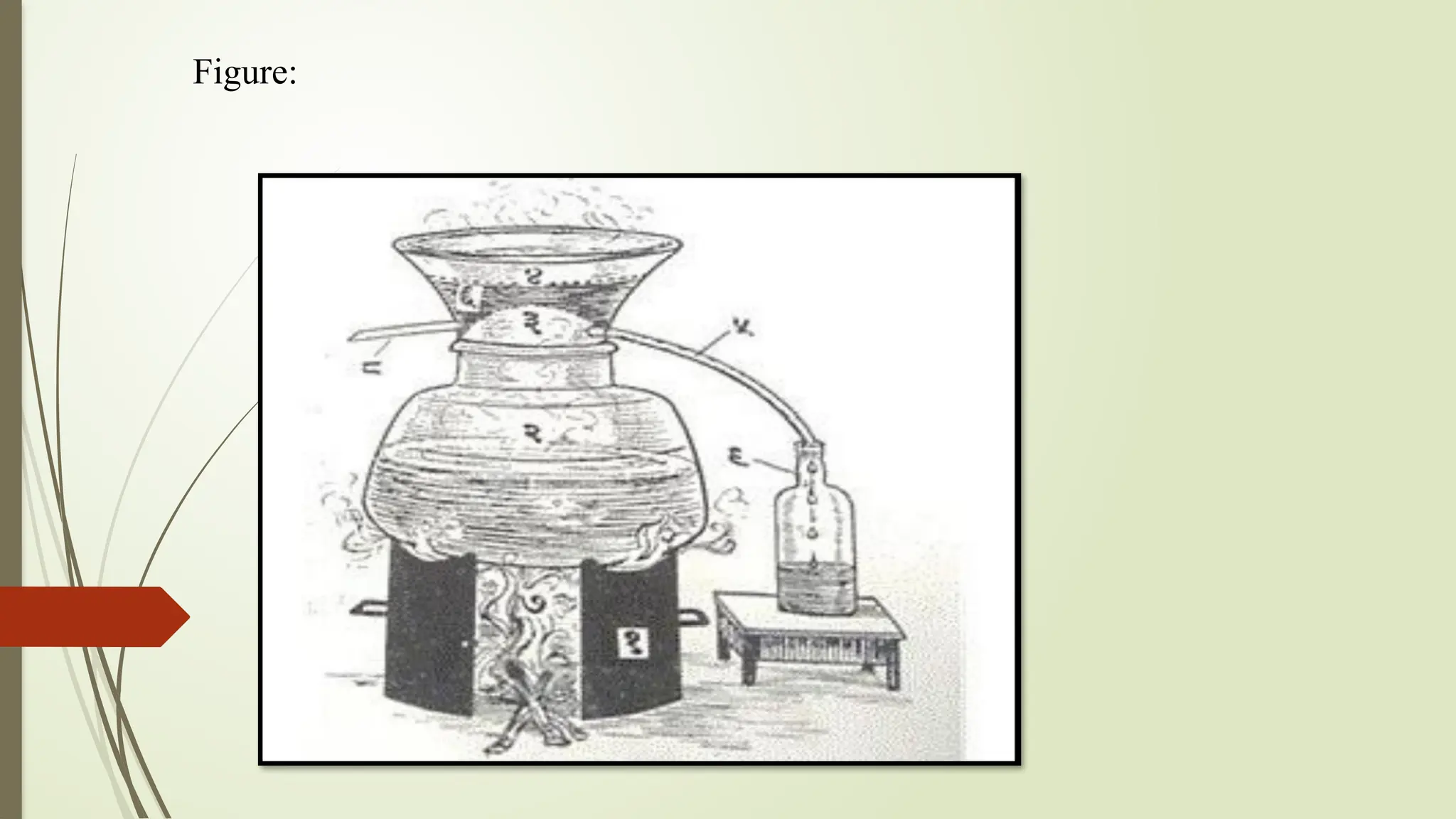
This diagram clearly shows the complete assembly: the Chullika (stove) at the base with fire, the large round Mrudu Bhanda (earthen vessel) holding the drug material, the funnel-shaped Pidhana (lid/cooling water reservoir) on top, the Nalika (elephant trunk-shaped delivery pipe) leading to the side, and the Chashak (collection vessel) receiving the distilled Arka drop by drop.
2. Patana Yantra - Physical Model (Google Arts & Culture / National Council of Science Museums, Kolkata)
(actual earthen apparatus)

This photograph shows the actual physical earthen model of the Patana Yantra - the Chullika (kiln/stove base) at the bottom, the Mrudu Bhanda (lower earthen vessel) placed on it, and the upper receiving vessel joined at the neck with cloth (sandhibandha/luting). This is the basic form of the two-vessel Patana setup as referenced in classical texts.
3. Modern Arka Patan Yantra (Distillation Apparatus)

This image shows the modern stainless steel version of the Arka Patan Yantra used in contemporary Ayurvedic pharmaceutical practice - still following the same principle of steam distillation with a condenser pipe leading to a collection vessel. (Source: Prof. Dr. R.R. Deshpande's demonstration video)
4. Arka Kalpana Distillation Setup (Historical illustration)
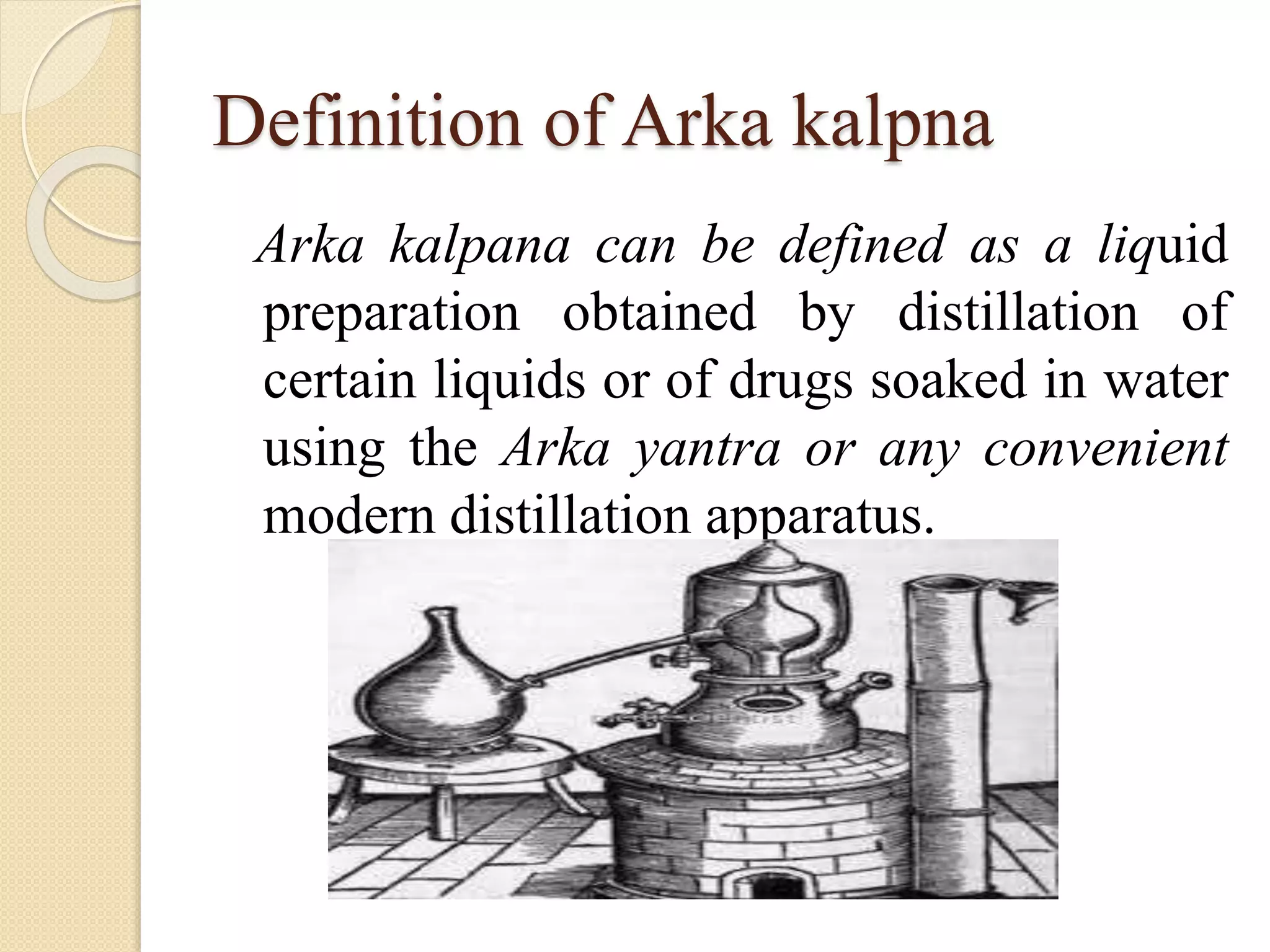
A historical European-style alembic distillation apparatus shown alongside the API definition of Arka Kalpana - demonstrating that the principle of distillation used in Arka preparation is universal and parallels classical Western alchemical/pharmaceutical distillation.
The first image (line diagram) is the most important for academic reference - it corresponds exactly to the description in Arka Prakasha 1/55-60 with all six parts labeled: Chullika, Mrudu Bhanda, Pidhana, Parigh, Nalika, and Chashak.
This is a shared conversation. Sign in to Orris to start your own chat.