
Neuromuscular transmission & factors modifying block . Simple and exam ready format . In a way I can remember and reproduce for md anaesthesia exam
Reading File
Finding Sources
Finding Sources
Finding Sources
Searching PubMed
neuromuscular blockade AND anesthesia
Searching the Web
neuromuscular blocking drugs factors modifying block anaesthesia review
Reading File
Reading File
Finding Sources
Finding Sources
Finding Sources
Finding Sources
Finding Sources
Finding Sources
Neuromuscular transmission and factors modifying neuromuscular block
1. Neuromuscular junction: a 30-second introduction
Neuromuscular transmission is conversion of a nerve action potential into skeletal-muscle contraction at the motor end plate.
Diagram to reproduce
Motor nerve terminal        Synaptic cleft             Muscle end plate
      ↓                          ↓                            ↓
AP arrives → Ca2+ influx → ACh release → ACh binds Nm receptor
                                                        ↓
                                              Na+ in, K+ out
                                                        ↓
                                            End-plate potential
                                                        ↓
                                           Muscle action potential
                                                        ↓
                                               Ca2+ release from SR
                                                        ↓
                                                 Contraction
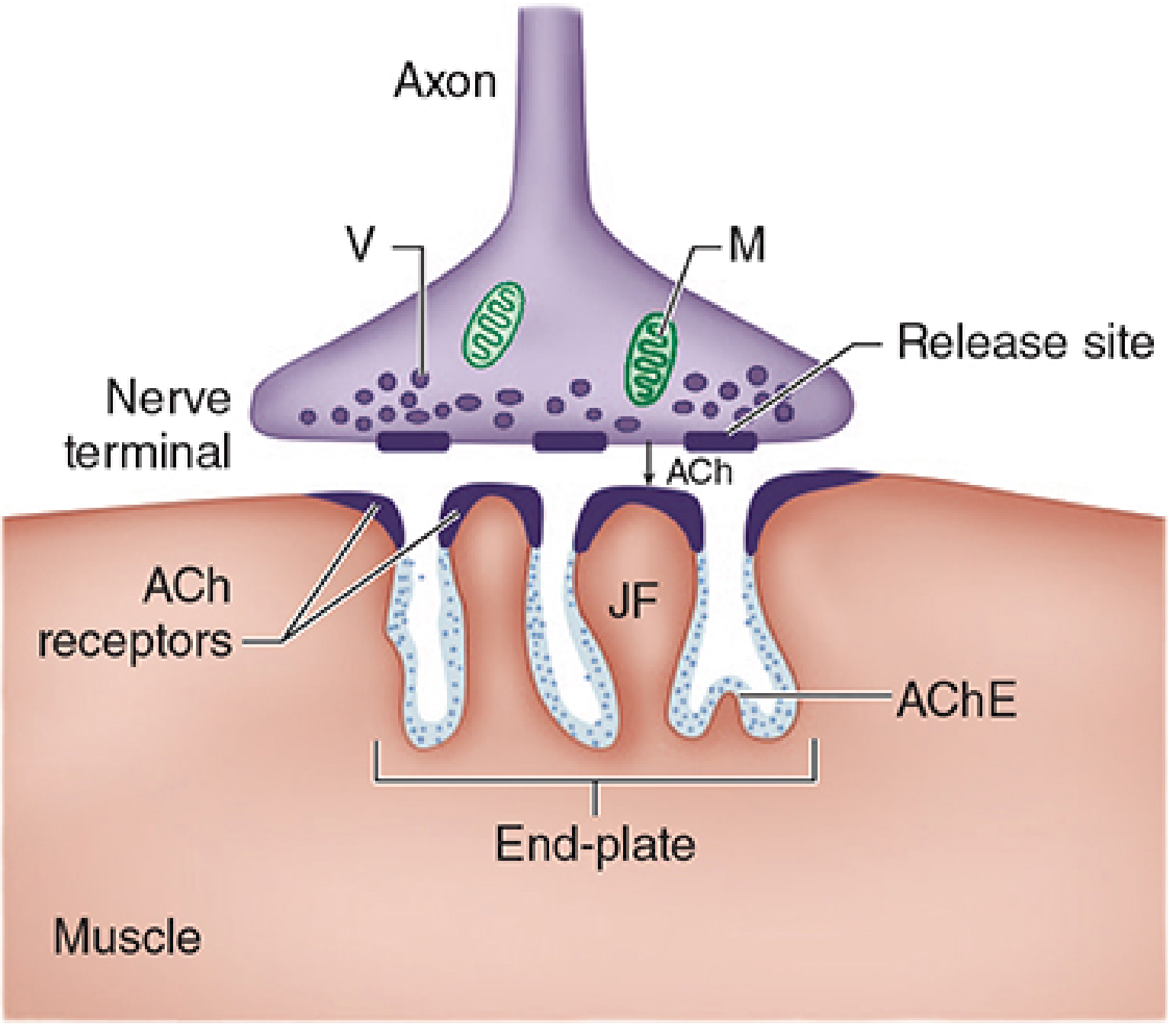
Sequence: “A-C-A-R-E-C”
- Action potential reaches presynaptic motor-nerve terminal.
- Voltage-gated Calcium channels open and Ca²⁺ enters the nerve terminal.
- ACh vesicles fuse with presynaptic membrane and release ACh quanta.
- ACh binds to both alpha subunits of postjunctional Recptor, the nicotinic muscle receptor, Nm.
- Ion channel opens, producing End-plate potential:
- Na⁺ and Ca²⁺ enter
- K⁺ leaves
- Muscle action potential causes SR Ca²⁺ release and contraction.
ACh is rapidly hydrolysed by acetylcholinesterase into acetate and choline. Choline is reuptaken into the nerve terminal for ACh resynthesis.
The adult Nm receptor is a pentamer: 2α, β, δ, ε. Both alpha subunits must bind ACh before the channel opens. At the normal NMJ, only about 10% of receptors need activation for contraction, producing a large margin of safety.
Morgan and Mikhail's Clinical Anesthesiology, 7e, pp. 369-371.
Morgan and Mikhail's Clinical Anesthesiology, 7e, pp. 369-371.
2. Mechanism of neuromuscular block
| Drug group | Receptor action | Pattern on nerve stimulation |
|---|---|---|
| Depolarising: succinylcholine | Nm agonist. Persistent end-plate depolarisation prevents repolarisation | Phase I: no fade, no post-tetanic facilitation |
| Nondepolarising: rocuronium, vecuronium, atracurium, cisatracurium | Competitive Nm antagonists. Prevent ACh binding and channel opening | Fade on TOF and tetanus; post-tetanic facilitation |
Why does fade occur with nondepolarising block?
Nondepolarising drugs also block presynaptic nicotinic receptors, decreasing mobilisation and release of ACh during repeated stimulation. Thus each successive twitch becomes weaker.
Phase II block with succinylcholine
Occurs after large doses, repeated doses, or prolonged infusion.
It resembles a nondepolarising block:
- TOF fade appears
- Post-tetanic facilitation appears
- Mechanism includes receptor desensitisation and altered membrane behaviour
3. Factors modifying neuromuscular block
Best exam classification: “Patient - Physiology - Drugs - Technique”
A. Patient factors
| Factor | Effect on block | Explanation / exam point |
|---|---|---|
| Age: neonates/infants | Variable, often prolonged clinically | Immature NMJ, altered volume of distribution and organ function |
| Elderly | Prolonged, especially aminosteroids | Reduced cardiac output, renal function and hepatic blood flow |
| Obesity | Risk of relative overdose if dosed on total body weight | Dose according to agent-specific weight scalar |
| Myasthenia gravis | Markedly sensitive to nondepolarising drugs | Fewer functional postjunctional ACh receptors |
| Lambert-Eaton syndrome | Markedly sensitive to both drug classes | Reduced presynaptic ACh release |
| Motor neuron disease / neuropathy / critical illness myopathy | Variable and often increased sensitivity to nondepolarisers | Reduced muscle mass and altered receptors |
| Burns, denervation, immobilisation, upper motor neuron lesions | Resistance to nondepolarisers; dangerous hyperkalaemia with succinylcholine | Upregulation of extrajunctional ACh receptors |
| Renal failure | Prolonged block with renally excreted agents | Particularly pancuronium, vecuronium and rocuronium |
| Hepatic failure | Prolonged aminosteroid block | Reduced biliary elimination and altered distribution |
| Low cardiac output / shock | Delayed onset but prolonged duration | Reduced delivery to NMJ and reduced clearance |
High-yield disease rule
Fewer receptors or less ACh release = more sensitivity to nondepolarising block.
More extrajunctional receptors = resistance to nondepolarisers, but risk with succinylcholine.
B. Physiological and metabolic factors
Factors that potentiate nondepolarising block
Mnemonic: “Cold, Acid, Low salts, High Mg”
| Factor | Effect / mechanism |
|---|---|
| Hypothermia | Prolongs block: reduces ACh mobilisation, muscle contraction, hepatic and renal metabolism, and Hofmann degradation |
| Respiratory or metabolic acidosis / hypercarbia | Potentiates block |
| Hypokalaemia | Potentiates block and makes neostigmine reversal less effective |
| Hypocalcaemia | Potentiates block due to reduced ACh release |
| Hypermagnesaemia | Strong potentiation: reduced presynaptic Ca²⁺-dependent ACh release plus postsynaptic effects |
| Hyponatraemia | May increase block |
| Hypophosphataemia | Muscle weakness, may worsen clinical recovery |
Hypothermia also makes peripheral nerve monitoring misleading if the monitored arm is cold.
Barash, Cullen, and Stoelting’s Clinical Anesthesia, 9e, pp. 1434-1443.
Barash, Cullen, and Stoelting’s Clinical Anesthesia, 9e, pp. 1434-1443.
Factors that may antagonise nondepolarising block
- Hypercalcaemia
- Hyperkalaemia, generally
- Alkalosis, although clinical effects can be inconsistent
- Chronic anticonvulsant therapy
- Burns, denervation and prolonged immobilisation, through receptor upregulation
C. Drug interactions
1. Anaesthetic drugs
| Drug / technique | Effect |
|---|---|
| Volatile anaesthetics | Potentiate and prolong nondepolarising block |
| Order of potentiation | Desflurane > sevoflurane > isoflurane > halothane > N₂O / opioid / propofol anaesthesia |
| Propofol | Minimal effect on duration of block |
| Local anaesthetics | Can potentiate block, particularly at high systemic concentrations |
| Ketamine, opioids, benzodiazepines | No major direct NMJ action at usual doses, but may worsen apparent weakness through central respiratory depression |
Volatile anaesthetics reduce dose requirements and prolong recovery from nondepolarising NMBAs. The effect is greater with higher concentration and longer exposure.
Miller's Anesthesia, 10e, p. 3306-3307.
Miller's Anesthesia, 10e, p. 3306-3307.
2. Antibiotics
Mnemonic: “A P C T block ACh”
- Aminoglycosides: gentamicin, amikacin, tobramycin, neomycin
- Polymyxins
- Clindamycin and lincomycin
- Tetracyclines
Mechanism: mainly reduced presynaptic ACh release. Aminoglycosides, polymyxins, clindamycin and lincomycin additionally reduce postsynaptic receptor sensitivity.
Clinical point: aminoglycosides can cause weakness even without an NMBA and may make neostigmine reversal difficult.
Miller's Anesthesia, 10e, p. 3308.
Miller's Anesthesia, 10e, p. 3308.
3. Other drugs potentiating nondepolarising block
- Magnesium sulfate
- Lithium
- Calcium-channel blockers, especially verapamil
- Antiarrhythmics: quinidine, procainamide, disopyramide
- Diuretics, indirectly through hypokalaemia and hypomagnesaemia
- High-dose corticosteroids, especially in critically ill patients receiving prolonged NMBA
- Acute phenytoin or carbamazepine therapy
4. Drugs causing resistance or shortening block
- Chronic phenytoin or carbamazepine therapy
- Resistance and shortened duration, especially with aminosteroid NMBAs
- Mechanisms include enzyme induction and receptor changes
- Theophylline
- Calcium
- Anticholinesterases, if given before the NMBA
5. Interaction between muscle relaxants
- Combining two nondepolarising NMBAs may be additive or synergistic. Avoid routine mixing.
- A defasciculating dose of a nondepolarising drug antagonises succinylcholine Phase I block, so a larger succinylcholine dose may be required.
- Prior succinylcholine may sometimes potentiate the later nondepolarising block, but evidence is inconsistent.
D. Factors modifying succinylcholine block specifically
Prolonged succinylcholine action
Mnemonic: “Low enzyme or enzyme inhibition”
- Inherited atypical butyrylcholinesterase
- Low butyrylcholinesterase states
- Pregnancy and early postpartum period
- Liver disease
- Malnutrition
- Severe burns
- Malignancy
- Chronic renal disease
- Organophosphate exposure
- Drugs that inhibit butyrylcholinesterase
- Anticholinesterases
- Echothiophate eye drops
- Organophosphates
- Metoclopramide
- Some local anaesthetics, especially procaine
- Hypothermia
Resistance to succinylcholine
- Burns
- Denervation
- Severe infection or trauma
- Chronic immobilisation
- Muscular dystrophies and receptor upregulation states
However, in these receptor-upregulation states, succinylcholine can cause life-threatening hyperkalaemia and is usually avoided.
4. A concise 10-mark answer to reproduce
Factors potentiating nondepolarising neuromuscular block
1. Patient factors
- Elderly age
- Renal or hepatic dysfunction
- Low cardiac output
- Myasthenia gravis, Lambert-Eaton syndrome, neuromuscular diseases
- Critical illness and muscle wasting
2. Metabolic factors
- Hypothermia
- Acidosis and hypercarbia
- Hypokalaemia
- Hypocalcaemia
- Hypermagnesaemia
3. Drug interactions
- Volatile anaesthetics: desflurane > sevoflurane > isoflurane
- Aminoglycosides, polymyxins, clindamycin, tetracyclines
- Magnesium
- Lithium
- Calcium-channel blockers
- Quinidine and other antiarrhythmics
- Local anaesthetics
4. Technique-related factors
- Large or repeated NMBA doses
- Combination of different nondepolarising drugs
- Inadequate monitoring and failure to adjust dose
5. Clinical implication
- Use quantitative neuromuscular monitoring.
- Titrate further doses to monitoring rather than time alone.
- Correct temperature and electrolyte disturbances.
- Extubate only after adequate recovery, generally TOF ratio ≥0.9.
One-line memory aid
“Cold, acid, low K/Ca, high Mg, volatiles, antibiotics, weak patients, and failing liver/kidney make nondepolarising block deeper and longer.”
Final viva pearl
Neuromuscular blockers do not provide unconsciousness, amnesia, or analgesia. A paralysed patient can still be awake, so anaesthesia and analgesia must always be adequate.
This is a shared conversation. Sign in to Orris to start your own chat.