
Neuro endocrine reflex
Reading File
Finding Sources
Finding Sources
Reading File
Finding Sources
Reading File
Reading File
Reading File
Reading File
Loading Image
Loading Image
Finding Sources
Now I have comprehensive information. Let me compile the full answer.
Neuroendocrine Reflex
A neuroendocrine reflex is a physiological response in which a neural stimulus (sensory input, stress, or peripheral signal) triggers hormone secretion from endocrine glands - most often via the hypothalamo-pituitary axis. The neural and endocrine limbs work together as a single integrated arc.
Core Concept: How It Works
The general pathway is:
Sensory/peripheral stimulus → Afferent nerve impulses → Hypothalamus → Pituitary (anterior or posterior) → Hormonal effector → Target organ
The hypothalamus acts as the master integrator - Sherrington called it "the head ganglion of the autonomic system." It receives inputs from osmoreceptors, baroreceptors, chemoreceptors, touch receptors, and the limbic system, then coordinates hormonal output accordingly.
- Ganong's Review of Medical Physiology, p. 1682
The Classic Example: Milk Ejection (Let-Down) Reflex
The most clearly defined neuroendocrine reflex in human physiology is the milk ejection reflex during lactation.
Reflex Arc
- Stimulus: Infant suckles at the breast, stimulating mechanoreceptors in the nipple and areola
- Afferent limb: Nerve impulses travel from the nipple to the hypothalamus via the spinal cord
- Integration: Hypothalamus activates the posterior pituitary (neurohypophysis)
- Efferent/hormonal limb: Oxytocin is released from the posterior pituitary into the bloodstream
- Effector organ: Oxytocin reaches the mammary gland and stimulates myoepithelial cells to contract around the alveoli, ejecting milk into the ducts
"This is a neuroendocrine reflex. Oxytocin release can also be stimulated by other pathways of sight, sound, and smell that represent the infant."
- Creasy & Resnik's Maternal-Fetal Medicine, p. 244
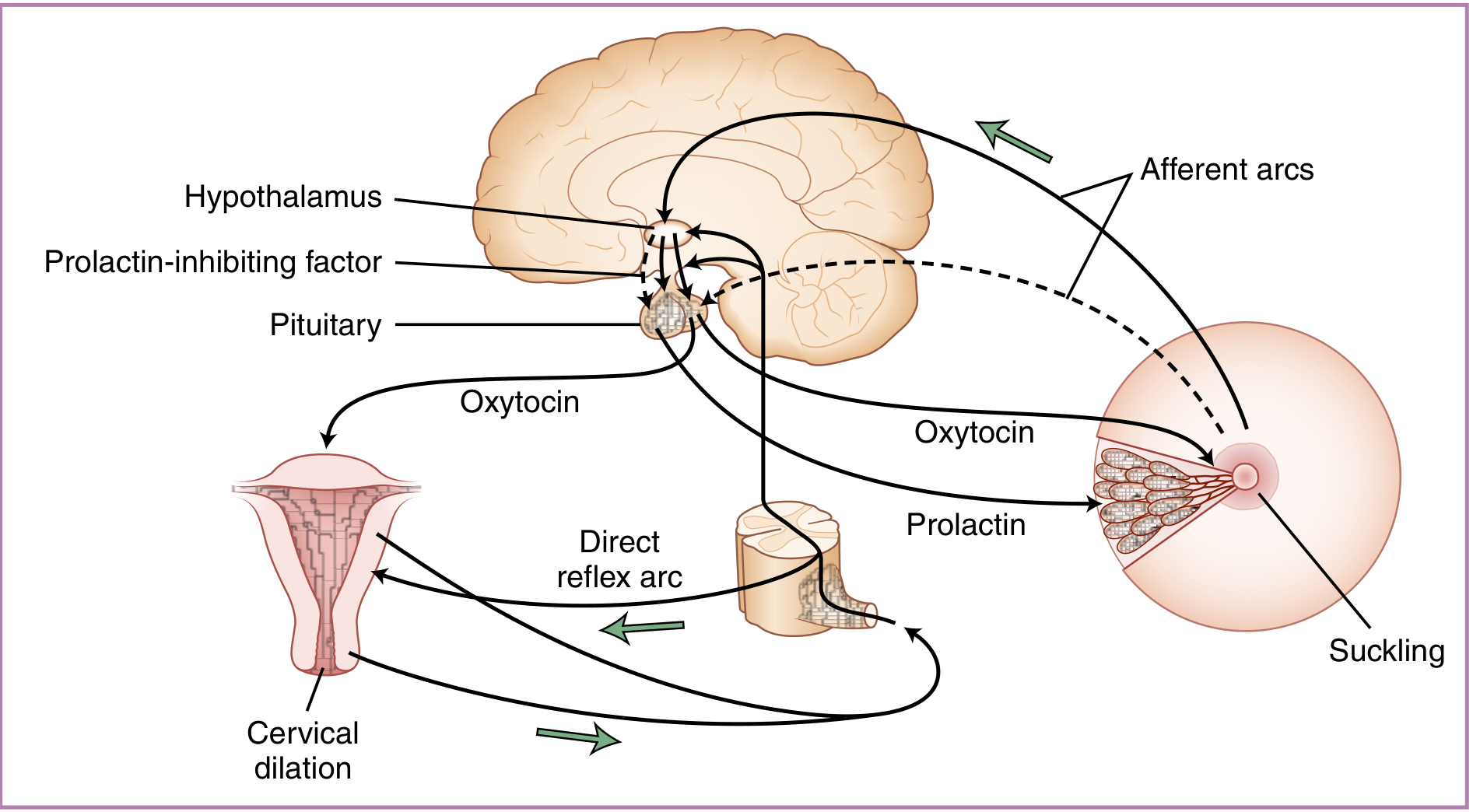
Figure: Neuroendocrine control of milk ejection - afferent arcs from suckling and cervical dilation converge on the hypothalamus; oxytocin and prolactin are released to act on breast myoepithelial cells and the uterus.
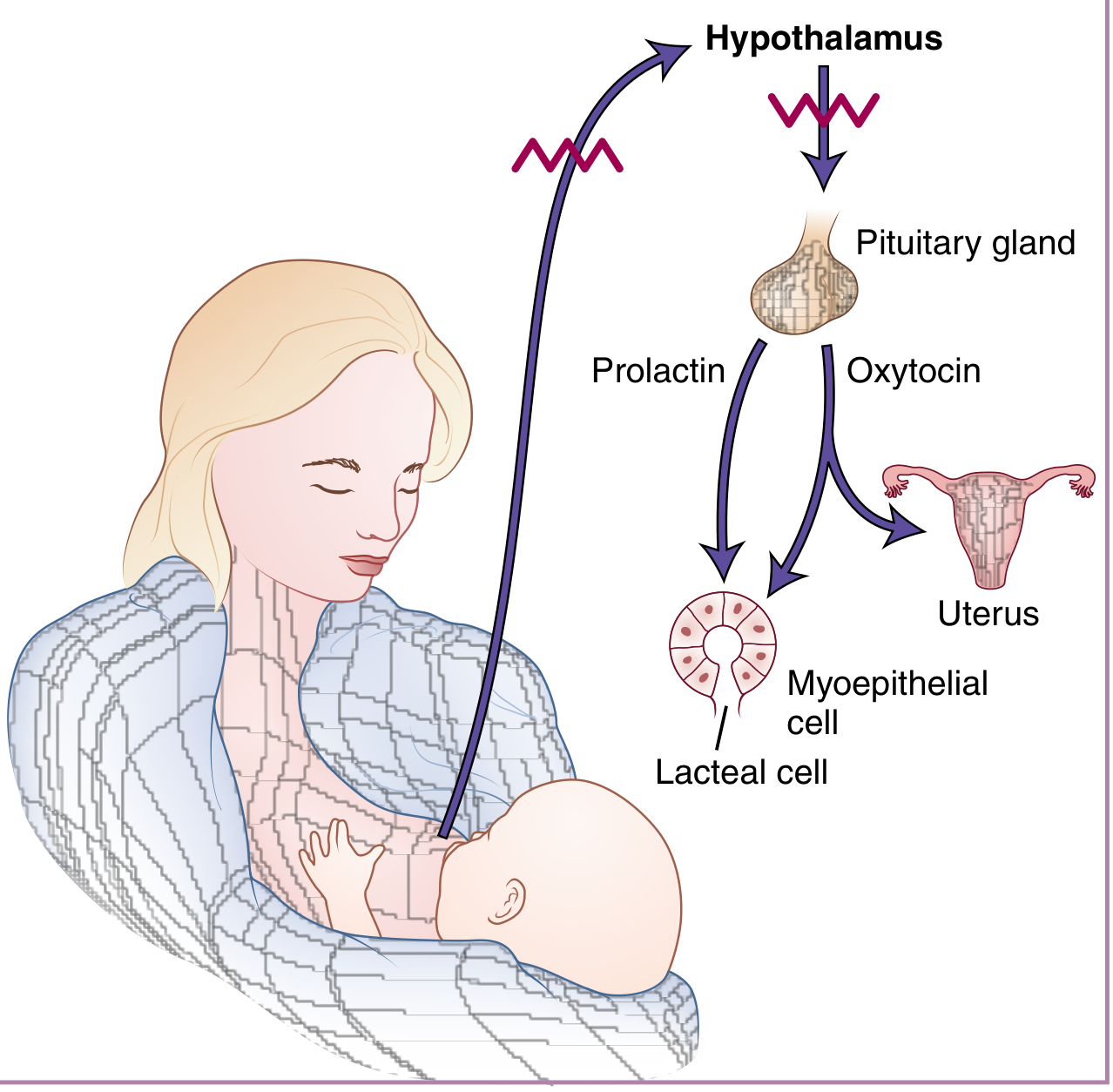
Figure: The let-down (ejection) reflex arc. Stress (pain, anxiety) can inhibit this reflex; seeing or hearing the infant can trigger oxytocin (but not prolactin) release.
Dual Hormonal Component
| Hormone | Source | Stimulus | Action |
|---|---|---|---|
| Oxytocin | Posterior pituitary | Suckling; also sight/sound/smell of infant | Contracts myoepithelial cells → milk ejection; also causes uterine contractions (postpartum involution) |
| Prolactin | Anterior pituitary | Suckling only (not sight/smell) | Milk production in alveolar lacteal cells |
How prolactin fits in: Suckling-induced nerve impulses reaching the hypothalamus inhibit dopamine synthesis (dopamine = prolactin-inhibiting hormone). With dopamine suppressed, the anterior pituitary releases prolactin. This is the neuroendocrine reflex component of prolactin secretion.
"Prolactin also participates in this neuroendocrine reflex, in that nerve impulses reaching the hypothalamus also inhibit the synthesis and secretion of dopamine, which functions as a prolactin release-inhibiting hormone."
- Henry's Clinical Diagnosis and Management by Laboratory Methods
Inhibition of the Reflex
Newton & Newton demonstrated that pain, anxiety, and psychological stress interfere with the let-down reflex by blocking oxytocin release. This is why a stressed or anxious mother may have difficulty with milk ejection even though she is producing milk.
Broader Neuroendocrine Reflexes: Summary Table
From Ganong's, the hypothalamus coordinates multiple neuroendocrine control systems:
| Hormone Regulated | Key Afferent Input | Hypothalamic Area |
|---|---|---|
| Oxytocin | Touch receptors in breast, uterus, genitalia | Supraoptic + paraventricular nuclei |
| Vasopressin (ADH) | Osmoreceptors, "volume receptors" | Supraoptic + paraventricular nuclei |
| Prolactin (via PIH/PRH) | Touch receptors in breast | Arcuate nucleus |
| TSH (via TRH) | Temperature receptors (infants) | Paraventricular nuclei |
| ACTH (via CRH) | Limbic system (emotional stimuli); reticular formation; blood cortisol | Paraventricular nuclei |
| LH/FSH (via GnRH) | Touch receptors in skin/genitalia; estrogen-sensitive cells | Preoptic area |
| Catecholamines | Limbic areas (emotion) | Dorsal/posterior hypothalamus |
- Ganong's Review of Medical Physiology, Table 17-1
Neuroendocrine Response to Stress/Shock/Surgery
A major clinical context for neuroendocrine reflexes is the stress response to trauma, surgery, or hemorrhagic shock. This involves:
- Trigger: Hypoxia, hypotension, or hypovolemia detected by aortic/carotid baroreceptors and chemoreceptors
- Sympathoadrenal axis: Hypothalamus activates the sympathetic nervous system → adrenal medulla releases epinephrine and norepinephrine
- Causes: glycogenolysis, gluconeogenesis, decreased insulin release → stress hyperglycemia
- HPA axis: Hypothalamus → ACTH (via CRH) → cortisol and aldosterone from adrenal cortex
- Cortisol: enhances gluconeogenesis, lipolysis, protein catabolism
- RAAS activation: Renin secretion → angiotensin II → aldosterone → Na+ and water retention
- ADH (vasopressin): Posterior pituitary → promotes water reabsorption by renal distal tubules
"The neuroendocrine reaction to shock consists of involuntary responses by the hypothalamus, autonomic nervous system, and secretory endocrine glands and is directed toward restoration of tissue perfusion and a redirected utilization of metabolic substrates."
- Mulholland and Greenfield's Surgery, p. 545
The surgical neuroendocrine stress response is characterized by elevated circulating levels of catecholamines, glucagon, and cortisol, resulting in mobilization of carbohydrate stores and proteins.
- Morgan and Mikhail's Clinical Anesthesiology
Key Points Summary
- A neuroendocrine reflex integrates a sensory/neural input with a hormonal output, bridging the nervous and endocrine systems
- The hypothalamus is the central integrator; the pituitary is the primary effector gland
- The milk ejection reflex (suckling → oxytocin release → myoepithelial contraction) is the textbook prototype
- Prolactin secretion during lactation is also neuroendocrine: suckling → dopamine inhibition → prolactin release
- Stress/shock activates a broad neuroendocrine reflex arc involving the sympathoadrenal axis, HPA axis, RAAS, and ADH, all aimed at restoring perfusion and mobilizing energy substrates
- These reflexes can be conditioned (e.g., seeing/hearing an infant triggers oxytocin) or inhibited by psychological stress
This is a shared conversation. Sign in to Orris to start your own chat.