
Cacophony means
- "The construction site produced a constant cacophony of drilling and hammering."
- "The orchestra's warm-up was a cacophony before the conductor raised his baton."
- Literal - a harsh combination of sounds (e.g., clashing instruments, overlapping loud noises)
- Figurative - a chaotic mix of voices, opinions, or competing elements (e.g., "a cacophony of conflicting advice")
Sanitary toilet
sanitary toilet definition standards types
Sanitary Toilet
Key Features of a Sanitary Toilet
| Feature | Description |
|---|---|
| Hygienic design | Smooth, non-porous surfaces that are easy to clean |
| Water seal / trap | A U-bend holds water to block sewer gases and odors |
| Proper waste disposal | Connected to a sewer system or septic tank |
| Hand-washing access | A basin with soap and water nearby |
| Ventilation | Prevents odor buildup and moisture accumulation |
| Privacy | Enclosed space to encourage regular use |
Types of Sanitary Toilets
- Flush toilet - Uses water to carry waste into a sewer or septic system (most common in urban areas)
- Pour-flush toilet - Manually flushed with a bucket of water; common in low-water regions
- Pit latrine (improved) - A lined pit with a slab cover and ventilation pipe
- Composting toilet - Converts waste into compost using natural decomposition
- Dry/ecological toilet - No water used; separates urine and feces
Why It Matters
- Prevents spread of diseases like cholera, typhoid, hepatitis A, and diarrheal illness
- Protects groundwater and soil from fecal contamination
- The WHO defines sanitation as access to facilities for the safe disposal of human waste - a basic human right
- About 3.5 billion people globally still lack safely managed sanitation
WHO / UNICEF Standards
- Contained in the toilet
- Treated either on-site or transported and treated off-site
- Disposed of safely without contaminating the environment
Rca latrine components
RCA latrine components parts sanitation
https://ihatepsm.com/blog/rca-latrine
RCA Latrine - Components
The 6 Main Components
1. Squatting Plate (Slab)
- Made of cement concrete - impervious, easy to clean and keep dry
- Dimensions: 90 cm x 90 cm (3 ft square), 5 cm (2 in) thick at outer edge
- Can also be circular (90 cm diameter)
- Has a gentle slope toward the pan so wash water drains into the latrine
- Includes raised footrests for squatting comfort
- Keeping it dry prevents survival of hookworm larvae
- Designed for the Indian squatting habit and water-based anal washing
2. Pan
- Receives nightsoil, urine, and wash water
- Dimensions:
- Length: 42.5 cm (17 in)
- Width (front): 12.5 cm (5 in)
- Width (widest part): 20 cm (8 in)
- Has a uniform slope front to back for swift drainage
- Smooth finish for easy cleaning
3. Trap (Water Seal)
- A bent pipe, 7.5 cm (3 in) diameter, connected to the pan
- Holds water to form a water seal of 2 cm (3/4 in) depth
- The water seal:
- Blocks foul odors/gases from rising
- Prevents flies from accessing excreta and spreading disease
- This is the most critical component for hygiene
4. Connecting Pipe
- Used in the indirect type RCA latrine (pit located away from squatting plate)
- Diameter: 7.5 cm (3 in)
- Length: at least 1 m (3 ft), bent at the end
- Connects the trap to the pit
- Advantage: When one pit fills, you can redirect the pipe to a second pit
In the direct type, there is no connecting pipe - the pit sits directly under the squatting plate. Cheaper, more compact, but only suitable for hard, stable soil.
5. Pit (Dug Well)
- Underground chamber that collects and stores waste
- Must be properly lined to prevent soil collapse
- When full, an indirect-type pit can be abandoned and a new one connected
6. Superstructure
- The enclosure above ground: walls, roof, and door
- Provides privacy and protects the latrine from rain
- Must be well-ventilated to reduce odor inside
Location Rule
- At least 15 meters (50 feet) away from any water source (well, pond, etc.)
- At a lower elevation than the water source to prevent bacterial contamination
- Away from flood-prone areas
Summary Table
| Component | Material / Size | Function |
|---|---|---|
| Squatting plate | Cement concrete, 90x90 cm | Hygienic defecation surface |
| Pan | Smooth concrete, 42.5 cm long | Receives waste & wash water |
| Trap | Bent pipe, 7.5 cm dia, 2 cm seal | Blocks odor & flies |
| Connecting pipe | 7.5 cm dia, ≥1 m long | Links trap to pit (indirect type) |
| Pit | Dug/lined well | Waste storage/decomposition |
| Superstructure | Walls + roof + door | Privacy & weather protection |
Create a diagram or poster showing RCA latrine components
A detailed educational diagram/poster of an RCA (Research-cum-Action) latrine showing all cross-sectional components clearly labeled with arrows. The diagram should show: 1) Superstructure - walls, roof, and door at the top, 2) Squatting plate - cement concrete slab 90x90cm with footrests and slope toward pan, 3) Pan - funnel-shaped receiver for waste and wash water, 4) Trap - bent pipe 7.5cm diameter with water seal 2cm deep blocking odors and flies, 5) Connecting pipe - 7.5cm diameter pipe at least 1 meter long connecting trap to pit, 6) Pit (dug well) - underground chamber for waste storage. The cross-section view should show both above-ground and below-ground parts. Include a note about 15 meter minimum distance from water sources. Clean technical illustration style with a light background, blue and earth-tone color scheme, clear labels and dimension callouts.
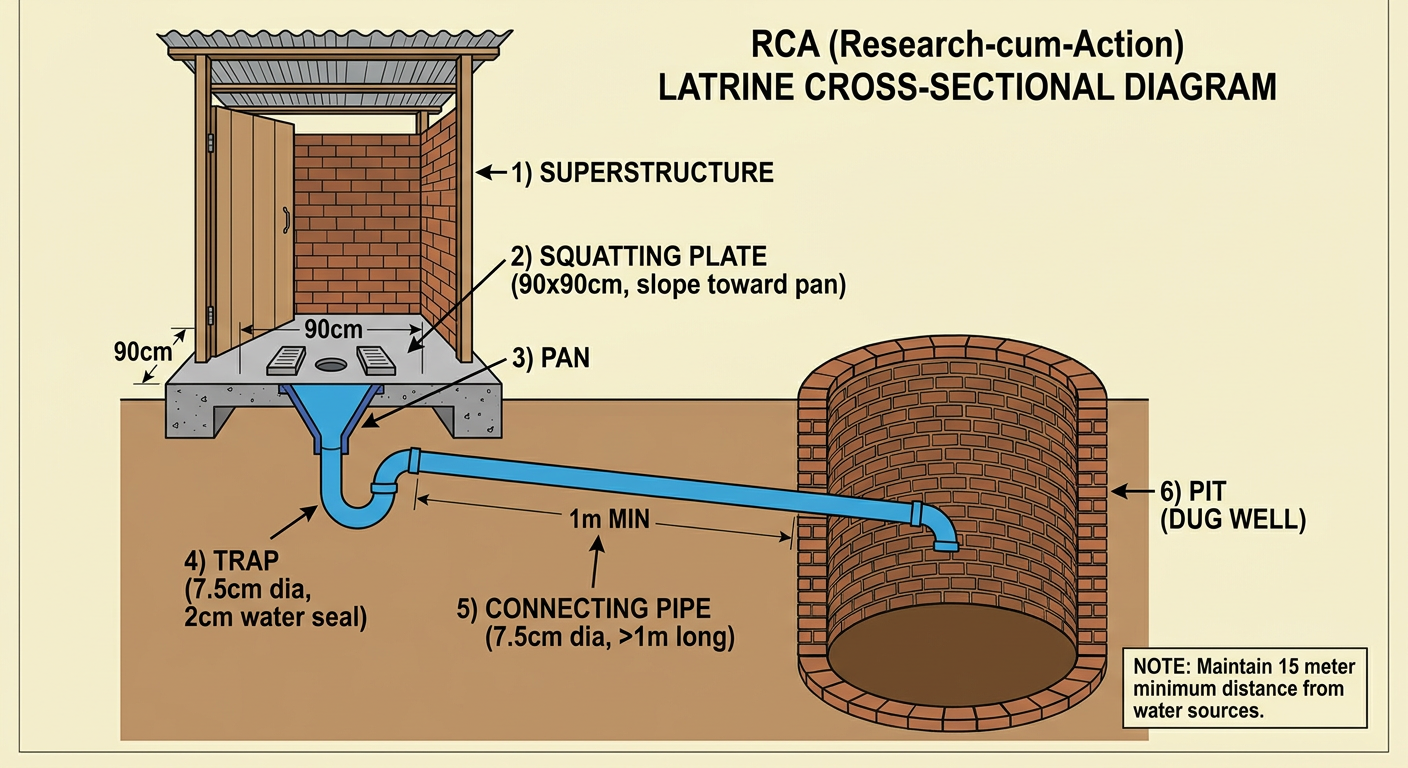
| # | Component | Key Detail |
|---|---|---|
| 1 | Superstructure | Walls, roof, door for privacy |
| 2 | Squatting Plate | 90x90 cm cement slab, sloped toward pan |
| 3 | Pan | 42.5 cm long, receives waste & wash water |
| 4 | Trap | 7.5 cm bent pipe, 2 cm water seal - blocks odor & flies |
| 5 | Connecting Pipe | 7.5 cm dia, ≥1 m long (indirect type) |
| 6 | Pit (Dug Well) | Underground waste storage chamber |
What is water seal
How It Works
- 🚫 Blocks foul gases (methane, hydrogen sulfide) from rising up into the toilet/latrine
- 🚫 Prevents flies and insects from crawling up from the pit to the surface
- 🚫 Stops odors from escaping into the superstructure
Water Seal in the RCA Latrine
| Detail | Measurement |
|---|---|
| Trap pipe diameter | 7.5 cm (3 inches) |
| Depth of water seal | 2 cm (¾ inch) |
Why It Matters (Public Health)
| Without Water Seal | With Water Seal |
|---|---|
| Flies move freely between pit and food | Fly access blocked |
| Foul gases enter the structure | Gases blocked underground |
| Bad odors discourage latrine use | Odor-free, encouraging use |
| Disease spread via fly-feces-food route | Transmission chain broken |
Key Point
Picture of water seal
A clear educational cross-section diagram of a water seal trap in a latrine. Show a U-shaped or P-shaped bent pipe in cutaway/cross-section view. Label the following clearly with arrows: 1) The pan/toilet opening at the top, 2) The bent U-shaped trap pipe (7.5 cm diameter), 3) The standing water inside the U-bend shown in blue, 4) The water seal depth labeled as "AB = 2 cm" with a double-headed arrow showing the measurement between the water surface level and the lowest point of the concave upper surface, 5) The pit/outlet side below, 6) Arrows showing how gases and flies are BLOCKED by the water barrier. Also show a small inset with a crossed-out fly icon and a crossed-out gas cloud to indicate what the water seal prevents. Clean technical illustration on white background, blue water shown clearly, educational poster style suitable for community health training.
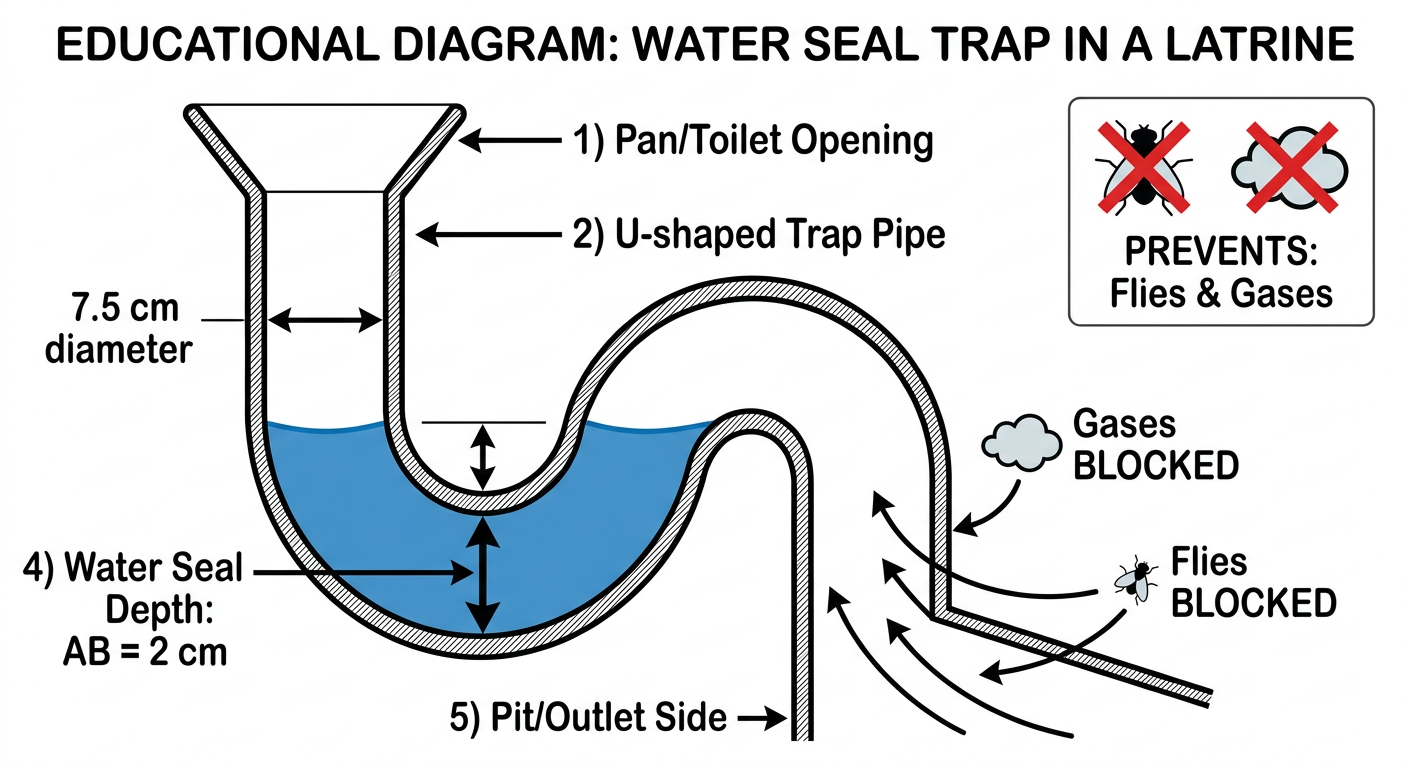
- Blue water sitting in the U-bend of the trap pipe is the water seal
- AB = 2 cm - the depth of the water seal in an RCA latrine
- The water physically blocks gases from rising up from the pit
- The water stops flies from crawling up through the pipe to the surface
- Waste and wash water from the pan flows over the water seal and down into the pit, while the water seal is automatically replenished by the wash water used for anal cleansing