
Advance parki pt exercise
I'll look up exercise recommendations for advanced Parkinson's disease from the medical library right away.
Searching sources...
Reading File
Finding Sources
Searching PubMed
"Parkinson disease" AND "exercise" AND "advanced"
Finding Sources
Reading Article
PMID: 38588457
Reading File
Reading File
Reading File
Finding Sources
Reading File
Finding Sources
Finding Sources
Finding Sources
Finding Sources
Searching the Web
advanced Parkinson disease exercise recommendations physiotherapy 2024 2025
Reading File
Reading Web Page
https://www.parkinson.org/sites/default/files/documents/Park…
Here is a comprehensive overview of exercise for patients with advanced Parkinson's disease (PD), drawing from neurology textbooks, the 2025 Parkinson's Foundation Exercise Guidelines, and recent Cochrane evidence.
Exercise in Advanced Parkinson's Disease
Why Exercise Matters in Advanced PD
Even in advanced disease, exercise is a primary non-pharmacological intervention. It does not merely manage symptoms - evidence from a 2023 systematic review (Li et al., Neurorehabilitation Neural Repair) suggests exercise may attenuate disease progression itself, likely via BDNF upregulation. The 2024 Cochrane network meta-analysis (154 RCTs, 7,837 participants) found beneficial effects across nearly all exercise types on motor signs and quality of life.
As noted in Adams and Victor's Principles of Neurology: "One must not neglect the maintenance of general health and neuromuscular efficiency by a program of exercise, activity, and rest." - p. 1097
Key Safety Considerations in Advanced PD
Advanced disease introduces specific risks that must shape every exercise session:
- Freezing of gait (FOG): Present in ~25% within 5 years and increases with progression. Feet stick to the floor while the center of mass keeps moving, causing forward falls. - Harrison's Principles, p. 1736
- Postural instability and toppling falls: A late feature of PD once postural reflexes are lost.
- Autonomic dysfunction: Orthostatic hypotension, blunted heart rate response to exercise, and arrhythmias - use RPE (Rate of Perceived Exertion) instead of target heart rate monitoring.
- Rigidity, dystonia, dyskinesia: Worsening flexed posture, fixed postures, and dyskinesias may limit exercise selection.
- Cognitive decline: Reduced ability to dual-task during exercise.
- Comorbidities: Osteoporosis, spinal stenosis, peripheral neuropathy, and arthritis are common.
- Medication timing: Schedule exercise sessions during ON medication periods for optimal safety and benefit. - Parkinson's Foundation Guidelines 2025
The 5 Domains of Exercise (2025 Parkinson's Foundation Guidelines)
| Domain | Frequency | Duration | Advanced PD Notes |
|---|---|---|---|
| Aerobic Activity | ≥3 days/week | ≥30 min/session; build to 150 min/week | Use supported equipment (recumbent bike, treadmill with harness). Interval training may substitute for continuous. |
| Strength Training | 2-3 non-consecutive days/week | 30-60 min | Prioritize posture and body mechanics. Use machines over free weights (fall risk). Progress weights cautiously. |
| Flexibility | 2-3 days/week (daily is most effective) | Hold 15-30 sec/stretch | Focus on trunk rotation, hip flexors, pectorals to counter flexed posture. Dynamic + static stretching. |
| Neuromotor/Functional Training | 2-3 days/week (daily integration) | 30-60 min | Amplitude-based training (LSVT BIG principle); focus on big, exaggerated movements. |
| Balance, Agility & Multitasking (BAM) | 2-3 days/week | 30-60 min | Supervised. Use parallel bars or support. Avoid dual-task challenges without supervision. |
Best Exercise Types for Advanced PD - Evidence Hierarchy
The Cochrane 2024 NMA ranks interventions as follows for motor sign improvement (UPDRS-M reduction):
- Dance/rhythmic movement - largest effect (MD -10.18 points on UPDRS-M). Tango, ballroom, and dance therapy are well-studied.
- Gait/balance/functional training - strong evidence (MD -7.50). Treadmill training, obstacle courses, stepping tasks.
- Multi-domain training - moderate effect (MD -5.90). Combined aerobic + balance + strength.
- Endurance training - small benefit (MD -5.76). Cycling (including forced-cadence cycling) is particularly effective.
- Mind-body training - small benefit (MD -3.62). Tai chi has the strongest evidence base: improves balance and reduces falls by objective criteria. - Adams and Victor's Neurology, p. 1097
Managing Freezing of Gait (FOG) During Exercise
FOG is a major barrier in advanced PD. Evidence-based cueing strategies from Harrison's Principles (p. 1584):
- Auditory cues: Metronome beats, rhythmic music, or a therapist counting steps. Entrains gait cadence.
- Visual cues: Laser pointer on walking frame, floor stripes, or colored tape on the floor to step over.
- Attentional strategies: Consciously thinking about taking large steps ("march like a soldier").
- End-of-dose FOG: May respond to adjustment of levodopa regimen or addition of MAO-B inhibitors (rasagiline, selegiline).
Specific Exercise Recommendations by Problem
| Advanced PD Feature | Preferred Exercise Approach |
|---|---|
| Postural instability / falls | Resistance training + sensory balance training (measurable gains in weeks, maintained at 6 months with 10-20 min daily home program) - Harrison's, p. 1748 |
| Gait freezing | Treadmill walking, rhythmic auditory stimulation (RAS), visual cueing |
| Bradykinesia | Amplitude training (LSVT BIG); high-effort, large-movement exercises |
| Rigidity | Yoga, stretching, massage, dance; warm-up before strength work |
| Hypophonia / speech | LSVT LOUD speech exercises - Adams and Victor's, p. 1097 |
| Tremor | Weighted utensils/gloves; exercise does not worsen rest tremor |
| Wheelchair-bound stage | Chair yoga, seated upper limb resistance, range-of-motion exercises, upper-body cycling (arm ergometer) |
Optimal Exercise Dose (2025 Network Meta-Analysis)
A recent meta-analysis (Journal of Science and Medicine in Sport, 2025) found:
- Optimal dose for alleviating motor symptoms: 1,300 MET-min/week
- Dance is most effective at 850 MET-min/week
Practical Points for the Therapist / Caregiver
- Refer to a PD-specialized physiotherapist at diagnosis and every 6 months - advanced PD warrants more frequent review.
- Allow upper extremity support (rails, parallel bars, walker) as needed.
- Monitor for orthostatic hypotension before/after sessions - have patient sit 2-3 min before standing.
- Circuit training efficiently combines aerobic + strength + balance within 150 min/week.
- Group exercise programs improve adherence and provide social support.
- Any activity that keeps the patient moving has value - Adams and Victor's Neurology, p. 1097.
Exercise That Has Strong Evidence
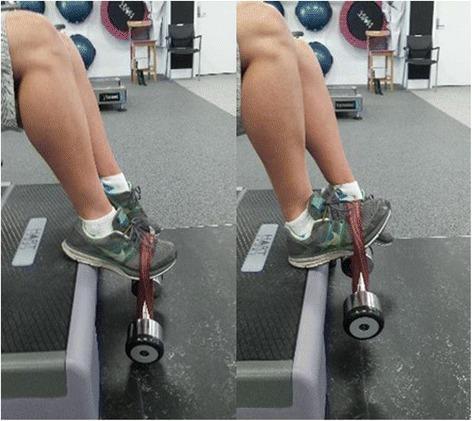
Seated unilateral dorsiflexion with resistance - used in PD gait training to strengthen tibialis anterior and improve toe clearance during swing phase.
A note on evidence currency: The 2025 Parkinson's Foundation Exercise Guidelines represent the most current structured framework available, reviewed by a multi-disciplinary expert panel. Combined with the 2024 Cochrane review (PMID: 38588457), the recommendation for multi-modal exercise in advanced PD is robust.
This is a shared conversation. Sign in to Orris to start your own chat.