
Fever of unknown origin get me everything on it including criteria recent guidelines 2026 all over
Reading File
Now I'll run all searches in parallel - textbook library, PubMed, and web - simultaneously.
Finding Sources
Searching PubMed
"fever of unknown origin" AND diagnosis
Searching the Web
fever of unknown origin criteria guidelines 2025 2026
Excellent results. Now let me pull the full content from all major textbook sections in parallel, plus key PubMed abstracts.
Reading File
Reading File
Reading File
Reading Article
PMID: 37951657
Reading Article
PMID: 39973942
Reading Article
PMID: 40841245
Excellent data. Now let me pull more content from the Harrison's chapter (the most up-to-date textbook, 22nd Ed 2025) and the Frameworks text, plus get more FUO details.
Reading File
Reading File
Finding Sources
Searching the Web
FUO fever unknown origin 2025 updated classification diagnostic criteria ESCMID
Now let me grab more key sections from Harrison's and the Frameworks text, plus fetch one of the FUO category diagrams.
Reading File
Reading File
Loading Image
Finding Sources
I now have comprehensive data from Harrison's 22nd Ed (2025), Goldman-Cecil, Frameworks, and recent PubMed. Let me compile the complete answer.
Fever of Unknown Origin (FUO) - Complete Reference Guide
1. Definition and Diagnostic Criteria
FUO was originally defined by Petersdorf and Beeson in 1961 as:
- Illness lasting at least 3 weeks
- Fever ≥38.3°C (≥101°F) on at least two occasions
- Diagnosis uncertain after 1 week of inpatient evaluation
The current, modern definition (as of Harrison's 22nd Ed, 2025) has been updated to reflect outpatient care and to exclude immunocompromised patients, who require a different approach. The three required criteria are now:
| Criterion | Requirement |
|---|---|
| Fever | ≥38.3°C (≥101°F) on at least two occasions |
| Duration | Illness lasting at least 3 weeks |
| Host | No known immunocompromised state |
The old "1 week of inpatient evaluation" requirement has been replaced by a minimum standard diagnostic workup (qualitative criteria), reflecting the reality that most evaluation is now outpatient-based.
- Harrison's Principles of Internal Medicine 22E (2025), Ch. 22
2. Classification - The Five Etiologic Categories
All FUO cases fall into one of five domains:
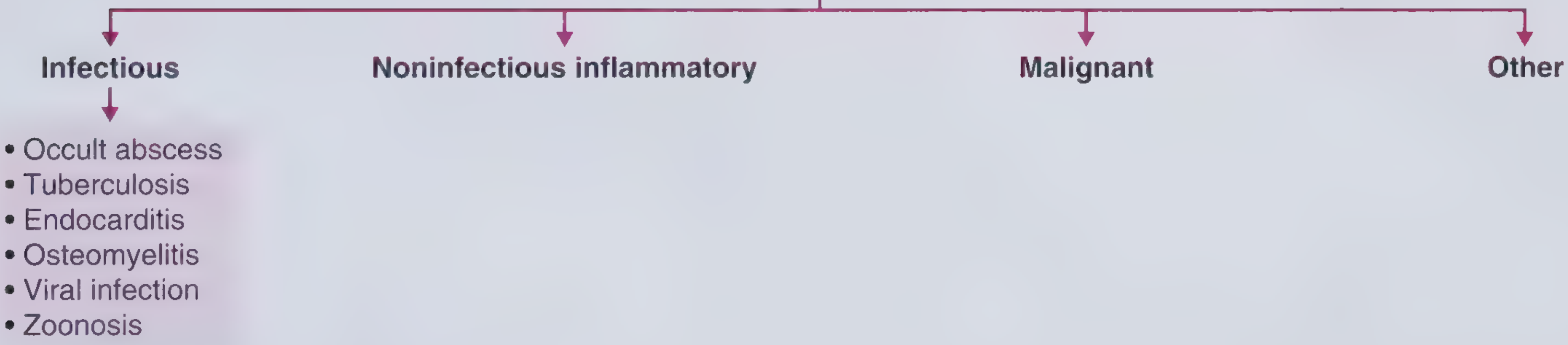
| Category | Key Examples |
|---|---|
| Infectious | Occult abscess, TB, endocarditis, osteomyelitis, viral (EBV, CMV, HIV), zoonoses |
| Non-infectious inflammatory (NIID) | Adult-onset Still's disease, SLE, RA, vasculitis (GCA, Takayasu's), IBD, sarcoidosis, autoinflammatory syndromes |
| Malignant | Lymphoma (most common), leukemia, renal cell carcinoma, hepatocellular carcinoma, atrial myxoma |
| Miscellaneous | Drug fever, factitious fever, deep vein thrombosis, Kikuchi disease, familial Mediterranean fever |
| Undiagnosed (UI) | No diagnosis despite complete workup - now the leading category in Western Europe |
3. Epidemiology by Region (Large Studies 2005-2023)
From Harrison's 22E Table 22-1, comparing geographic outcomes:
| Region | Infections | NIID | Malignancy | Misc | No Diagnosis |
|---|---|---|---|---|---|
| Western Europe | 15.5% (4-36%) | 25% | 11% (3-30%) | 7.5% | 39.5% (26-54%) |
| Other Europe/Turkey | 42% (26-74%) | - | - | - | Lower |
| Asia | Higher | Lower | - | - | Much lower |
Key trend: The proportion of undiagnosed FUO is 2-5x higher in European patients vs. Asian patients. Historically infections dominated; in modern high-income settings, UI and NIID have overtaken infections as leading categories.
4. Major Causes in Detail
Infectious Causes
Intra-abdominal abscess - most common infectious cause in industrialized countries. Affected sites: liver, spleen, intraperitoneal cavity. Most have a compatible history (biliary disease, diverticulitis, appendicitis, Crohn's). CT abdomen has high diagnostic yield.
Tuberculosis - forms most likely to be occult:
- Extrapulmonary disease (hepatic TB) without clear localizing features
- Miliary TB without classic chest X-ray pattern
- Pulmonary TB in immunocompromised patients (CXR may be normal in HIV)
- Key investigations: chest imaging, TST/IGRA, bronchoscopy + BAL (smear, culture, PCR), tissue biopsy
Culture-negative endocarditis - occurs with:
- Pre-treatment antibiotics masking typical organisms
- Atypical organisms: Bartonella, Brucella, Coxiella burnetii, Tropheryma whipplei, HACEK organisms, fungi
Viral causes: EBV, CMV, HIV (acute infection), hepatitis viruses
Zoonoses: Cat-scratch disease (Bartonella henselae) - suspect in young patient with cat exposure + tender lymphadenopathy; Q fever (Coxiella burnetii), Brucellosis, Leptospirosis
Osteomyelitis - vertebral osteomyelitis is the most common site in FUO presentations
Non-infectious Inflammatory Causes
Adult-Onset Still's Disease (AOSD)
- Bimodal age peaks: 15-25 years and 36-46 years
- Classic triad: high quotidian fever (≥39°C) + salmon-colored evanescent rash (appears with fever, disappears when afebrile) + arthritis/arthralgias
- Markedly elevated ferritin (often >2000 ng/mL) is characteristic
- Presents as FUO in up to 10% of cases
- First-line treatment: glucocorticoids
Giant Cell Arteritis (GCA) - accounts for ~1/5 of FUO in the elderly. Headache, jaw claudication, elevated ESR, tender temporal artery. Confirm with temporal artery biopsy. Treat with glucocorticoids.
Polymyalgia Rheumatica (PMR) - strictly a clinical diagnosis; pain/stiffness in neck, shoulders, hips, thighs; dramatic response to glucocorticoids.
SLE - clues: leukopenia, ANA+, anti-dsDNA antibodies, low complement (note: ANA false-positive rate is significant in FUO population)
RA - clues: RF or anti-CCP antibodies; joint erosions on hand/foot X-rays
Sarcoidosis - clues: hilar lymphadenopathy, granulomas on biopsy. Excisional lymph node biopsy > needle aspiration for yield. Highest yield nodes: posterior cervical, epitrochlear, supraclavicular, hilar, mediastinal, retroperitoneal.
Familial Mediterranean Fever (FMF)
- Autosomal recessive; Mediterranean ethnic groups (Arabs, Armenians, Turks, North Africans, Jews)
- Periodic attacks of fever + serositis (peritonitis, pleuritis, synovitis)
- First attack usually before age 10; attacks last 1-4 days
- Colchicine is the treatment of choice
IBD (especially ulcerative colitis) - a rare cause; fever present in ~50% of UC patients at presentation. Colonoscopy +/- nuclear medicine imaging helpful.
Malignant Causes
- Lymphoma (Hodgkin's and non-Hodgkin's) - most common malignant cause of FUO
- Leukemia - often associated with macrocytosis
- Renal cell carcinoma - classic triad: fever + hematuria + polycythemia (paraneoplastic)
- Hepatocellular carcinoma - occurs in patients with cirrhosis
- Colorectal cancer - S. gallolyticus (formerly S. bovis) endocarditis is a strong clue
- Atrial myxoma - "tumor plop" on auscultation
- In patients with known malignancy, infection is responsible for the majority of FUO cases; the malignancy itself accounts for just under half.
5. Diagnostic Approach
History - Key Red Flags and Clues
| Clue | Suggests |
|---|---|
| Travel history | Endemic infections (malaria, typhoid, brucellosis, leishmaniasis) |
| Animal/occupational exposure | Zoonosis (Q fever, brucellosis, cat-scratch disease) |
| Ethnic origin (Mediterranean) | FMF |
| Age >60 + headache + high ESR | GCA/PMR |
| High ferritin + salmon rash + quotidian fever | AOSD |
| History of malignancy + significant weight loss | Malignant FUO |
| Biliary/GI disease history | Intra-abdominal abscess |
| Prior antibiotic use | Culture-negative endocarditis |
| Drug exposure | Drug fever |
Initial Minimum Workup (Standard Baseline)
The modern FUO definition requires completion of a standard minimum diagnostic panel before the label applies:
- CBC with differential
- Comprehensive metabolic panel (LFTs, renal function)
- ESR, CRP
- Blood cultures (x3, before antibiotics)
- Urinalysis + urine culture
- Chest X-ray
- ANA, RF (rheumatologic screen)
- HIV testing
- TST or IGRA (for TB)
- LDH, ferritin, uric acid (malignancy/Still's screening)
- Abdominal CT or ultrasound
- Echocardiography (if endocarditis suspected)
Advanced Workup
FDG-PET/CT - the key modern tool:
- Detects a cause in 30-60% of cases when initial workup is unrevealing
- Can be directly diagnostic (e.g., large-vessel vasculitis showing aortic wall uptake, lymphoma)
- Or identifies a metabolically active focus amenable to biopsy
- Role established by multiple studies; now the gold standard nuclear imaging modality for FUO (replaced Gallium-67)
Biopsy targets (guided by FDG-PET/CT):
- Lymph node (excisional > needle)
- Liver
- Bone marrow
- Temporal artery (if GCA suspected in elderly)
Next-generation sequencing (NGS) / metagenomic NGS (mNGS)
- A 2025-2026 emerging tool with diagnostic sensitivity of ~81.5% for infectious FUO vs. ~47% for conventional testing
- Shows promise for identifying rare or fastidious pathogens
- Should be used selectively, guided by clinical context and potential diagnostic clues (PDCs)
Cytokine-based assays (emerging 2025):
- IL-1β/DNA complex detection - promising for distinguishing sterile from infectious inflammation
6. Treatment
General Principles
- Rational treatment is based on the final diagnosis
- Empirical therapy should be avoided except when the patient's condition is rapidly deteriorating
- Antibiotic or antituberculous therapy may permanently diminish the ability to culture bacteria
Empirical Therapy Options (When Indicated)
| Drug | When to Use |
|---|---|
| Antibiotics | Hemodynamic instability or neutropenia |
| Antituberculous therapy | Positive TST/IGRA, granulomatous disease, endemic region + clinical fit - only after samples sent for culture/PCR; reassess at 6 weeks if no response |
| NSAIDs | Supportive; dramatic response seen in Still's disease |
| Colchicine | Features compatible with FMF, recurrent pericarditis; not fully reliable in acute phase |
| Glucocorticoids | GCA/PMR (impressive response); only after infection and lymphoma reasonably excluded |
| Anakinra (IL-1 inhibitor) | Autoinflammatory syndromes (FMF, CAPS, TRAPS, MKD, Schnitzler syndrome, Still's disease); can be used as a diagnostic-therapeutic trial |
IL-1 Inhibition (Anakinra)
Anakinra blocks both IL-1α and IL-1β. Extremely effective in:
- Familial Mediterranean Fever (FMF)
- Cryopyrin-Associated Periodic Syndrome (CAPS)
- TNF receptor-associated periodic syndrome (TRAPS)
- Mevalonate kinase deficiency (hyper-IgD syndrome)
- Schnitzler's syndrome
- Adult-onset Still's disease
7. Prognosis
- Patients who complete full evaluation and remain undiagnosed have a generally favorable prognosis - the large majority become symptom-free spontaneously
- FUO-related mortality risk is highest during early diagnostic phases (index admission)
- In one cohort of 168 undiagnosed FUO patients, all 4 deaths occurred during the index admission; 2 had diagnoses made only at autopsy (intravascular lymphoma, bilateral pneumonia)
- Chance of remaining undiagnosed is 2-5x higher in Europe vs. Asia
8. Special Categories (Subgroups)
The classic FUO definition applies to immunocompetent adults. Separate management pathways exist for:
| Population | Key Considerations |
|---|---|
| Neutropenic/oncology patients | 2024 AGIHO guideline (published Lancet Reg Health Eur, 2025) covers febrile neutropenia - an oncologic emergency requiring immediate empirical antibiotics; separate risk stratification (MASCC score) |
| HIV/immunocompromised | Broader differential including opportunistic infections; excluded from classic FUO definition |
| Children/adolescents | Infectious etiology still predominates; typically self-limiting if workup reassuring (ACR 2024 appropriateness criteria for pediatric FUO imaging) |
| Elderly | GCA and PMR account for much higher proportion; lower threshold for temporal artery biopsy |
| Travel returnees | Malaria must always be excluded first; typhoid, brucellosis, visceral leishmaniasis |
9. Recent Guidelines and Literature (2024-2026)
| Source | Year | Key Points |
|---|---|---|
| AGIHO guideline (Sandherr et al., Lancet Reg Health Eur) [PMID 39973942] | 2025 | Updated guideline for FUO in neutropenic cancer patients; risk stratification, empirical antifungal therapy, antimicrobial duration |
| Fever and inflammation of unknown origin in the 21st century (Antoniadou et al., Eur J Intern Med) [PMID 40841245] | 2025 | Proposes IUO (inflammation of unknown origin) as a companion concept to FUO; highlights shift toward undiagnosed illness in Europe; validates PET/CT + NGS as key tools; discusses IL-1β/DNA complex assay |
| ACR Appropriateness Criteria: Pediatric FUO [PMID 40409880] | 2024 | Updated imaging recommendations for children with fever without source or unknown origin |
| FUO in adolescents (Ryan K, Med Clin North Am) [PMID 37951657] | 2024 | Infection still predominates in adolescents; overall prognosis favorable when workup unrevealing |
| Harrison's Principles of Internal Medicine 22E | 2025 | Current gold-standard textbook definition with 3 criteria; recommends FDG-PET/CT when initial workup unrevealing; validates anakinra trial in autoinflammatory FUO |
10. The Concept of "Inflammation of Unknown Origin" (IUO) - 2025 Update
A 2025 European review (Antoniadou et al.) formalized the concept of IUO - where patients have elevated inflammatory markers without meeting the fever temperature threshold. Key points:
- FUO and IUO share diagnostic evaluation and overlapping etiologies
- IUO is more strongly associated with NIID (less likely infectious) compared to classic FUO
- Both conditions now benefit from PET/CT and mNGS in the workup
- Undiagnosed illness (UI) is now the leading cause of FUO in Western European high-income settings
Sources:
- Harrison's Principles of Internal Medicine, 22nd Ed. (2025, McGraw Hill) - Ch. 22, Mulders-Manders & Rovers
- Goldman-Cecil Medicine International Edition - Ch. 259
- Frameworks for Internal Medicine (Lippincott) - Ch. 21
- AGIHO 2024 Guideline, Lancet Reg Health Eur [PMID 39973942]
- Antoniadou et al. 2025, Eur J Intern Med [PMID 40841245]
- Ryan K. 2024, Med Clin North Am [PMID 37951657]
- ACR Appropriateness Criteria Pediatric FUO 2024 [PMID 40409880]
This is a shared conversation. Sign in to Orris to start your own chat.