
Fns and dhs details
Asking for Preferences
Could you clarify what you mean by 'Fns and dhs details'? Which of these do you have in mind?
The user skipped, so I'll cover the most likely interpretation - FNS (Food and Nutrition Service) and DHS (Department of Homeland Security) as US federal agencies, but will also briefly note if it could be something else.
Searching sources...
Searching the Web
FNS Food and Nutrition Service USDA details overview 2025
Searching the Web
DHS Department of Homeland Security details overview 2025
Here is an overview of both FNS and DHS as US federal agencies:
FNS - Food and Nutrition Administration (formerly Food and Nutrition Service)
Note: As of June 1, 2026, the Food and Nutrition Service (FNS) was officially renamed the Food and Nutrition Administration (FNA) under the USDA.
What it is
- A federal agency within the U.S. Department of Agriculture (USDA)
- Headquartered in Alexandria, Virginia
- Mission: Provide nutrition assistance to low-income individuals and families and promote healthy eating across America
Key Programs Administered
| Program | Purpose |
|---|---|
| SNAP (Supplemental Nutrition Assistance Program) | Monthly food benefits via EBT cards for low-income households |
| WIC (Women, Infants & Children) | Nutrition support for pregnant women, new mothers, and young children |
| National School Lunch Program | Free/reduced-price meals in schools |
| School Breakfast Program | Morning meals for students |
| CACFP (Child and Adult Care Food Program) | Meals in day care settings |
| TEFAP (Emergency Food Assistance Program) | Food for food banks |
| CSFP (Commodity Supplemental Food Program) | Food boxes for low-income seniors |
| Summer EBT | Nutrition benefits during summer school break |
Key Facts
- Serves tens of millions of Americans annually
- Works through state agencies that administer programs under federal standards
- Budget is one of the largest within USDA
- Focused on reducing fraud, waste, and abuse in nutrition programs
DHS - Department of Homeland Security
What it is
- A cabinet-level federal department of the U.S. government
- Created in 2002 after the September 11 attacks (via the Homeland Security Act of 2002)
- One of the largest federal departments with 260,000+ employees
- Current Secretary (as of 2025-2026): Kristi Noem
Core Missions
- Preventing terrorism and enhancing security
- Border security and immigration enforcement
- Disaster preparedness and response
- Cybersecurity
- Critical infrastructure protection
Major Component Agencies
| Agency | Role |
|---|---|
| CBP (Customs and Border Protection) | Border protection, ports of entry |
| ICE (Immigration and Customs Enforcement) | Immigration enforcement, deportations |
| FEMA (Federal Emergency Management Agency) | Disaster response and recovery |
| TSA (Transportation Security Administration) | Airport/transit security |
| USCIS (U.S. Citizenship and Immigration Services) | Immigration benefits and naturalization |
| USCG (U.S. Coast Guard) | Maritime law enforcement |
| Secret Service | Protects the President and financial crimes |
| CISA (Cybersecurity and Infrastructure Security Agency) | Cyber defense |
| S&T Directorate | Homeland security research and technology |
Key 2025-2026 Highlights
- Strong focus on border enforcement and increased ICE detention capacity (50,000 beds)
- Expanded counter-drone (C-UAS) technology deployment
- Annual Homeland Threat Assessment identifies domestic/foreign terrorism as high threats
- Partnership with international allies on biosecurity and border threats
Quick comparison:
| FNS / FNA | DHS | |
|---|---|---|
| Parent Dept. | USDA | Independent cabinet dept. |
| Focus | Nutrition assistance | Security, immigration, disasters |
| Key law | Farm Bill | Homeland Security Act (2002) |
| Renamed | Yes - FNA since June 2026 | No |
Could you let me know if you were looking for a different "FNS" and "DHS"? For example, in some contexts these abbreviations refer to state-level agencies (like a state's Family and Nutrition Services + Department of Human Services), or they could refer to something entirely different. I'm happy to go deeper on whichever version is relevant to you.
Femoral neck system and dynamic hip screw
Reading File
Finding Sources
Finding Sources
Searching the Web
Femoral Neck System FNS vs Dynamic Hip Screw DHS comparison fixation
Finding Sources
Finding Sources
Reading File
Reading File
Reading File
Loading Image
Loading Image
Searching PubMed
"femoral neck system" AND "dynamic hip screw" fracture fixation
Reading Article
PMID: 38419236
Reading Article
PMID: 41366897
Here is a detailed comparison of the Femoral Neck System (FNS) and Dynamic Hip Screw (DHS) for femoral neck fracture fixation:
Dynamic Hip Screw (DHS)
Design and Mechanism
The DHS is a sliding lag screw and side plate construct. It consists of:
- A large-diameter lag screw inserted into the femoral head along the neck
- A barrel on the side plate into which the lag screw can freely slide
- 4-hole (or more) side plate fixed to the lateral femoral cortex with cortical screws
The key mechanism is controlled dynamic collapse - as the patient weight-bears, the lag screw slides within the barrel, allowing the fracture ends to impact together and stimulate union. This prevents the screw from cutting out through osteoporotic bone.

DHS: (a) lag screw traversing the fracture into the femoral head; (b) magnified view showing the smooth barrel in which the screw can slide, allowing controlled compression at the fracture site. - Bailey and Love's Short Practice of Surgery, 28th Ed.
Indications
- Stable extracapsular (intertrochanteric) fractures - primary indication; provides reliable head-shaft connection
- Unstable extracapsular fractures - can be used but intramedullary nail may be preferred
- Intracapsular fractures in physiologically young patients (to preserve native femoral head)
- Undisplaced intracapsular fractures where head preservation is the goal
Surgical Technique Highlights
- Open or percutaneous approach to lateral femur
- Guidewire placed under fluoroscopy into the center of the femoral head (tip-apex distance <25 mm is key)
- Sequential reaming then screw insertion
- Side plate attached with cortical screws
- Tap recommended in non-osteoporotic bone; consider derotational screw to prevent rotational instability
Limitations
- Larger implant, more tissue dissection
- Rotational instability of the femoral head around the lag screw axis (only one point of fixation in the head)
- Not ideal for high Pauwels angle fractures (vertical shear - risk of implant failure)
- More blood loss and longer operative time compared to FNS
Femoral Neck System (FNS)
Design and Mechanism
The FNS (Synthes/DePuy) is a fixed-angle gliding fixation device introduced as a minimally invasive option specifically for femoral neck fractures. It combines:
- A large femoral neck bolt (main axial load-bearing element)
- An antirotation screw (ARScrew) locked to the bolt at a fixed angle - prevents rotation of the femoral head fragment
- A low-profile base plate fixed to the lateral femur
The bolt and antirotation screw glide together as a locked unit within the barrel of the base plate - allowing controlled collapse (like DHS) while simultaneously preventing rotation around the head-neck axis. This is the key design advantage over the DHS.
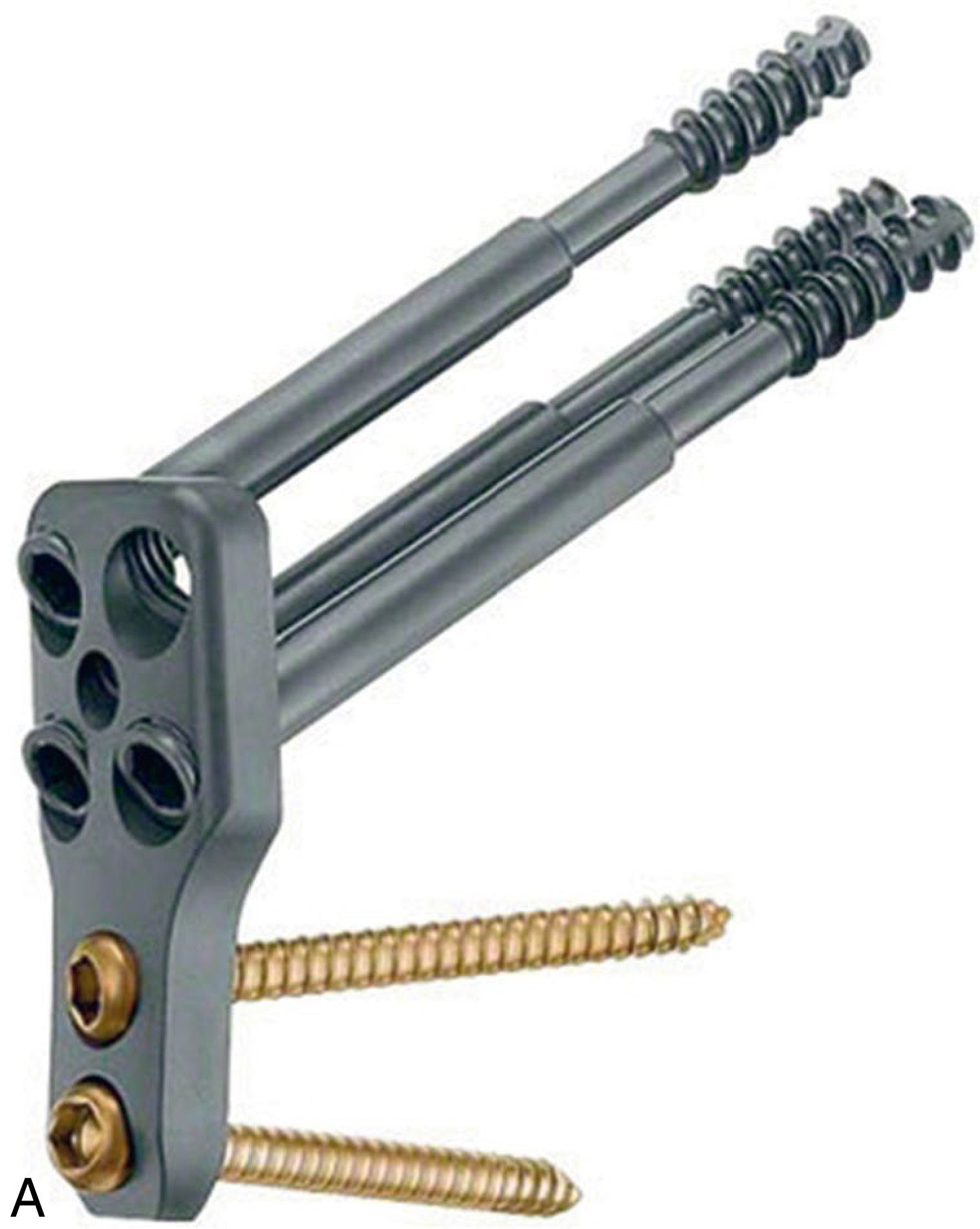
Fixed-angle femoral neck system type implant (Targon FN, Aesculap) - showing the dual-rod construct and base plate. - Campbell's Operative Orthopaedics 15th Ed 2026
Indications
- All types of femoral neck fractures - both displaced and undisplaced
- Particularly suited for intracapsular fractures in younger patients (head preservation)
- High Pauwels angle (type III) fractures where rotational stability is most important
- Cases where minimally invasive approach is desired
Advantages Over Cannulated Screws and DHS
From Campbell's Operative Orthopaedics (15th Ed, 2026):
"Data suggest decreased rates of avascular necrosis (AVN), complications, shortening, fluoroscopy use, and increased functional outcomes compared with cannulated screws. A biomechanical study has shown the stability of the FNS to be similar to the dynamic hip screw and superior to multiple cannulated screws."
Head-to-Head Comparison: FNS vs DHS
| Feature | FNS | DHS |
|---|---|---|
| Design | Bolt + locked antirotation screw + base plate | Single lag screw + barrel side plate |
| Anti-rotation | Built-in (ARScrew locked to bolt) | None (relies on single screw; often needs separate derotation screw) |
| Dynamic collapse | Yes (gliding in barrel) | Yes (lag screw slides in barrel) |
| Approach | Minimally invasive | Open or percutaneous |
| Blood loss | Less | More |
| Operative time | Shorter | Longer |
| Bone preservation | Greater (smaller footprint) | Less (larger lag screw) |
| Fluoroscopy use | Less | More |
| AVN rate | Lower (vs cannulated screws; comparable to DHS) | Standard reference |
| Harris Hip Score | Slightly better | Slightly lower |
| Biomechanical stability | Comparable to DHS | Gold standard extracapsular |
| Primary indication | Intracapsular FNF (all types) | Extracapsular (intertrochanteric) FNF |
Recent Evidence (2024-2025)
Two systematic reviews directly compare FNS vs DHS:
Meta-analysis (Jiang et al., 2024 - PMID 38419236) - 6 studies, 577 patients:
- FNS had shorter operative time, less blood loss, and better Harris Hip Score
- No significant difference in complication rates, femoral neck shortening, or hospitalisation
- FNS can "optimise surgical procedures" but overall complication rates are comparable
Meta-analysis (Lim et al., 2025 - PMID 41366897) - 8 studies, 726 patients (most recent):
- FNS: operative time ~20 minutes shorter (95% CI: -26 to -13 min, p<0.001)
- FNS: blood loss ~17 mL less (p<0.001)
- FNS: Harris Hip Score significantly better (p=0.02)
- No difference in femoral neck shortening, nonunion, or osteonecrosis of femoral head
- Conclusion: FNS is a viable alternative to DHS for femoral neck fractures
Biomechanical study (Nature Scientific Reports): Both FNS and DHS showed comparable axial stiffness (~234 vs 253 N/mm, p=NS) and similar screw migration in basicervical fractures.
Summary: When to Choose Which?
| Scenario | Preferred Implant |
|---|---|
| Stable intertrochanteric (extracapsular) fracture | DHS (classic indication) |
| Unstable intertrochanteric | Cephalomedullary nail (preferred) or DHS |
| Undisplaced intracapsular, young patient | FNS or cannulated screws |
| Displaced intracapsular, young patient | FNS (better rotational control vs screws, less AVN) |
| High Pauwels angle (type III) fracture | FNS or fixed-angle device |
| Elderly, displaced intracapsular | Hemiarthroplasty or THR (not internal fixation) |
- Campbell's Operative Orthopaedics, 15th Ed 2026
- Bailey and Love's Short Practice of Surgery, 28th Ed
- Jiang et al., JPMA 2024 [PMID 38419236]
- Lim et al., Medicine 2025 [PMID 41366897]
This is a shared conversation. Sign in to Orris to start your own chat.