
Explain in detail about Menstrual Cycle
Reading File
Finding Sources
Finding Sources
Searching PubMed
"menstrual cycle" AND physiology
Searching the Web
menstrual cycle phases hormone changes ovulation endometrium physiology
Reading File
Reading File
Reading File
Searching Images
diagram menstrual cycle ovarian endometrial phases FSH LH estradiol progesterone ovulation
Reading Web Page
https://www.ncbi.nlm.nih.gov/books/NBK500020
Menstrual cycle
The menstrual cycle is the recurring, hormone-controlled sequence that prepares the ovary to release an egg and prepares the uterus for a possible pregnancy. If pregnancy does not occur, the uterine lining is shed as menstrual bleeding.
- Day 1 is the first day of full menstrual bleeding.
- A commonly taught cycle is 28 days, but healthy cycles vary between people and from cycle to cycle.
- Two coordinated cycles occur at the same time:
- Ovarian cycle: follicle development, ovulation, and corpus luteum formation.
- Uterine or endometrial cycle: menstruation, proliferation, and secretion.
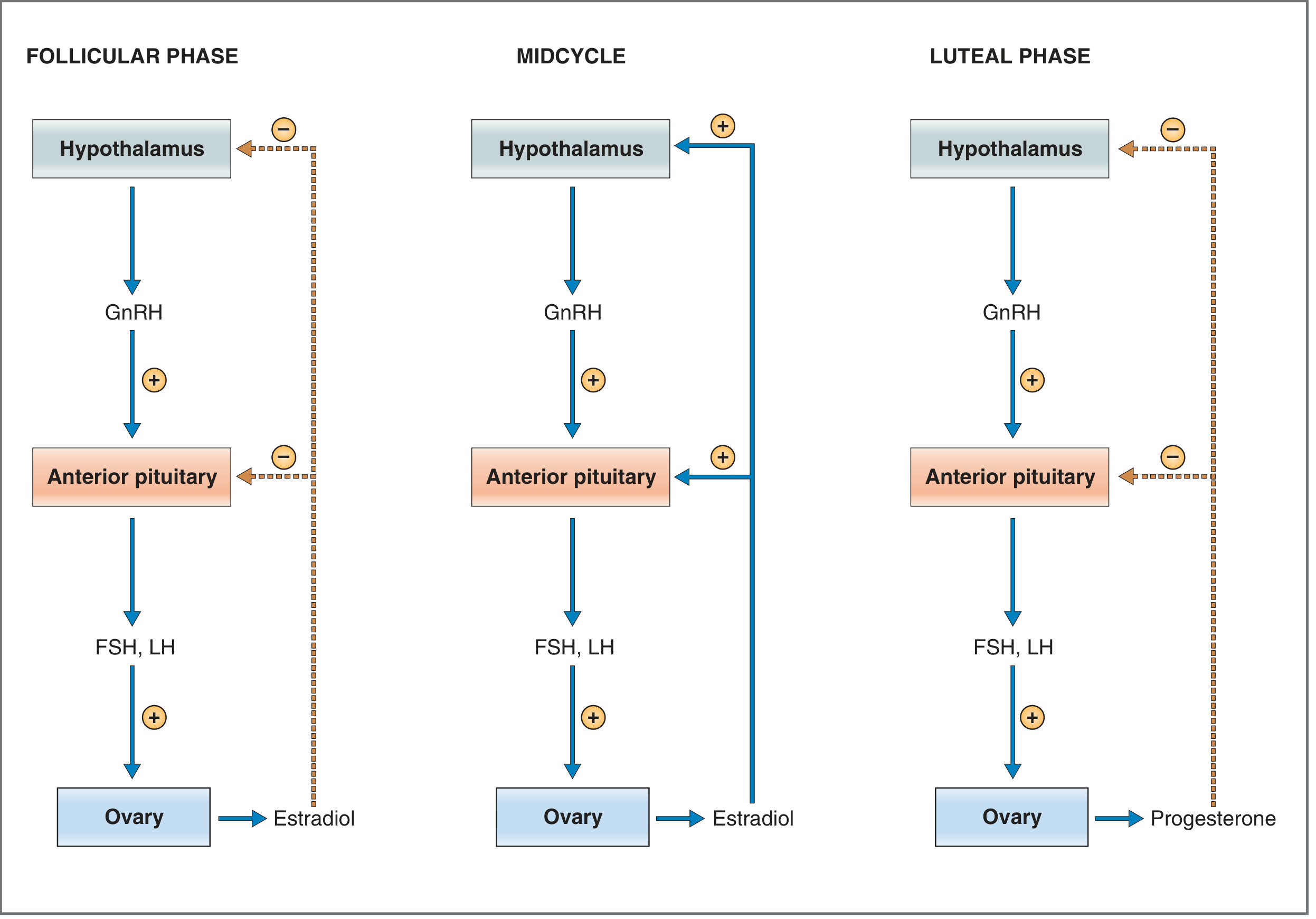
The cycle is regulated by the hypothalamic-pituitary-ovarian axis:
Hypothalamus (GnRH) → anterior pituitary (FSH and LH) → ovary (estrogen, progesterone, inhibin) → uterus and feedback to brain/pituitary.
Hypothalamus (GnRH) → anterior pituitary (FSH and LH) → ovary (estrogen, progesterone, inhibin) → uterus and feedback to brain/pituitary.
Costanzo Physiology, 7th ed., p. 477; Berek & Novak's Gynecology, p. 264.
1. Main hormones and their roles
| Hormone | Main source | Main function |
|---|---|---|
| GnRH | Hypothalamus | Released in pulses; stimulates pituitary release of FSH and LH |
| FSH | Anterior pituitary | Recruits and supports growth of ovarian follicles; stimulates granulosa cells and estrogen production |
| LH | Anterior pituitary | Triggers ovulation; promotes corpus luteum formation |
| Estrogen, mainly estradiol | Growing ovarian follicles | Builds the endometrium; usually inhibits FSH/LH, but sustained high levels before ovulation trigger positive feedback and the LH surge |
| Progesterone | Corpus luteum after ovulation | Converts endometrium to a secretory, implantation-ready state; stabilizes it and suppresses further FSH/LH release |
| Inhibin | Granulosa cells and corpus luteum | Suppresses FSH, helping select a dominant follicle |
GnRH must be pulsatile. Continuous GnRH exposure eventually suppresses pituitary FSH and LH secretion.
2. Ovarian cycle
The ovarian cycle has three parts:
- Follicular phase
- Ovulation
- Luteal phase
A. Follicular phase: from menstruation to ovulation
This phase begins on day 1 of bleeding and ends at ovulation. Its length is the most variable part of the cycle.
Early follicular phase
At the end of the preceding cycle, the corpus luteum degenerates. Therefore:
- Progesterone and estrogen fall
- Their negative feedback on the pituitary is removed
- FSH rises modestly
- Several ovarian follicles begin growing
Each developing follicle contains an oocyte. FSH acts primarily on granulosa cells, stimulating follicular growth and aromatase activity. Aromatase converts androgens into estradiol.
Dominant follicle selection
Usually, one follicle becomes the dominant follicle. It is selected because it responds best to FSH and produces increasing estradiol. The other recruited follicles undergo atresia.
As estradiol rises:
- It promotes endometrial growth.
- It reduces FSH through negative feedback, which helps prevent maturation of multiple follicles.
- Inhibin B from granulosa cells also reduces FSH.
B. Ovulation: release of the oocyte
Near the middle of the cycle, sustained high estradiol from the mature dominant follicle switches from its usual negative feedback to positive feedback on the hypothalamus and pituitary.
This produces:
- A large LH surge
- A smaller FSH surge
The LH surge causes:
- Completion of the first meiotic division by the primary oocyte
- Rupture of the mature follicle
- Release of the secondary oocyte
- Beginning of luteinization, which turns the ruptured follicle into the corpus luteum
In a textbook 28-day cycle, ovulation is often placed around day 14, but it does not always occur on day 14. It normally occurs about 12 to 14 days before the next period, because the luteal phase is relatively stable while the follicular phase varies. The onset of the LH surge typically precedes ovulation by roughly 34 to 36 hours, according to Endotext's ovulation review.
C. Luteal phase: from ovulation to next menstruation
After ovulation, LH transforms the ruptured follicle into the corpus luteum.
The corpus luteum secretes:
- Progesterone, predominantly
- Estrogen
- Inhibin A
These hormones exert negative feedback on GnRH, FSH, and LH. This prevents another ovulation within the same cycle.
If fertilization and implantation do not occur:
- The corpus luteum survives for about 12 to 14 days, then regresses.
- Progesterone and estrogen concentrations decline sharply.
- The endometrium loses hormonal support.
- Menstruation begins.
- FSH begins to rise again, initiating the next cycle.
If pregnancy occurs, the early embryo produces human chorionic gonadotropin (hCG), which maintains the corpus luteum until the placenta can produce sufficient progesterone and estrogen.
3. Uterine or endometrial cycle
The endometrium is the inner lining of the uterus. Its changes are synchronized with ovarian hormone secretion.
| Endometrial phase | Approximate timing in a 28-day cycle | Dominant hormone/event |
|---|---|---|
| Menstrual phase | Days 1-4 or 5 | Withdrawal of progesterone and estrogen |
| Proliferative phase | After menses to ovulation | Estrogen |
| Secretory phase | After ovulation to menses | Progesterone |
A. Menstrual phase
Menstruation occurs because the corpus luteum regresses and progesterone and estrogen fall.
Progesterone withdrawal causes:
- Constriction of the endometrial spiral arteries
- Local ischemia and tissue breakdown
- Inflammatory mediator and prostaglandin release
- Breakdown and shedding of the superficial functional layer of endometrium
The basal layer remains intact. It regenerates the endometrium during the next proliferative phase.
Menstrual blood contains blood, endometrial tissue, cervical mucus, and vaginal secretions. Normal menstrual loss is not simply “loss of blood.”
B. Proliferative phase
This occurs after menstruation and before ovulation. It overlaps with the ovarian follicular phase.
Rising estradiol from the developing follicle causes:
- Regrowth and thickening of the functional endometrium
- Proliferation of endometrial stromal cells
- Lengthening of endometrial glands
- Growth of spiral arteries
- Production of thinner, clearer, more watery cervical mucus
This watery cervical mucus near ovulation makes sperm passage through the cervix easier.
C. Secretory phase
This begins after ovulation and overlaps with the ovarian luteal phase.
Progesterone from the corpus luteum changes the estrogen-primed endometrium into one suitable for implantation:
- Glands become coiled and secrete nutrient-rich material, including glycogen
- The endometrium becomes more edematous and vascular
- Stromal cells begin decidual changes
- Cervical mucus becomes thicker and less penetrable to sperm
- Basal body temperature rises slightly, often by about 0.3 to 0.5°C, due to progesterone
The secretory endometrium is optimally receptive to implantation about 6 to 10 days after ovulation.
The correspondence between ovarian and uterine events is summarized in StatPearls' physiology review.
4. Hormonal pattern through the cycle
A simple way to remember the pattern:
- Beginning of cycle: estrogen and progesterone are low; FSH rises.
- Follicular phase: estrogen progressively rises as the dominant follicle matures.
- Just before ovulation: prolonged high estrogen causes the LH surge.
- After ovulation: progesterone rises because of the corpus luteum.
- Late luteal phase: progesterone and estrogen fall if pregnancy has not occurred, triggering menstruation.
Feedback mechanisms
Negative feedback
For most of the cycle:
- Moderate estrogen inhibits GnRH, FSH, and LH.
- Progesterone inhibits GnRH, FSH, and LH.
- Inhibin suppresses FSH.
Positive feedback
Immediately before ovulation:
- Sustained high estradiol changes to positive feedback.
- This generates the LH surge required for ovulation.
This switch is the defining endocrine event of the mid-cycle period.
Costanzo Physiology, 7th ed., p. 477.
Costanzo Physiology, 7th ed., p. 477.
5. Relationship to fertility
The fertile window includes the days before ovulation and the day of ovulation:
- Sperm can survive in the female reproductive tract for several days under favorable cervical mucus conditions.
- The oocyte remains capable of fertilization for only about 12 to 24 hours after ovulation.
Therefore, pregnancy can result from intercourse in the days before ovulation, not only on the day of ovulation.
Common possible signs of ovulation include:
- Clear, stretchy, slippery cervical mucus
- Mild one-sided pelvic discomfort in some people, called mittelschmerz
- A small sustained rise in basal body temperature after ovulation
- Positive urinary LH test before ovulation
These signs can help estimate ovulation but do not guarantee it.
6. Premenstrual symptoms and cramps
During the late luteal phase, hormonal changes may contribute to:
- Breast tenderness
- Bloating
- Acne
- Fatigue
- Food cravings
- Mood changes
- Headache
Menstrual cramps, or primary dysmenorrhea, are mainly related to endometrial prostaglandins, particularly prostaglandin F2α. These increase uterine contractions and can temporarily reduce uterine blood flow.
7. When menstrual patterns may need medical assessment
Clinical review is appropriate for situations such as:
- Very heavy bleeding, such as soaking pads or tampons hourly for several hours
- Bleeding lasting over about 7 days repeatedly
- Periods consistently less than 21 days or more than 35 days apart in adults
- No period for 3 months without an obvious explanation
- Severe pain, new pelvic pain, fainting, or symptoms of anemia
- Possible pregnancy with bleeding or pain
- New irregular bleeding after previously regular cycles
- Bleeding after sex or after menopause
Common contributors to abnormal cycles include pregnancy, stress, weight changes, intense exercise, polycystic ovary syndrome, thyroid disease, hyperprolactinemia, perimenopause, certain medicines, and structural uterine conditions such as fibroids.
One-line summary
FSH develops follicles → estrogen proliferates endometrium → sustained high estrogen causes the LH surge → LH triggers ovulation → corpus luteum produces progesterone → progesterone makes the endometrium secretory → hormone withdrawal causes menstruation if there is no pregnancy.
Explain the menstrual cycle with a simple diagram
Reading File
Menstrual Cycle: Simple Diagram
DAY:       1          5          14                    28
           |----------|-----------|---------------------|

OVARY:     Follicles grow       Ovulation         Corpus luteum
           (FSH, estrogen ↑)    (LH surge)        (progesterone ↑)
                                      |
                                      ↓
UTERUS:    Menstrual bleeding → Endometrium grows → Secretory lining
           (period)               (thickens)        (ready for pregnancy)

IF NO PREGNANCY:
Corpus luteum breaks down → Estrogen and progesterone fall → Period begins again
The three main stages
1. Menstrual phase: about days 1-5
- This is the period.
- The uterus sheds its inner lining, called the endometrium.
- This happens because estrogen and progesterone levels fall.
2. Follicular or proliferative phase: from day 1 to ovulation
- The brain releases FSH (follicle-stimulating hormone).
- FSH helps several follicles in the ovary begin to grow. Usually one becomes the dominant follicle.
- The growing follicle makes increasing estrogen.
- Estrogen rebuilds and thickens the uterine lining.
FSH ↑ → Follicle grows → Estrogen ↑ → Uterine lining grows
3. Ovulation: around mid-cycle
- When estrogen remains high for a short period, it causes a sudden rise in LH, called the LH surge.
- The LH surge causes release of an egg from the ovary. This is ovulation.
High estrogen → LH surge → Egg released (ovulation)
In a 28-day example cycle, ovulation is often around day 14. In real life, the timing can differ. Ovulation usually occurs about 12-14 days before the next period.
4. Luteal or secretory phase: after ovulation
- The empty follicle becomes the corpus luteum.
- It produces mainly progesterone.
- Progesterone changes the thickened uterine lining into a soft, nutrient-rich lining suitable for implantation if pregnancy occurs.
Corpus luteum → Progesterone ↑ → Uterus prepared for implantation
If pregnancy does not occur
No fertilization
       ↓
Corpus luteum degenerates
       ↓
Progesterone and estrogen fall
       ↓
Uterine lining breaks down
       ↓
Menstruation begins: a new cycle starts
Hormone pattern at a glance
FSH:          small rise early in the cycle
Estrogen:     rises before ovulation
LH:           sharp surge at ovulation
Progesterone: rises after ovulation, then falls before the period
Easy sequence to remember:
Period → Follicle grows → Estrogen rises → LH surge → Ovulation
→ Progesterone rises → Uterus prepared → Hormones fall → Period
Costanzo Physiology, 7th ed., p. 477; Berek & Novak's Gynecology, p. 264.
This is a shared conversation. Sign in to Orris to start your own chat.