
How to differentiate tinea from eczema
Reading File
Now I'll search the medical library for tinea vs eczema differentiation in parallel:
Finding Sources
Finding Sources
Searching PubMed
tinea eczema differential diagnosis
Good results. Now let me read the most relevant sections - tinea corporis from Andrews' (best clinical dermatology text) and the differential diagnosis content, plus the eczema section from Harrison's and Dermatology 2-Volume Set:
Reading File
Reading File
Finding Sources
Excellent. Now let me read the differential diagnosis table from Fitzpatrick's (the authoritative dermatology reference):
Reading File
Reading File
Finding Sources
I now have rich, authoritative content. Let me also get the nummular eczema description from the Family Medicine text since nummular eczema is the key mimic of tinea:
Reading File
Finding Sources
I have all the content I need. Let me fetch a couple of the clinical images from Fitzpatrick's to include in the answer:
Loading Image
That image shows tinea pedis (foot), not the classic tinea corporis annular ring. Let me get the armpit/annular image which is more relevant for differentiating from eczema:
Loading Image
I now have everything I need for a thorough, well-sourced answer. Here is the comprehensive breakdown:
Differentiating Tinea from Eczema
The overlap between tinea (dermatophytosis) and eczema - particularly nummular (discoid) eczema - is one of the most common diagnostic pitfalls in dermatology. The key is to approach differentiation systematically across morphology, history, distribution, and investigations.
1. Morphology - the Most Important Clue
| Feature | Tinea (Corporis) | Nummular/Atopic Eczema |
|---|---|---|
| Border | Active, raised, scaly, well-demarcated advancing edge - often vesicular or pustular at the rim | Ill-defined, blends gradually into surrounding skin |
| Central clearing | Classic feature - lesions clear centrally as they expand outward ("ringworm") | Absent - entire coin-shaped plaque is involved uniformly |
| Shape | Annular, serpiginous, polycyclic | Coin-shaped (nummular) or irregular patches; atopic eczema favors flexures |
| Scale | Fine scale concentrated at the active border | Scale distributed throughout the plaque |
| Vesicles | Vesicular border possible, but mainly at the periphery | Vesicles scattered across the whole lesion in dyshidrotic or acute eczema |
| Lichenification | Absent | Common with chronic scratching |
The polycyclic tinea corporis lesions from Fitzpatrick's - note the scaly advancing rings with central clearing:
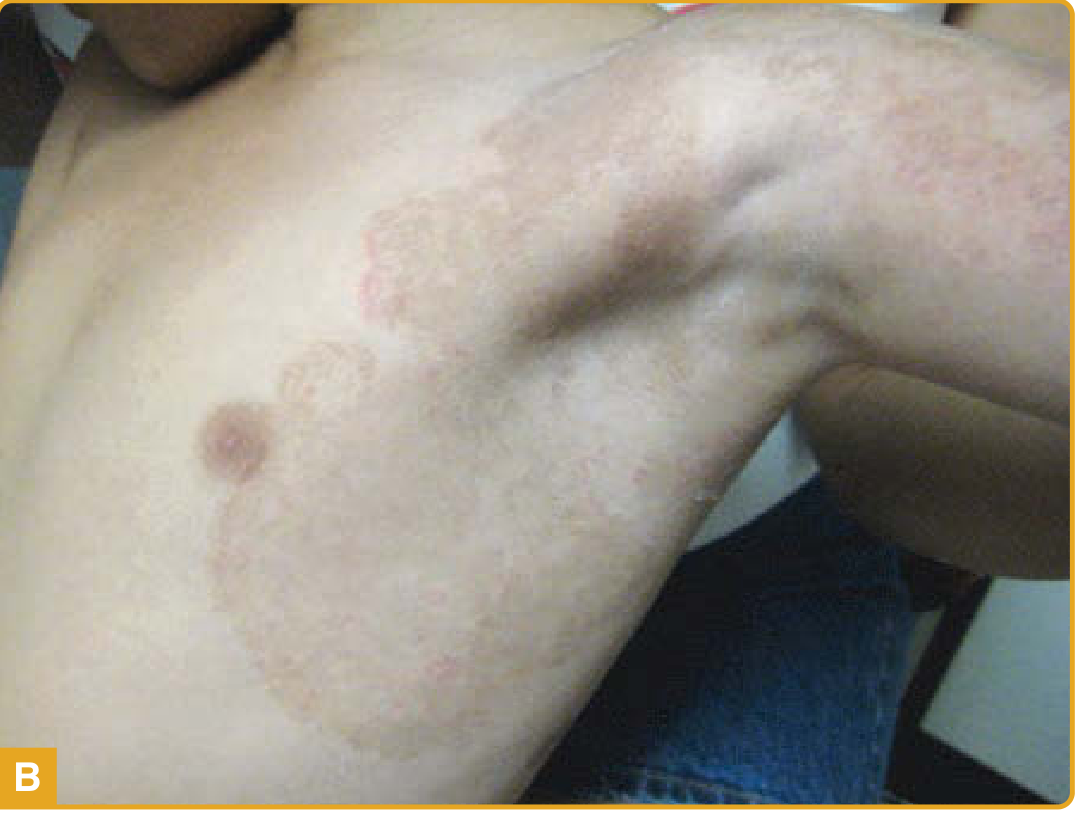
Fitzpatrick's Dermatology, Fig. 160-9B - polycyclic tinea corporis plaques
2. Clinical History
| Feature | Tinea | Eczema |
|---|---|---|
| Atopic history | Not expected | Often yes - personal/family history of asthma, hay fever, atopic dermatitis |
| Contact/trigger | Exposure to infected animal, person, or fomite; wrestling; occlusive clothing; humid climate | Irritants, allergens, dry skin, stress |
| Progression | Centrifugal expansion with central clearing over weeks | Chronic, relapsing course; worsens with dry/cold weather (nummular) |
| Spread pattern | May autoinoculate from feet to groin to trunk | Spreads via scratching; atopic favors flexures (antecubital, popliteal) |
| Response to steroids | Worsens - creates "tinea incognita" (masked appearance with diminished erythema, lost border) | Improves with topical corticosteroids |
Tinea incognita is a major pitfall: when tinea has been inadvertently treated with topical steroids, it loses its classic scaling border and central clearing, looking deceptively like eczema. Biopsy and KOH scraping from the edge are needed in these cases. - Red Book 2021, p. 1168
3. Distribution
| Site | Tinea | Eczema |
|---|---|---|
| Trunk/limbs | Tinea corporis - annular, anywhere on glabrous skin | Nummular eczema - extremities and trunk in adults |
| Groin | Tinea cruris - inguinal fold, inner thigh, NOT scrotum (E. floccosum) | Contact/irritant dermatitis may involve scrotum |
| Feet | Tinea pedis - interdigital, moccasin, vesicular types | Dyshidrotic eczema - vesicles on soles/sides of feet |
| Scalp | Tinea capitis - scaling, alopecia, kerion in children | Seborrheic dermatitis - diffuse, greasy scale; no alopecia |
| Flexures | Uncommon primary site | Classic atopic eczema distribution |
| Face | Tinea faciei | Atopic/seborrheic favors perinasal, periocular |
4. Investigations
KOH (Potassium Hydroxide) Preparation - Gold Standard
- Scrape the active scaling border of tinea (not the center) - this maximizes fungal yield
- Hyphae (branching, septate) confirm tinea
- Eczema: KOH is negative - no hyphae seen
- Pitfall: "mosaic false hyphae" from junctions of keratinocytes can mimic fungus; cotton/synthetic fibers also mimic hyphae - experience is needed
"The diagnosis of tinea corporis is by finding the fungus by KOH examination... [mosaic false hyphae at keratinocyte junctions] is the most common artifact misinterpreted as a positive KOH examination." - Andrews' Diseases of the Skin, p. 347
Fungal Culture
- Sabouraud dextrose agar: results in 1-4 weeks
- Confirms genus and species
- Useful when KOH is equivocal or negative but clinical suspicion remains high
Wood's Lamp (UV Light)
- Tinea corporis caused by Microsporum species fluoresces bright green
- Trichophyton species (most common cause) do not fluoresce - so a negative Wood's lamp does NOT rule out tinea
- Eczema: no fluorescence
Skin Biopsy
- Use when KOH is negative but suspicion remains, or when tinea incognita is suspected
- PAS staining shows fungal hyphae in the stratum corneum
- Also differentiates nummular eczema from psoriasis when needed
5. Pitfall: The "Id" (Autoeczematization) Reaction
An important complication that blurs the picture: tinea can trigger a dermatophytid ("id") reaction - a hypersensitivity response manifesting as diffuse, pruritic, papular, vesicular, or eczematous lesions at sites distant from the fungal infection. These id reactions respond to treatment of the underlying tinea, not to antifungals applied to the secondary sites. They may be mistaken for primary eczema. - Red Book 2021, p. 1168
Summary: Key Differentiating Points at a Glance
| Tinea | Eczema | |
|---|---|---|
| Border | Sharp, active, raised, scaly rim | Ill-defined |
| Central clearing | Present | Absent |
| KOH scraping | Positive (hyphae) | Negative |
| Steroid response | Worsens (tinea incognita) | Improves |
| Atopic history | No | Often yes |
| Wood's lamp | Green (Microsporum only) | Negative |
| Pruritus | Present | Prominent, often severe |
| Lichenification | Absent | Common (chronic) |
"Nummular dermatitis can be confused with plaques of psoriasis or tinea corporis, but skin scrapings will not reveal hyphae on KOH preparation. Also, lesions lack the typical central sparing of tinea corporis." - Textbook of Family Medicine, 9th ed., p. 934
Sources: Andrews' Diseases of the Skin; Fitzpatrick's Dermatology, 9th ed.; Red Book 2021; Textbook of Family Medicine, 9th ed.
This is a shared conversation. Sign in to Orris to start your own chat.