
caput succedaneum
Reading File
Finding Sources
Finding Sources
Reading File
Reading File
Reading File
Loading Image
Caput Succedaneum
Definition: Superficial hemorrhagic edema between the skin and the epicranial aponeurosis (the most superficial layer), occurring over the presenting part of the fetal head during delivery. It results from pressure against the cervix compressing local tissue.
Anatomy & Layer
As shown in the diagram below, caput succedaneum is the most superficial of the birth-related extradural fluid collections — above the epicranial aponeurosis, directly under the skin:
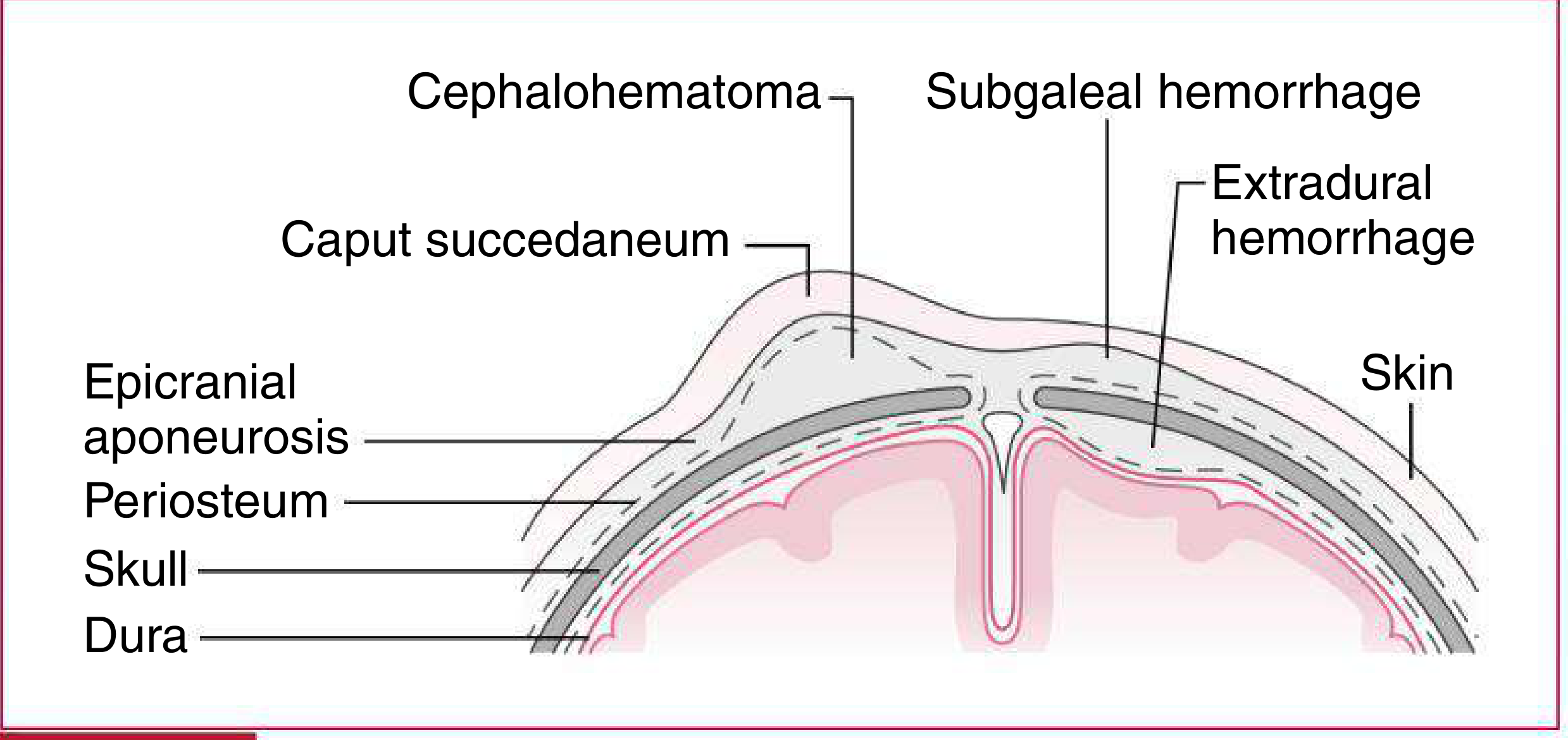
— Harriet Lane Handbook, 23rd ed.
Clinical Features
| Feature | Caput Succedaneum |
|---|---|
| Location | At point of contact; crosses suture lines |
| Feel | Soft, vaguely demarcated, pitting edema; shifts with gravity |
| Timing | Maximal at birth; resolves within 48–72 hours |
| Associated findings | Petechiae and ecchymosis may be present |
| Severity | Minimal; generally benign |
Pathophysiology
Prolonged pressure of the cervix on the presenting fetal scalp leads to interstitial fluid accumulation and subcutaneous edema. Because the edema is superficial (above the epicranial aponeurosis), it is not confined by suture lines and can spread freely across the scalp.
Comparison with Similar Conditions
| Caput Succedaneum | Cephalohematoma | Subgaleal Hemorrhage | |
|---|---|---|---|
| Layer | Above epicranial aponeurosis | Subperiosteal (below periosteum) | Below aponeurosis, above periosteum |
| Suture lines | Crosses freely | Does NOT cross | Does NOT cross |
| Onset | Present at birth | Increases 12–24 h after birth | Progressive after birth |
| Resolution | 48–72 hours | Weeks | Weeks |
| Severity | Minimal | Rarely severe | Can be life-threatening (hemorrhagic shock) |
| Cause | Cervical pressure | Vacuum/forceps; rupture of diploic/emissary veins | Vacuum extraction; coagulopathy |
Complications
- Hyperbilirubinemia: resorption of blood/edema fluid can contribute to neonatal jaundice (a consideration with all extracranial hemorrhages).
- No treatment is required. The edema resolves spontaneously.
Key Distinguishing Point (exam pearl)
Caput succedaneum crosses suture lines and is present at birth — both features distinguish it from cephalohematoma, which is bounded by sutures and may enlarge after birth.
Sources: Fitzpatrick's Dermatology, Vol. 1–2; Harriet Lane Handbook, 23rd ed.; Bradley and Daroff's Neurology in Clinical Practice
This is a shared conversation. Sign in to Orris to start your own chat.