
Clinical presentation of hyperthyroidism
Reading File
Now I'll search the medical library for hyperthyroidism clinical presentation.
Finding Sources
Finding Sources
I have two excellent sources. Let me read both in parallel.
Reading File
Reading File
I have detailed content from Goldman-Cecil. Let me now read the full clinical manifestations section from Goldman-Cecil, plus fetch the Harrison's content for a comprehensive answer.
Reading File
Finding Sources
I have rich content. Let me also fetch the image of Graves ophthalmopathy mentioned, and get the Harrison's content on hyperthyroidism.
Finding Sources
Reading File
Excellent - I have everything I need. Let me also read the Tietz "Signs and Symptoms of Thyrotoxicosis" section which should have a good structured table, and fetch the Graves ophthalmopathy image.
Reading File
Loading Image
I now have comprehensive, multi-source content. Let me read a bit more of the Tietz section on other organ systems.
Reading File
I now have a very comprehensive picture from multiple authoritative textbooks. Let me compose the full answer.
Clinical Presentation of Hyperthyroidism
The clinical presentation depends on the level of circulating thyroid hormones, the duration of the disease, and the patient's age. In mild subclinical disease patients may be asymptomatic; in florid Graves disease the presentation can progress to hemodynamic crisis (thyroid storm). Elderly patients may present with "apathetic hyperthyroidism" - lacking the classic hyperadrenergic features, presenting instead with cardiovascular dysfunction such as atrial fibrillation and heart failure.
General / Constitutional Symptoms
| Symptom | Mechanism |
|---|---|
| Weight loss despite increased appetite | Raised basal metabolic rate (catabolic effect) |
| Heat intolerance, sweating | Increased thermogenesis |
| Fatigue and weakness | Muscle catabolism, proximal myopathy |
| Thirst and polyuria | Increased metabolic activity |
Cardiovascular System
Cardiovascular complications carry the highest potential for morbidity and mortality:
- Palpitations - most common complaint
- Tachycardia - sinus tachycardia at rest; heart rate rarely falls below 90 bpm even during sleep
- Atrial fibrillation - particularly in older patients (up to 10-20%); source of embolic stroke
- Systolic hypertension with widened pulse pressure - due to increased cardiac output and decreased peripheral vascular resistance
- Cardiac hypertrophy and eventually high-output cardiac failure in prolonged/severe disease
- Angina - precipitation of ischemia in susceptible patients (increased oxygen demand)
- Exertional dyspnoea - from respiratory muscle weakness, enhanced ventilatory drive, and cardiac failure
Thyroid hormone directly stimulates cardiac muscle, increases heart rate and stroke volume at rest, reduces peripheral vascular resistance, and markedly increases cardiac output. Many cardiovascular signs mimic beta-adrenergic excess, which is why beta-blockers are used symptomatically.
Nervous System
- Fine tremor - most evident in the hands (best detected with arms outstretched); responds to propranolol
- Hyperreflexia
- Anxiety, restlessness, irritability, emotional lability
- Difficulty concentrating, insomnia
- Rarely: psychosis, encephalopathy, coma (thyroid storm), or seizures
Musculoskeletal System
- Proximal myopathy - affects pelvic girdle and shoulder muscles; difficulty climbing stairs or raising arms above the head; occurs in the majority of patients with overt hyperthyroidism
- Muscle wasting in advanced disease (catabolic effect of excess T3/T4)
- Increased bone turnover - raised hydroxyproline, hypercalciuria, occasionally hypercalcemia; increased fracture risk with prolonged hyperthyroidism
Gastrointestinal System
- Increased bowel motility / hyperdefecation - shortened small bowel transit time; true diarrhoea is uncommon
- Nausea and vomiting - not typical but may precede thyroid storm
- Weight loss - prominent feature
- Mild hepatic dysfunction - mildly elevated aminotransferases (increased hepatic oxygen demand); in severe states, hypoalbuminaemia and markedly raised alkaline phosphatase can occur
Eye Signs
Two categories must be distinguished:
1. Eye signs seen in ALL causes of hyperthyroidism (sympathetic activation)
- Lid retraction - "staring" or "frightened" appearance; sclera visible above and below the iris
- Lid lag (von Graefe's sign) - the upper eyelid lags behind the globe as the patient looks downward
2. Graves Ophthalmopathy (specific to Graves disease)
- Proptosis (exophthalmos) - forward displacement of eyeball due to increased orbital contents (glycosaminoglycan deposition and lymphocyte infiltration behind the eye)
- Periorbital and conjunctival edema and erythema (chemosis)
- Diplopia - from extraocular muscle involvement (inferior and medial recti most commonly)
- Retro-orbital pain, photophobia, grittiness, excess lacrimation
- Corneal ulceration - in severe cases, from incomplete eye closure
- May precede, coincide with, or follow thyrotoxicosis by months to years; usually bilateral but asymmetrical in ~15%
- Risk factors: smoking, radioiodine therapy
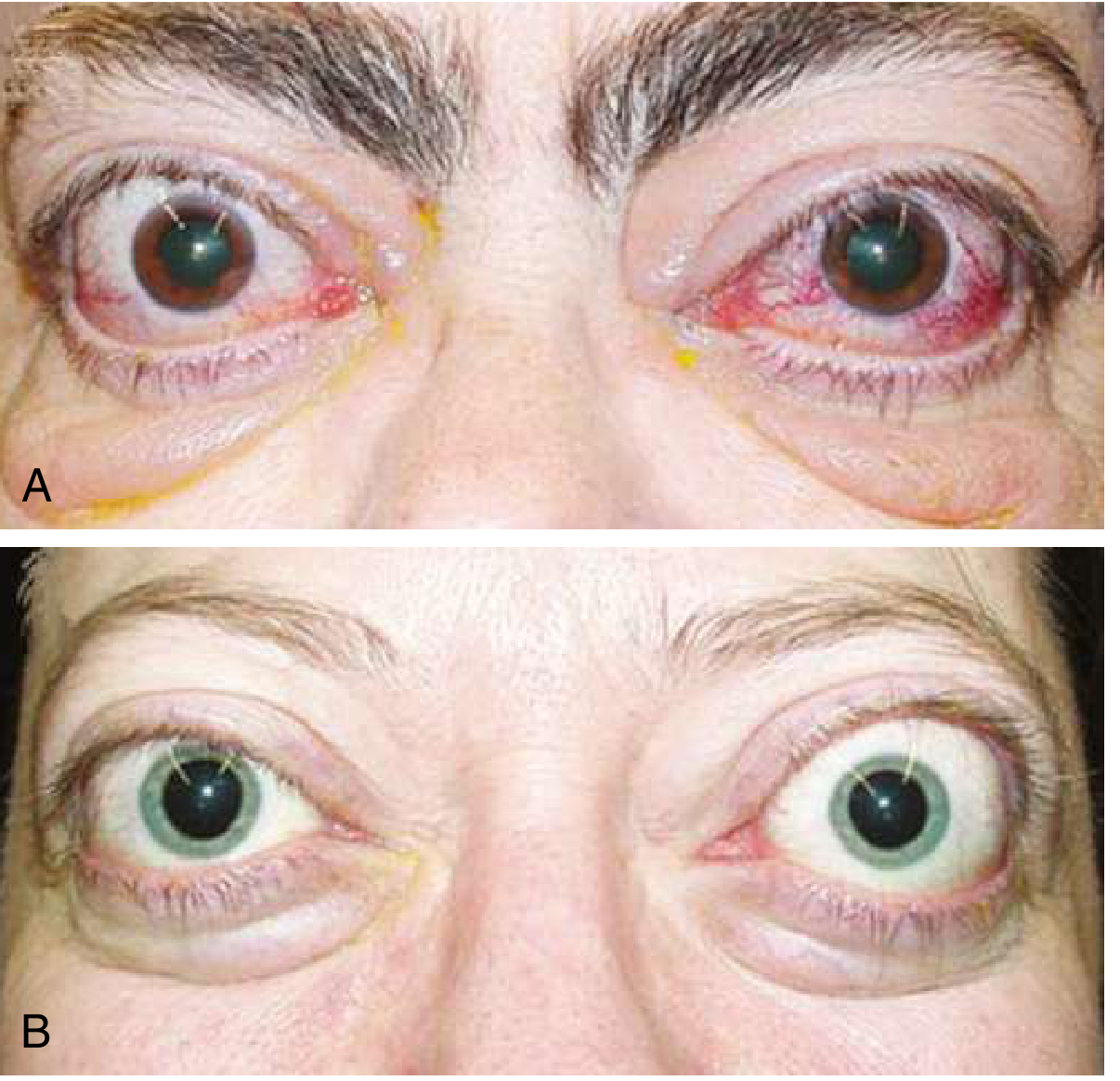
Graves ophthalmopathy. A: Severe proptosis, eyelid edema, erythema, and conjunctival chemosis with caruncle prolapse. B: Excess proptosis with minimal injection and slight eyelid erythema. - Goldman-Cecil Medicine
Skin and Hair
- Warm, moist, smooth skin - due to peripheral vasodilation and increased sweating
- Palmar erythema
- Diffuse hair loss (effluvium) with prolonged elevation of thyroid hormones
- Brittle nails, occasionally onycholysis (nail separation from nail bed)
Graves-Specific Skin Manifestations
- Pretibial myxedema (thyroid dermopathy) - non-pitting, thickened, indurated plaques or nodules on the extensor surfaces of the shins; occasionally confluent, "peau d'orange" texture; rare
- Thyroid acropachy - the rarest extrathyroidal manifestation; triad of:
- Digital clubbing of fingers and toes
- Soft tissue swelling of hands and feet
- Periosteal reaction of distal metatarsals on X-ray
Reproductive System
- Menstrual irregularity in women - oligomenorrhoea or amenorrhoea; reduced fertility
- Gynecomastia in men (rarely)
- Increased sex hormone-binding globulin - elevates total T4/T3 levels
Thyroid Gland on Examination
| Finding | Significance |
|---|---|
| Diffuse, smooth goiter | Graves disease |
| Systolic bruit over the gland | Graves disease (increased vascularity) |
| Single palpable nodule | Toxic adenoma |
| Irregular, multinodular goiter | Toxic multinodular goiter (Plummer's disease) |
| Tender thyroid | Subacute (de Quervain's) thyroiditis |
| No goiter | Exogenous thyroid hormone ingestion, ectopic production |
Special Populations
Apathetic (Masked) Hyperthyroidism - seen in elderly patients:
- Absent hyperadrenergic features (no anxiety, no tremor, no hyperactivity)
- Weight loss may be the only symptom
- Prominent cardiovascular features: atrial fibrillation, heart failure
- Apathy, depression, weakness
- Easy to miss clinically - a high index of suspicion is required
Subclinical Hyperthyroidism:
- No or minimal symptoms
- Suppressed TSH with normal free T4/T3
- Still associated with long-term risks: atrial fibrillation, bone loss
Summary: System-by-System Overview
| System | Key Features |
|---|---|
| General | Weight loss, heat intolerance, sweating, fatigue |
| Cardiovascular | Tachycardia, AF, systolic HTN, widened pulse pressure, high-output failure |
| Neurological | Tremor, anxiety, emotional lability, hyperreflexia, insomnia |
| Musculoskeletal | Proximal myopathy, muscle wasting, osteoporosis |
| GI | Hyperdefecation, weight loss, mild elevated LFTs |
| Eye | Lid retraction, lid lag; + Graves ophthalmopathy (proptosis, chemosis, diplopia) |
| Skin/Hair | Warm moist skin, palmar erythema, hair loss, onycholysis; ± pretibial myxedema, acropachy |
| Thyroid | Goiter (diffuse or nodular), bruit |
| Reproductive | Oligomenorrhoea, reduced fertility |
Sources:
- Goldman-Cecil Medicine, pp. 2436-2437 - Clinical Manifestations of Hyperthyroidism
- Tietz Textbook of Laboratory Medicine, 7th Ed., pp. 2319-2322 - Signs and Symptoms of Thyrotoxicosis
- Sabiston Textbook of Surgery, p. 1497 - Hyperthyroidism
This is a shared conversation. Sign in to Orris to start your own chat.