
Secretion of hcl by gastric parital cells and it's circulation give me a flowchart and diagram in a easy understanding way
Reading File
Now let me search the medical library for HCl secretion by gastric parietal cells.
Finding Sources
Finding Sources
Excellent results. Let me read the key sections from Medical Physiology and Costanzo for the detailed mechanism and circulation (carbonic anhydrase cycle).
Reading File
Reading File
Reading File
I have rich detail. Let me also fetch the key diagram image and read a bit more for the "alkaline tide" / circulation aspect.
Loading Image
Reading File
Reading File
I now have all the information needed. Let me create the comprehensive flowchart and diagrams as an HTML file in the sandbox.
Running Command
ls -la /home/daytona/workspace/
Running Command
mkdir -p /home/daytona/workspace/hcl-secretion
Writing File
~/hcl-secretion/HCl_Secretion_Parietal_Cell.html
<!DOCTYPE html>
<html lang="en">
<head>
<meta charset="UTF-8">
<meta name="viewport" content="width=device-width, initial-scale=1.0">
<title>HCl Secretion by Gastric Parietal Cells</title>
<style>
* { box-sizing: border-box; margin: 0; padding: 0; }
body {
font-family: 'Segoe UI', Arial, sans-serif;
background: #f0f4f8;
color: #1a2332;
padding: 20px;
}
h1 {
text-align: center;
color: #c0392b;
font-size: 2rem;
margin-bottom: 6px;
letter-spacing: 1px;
}
.subtitle {
text-align: center;
color: #555;
font-size: 1rem;
margin-bottom: 30px;
}
.section-title {
font-size: 1.25rem;
font-weight: 700;
color: #fff;
background: #2c3e50;
padding: 10px 20px;
border-radius: 8px 8px 0 0;
margin-bottom: 0;
}
.card {
background: #fff;
border-radius: 0 0 12px 12px;
box-shadow: 0 4px 18px rgba(0,0,0,0.10);
padding: 28px 24px 22px 24px;
margin-bottom: 32px;
}
/* ===== FLOWCHART ===== */
.flowchart {
display: flex;
flex-direction: column;
align-items: center;
gap: 0;
}
.flow-step {
display: flex;
flex-direction: column;
align-items: center;
width: 100%;
max-width: 680px;
}
.flow-box {
width: 100%;
border-radius: 10px;
padding: 14px 20px;
font-size: 0.97rem;
font-weight: 600;
text-align: center;
line-height: 1.5;
border: 2.5px solid transparent;
}
.flow-box small {
display: block;
font-weight: 400;
font-size: 0.85rem;
color: #555;
margin-top: 4px;
}
.box-stimulus { background: #fef9e7; border-color: #f39c12; color: #7d4e00; }
.box-receptor { background: #eaf4fb; border-color: #2980b9; color: #1a4e7a; }
.box-signal { background: #eafaf1; border-color: #27ae60; color: #1a5c36; }
.box-pump { background: #fde8e8; border-color: #c0392b; color: #7b1a1a; }
.box-cl { background: #f5eef8; border-color: #8e44ad; color: #4a1a6e; }
.box-hcl { background: #fdedec; border-color: #e74c3c; color: #922b21; font-size:1.1rem; }
.box-bicarb { background: #e8f8f5; border-color: #1abc9c; color: #0b5345; }
.box-alkaline { background: #e8f4fd; border-color: #3498db; color: #1a4e7a; }
.arrow {
font-size: 2rem;
color: #7f8c8d;
line-height: 1;
margin: 2px 0;
}
.flow-branch {
display: flex;
gap: 14px;
width: 100%;
max-width: 760px;
justify-content: center;
align-items: flex-start;
margin: 2px 0;
}
.branch-box {
flex: 1;
border-radius: 10px;
padding: 12px 14px;
font-size: 0.88rem;
font-weight: 600;
text-align: center;
border: 2px solid transparent;
min-width: 150px;
}
.branch-arrow {
display: flex;
flex-direction: column;
align-items: center;
justify-content: center;
font-size: 1.5rem;
color: #7f8c8d;
padding-top: 14px;
}
.branch-label {
font-size: 0.7rem;
color: #888;
background: #f0f4f8;
border-radius: 6px;
padding: 2px 8px;
margin: 2px 0;
text-align: center;
}
/* ===== MECHANISM DIAGRAM ===== */
.diagram-wrapper {
display: flex;
gap: 30px;
flex-wrap: wrap;
justify-content: center;
}
.cell-diagram {
position: relative;
width: 560px;
min-height: 560px;
background: #fff8f0;
border-radius: 16px;
border: 3px solid #e67e22;
overflow: visible;
flex-shrink: 0;
}
.cell-label {
text-align: center;
font-weight: 700;
font-size: 1rem;
color: #c0392b;
padding: 8px;
border-bottom: 2px dashed #e67e22;
}
.diagram-svg {
width: 100%;
height: auto;
display: block;
}
/* ===== LEGEND ===== */
.legend {
display: flex;
flex-wrap: wrap;
gap: 12px;
margin-top: 10px;
justify-content: center;
}
.legend-item {
display: flex;
align-items: center;
gap: 8px;
background: #f7f9fb;
border-radius: 8px;
padding: 6px 12px;
font-size: 0.85rem;
font-weight: 500;
}
.legend-dot {
width: 16px;
height: 16px;
border-radius: 50%;
flex-shrink: 0;
}
/* ===== CIRCULATION TABLE ===== */
.circ-table {
width: 100%;
border-collapse: collapse;
font-size: 0.93rem;
}
.circ-table th {
background: #2c3e50;
color: #fff;
padding: 10px 14px;
text-align: left;
}
.circ-table td {
padding: 10px 14px;
border-bottom: 1px solid #e0e6ed;
vertical-align: top;
}
.circ-table tr:nth-child(even) td { background: #f7f9fb; }
.circ-table tr:hover td { background: #eaf4fb; }
/* ===== PHASES ===== */
.phases-grid {
display: grid;
grid-template-columns: repeat(3, 1fr);
gap: 16px;
margin-top: 4px;
}
.phase-card {
border-radius: 10px;
padding: 14px;
font-size: 0.88rem;
border: 2px solid transparent;
}
.phase-cephalic { background: #fef9e7; border-color: #f39c12; }
.phase-gastric { background: #fde8e8; border-color: #e74c3c; }
.phase-intestinal{ background: #eaf4fb; border-color: #2980b9; }
.phase-title { font-weight: 700; font-size: 0.97rem; margin-bottom: 6px; }
.phase-cephalic .phase-title { color: #7d4e00; }
.phase-gastric .phase-title { color: #7b1a1a; }
.phase-intestinal .phase-title { color: #1a4e7a; }
/* ===== INHIBITION ===== */
.inhib-grid {
display: flex;
flex-wrap: wrap;
gap: 14px;
margin-top: 4px;
}
.inhib-card {
flex: 1;
min-width: 160px;
background: #fdf2f8;
border: 2px solid #8e44ad;
border-radius: 10px;
padding: 12px 14px;
font-size: 0.88rem;
}
.inhib-card .inhib-title { font-weight: 700; color: #6c3483; margin-bottom: 5px; }
@media (max-width: 640px) {
.phases-grid { grid-template-columns: 1fr; }
.cell-diagram { width: 100%; }
.flow-branch { flex-direction: column; }
}
</style>
</head>
<body>
<h1>HCl Secretion by Gastric Parietal Cells</h1>
<p class="subtitle">Mechanism, Ionic Circulation & Regulation - Easy Visual Guide</p>
<!-- ============================================================ -->
<!-- SECTION 1: OVERVIEW FLOWCHART -->
<!-- ============================================================ -->
<div class="section-title">1. Overview Flowchart - From Stimulus to HCl</div>
<div class="card">
<div class="flowchart">
<!-- STIMULI -->
<div class="flow-step">
<div class="flow-box box-stimulus">
🍽 STIMULUS (Meal / Smell / Taste / Vagal reflex / Distension)
<small>Cephalic, Gastric, or Intestinal phase</small>
</div>
</div>
<div class="arrow">▼</div>
<!-- 3 STIMULATORY PATHWAYS -->
<div style="width:100%;max-width:760px;background:#f7f9fb;border:2px dashed #bdc3c7;border-radius:12px;padding:16px 10px 8px 10px;margin:2px 0;">
<div style="text-align:center;font-weight:700;color:#555;margin-bottom:10px;">3 Secretagogues Acting on Parietal Cell</div>
<div class="flow-branch">
<div class="branch-box" style="background:#eaf4fb;border-color:#2980b9;color:#1a4e7a;">
<b>HISTAMINE</b><br>
<small>From ECL cells</small><br>
<small>H₂ receptor → cAMP → PKA</small>
</div>
<div class="branch-arrow">+</div>
<div class="branch-box" style="background:#fef9e7;border-color:#f39c12;color:#7d4e00;">
<b>ACETYLCHOLINE</b><br>
<small>Vagus nerve</small><br>
<small>M₃ receptor → IP₃/Ca²⁺</small>
</div>
<div class="branch-arrow">+</div>
<div class="branch-box" style="background:#eafaf1;border-color:#27ae60;color:#1a5c36;">
<b>GASTRIN</b><br>
<small>G cells → blood → parietal cell</small><br>
<small>CCK-B receptor → IP₃/Ca²⁺</small>
</div>
</div>
<div style="text-align:center;font-size:0.82rem;color:#888;margin-top:8px;">★ Potentiation: Combined effect > sum of individual effects</div>
</div>
<div class="arrow">▼</div>
<!-- CANALICULUS ACTIVATION -->
<div class="flow-step">
<div class="flow-box box-signal">
⚡ Parietal Cell Activated
<small>Tubulovesicles fuse → intracellular canaliculi expand → H⁺/K⁺-ATPase moves to apical membrane</small>
</div>
</div>
<div class="arrow">▼</div>
<!-- CARBONIC ANHYDRASE -->
<div class="flow-step">
<div class="flow-box box-receptor">
💧 CO₂ + H₂O <b>→ [Carbonic Anhydrase] →</b> H₂CO₃ <b>→</b> H⁺ + HCO₃⁻
<small>CO₂ diffuses from blood capillaries across basement membrane into parietal cell</small>
</div>
</div>
<div class="arrow">▼</div>
<!-- PARALLEL PATHS -->
<div style="width:100%;max-width:760px;background:#fdf2f8;border:2px dashed #bdc3c7;border-radius:12px;padding:16px 10px 8px 10px;margin:2px 0;">
<div style="text-align:center;font-weight:700;color:#555;margin-bottom:10px;">Simultaneous Ion Transport across Apical Membrane (Canaliculus)</div>
<div class="flow-branch">
<div class="branch-box" style="background:#fde8e8;border-color:#c0392b;color:#7b1a1a;">
<b>H⁺/K⁺-ATPase Pump</b><br>
<small>H⁺ pumped OUT into lumen</small><br>
<small>K⁺ taken IN (recycled back out via K⁺ channels)</small>
</div>
<div class="branch-arrow" style="padding-top:30px;">&</div>
<div class="branch-box" style="background:#f5eef8;border-color:#8e44ad;color:#4a1a6e;">
<b>Cl⁻ Channel (Uniporter)</b><br>
<small>Cl⁻ secreted OUT into lumen</small><br>
<small>from cell cytoplasm</small>
</div>
</div>
</div>
<div class="arrow">▼</div>
<!-- HCL FORMED -->
<div class="flow-step">
<div class="flow-box box-hcl">
⚗️ H⁺ + Cl⁻ → <b>HCl</b> in Gastric Lumen
<small>Concentration ~150 mmol/L | pH ~ 1.0-2.0 | 3 × 10⁴ H⁺ ions/second per parietal cell</small>
</div>
</div>
<div class="arrow">▼</div>
<!-- HCO3- EXIT = ALKALINE TIDE -->
<div class="flow-step">
<div class="flow-box box-bicarb">
🔄 Meanwhile: HCO₃⁻ exits BASOLATERAL membrane via Cl⁻/HCO₃⁻ Antiporter (AE2)
<small>Cl⁻ enters cell in exchange → provides more Cl⁻ for luminal secretion</small>
</div>
</div>
<div class="arrow">▼</div>
<!-- ALKALINE TIDE -->
<div class="flow-step">
<div class="flow-box box-alkaline">
🌊 HCO₃⁻ enters blood → "Alkaline Tide" (postprandial alkalosis in venous blood leaving stomach)
<small>Blood leaving gastric mucosa is more alkaline after a meal</small>
</div>
</div>
</div>
</div>
<!-- ============================================================ -->
<!-- SECTION 2: CELL MECHANISM DIAGRAM (SVG) -->
<!-- ============================================================ -->
<div class="section-title">2. Parietal Cell Molecular Diagram</div>
<div class="card">
<div style="text-align:center;color:#555;font-size:0.9rem;margin-bottom:18px;">
Cross-section of a parietal cell showing ionic pathways at apical (canalicular) and basolateral membranes
</div>
<div style="display:flex;justify-content:center;">
<svg viewBox="0 0 700 520" xmlns="http://www.w3.org/2000/svg" style="max-width:700px;width:100%;font-family:Segoe UI,Arial,sans-serif;">
<!-- Background zones -->
<!-- Blood side -->
<rect x="0" y="0" width="700" height="520" rx="16" fill="#f0f4f8"/>
<!-- Lumen -->
<rect x="0" y="0" width="700" height="70" rx="10" fill="#fff3cd" opacity="0.9"/>
<text x="350" y="40" text-anchor="middle" font-size="17" font-weight="bold" fill="#c0392b">GASTRIC LUMEN</text>
<text x="350" y="57" text-anchor="middle" font-size="12" fill="#888">(intracellular canaliculus)</text>
<!-- Blood -->
<rect x="0" y="450" width="700" height="70" rx="0" fill="#fde8e8" opacity="0.9"/>
<text x="350" y="475" text-anchor="middle" font-size="17" font-weight="bold" fill="#2c3e50">BLOOD CAPILLARY / INTERSTITIUM</text>
<!-- Parietal Cell body -->
<ellipse cx="350" cy="270" rx="220" ry="195" fill="#ffe9d0" stroke="#e67e22" stroke-width="3"/>
<text x="350" y="210" text-anchor="middle" font-size="14" font-weight="bold" fill="#e67e22">PARIETAL CELL</text>
<!-- Nucleus -->
<ellipse cx="350" cy="295" rx="50" ry="35" fill="#fff8dc" stroke="#c0a000" stroke-width="2"/>
<text x="350" y="292" text-anchor="middle" font-size="11" fill="#7d6000">Nucleus</text>
<!-- Mitochondria -->
<ellipse cx="250" cy="300" rx="30" ry="16" fill="#d5f5e3" stroke="#27ae60" stroke-width="1.5"/>
<text x="250" y="304" text-anchor="middle" font-size="9" fill="#1a5c36">Mitochondria</text>
<text x="250" y="316" text-anchor="middle" font-size="9" fill="#1a5c36">(ATP)</text>
<!-- Carbonic Anhydrase zone -->
<rect x="160" y="240" width="130" height="55" rx="8" fill="#eafaf1" stroke="#27ae60" stroke-width="1.5"/>
<text x="225" y="260" text-anchor="middle" font-size="10" font-weight="bold" fill="#1a5c36">Carbonic Anhydrase</text>
<text x="225" y="274" text-anchor="middle" font-size="10" fill="#1a5c36">CO₂ + H₂O</text>
<text x="225" y="286" text-anchor="middle" font-size="10" fill="#1a5c36">→ H⁺ + HCO₃⁻</text>
<!-- === APICAL MEMBRANE (top of cell) === -->
<!-- H+/K+ ATPase pump -->
<rect x="380" y="70" width="100" height="55" rx="8" fill="#fde8e8" stroke="#c0392b" stroke-width="2.5"/>
<text x="430" y="89" text-anchor="middle" font-size="10" font-weight="bold" fill="#c0392b">H⁺/K⁺-ATPase</text>
<text x="430" y="101" text-anchor="middle" font-size="9" fill="#c0392b">Proton Pump</text>
<text x="430" y="113" text-anchor="middle" font-size="9" fill="#555">(uses ATP)</text>
<!-- K+ channel apical -->
<rect x="500" y="70" width="80" height="45" rx="8" fill="#f5eef8" stroke="#8e44ad" stroke-width="2"/>
<text x="540" y="90" text-anchor="middle" font-size="10" font-weight="bold" fill="#8e44ad">K⁺ Channel</text>
<text x="540" y="104" text-anchor="middle" font-size="9" fill="#8e44ad">(Uniporter)</text>
<!-- Cl- channel apical -->
<rect x="220" y="70" width="80" height="45" rx="8" fill="#eaf4fb" stroke="#2980b9" stroke-width="2"/>
<text x="260" y="90" text-anchor="middle" font-size="10" font-weight="bold" fill="#2980b9">Cl⁻ Channel</text>
<text x="260" y="104" text-anchor="middle" font-size="9" fill="#2980b9">(CFTR)</text>
<!-- === BASOLATERAL MEMBRANE (bottom) === -->
<!-- Cl/HCO3 antiporter -->
<rect x="200" y="440" width="120" height="55" rx="8" fill="#e8f8f5" stroke="#1abc9c" stroke-width="2.5"/>
<text x="260" y="459" text-anchor="middle" font-size="10" font-weight="bold" fill="#0b5345">Cl⁻/HCO₃⁻</text>
<text x="260" y="472" text-anchor="middle" font-size="10" fill="#0b5345">Antiporter (AE2)</text>
<text x="260" y="485" text-anchor="middle" font-size="9" fill="#555">(basolateral)</text>
<!-- Na/K ATPase basolateral -->
<rect x="390" y="445" width="110" height="45" rx="8" fill="#fef9e7" stroke="#f39c12" stroke-width="2"/>
<text x="445" y="464" text-anchor="middle" font-size="10" font-weight="bold" fill="#7d4e00">Na⁺/K⁺-ATPase</text>
<text x="445" y="478" text-anchor="middle" font-size="9" fill="#7d4e00">(basolateral)</text>
<!-- === ARROWS === -->
<!-- CO2 from blood up into cell -->
<defs>
<marker id="arrow" markerWidth="8" markerHeight="8" refX="6" refY="3" orient="auto">
<path d="M0,0 L0,6 L8,3 z" fill="#555"/>
</marker>
<marker id="arrow-red" markerWidth="8" markerHeight="8" refX="6" refY="3" orient="auto">
<path d="M0,0 L0,6 L8,3 z" fill="#c0392b"/>
</marker>
<marker id="arrow-blue" markerWidth="8" markerHeight="8" refX="6" refY="3" orient="auto">
<path d="M0,0 L0,6 L8,3 z" fill="#2980b9"/>
</marker>
<marker id="arrow-green" markerWidth="8" markerHeight="8" refX="6" refY="3" orient="auto">
<path d="M0,0 L0,6 L8,3 z" fill="#1abc9c"/>
</marker>
<marker id="arrow-purple" markerWidth="8" markerHeight="8" refX="6" refY="3" orient="auto">
<path d="M0,0 L0,6 L8,3 z" fill="#8e44ad"/>
</marker>
<marker id="arrow-orange" markerWidth="8" markerHeight="8" refX="6" refY="3" orient="auto">
<path d="M0,0 L0,6 L8,3 z" fill="#e67e22"/>
</marker>
</defs>
<!-- CO2 arrow up from blood -->
<line x1="130" y1="448" x2="185" y2="300" stroke="#27ae60" stroke-width="2" stroke-dasharray="5,3" marker-end="url(#arrow-green)"/>
<text x="105" y="400" font-size="11" fill="#1a5c36" font-weight="bold">CO₂</text>
<text x="95" y="414" font-size="10" fill="#888">(from blood)</text>
<!-- H+ arrow from CA to H/K pump -->
<line x1="290" y1="263" x2="380" y2="115" stroke="#c0392b" stroke-width="2" marker-end="url(#arrow-red)"/>
<text x="310" y="185" font-size="11" fill="#c0392b" font-weight="bold">H⁺</text>
<!-- H+ out to lumen from pump -->
<line x1="430" y1="70" x2="430" y2="28" stroke="#c0392b" stroke-width="2.5" marker-end="url(#arrow-red)"/>
<text x="440" y="52" font-size="11" fill="#c0392b" font-weight="bold">H⁺ OUT</text>
<!-- K+ in from lumen to pump -->
<line x1="410" y1="28" x2="400" y2="70" stroke="#8e44ad" stroke-width="2" stroke-dasharray="4,2" marker-end="url(#arrow-purple)"/>
<text x="360" y="48" font-size="11" fill="#8e44ad" font-weight="bold">K⁺ IN</text>
<!-- K+ out via K channel -->
<line x1="540" y1="70" x2="540" y2="28" stroke="#8e44ad" stroke-width="2" marker-end="url(#arrow-purple)"/>
<text x="548" y="50" font-size="10" fill="#8e44ad">K⁺ recycled</text>
<text x="550" y="62" font-size="10" fill="#8e44ad">OUT</text>
<!-- Cl- up through Cl channel to lumen -->
<line x1="260" y1="70" x2="260" y2="28" stroke="#2980b9" stroke-width="2.5" marker-end="url(#arrow-blue)"/>
<text x="200" y="48" font-size="11" fill="#2980b9" font-weight="bold">Cl⁻ OUT</text>
<!-- HCl formed in lumen label -->
<rect x="280" y="4" width="90" height="22" rx="6" fill="#c0392b"/>
<text x="325" y="19" text-anchor="middle" font-size="12" font-weight="bold" fill="#fff">HCl FORMED</text>
<!-- HCO3- from CA to basolateral -->
<line x1="225" y1="295" x2="255" y2="440" stroke="#1abc9c" stroke-width="2" marker-end="url(#arrow-green)"/>
<text x="195" y="380" font-size="11" fill="#0b5345" font-weight="bold">HCO₃⁻</text>
<!-- HCO3- exits to blood -->
<line x1="260" y1="495" x2="260" y2="515" stroke="#1abc9c" stroke-width="2.5" marker-end="url(#arrow-green)"/>
<text x="175" y="512" font-size="11" fill="#0b5345" font-weight="bold">HCO₃⁻ → blood</text>
<!-- Cl- enters from blood via AE2 -->
<line x1="300" y1="515" x2="310" y2="495" stroke="#2980b9" stroke-width="2" stroke-dasharray="4,2" marker-end="url(#arrow-blue)"/>
<text x="310" y="512" font-size="10" fill="#2980b9">Cl⁻ in</text>
<!-- Alkaline tide label -->
<rect x="420" y="468" width="190" height="28" rx="6" fill="#3498db" opacity="0.15" stroke="#3498db" stroke-width="1"/>
<text x="515" y="484" text-anchor="middle" font-size="11" fill="#1a4e7a" font-weight="bold">🌊 Alkaline Tide (HCO₃⁻ to blood)</text>
<!-- ATP label on pump -->
<text x="470" y="97" font-size="10" fill="#e74c3c">ATP→ADP</text>
</svg>
</div>
<!-- Legend -->
<div class="legend" style="margin-top:18px;">
<div class="legend-item"><div class="legend-dot" style="background:#c0392b;"></div>H⁺ (proton)</div>
<div class="legend-item"><div class="legend-dot" style="background:#2980b9;"></div>Cl⁻ (chloride)</div>
<div class="legend-item"><div class="legend-dot" style="background:#8e44ad;"></div>K⁺ (potassium)</div>
<div class="legend-item"><div class="legend-dot" style="background:#1abc9c;"></div>HCO₃⁻ (bicarbonate)</div>
<div class="legend-item"><div class="legend-dot" style="background:#27ae60;"></div>CO₂ from blood</div>
<div class="legend-item"><div class="legend-dot" style="background:#f39c12;"></div>Na⁺/K⁺-ATPase</div>
</div>
</div>
<!-- ============================================================ -->
<!-- SECTION 3: IONIC CIRCULATION SUMMARY TABLE -->
<!-- ============================================================ -->
<div class="section-title">3. Ionic Circulation - Step by Step</div>
<div class="card">
<table class="circ-table">
<thead>
<tr>
<th>#</th>
<th>Ion / Molecule</th>
<th>Direction</th>
<th>Transporter</th>
<th>Result</th>
</tr>
</thead>
<tbody>
<tr>
<td>1</td>
<td>CO₂ + H₂O</td>
<td>Blood → Parietal Cell cytoplasm</td>
<td>Diffusion across basement membrane</td>
<td>Substrate for carbonic anhydrase reaction</td>
</tr>
<tr>
<td>2</td>
<td>H₂CO₃ → H⁺ + HCO₃⁻</td>
<td>Inside cytoplasm</td>
<td>Carbonic anhydrase (enzyme)</td>
<td>Generates H⁺ for secretion & HCO₃⁻ for exchange</td>
</tr>
<tr>
<td>3</td>
<td>H⁺</td>
<td>Cytoplasm → Canaliculus lumen (OUT)</td>
<td>H⁺/K⁺-ATPase (active, uses ATP)</td>
<td>Acidifies gastric lumen</td>
</tr>
<tr>
<td>4</td>
<td>K⁺</td>
<td>Canaliculus → Cytoplasm (IN)</td>
<td>H⁺/K⁺-ATPase (exchanges with H⁺)</td>
<td>K⁺ enters cell, then recycled back out</td>
</tr>
<tr>
<td>5</td>
<td>K⁺</td>
<td>Cytoplasm → Canaliculus (OUT)</td>
<td>K⁺ channel (uniporter)</td>
<td>Recycles K⁺ to maintain pump activity</td>
</tr>
<tr>
<td>6</td>
<td>Cl⁻</td>
<td>Cytoplasm → Canaliculus lumen (OUT)</td>
<td>Cl⁻ channel / CFTR (uniporter)</td>
<td>Cl⁻ pairs with H⁺ to form HCl</td>
</tr>
<tr>
<td>7</td>
<td>H⁺ + Cl⁻</td>
<td>In lumen</td>
<td>-</td>
<td><b>HCl formed (pH ~1.0–2.0)</b></td>
</tr>
<tr>
<td>8</td>
<td>HCO₃⁻</td>
<td>Cytoplasm → Interstitium/Blood (OUT)</td>
<td>Cl⁻/HCO₃⁻ antiporter AE2 (basolateral)</td>
<td>HCO₃⁻ enters blood → Alkaline Tide</td>
</tr>
<tr>
<td>9</td>
<td>Cl⁻</td>
<td>Interstitium → Cytoplasm (IN)</td>
<td>Same AE2 antiporter (exchange for HCO₃⁻)</td>
<td>Replenishes Cl⁻ for step 6</td>
</tr>
<tr>
<td>10</td>
<td>Na⁺ / K⁺</td>
<td>Basolateral membrane</td>
<td>Na⁺/K⁺-ATPase</td>
<td>Maintains cell electrochemical gradient</td>
</tr>
</tbody>
</table>
</div>
<!-- ============================================================ -->
<!-- SECTION 4: PHASES OF SECRETION -->
<!-- ============================================================ -->
<div class="section-title">4. Three Phases of Gastric HCl Secretion</div>
<div class="card">
<div class="phases-grid">
<div class="phase-card phase-cephalic">
<div class="phase-title">🧠 Cephalic Phase (~30%)</div>
<b>Trigger:</b> Sight, smell, taste, chewing, swallowing, conditioned reflex<br><br>
<b>Pathway:</b> CNS → Vagus nerve (CN X)<br><br>
<b>Action:</b> ACh released → directly stimulates parietal cells + stimulates ECL cells (histamine) + stimulates G cells (gastrin via GRP)
</div>
<div class="phase-card phase-gastric">
<div class="phase-title">🍖 Gastric Phase (~60%)</div>
<b>Trigger:</b> Food in stomach - distension, peptides, amino acids, pH rise<br><br>
<b>Pathway:</b> Distension → vagal reflex + G cells → gastrin into blood<br><br>
<b>Action:</b> Gastrin travels via blood → binds CCK-B receptor on parietal cells → H⁺ secretion. Largest phase.
</div>
<div class="phase-card phase-intestinal">
<div class="phase-title">🫁 Intestinal Phase (~10%)</div>
<b>Trigger:</b> Chyme enters duodenum<br><br>
<b>Pathway:</b> Duodenal G cells release gastrin<br><br>
<b>Action:</b> Modest stimulation of HCl. Inhibited as pH drops via secretin and CCK.
</div>
</div>
</div>
<!-- ============================================================ -->
<!-- SECTION 5: INHIBITION -->
<!-- ============================================================ -->
<div class="section-title">5. Inhibition of HCl Secretion</div>
<div class="card">
<div class="inhib-grid">
<div class="inhib-card">
<div class="inhib-title">🔴 Somatostatin (D cells)</div>
Released when gastric pH < 3. Inhibits G cells (stops gastrin) and directly inhibits parietal cells.
</div>
<div class="inhib-card">
<div class="inhib-title">🔴 Secretin</div>
Released by S cells in duodenum when acid enters. Inhibits gastrin release and HCl secretion.
</div>
<div class="inhib-card">
<div class="inhib-title">🔴 GIP (Gastric Inhibitory Peptide)</div>
Released from K cells in duodenum when fat/glucose enters. Inhibits HCl secretion.
</div>
<div class="inhib-card">
<div class="inhib-title">💊 PPIs (Omeprazole)</div>
Irreversibly block H⁺/K⁺-ATPase by covalent binding to cysteine residues on extracytoplasmic surface.
</div>
<div class="inhib-card">
<div class="inhib-title">💊 H₂ Blockers (Cimetidine)</div>
Block H₂ receptors on parietal cells. Also block histamine-potentiated effects of ACh & Gastrin.
</div>
<div class="inhib-card">
<div class="inhib-title">💊 Atropine</div>
Blocks M₃ muscarinic receptors on parietal cells. Blocks direct ACh effects + ACh-potentiated histamine/gastrin.
</div>
</div>
</div>
<!-- ============================================================ -->
<!-- SECTION 6: QUICK MEMORY AID -->
<!-- ============================================================ -->
<div class="section-title">6. Quick Memory Aid</div>
<div class="card">
<div style="background:#fef9e7;border-radius:10px;padding:16px 20px;border-left:5px solid #f39c12;">
<b style="font-size:1rem;color:#7d4e00;">The "HACK" of Parietal Cell:</b><br><br>
<b style="color:#c0392b;">H</b>istamine (H₂) → <b>cAMP / PKA</b> pathway<br>
<b style="color:#27ae60;">A</b>cetylcholine (M₃) → <b>IP₃/Ca²⁺</b> pathway<br>
<b style="color:#2980b9;">C</b>arbonic anhydrase → <b>CO₂ + H₂O → H⁺ + HCO₃⁻</b><br>
<b style="color:#8e44ad;">K</b>⁺ is recycled by H⁺/K⁺-ATPase to keep the pump running<br><br>
<b style="color:#1abc9c;">Alkaline Tide</b> = HCO₃⁻ dumped into blood after every meal = postprandial venous alkalosis
</div>
<div style="margin-top:16px;background:#eaf4fb;border-radius:10px;padding:14px 18px;border-left:5px solid #3498db;">
<b style="color:#1a4e7a;">Key Numbers:</b><br>
• HCl concentration in lumen: ~<b>150 mmol/L</b><br>
• H⁺ secretion rate: ~<b>3 × 10⁴ ions/second</b> per parietal cell<br>
• Final gastric pH: ~<b>1.0–2.0</b><br>
• H⁺ concentration in lumen is <b>3,000,000×</b> higher than in blood (pH 7.4)
</div>
</div>
<div style="text-align:center;color:#aaa;font-size:0.8rem;margin-top:20px;padding-bottom:10px;">
Sources: Histology: A Text and Atlas (Pawlina) | Medical Physiology (Boron & Boulpaep) | Costanzo Physiology 7th ed | Ganong's Review of Medical Physiology
</div>
</body>
</html>
Here is the complete visual guide! First, the official textbook diagram:
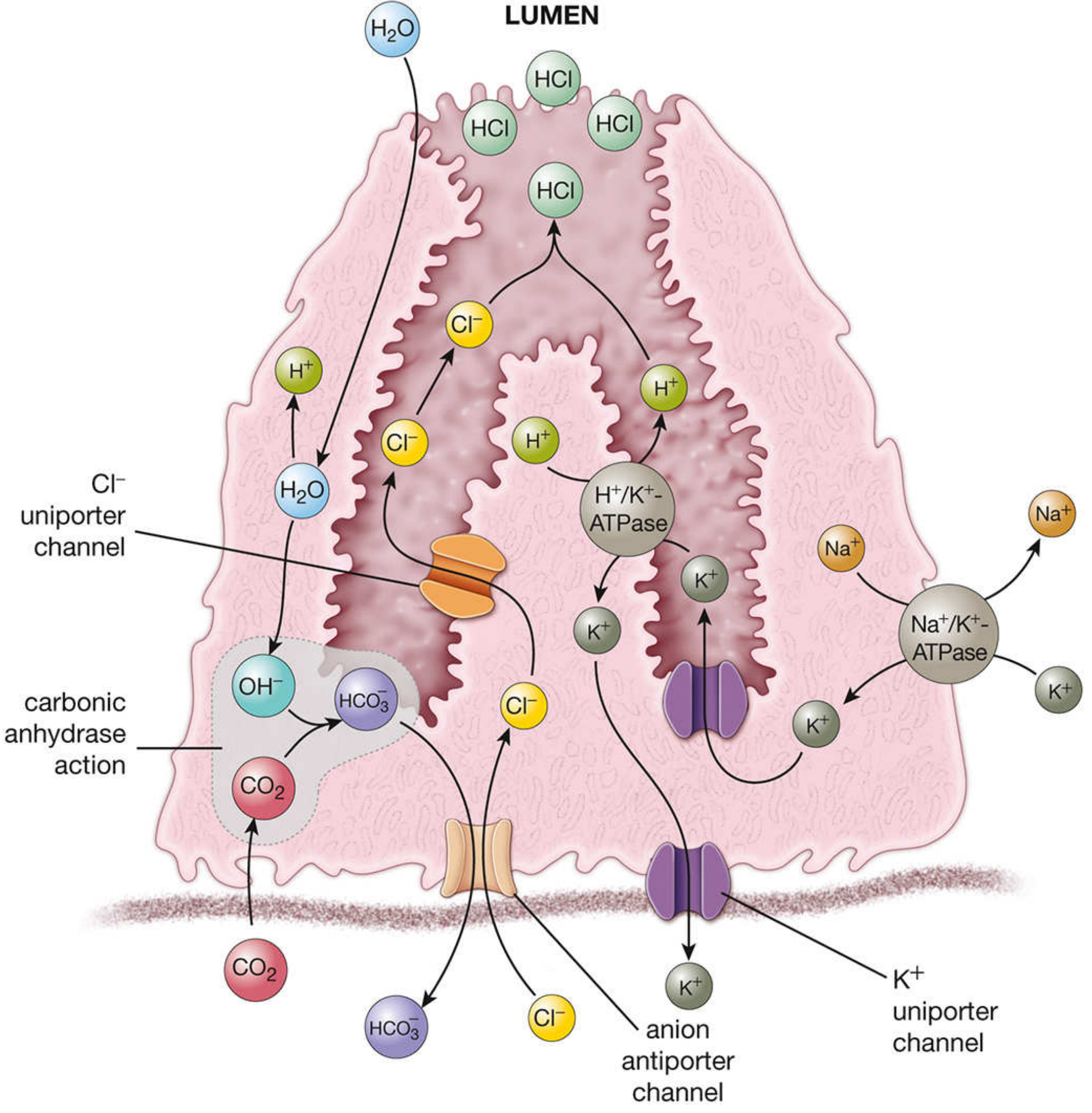
And the full interactive flowchart + diagrams file:
HCl Secretion Parietal Cell
HTML File · HTML
HCl Secretion by Gastric Parietal Cells - Complete Guide
Part 1: Overview Flowchart
STIMULUS (meal / smell / taste / vagal reflex / stomach distension)
            │
            ▼
┌───────────────────────────────────────────────────┐
│        3 SECRETAGOGUES (act together)             │
│  HISTAMINE   +   ACETYLCHOLINE   +   GASTRIN      │
│  (ECL cells)     (Vagus / CN X)   (G cells→blood)│
│  H₂ receptor     M₃ receptor      CCK-B receptor  │
│  → cAMP/PKA      → IP₃/Ca²⁺      → IP₃/Ca²⁺     │
└───────────────────────────────────────────────────┘
            │
            ▼
  Parietal cell ACTIVATED
  Tubulovesicles fuse → canaliculi expand
  H⁺/K⁺-ATPase moves to apical membrane
            │
            ▼
  CO₂ (from blood) + H₂O
        ↓ [Carbonic Anhydrase]
    H₂CO₃ → H⁺ + HCO₃⁻
            │
     ┌──────┴──────┐
     ▼             ▼
H⁺/K⁺-ATPase    Cl⁻ channel (CFTR)
H⁺ pumped OUT   Cl⁻ secreted OUT
K⁺ taken IN     (into canaliculus)
(then recycled)
     └──────┬──────┘
            ▼
     H⁺ + Cl⁻ = HCl in LUMEN
     (~150 mmol/L, pH 1–2)
            │
            ▼
  HCO₃⁻ exits via AE2 (basolateral)
  exchanges for Cl⁻ entering the cell
            │
            ▼
  HCO₃⁻ → BLOOD = "ALKALINE TIDE"
  (postprandial venous alkalosis)
Part 2: Ionic Circulation - Step by Step
| Step | What moves | Direction | Transporter | Why |
|---|---|---|---|---|
| 1 | CO₂ | Blood → Cell | Diffusion | Raw material |
| 2 | CO₂ + H₂O → H⁺ + HCO₃⁻ | Inside cell | Carbonic anhydrase | Makes H⁺ |
| 3 | H⁺ | Cell → Lumen | H⁺/K⁺-ATPase (uses ATP) | Acidifies stomach |
| 4 | K⁺ | Lumen → Cell | Same H⁺/K⁺-ATPase | Exchanged for H⁺ |
| 5 | K⁺ | Cell → Lumen | K⁺ channel (uniporter) | Recycled to keep pump running |
| 6 | Cl⁻ | Cell → Lumen | Cl⁻ channel / CFTR | Pairs with H⁺ to form HCl |
| 7 | H⁺ + Cl⁻ | In lumen | - | HCl formed |
| 8 | HCO₃⁻ | Cell → Blood | AE2 antiporter (basolateral) | Alkaline tide |
| 9 | Cl⁻ | Blood → Cell | Same AE2 (exchange) | Replenishes Cl⁻ for step 6 |
Part 3: Three Phases of Secretion
| Phase | % Output | Trigger | Mechanism |
|---|---|---|---|
| Cephalic | ~30% | Sight, smell, taste, anticipation | Vagus → ACh → parietal cells + ECL + G cells |
| Gastric | ~60% | Food in stomach, distension, peptides | G cells → gastrin → blood → parietal cells (largest phase) |
| Intestinal | ~10% | Chyme enters duodenum | Duodenal G cells; quickly inhibited by secretin/CCK |
Part 4: Inhibition
- Somatostatin (D cells): released when pH < 3 - inhibits G cells and parietal cells directly
- Secretin (S cells): released when acid enters duodenum - blocks gastrin and HCl
- GIP: released by fat/glucose in duodenum - inhibits parietal cells
- PPIs (omeprazole): irreversibly block H⁺/K⁺-ATPase (covalent binding)
- H₂ blockers (cimetidine): block H₂ receptors - also kill histamine-potentiated ACh/gastrin effects
- Atropine: blocks M₃ receptors
Quick Memory Aid - "HACK"
- Histamine → cAMP/PKA
- Acetylcholine → IP₃/Ca²⁺
- Carbonic anhydrase → CO₂ + H₂O → H⁺ + HCO₃⁻
- K⁺ recycled by the pump to keep it running
- Alkaline Tide = HCO₃⁻ floods the blood after every meal
Key numbers: HCl in lumen ~150 mmol/L | pH ~1–2 | 3×10⁴ H⁺ ions/sec per parietal cell | H⁺ concentration is 3,000,000x higher than in blood.
- Histology: A Text and Atlas (Pawlina), Fig. 17.11
- Medical Physiology (Boron & Boulpaep), Fig. 42-4
- Costanzo Physiology 7th ed., pp. 366-368
This is a shared conversation. Sign in to Orris to start your own chat.