
Calcium Channel Blockers* - MOA, adverse effects*, therapeutic uses mechanism of action in Angina Pectoris, adverse effects precautions 2nd mbbs pharmacology refer kd tripathi
Reading File
Searching sources...
Finding Sources
Finding Sources
Finding Sources
Finding Sources
I found Katzung and Goodman & Gilman in the library. Since KD Tripathi isn't available but Katzung and Goodman & Gilman cover the same content (and are the gold standard references for 2nd MBBS pharmacology), let me pull CCB content from those.
Finding Sources
Finding Sources
Finding Sources
Finding Sources
I found the key sections. Let me now read:
- Katzung CCB main section (block13)
- Katzung angina section (block3)
- Lippincott CCB section
- Braunwald's CCB section
Reading File
Reading File
Reading File
I need to read the primary CCB section from Katzung block13. Let me find the right offset:
Reading File
Reading File
Excellent! I found the CCB content in Lippincott. Let me read the full CCB section from Lippincott, which starts around line 520:
Reading File
Reading File
I now have comprehensive content. Let me fetch the key images from Lippincott and compile the full answer:
Loading Image
I now have all the content needed to write a thorough, exam-ready answer. Let me compile it:
Calcium Channel Blockers (CCBs)
(Based on Katzung's Basic & Clinical Pharmacology 16e and Lippincott Illustrated Reviews: Pharmacology - closest equivalents to KD Tripathi content for 2nd MBBS)
I. MECHANISM OF ACTION (MOA)
Calcium is required for smooth muscle and cardiac muscle contraction. During membrane depolarization, voltage-gated L-type (long-acting) calcium channels open and allow Ca²⁺ to enter cells down its concentration gradient.
CCBs block voltage-sensitive L-type calcium channels in cardiac and vascular smooth muscle, preventing Ca²⁺ influx. This results in:
- Vascular smooth muscle relaxation - arteriolar vasodilation, reduced peripheral vascular resistance (PVR), reduced afterload
- Negative inotropy - reduced force of myocardial contraction (especially verapamil)
- Negative chronotropy & dromotropy - slowed SA node automaticity and AV nodal conduction (especially verapamil and diltiazem)
Calcium influx is also increased in ischemia (due to membrane depolarization from hypoxia), which activates ATP-consuming enzymes and worsens injury. CCBs protect ischemic tissue by blocking this entry.
II. CLASSIFICATION
| Class | Drug(s) | Vascular Selectivity | Cardiac Effect |
|---|---|---|---|
| Phenylalkylamine | Verapamil | Low (more cardiac) | Strong -ve inotrope & chronotrope |
| Benzothiazepine | Diltiazem | Intermediate | Moderate -ve inotrope & chronotrope |
| Dihydropyridines (DHPs) | Nifedipine, Amlodipine, Felodipine, Nicardipine | High (peripheral vascular) | Minimal direct cardiac effect |
Memory aid: "Verapamil = Vessel + heart; Nifedipine = predominantly peripheral."
Amlodipine (DHP) is most peripherally active → Diltiazem is intermediate → Verapamil has the strongest cardiac (myocardial) effects.
III. THERAPEUTIC USES
1. Hypertension
- All CCBs are effective antihypertensives - reduce PVR via arteriolar vasodilation.
- Long-acting DHPs (amlodipine, felodipine) or extended-release nifedipine are preferred.
- Avoid short-acting nifedipine (causes reflex tachycardia and fluctuating BP).
2. Angina Pectoris (detailed below)
3. Cardiac Arrhythmias
- Verapamil and diltiazem are used for SVT (supraventricular tachycardias), rate control in atrial flutter/fibrillation.
- They slow AV node conduction (negative dromotropic effect).
4. Hypertrophic Cardiomyopathy
- Verapamil improves diastolic relaxation and reduces outflow obstruction.
5. Raynaud's Phenomenon
- DHPs (nifedipine) reduce vasospasm in peripheral vessels.
6. Migraine Prophylaxis
- Verapamil is used off-label for migraine prevention.
7. Esophageal Spasm
- Nifedipine relaxes esophageal smooth muscle.
IV. MECHANISM OF ACTION IN ANGINA PECTORIS
Angina results from an imbalance between myocardial oxygen supply and demand. CCBs address both sides:
A. Stable (Effort) Angina
CCBs reduce myocardial oxygen demand by:
- Decreasing afterload - arteriolar vasodilation lowers PVR, reducing cardiac work
- Decreasing contractility (verapamil/diltiazem) - reduces O₂ consumption
- Decreasing heart rate (verapamil/diltiazem) - prolongs diastole, improves coronary perfusion time
They also increase oxygen supply by dilating coronary arteries.
From Katzung: "In the treatment of effort-induced angina, calcium channel blockers reduce myocardial oxygen consumption by decreasing vascular resistance, thereby decreasing afterload."
B. Vasospastic (Variant/Prinzmetal) Angina
- CCBs are the drugs of choice - they directly relax coronary artery spasm.
- Beta-blockers are contraindicated in vasospastic angina (may worsen spasm by leaving alpha-adrenergic vasoconstriction unopposed).
- Nitrates + CCBs together are very effective.
C. Unstable Angina
- CCBs are used as adjunct therapy but beta-blockers and antiplatelet agents take priority.
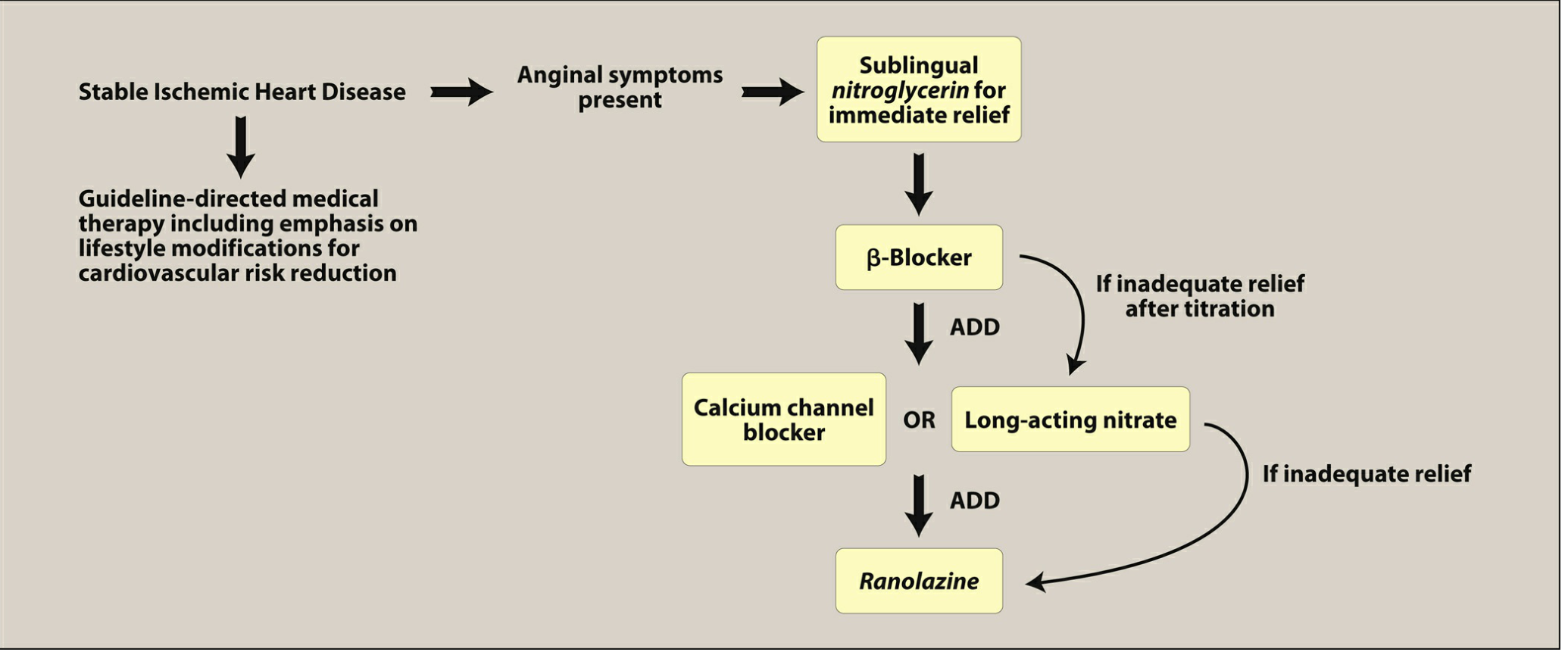
Combination in Angina
- CCB + beta-blocker: additive reduction in heart rate and BP; however, combining verapamil or diltiazem with beta-blockers risks severe bradycardia and AV block (use DHPs like amlodipine instead).
- CCB + nitrate: combined vasodilation, counteracts reflex tachycardia from nitrates.
Angina Treatment Algorithm:
V. ADVERSE EFFECTS
A. Dihydropyridines (Nifedipine, Amlodipine, Felodipine)
| Adverse Effect | Mechanism |
|---|---|
| Peripheral edema (most common) | Arteriolar dilation - fluid shifts to interstitium |
| Flushing / headache | Vasodilation |
| Reflex tachycardia | Especially with short-acting nifedipine - compensatory sympathetic activation from rapid BP drop |
| Hypotension | Excess vasodilation |
| Worsening angina | Short-acting nifedipine can precipitate angina (avoid immediate-release formulations) |
"Use extended-release formulations (short-acting agents can worsen angina)" - Lippincott
B. Non-Dihydropyridines (Verapamil, Diltiazem)
| Adverse Effect | Mechanism |
|---|---|
| Bradycardia | SA node depression |
| AV block | AV nodal depression |
| Constipation | Very common with verapamil (smooth muscle relaxation in gut); less with diltiazem |
| Gingival hyperplasia | Verapamil (also seen with nifedipine and phenytoin) |
| Heart failure exacerbation | Negative inotropy - avoid in systolic HF |
| Edema | Particularly diltiazem |
C. Class-wide adverse effects
- Dizziness, nausea
- Interaction with CYP3A4 (verapamil, diltiazem, nicardipine inhibit CYP3A4 and P-glycoprotein - increased levels of co-administered drugs)
- Amiodarone + verapamil/diltiazem: additive AV conduction depression
VI. PRECAUTIONS AND CONTRAINDICATIONS
| Situation | Drug to Avoid | Reason |
|---|---|---|
| Systolic heart failure (HFrEF) | Verapamil, diltiazem | Negative inotropy worsens pump function |
| Bradycardia / Sick sinus syndrome | Verapamil, diltiazem | Further rate reduction |
| AV block (2nd/3rd degree) | Verapamil, diltiazem | Further conduction suppression |
| Vasospastic angina | Beta-blockers preferred - not CCBs (actually CCBs ARE preferred here; avoid beta-blockers) | - |
| Concurrent beta-blocker therapy | Verapamil or diltiazem | Risk of severe bradycardia, AV block, and cardiac failure; DHPs (amlodipine) are safe to combine |
| Post-MI (recent) | Short-acting nifedipine | Associated with increased mortality |
| Pregnancy | Use with caution; nifedipine is sometimes used for preterm labour (tocolysis) | - |
| Wolff-Parkinson-White + AF | Verapamil | Can accelerate accessory pathway conduction - risk of ventricular fibrillation |
VII. QUICK DRUG PROFILES (2nd MBBS High-Yield)
| Drug | Class | Key Use | Key SE |
|---|---|---|---|
| Nifedipine | DHP | HTN, vasospastic angina, Raynaud's | Reflex tachy, flushing, edema |
| Amlodipine | DHP (long-acting) | HTN, stable angina | Edema, less tachycardia |
| Verapamil | Phenylalkylamine | SVT, HTN, HCM, migraine | Constipation, bradycardia, AV block, HF |
| Diltiazem | Benzothiazepine | SVT, HTN, angina | Bradycardia, AV block, edema (intermediate profile) |
Key Exam Points (KD Tripathi style mnemonics)
- "VAN" rule for vasospastic angina: Verapamil, Amlodipine, Nitrates - YES; Beta-blockers - NO
- Verapamil's 3 C's: Cardiac conduction depression, Constipation, Contractility reduction
- Amlodipine advantage: Long half-life (~35-50 hours), once-daily dosing, no reflex tachycardia, safe to combine with beta-blockers
- Nifedipine IR risk: Short-acting nifedipine causes reflex tachycardia and may precipitate MI - use only extended-release
- CCBs are preferred in: asthma + angina (beta-blockers are contraindicated), elderly hypertensives, angina + peripheral vascular disease
Sources: Lippincott Illustrated Reviews: Pharmacology (p. 416-423); Katzung's Basic & Clinical Pharmacology, 16th Edition (Chapters 12, 13)
Note: KD Tripathi's "Essentials of Medical Pharmacology" is not available in this library, but Katzung and Lippincott cover identical content for 2nd MBBS syllabus and are widely accepted as equivalent references.
This is a shared conversation. Sign in to Orris to start your own chat.