
Omentocele vs enterocole
Reading File
Finding Sources
Searching the Web
omentocele vs enterocele hernia difference
Finding Sources
Reading File
Finding Sources
Finding Sources
Reading File
Finding Sources
Reading File
Finding Sources
Reading File
Finding Sources
I now have enough information to provide a comprehensive answer. The term "omentocele" is not a widely used standalone clinical term in major textbooks — it refers specifically to a hernia whose contents are omentum, as opposed to "enterocele" (from Greek entero- = intestine). Let me compile the full comparison.
Loading Image
Loading Image
Omentocele vs Enterocele
These two terms describe the same basic entity — a hernia — classified by what is inside the hernial sac (the contents). They are not two different types of hernias structurally; rather, they are subcategories based on content.
Core Concept: Hernial Contents
Every hernia has three components:
- Hernial opening (the defect/ring)
- Hernial sac (parietal peritoneum)
- Hernial contents — "may be almost any intra-abdominal viscus but usually consist of greater omentum or loops of small bowel"
(General Anatomy and Musculoskeletal System, THIEME Atlas)
The most common contents of a hernia are omentum and small bowel — and these give rise to the two terms:
Comparison Table
| Feature | Omentocele | Enterocele |
|---|---|---|
| Definition | Hernia whose sac contains omentum (greater omentum) | Hernia whose sac contains intestine (small bowel/peritoneal contents) |
| Etymology | Omentum + -cele (Greek: tumor/swelling) | Enteron (intestine) + -cele |
| Contents | Greater omentum | Small intestine (± peritoneal sac) |
| Sac | Present (parietal peritoneum) | Present (parietal peritoneum) |
| Reducibility | Usually reducible; omentum is pliable and less likely to strangulate | More prone to obstruction/strangulation given bowel contents |
| Strangulation risk | Lower — omentum tolerates compression better | Higher — bowel can obstruct, infarct |
| Clinical presentation | Soft, doughy, non-tender lump | Soft lump; may have colicky pain if bowel obstructs |
| Primary context | Inguinal/umbilical hernias in adults, epigastric hernias | Inguinal hernias; also specifically pelvic enterocele in women |
| Special use of "enterocele" | — | In gynecology/urology: specifically means herniation of peritoneum + bowel through the pelvic floor (typically between vaginal cuff/uterus and rectum) — a form of pelvic organ prolapse |
Clinical Significance
Omentocele:
- Common in inguinal, umbilical, and epigastric hernias
- The omentum acts as a "plug" — it partially seals the defect
- Lower urgency for repair (rarely strangulates acutely)
- On imaging: fat-density contents in the sac
Enterocele:
- When bowel is in the sac, there is risk of incarceration → strangulation → bowel obstruction
- Richter hernia (only the antimesenteric wall protrudes) is a subtype — strangulation without obstruction is possible
- In pelvic enterocele (urogynecology): herniation of peritoneum and small intestine through the pelvic floor, commonly after hysterectomy or retropubic urethropexy. Presents with vaginal bulge, pelvic pressure, and defecatory dysfunction. Two mechanisms: (1) endopelvic fascia defect, or (2) full-thickness support failure
(Berek & Novak's Gynecology; Hinman's Atlas of Urologic Surgery)
Pelvic Enterocele (Special Category)
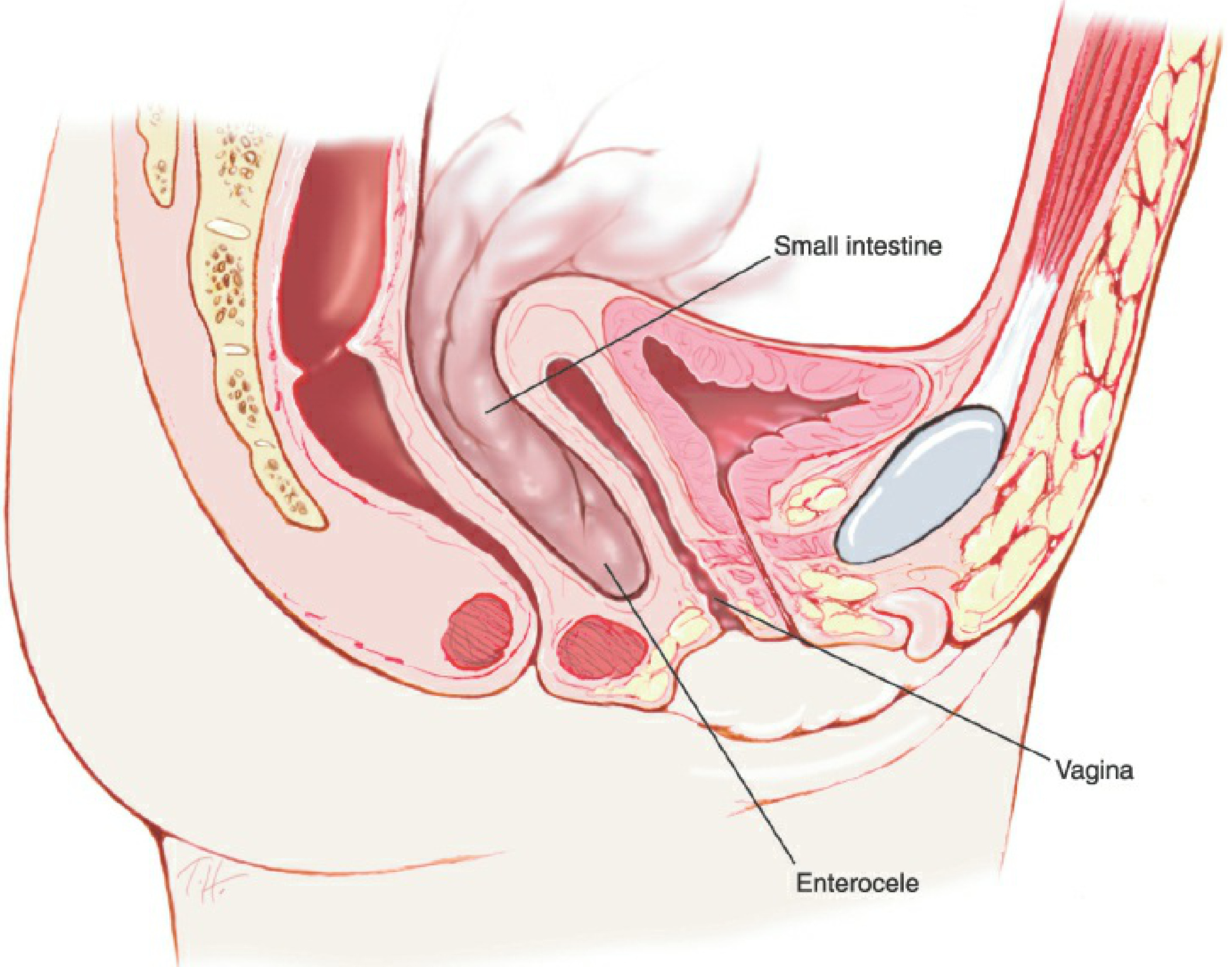
In women, "enterocele" has a distinct, specific gynecological meaning: herniation of the peritoneal sac (containing small bowel) through the pelvic floor, usually at the apex (vaginal vault), between the uterus/vaginal cuff and the rectum. There is no equivalent "omentocele" in this pelvic context — omentum does not typically prolapse through the pelvic floor.
Summary
Omentocele = hernia containing omentum; Enterocele = hernia containing intestine. Both share the same sac structure; the difference is purely the content. Enterocele carries higher risk of obstruction and strangulation. In gynecology, "enterocele" has a more specific meaning — apical pelvic organ prolapse with bowel herniation through the pelvic floor.
This is a shared conversation. Sign in to Orris to start your own chat.