
What is constitutional genetic disease and somatic genetic disease tel me in detail
Reading File
Now let me search the medical library for both topics in parallel.
Finding Sources
Finding Sources
Finding Sources
Finding Sources
Excellent results. Let me now read the most relevant sections in parallel.
Reading File
Reading File
Reading File
Now let me get the Goldman-Cecil and Thompson & Thompson content on germline vs somatic in cancer, plus more from Emery's:
Reading File
Reading File
Excellent data gathered. Let me fetch the key diagram image and also get the Dermatology textbook snippet about somatic vs germline mutations:
Loading Image
Loading Image
Finding Sources
I now have rich, detailed content from multiple authoritative textbooks. Let me compose the comprehensive answer.
Constitutional Genetic Disease vs. Somatic Genetic Disease
These two categories represent fundamentally different ways that genetic changes can cause disease. The key difference lies in when the mutation arises and which cells carry it.
1. Constitutional Genetic Disease
Definition
A constitutional mutation is one that is present in every cell of the body - from the earliest embryonic stage onward. The word "constitutional" means it is built into the person's entire genetic constitution. It is also called a germline mutation or hereditary variant.
"Genomic variants can be inherited from a parent (hereditary, constitutional, or germline variants) and thus be present in every cell."
- Goldman-Cecil Medicine
Because the mutation originates in either a parental gamete (egg or sperm) or at fertilization, it gets replicated into every single cell as the embryo develops. Every diploid cell in the body - liver, brain, muscle, skin - carries the same mutation.
Key Features
| Feature | Detail |
|---|---|
| Origin | Present in parental gamete (egg/sperm) or arises at fertilization/very early embryogenesis |
| Which cells affected | ALL cells of the body (every tissue) |
| Heritability | YES - can be passed to offspring with 50% probability (if heterozygous) |
| Timing | Present from conception |
| Examples | Down syndrome, cystic fibrosis, Huntington disease, BRCA1/2 germline mutations |
Types of Constitutional Genetic Disease
There are three main categories (Thompson & Thompson Genetics and Genomics in Medicine):
a) Chromosome Disorders
- The defect is due to a change in dosage of genes on entire chromosomes or large chromosome segments, not an individual gene mutation.
- An extra copy (trisomy) of chromosome 21 causes Down syndrome, even though no individual gene is abnormal.
- Copy number variations (CNVs) - duplications/deletions - can cause complex birth defects like 22q11.2 deletion syndrome.
- Prevalence: ~3% in liveborn infants; account for ~50% of first-trimester spontaneous abortions.
b) Monogenic (Single-Gene) Disorders
- Caused by a pathogenic mutation in a single gene.
- Can be autosomal dominant, autosomal recessive, X-linked, or mitochondrial.
- Examples: cystic fibrosis (CFTR gene), Huntington disease (HTT gene), Marfan syndrome (FBN1 gene), phenylketonuria (PAH gene).
- Overall incidence: ~1 per 300 liveborn infants for serious monogenic disorders; lifetime prevalence 1 in 50.
- A person with a constitutional mutation in a tumor suppressor (e.g., BRCA1, RB1, APC) has an elevated lifetime cancer risk - this is the basis of familial cancer syndromes.
c) Multifactorial (Polygenic) Disorders
- Disease results from the combined impact of variants in many genes, often interacting with environmental factors.
- No single pathogenic variant; rather, many genes each contribute small effects.
- Examples: type 1 and 2 diabetes, cleft lip/palate, congenital heart defects, hypertension, Alzheimer disease.
- Estimated to affect >60% of the entire population over a lifetime.
Constitutional Mutations and Familial Cancer Syndromes
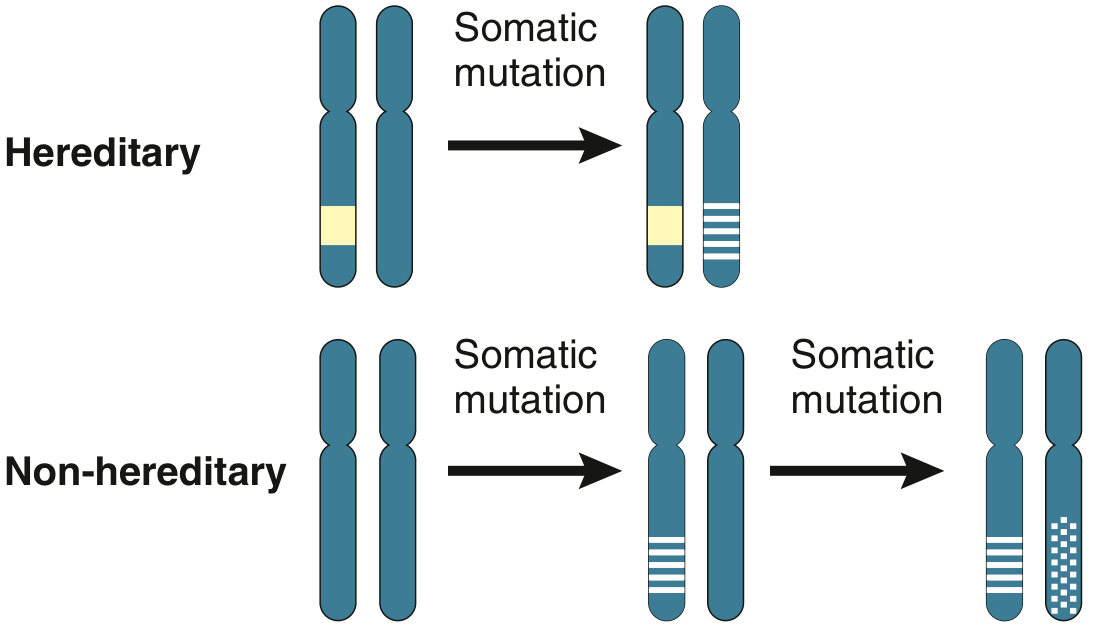
This is one of the most important clinical applications of the concept. When a person inherits a germline (constitutional) mutation in a tumor suppressor gene (e.g., BRCA1, RB1, TP53, APC):
- Every cell in their body starts life with one copy of the tumor suppressor already inactivated (first "hit").
- Only one additional somatic mutation (second "hit") in any cell is then needed to knock out the second copy and initiate cancer.
- This is Knudson's "two-hit hypothesis": familial cancers appear earlier and more frequently because the first hit is already present from birth.
- The pattern of inheritance is autosomal dominant at the family level (one mutant allele inherited), but cancer behavior is recessive at the cellular level (requires both copies lost).
2. Somatic (Acquired) Genetic Disease
Definition
A somatic mutation is a genetic change that arises after conception in a non-germline (body/somatic) cell. It is present only in the cells that descend from that original mutant cell - forming a clone - not in the whole body.
"Not all genetic errors are present from conception. Many billions of cell divisions (mitoses) occur in the course of an average human lifetime. During each mitosis there is an opportunity both for single-gene mutations to occur, because of DNA copy errors, and for numerical chromosome abnormalities to arise as a result of errors in chromosome separation."
- Emery's Elements of Medical Genetics and Genomics
"In some cases, notably cancer, an acquired mutation may arise in a single somatic cell, which then divides mitotically, giving rise to a new clone of cells. The mutation will be limited to this clone and will not be transmitted to progeny of the individual."
- Henry's Clinical Diagnosis and Management by Laboratory Methods
Key Features
| Feature | Detail |
|---|---|
| Origin | Arises during life in a non-germline body cell (post-conception) |
| Which cells affected | Only the mutant cell and its clonal descendants (a subset of cells) |
| Heritability | NO - cannot be passed to offspring |
| Timing | Anytime during postnatal (or late prenatal) life |
| Examples | Most cancers, acquired chromosomal abnormalities in leukemia, somatic mosaicism |
Primary Diseases Caused by Somatic Mutations
a) Cancer (the Major Example)
- The accumulation of somatic mutations and chromosomal abnormalities in body cells is the primary cause of cancer.
- Cancer is fundamentally a disease of the somatic genome - mutations in oncogenes (gain of function) and tumor suppressor genes (loss of function) accumulate over time in a single cell lineage.
- Because this process takes many mutations and many cell divisions, most cancers increase in incidence with age.
- The catalog of somatic mutations in human cancers is tracked by databases like COSMIC (Catalog of Somatic Mutations in Cancer) and TCGA (The Cancer Genome Atlas).
- In sporadic (non-familial) cancer, all the hits must occur somatically in the same cell - meaning both alleles of a tumor suppressor must be independently lost in the same clone.
b) Aging
- Accumulating somatic mutations probably explain the rising incidence with age of many serious illnesses, as well as the aging process itself (Emery's Elements of Medical Genetics).
- Somatic mitochondrial DNA (mtDNA) mutations accumulate with aging and may contribute to metabolic syndrome, diabetes, neurodegeneration, and cardiovascular disease (Harrison's Principles of Internal Medicine 22E, 2025).
- These somatic mtDNA mutations are not carried forward to offspring.
c) Somatic Mosaicism
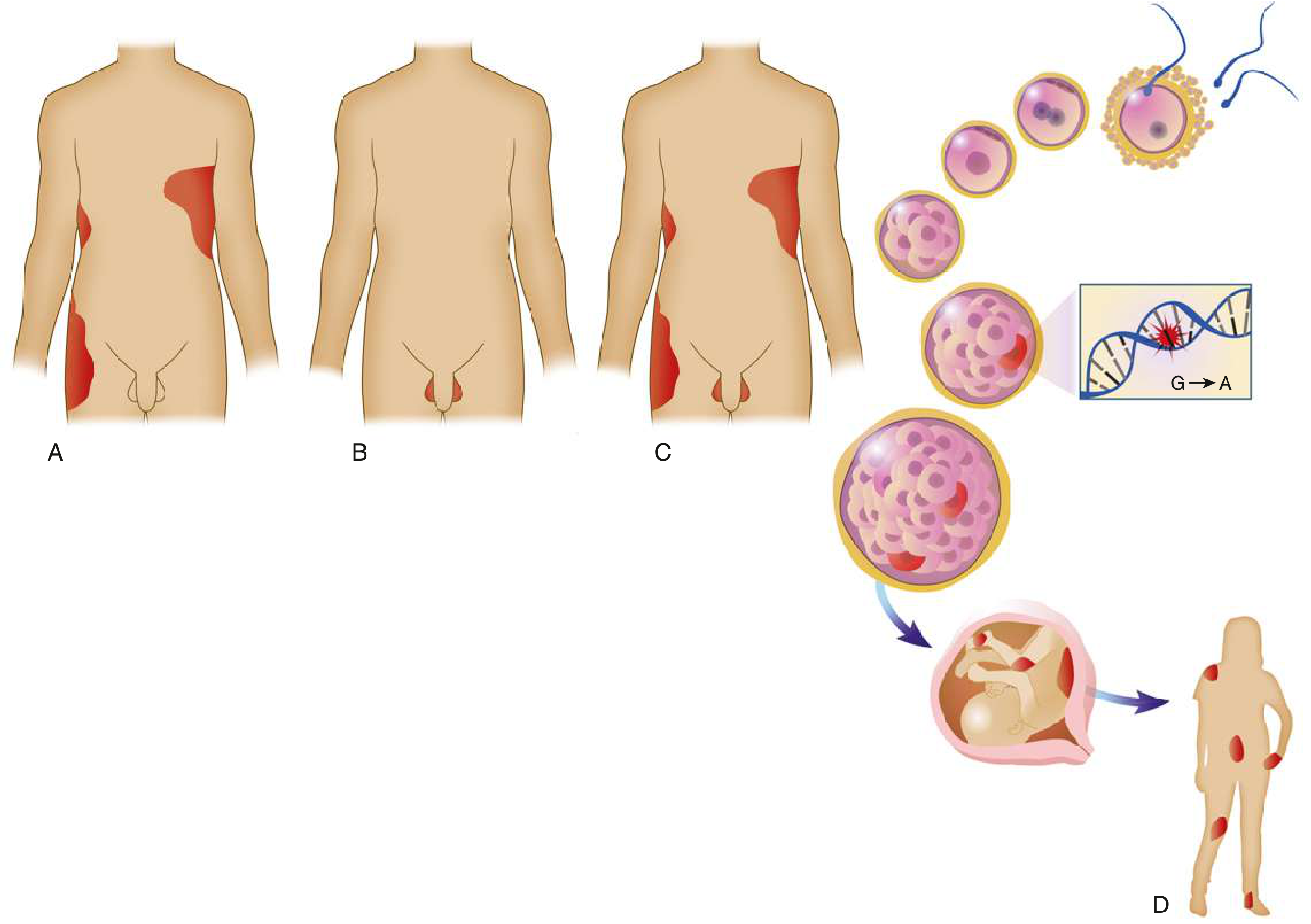
- When a mutation arises early in embryonic development (not in a gamete), it creates a mosaic organism: a person with two or more genetically distinct cell populations.
- The body has patches of normal and mutant cells.
- The extent of disease depends on how early the mutation arose (earlier = more cells affected) and which tissues are involved.
- Example: Sturge-Weber syndrome, McCune-Albright syndrome, some cases of neurofibromatosis.
d) Somatic Gonadal Mosaicism (Special Case)
- Rarely, a de novo somatic mutation arises specifically in the gonads (testes/ovaries), resulting in a mixed population of normal and mutant gametes.
- A proportion of offspring can then receive this mutation and display a phenotype not seen in either parent.
- This explains some "sporadic" cases of dominant disorders (e.g., osteogenesis imperfecta, Duchenne muscular dystrophy) where neither parent is affected but multiple siblings are.
Side-by-Side Comparison
| Feature | Constitutional Genetic Disease | Somatic Genetic Disease |
|---|---|---|
| Mutation present in | Every cell of the body | Only the mutant clone (subset of cells) |
| Origin | Gamete / fertilization / very early embryo | Post-conception body cell |
| Heritable? | Yes (passed to children) | No (not in germline) |
| Disease onset | Often congenital or childhood; fixed at birth | Can arise at any age; accumulates with time |
| Cancer link | Familial cancer syndromes (first "hit" pre-set) | Sporadic cancers (all hits must occur de novo) |
| Detectable in | Blood / any tissue (same in all cells) | Tumor tissue / affected tissue only |
| Key concept | Germline = constitutional = heritable | Somatic = acquired = clonal = non-heritable |
| Examples | Down syndrome, cystic fibrosis, BRCA1 syndrome | Leukemia, most solid tumors, McCune-Albright |
Key Takeaway
"It is therefore necessary to appreciate that not all disease with a genetic basis is hereditary."
- Emery's Elements of Medical Genetics and Genomics
This sentence captures the whole distinction. Constitutional disease = genetic AND hereditary. Somatic disease = genetic BUT NOT hereditary. Both involve DNA changes, but only constitutional mutations are woven into every cell from the very beginning of life.
Sources:
- Emery's Elements of Medical Genetics and Genomics, block 1 (Acquired Somatic Genetic Disease section)
- Thompson & Thompson Genetics and Genomics in Medicine, 9th ed., block 1 (Categories of Genetic Disease)
- Goldman-Cecil Medicine International Edition, block 3 (Mutation and Variants) and block 22 (Germline vs Somatic DNA Alterations in Cancer)
- Henry's Clinical Diagnosis and Management by Laboratory Methods, block 34 (Definitions)
- Harrison's Principles of Internal Medicine 22E (2025), block 53
This is a shared conversation. Sign in to Orris to start your own chat.