
How to sedate a acute febrile illness with severe dehydration, pt is on agitated state
Reading File
Now let me search the medical library for relevant content on sedation in febrile/agitated patients with dehydration.
Finding Sources
Finding Sources
Searching PubMed
sedation agitation febrile illness dehydration
Reading File
Finding Sources
Reading File
Reading File
Let me fetch that algorithm image and also read the ketamine and second-generation antipsychotic sections.
Loading Image
Reading File
I now have comprehensive information to provide a thorough clinical answer. Let me synthesize everything.
Managing Agitation in Acute Febrile Illness with Severe Dehydration
This is a medical emergency. The agitation here is most likely hyperactive delirium driven by fever, dehydration, and the resultant metabolic/electrolyte disturbance - NOT a primary psychiatric condition. Treating the agitation pharmacologically is only part of the approach; correcting the underlying cause simultaneously is non-negotiable.
Step 1 - Immediate Assessment (Do First)
Before any sedation, rapidly rule out immediately reversible/dangerous causes:
- Hypoglycemia (check bedside glucose)
- Hypoxia (pulse oximetry, ABG if needed)
- Electrolyte disturbance - hyponatremia or hypernatremia (both cause agitated delirium)
- Sepsis / meningitis - fever + agitation always raises this flag; do not delay antibiotics if suspected
- CNS pathology - herniation, stroke, hypertensive encephalopathy
Step 2 - Treat the Root Cause Simultaneously
This is the most important step and should not be deferred while awaiting sedation effect:
| Problem | Intervention |
|---|---|
| Severe dehydration | IV fluid resuscitation (NS or LR), carefully titrated - if hyponatremia is suspected, avoid overcorrection (risk of osmotic demyelination) |
| Fever / febrile illness | Antipyretics (paracetamol/acetaminophen), identify and treat infectious source |
| Sepsis | IV antibiotics, fluid resuscitation, source control |
| Electrolyte abnormality | Correct cautiously with serial monitoring |
Step 3 - Non-pharmacological Measures First
Before reaching for medications:
- Verbal reassurance, calm tone, reduce sensory stimulation (lower lighting/noise)
- Involve family members if present
- Ensure the patient is safe (side rails up, staff supervision)
- Only if immediate danger to patient/staff exists or non-pharmacological measures fail, proceed to medications
Step 4 - Pharmacological Sedation
For this patient (agitation associated with medical/metabolic delirium - fever + dehydration), the algorithm guides you as follows:
Preferred: Antipsychotics (NOT benzodiazepines as first-line)
Critical point: Benzodiazepines should generally be AVOIDED in delirium from medical causes (fever, dehydration) because they can worsen delirium severity. They are first-line only in alcohol/benzodiazepine withdrawal.
First-line options:
| Agent | Route | Dose | Notes |
|---|---|---|---|
| Haloperidol | IV | 0.5–1 mg IV | Start low; max 10–20 mg/day. Monitor QTc. Minimal anticholinergic effects - good choice in medically ill |
| Haloperidol | IM | 1–2.5 mg IM | Onset ~20–40 min |
| Olanzapine | IM | 2.5–5 mg IM | Onset ~15–45 min; max 30 mg/day; excellent choice if no alcohol involvement |
| Droperidol | IV/IM | 2.5–5 mg | Fast onset; black-box warning for QTc prolongation |
Why haloperidol/olanzapine over benzodiazepines here:
- Haloperidol: potent dopamine blockade, minimal anticholinergic and vasodilatory side effects - well-tolerated in medically ill patients
- Olanzapine 10 mg IM achieves equally rapid sedation as 5 mg IM midazolam in studies - without worsening the underlying delirium
- The goal is calming, not deep sleep - sedated patients cannot be clinically assessed
If antipsychotic alone is insufficient:
- Add lorazepam 1–2 mg IM/IV as adjunct (do not use as monotherapy in non-withdrawal delirium)
Special Considerations in This Patient
| Factor | Impact on Drug Choice |
|---|---|
| Severe dehydration | Risk of hypotension with most agents - use lowest effective dose; resuscitate fluids first |
| High fever | Increases risk of metabolic encephalopathy worsening; antipyretics are essential |
| QTc monitoring | Check baseline ECG if possible before haloperidol/droperidol, especially if other QTc-prolonging drugs are on board |
| Elderly patient | Start at even lower doses; black-box warning of increased mortality with antipsychotics in dementia-related psychosis |
| Renal/hepatic impairment | Reduce doses; altered drug clearance |
Ketamine - Reserve for Refractory Cases
- Ketamine (1–2 mg/kg IV or 4–5 mg/kg IM) may be used if refractory to antipsychotics
- Risk of hypersalivation, possible increased intubation requirement (up to 39% in some series at higher doses), and possible worsening of psychosis
- Not routine first-line; use only if all else fails
Step 5 - Monitoring After Sedation
- Level of consciousness, respiratory rate, SpO2
- Blood pressure (hypotension risk with dehydration + sedatives)
- Temperature and fluid balance (continue rehydration)
- Reassess the underlying cause continuously - sedation does not treat the illness
Treatment Algorithm (Delirium from Medical Cause)
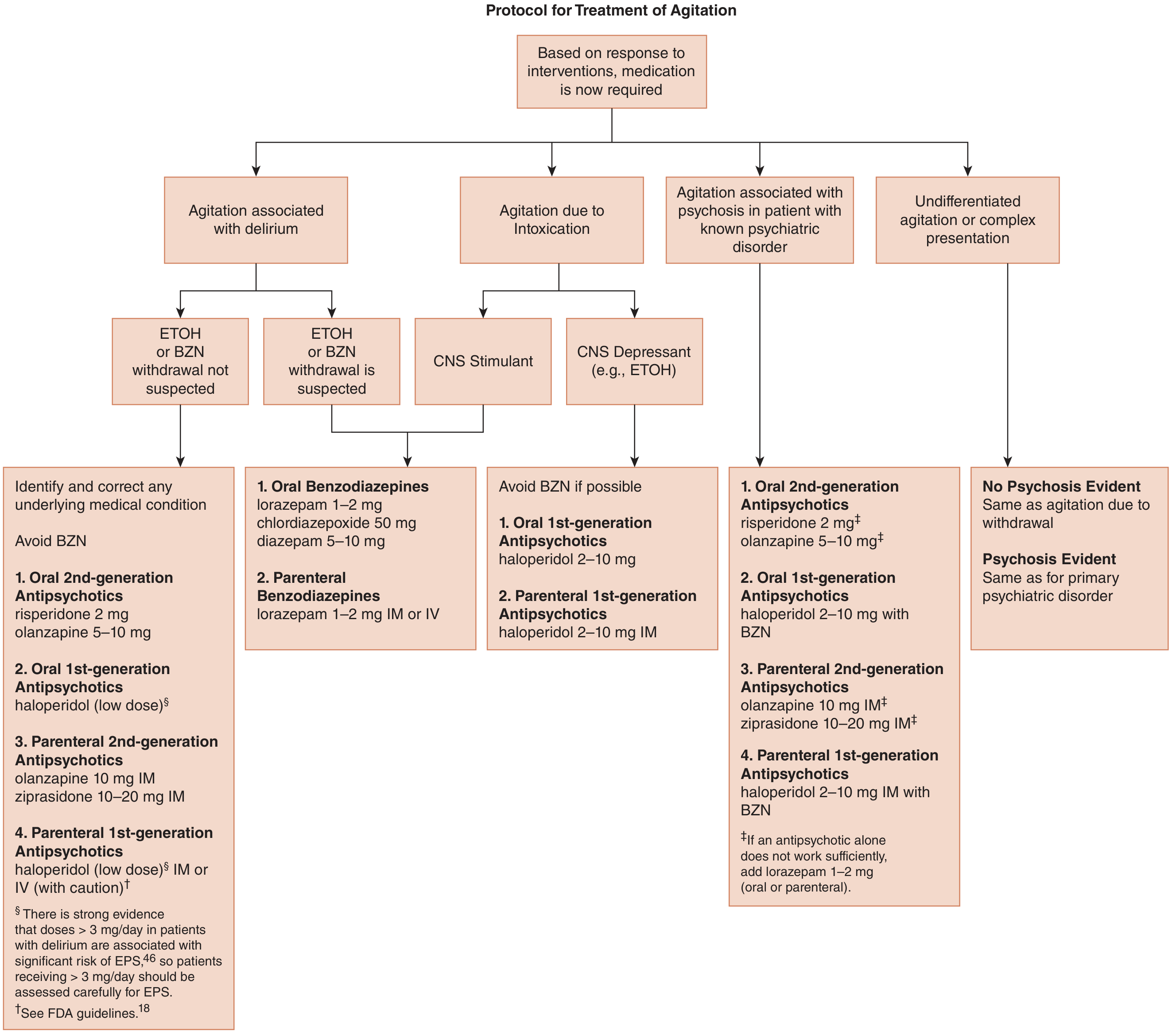
For agitation associated with delirium (non-withdrawal): the algorithm recommends oral or parenteral second-generation antipsychotics (olanzapine, risperidone) first, then low-dose haloperidol IM/IV with caution, while avoiding benzodiazepines.
Summary - Practical Steps at the Bedside
- Secure IV access - start fluid resuscitation immediately
- Check glucose, SpO2, temperature - correct what is correctable NOW
- Draw blood for electrolytes, CBC, cultures if sepsis suspected
- Non-pharmacological calming first
- Haloperidol 0.5–1 mg IV (or olanzapine 5 mg IM) - titrate to calm, not sleep
- Treat fever with paracetamol; treat infection with antibiotics if indicated
- Monitor BP, SpO2, mental status continuously
Sources: Rosen's Emergency Medicine, 9th Ed., p. 1482 (Table 90.5) | Tintinalli's Emergency Medicine, p. 1980–1981 (Figure 287-1, Table 287-2)
Is haloperiodol 1mg iv safe
Haloperidol 1 mg IV is generally considered a low, safe dose for acute agitation in most adults. It is widely used in emergency and ICU settings. The main concerns are QTc prolongation (greater with IV than IM), extrapyramidal side effects, and hypotension - all of which are low risk at 1 mg. However, IV use is technically off-label per FDA.
Searching sources...
Finding Sources
Searching PubMed
haloperidol intravenous safety agitation
Reading File
Reading Article
PMID: 41790521
Reading Article
PMID: 38309683
Is Haloperidol 1 mg IV Safe?
Short answer: Yes, 1 mg IV haloperidol is a low, conservative dose and is generally considered safe in most adults. It is one of the most widely used agents for acute agitation in emergency and ICU settings globally. That said, there are specific risks and precautions you must know.
Safety Profile at 1 mg IV
| Concern | Reality at 1 mg IV |
|---|---|
| QTc prolongation | Does occur, but clinically significant TdP (Torsades de Pointes) at this dose is rare; mean QTc increase with 10 mg IM haloperidol is up to ~15 ms - 1 mg IV causes far less |
| Extrapyramidal side effects (EPS) | Incidence <10% with IV haloperidol overall; lower at 1 mg |
| Hypotension | Minimal at low doses; more relevant with dehydration - monitor BP |
| Respiratory depression | Not a significant concern at this dose (unlike benzodiazepines) |
| Sedation | Goal is calming, not deep sedation - 1 mg achieves this well |
A 2026 Harvard Review of Psychiatry paper (PMID 41790521) directly challenges the over-reliance on QTc cut-offs as a contraindication to IV haloperidol, arguing that the association between IV haloperidol, QTc prolongation, and actual TdP does not justify rigid numerical thresholds. The clinical risk-benefit calculation matters more than a single QTc number.
FDA Status - Important to Know
IV haloperidol is off-label (FDA has a black-box warning for IV use, issued 2007, related to TdP risk). However, this does not mean it is contraindicated - it means it should be used with awareness and monitoring. It is standard practice in ICUs and EDs worldwide.
When to Be Extra Cautious with IV Haloperidol
Even at 1 mg, exercise extra caution in:
- QTc already prolonged (>500 ms or >60 ms increase from baseline) - consider alternative
- Concurrent QTc-prolonging drugs (e.g., azithromycin, fluoroquinolones, ondansetron, methadone)
- Electrolyte disturbances - hypokalemia, hypomagnesemia (common with dehydration!) significantly increase TdP risk - correct these before or alongside administration
- Acute coronary ischemia or uncompensated heart failure
- Severe hepatic dysfunction (impaired clearance)
- Elderly/dementia patients - black-box warning for increased mortality in antipsychotic-treated dementia patients
Specific to Your Patient (Febrile + Severe Dehydration)
The dehydration angle matters here:
- Dehydration causes hypokalemia and hypomagnesemia, which potentiate QTc prolongation
- Correct electrolytes while giving haloperidol - give IV potassium/magnesium if levels are low
- Monitor blood pressure - 1 mg IV haloperidol + dehydration can drop BP; ensure fluids are running
- Administer slowly - give as a slow IV push over 2-3 minutes, not a bolus
Practical Administration
- Dose: 0.5–1 mg IV slow push (over 2-3 min) - start at 0.5 mg if elderly or frail
- Repeat: Can repeat every 30–60 minutes if needed; observe response
- Monitoring: Cardiac monitor (telemetry ideally), BP, SpO2 for at least 30–60 minutes post-dose
- ECG: Baseline ECG is recommended by formal prescribing information in most countries before IV use
Bottom Line
Haloperidol 1 mg IV is a conservative, low dose used routinely worldwide. At this dose, serious cardiac events are rare. The key safety steps for your patient are:
- Check and correct electrolytes (K⁺, Mg²⁺) - dehydration increases risk
- Monitor cardiac rhythm and BP after administration
- Continue IV fluid resuscitation alongside sedation
- Do not co-administer with other QTc-prolonging drugs without weighing the risk
Sources: Maudsley Prescribing Guidelines, 15th Ed., p. 88 | Rosen's Emergency Medicine | Castro et al., 2024 - Systematic Review, PMID 38309683 | Levinsohn et al., 2026 - Harvard Rev Psychiatry, PMID 41790521
This is a shared conversation. Sign in to Orris to start your own chat.