
ECG read in simple language
I'll read the medical library skill first, then search for ECG content.
Reading File
Now let me search the library for ECG content in parallel:
Finding Sources
Finding Sources
Finding Sources
Finding Sources
Reading File
Finding Sources
Now let me read the key ECG sections from Guyton & Hall and Goldman-Cecil in parallel:
Reading File
Reading File
Reading File
Now let me get the systematic approach section and fetch the cardiac conduction diagram:
Reading File
Loading Image
Loading Image
I now have rich content from multiple authoritative sources. Let me compile the full, simple-language ECG guide.
How to Read an ECG - In Plain Language
What Is an ECG?
An ECG (electrocardiogram) is a recording of the electrical activity of your heart, picked up by electrodes placed on the skin. Every time the heart beats, a tiny electrical wave travels through it - the ECG captures that wave and draws it on paper (or a screen). It does not measure pumping force directly; it measures the electrical signals that trigger each heartbeat.
- Paper speed: 25 mm/second
- Small box = 1 mm = 0.04 seconds
- Large box = 5 mm = 0.20 seconds
- Height (amplitude): 10 mm = 1 mV
(Harriet Lane Handbook)
Step 1 - Understand the Electrical Journey of One Heartbeat
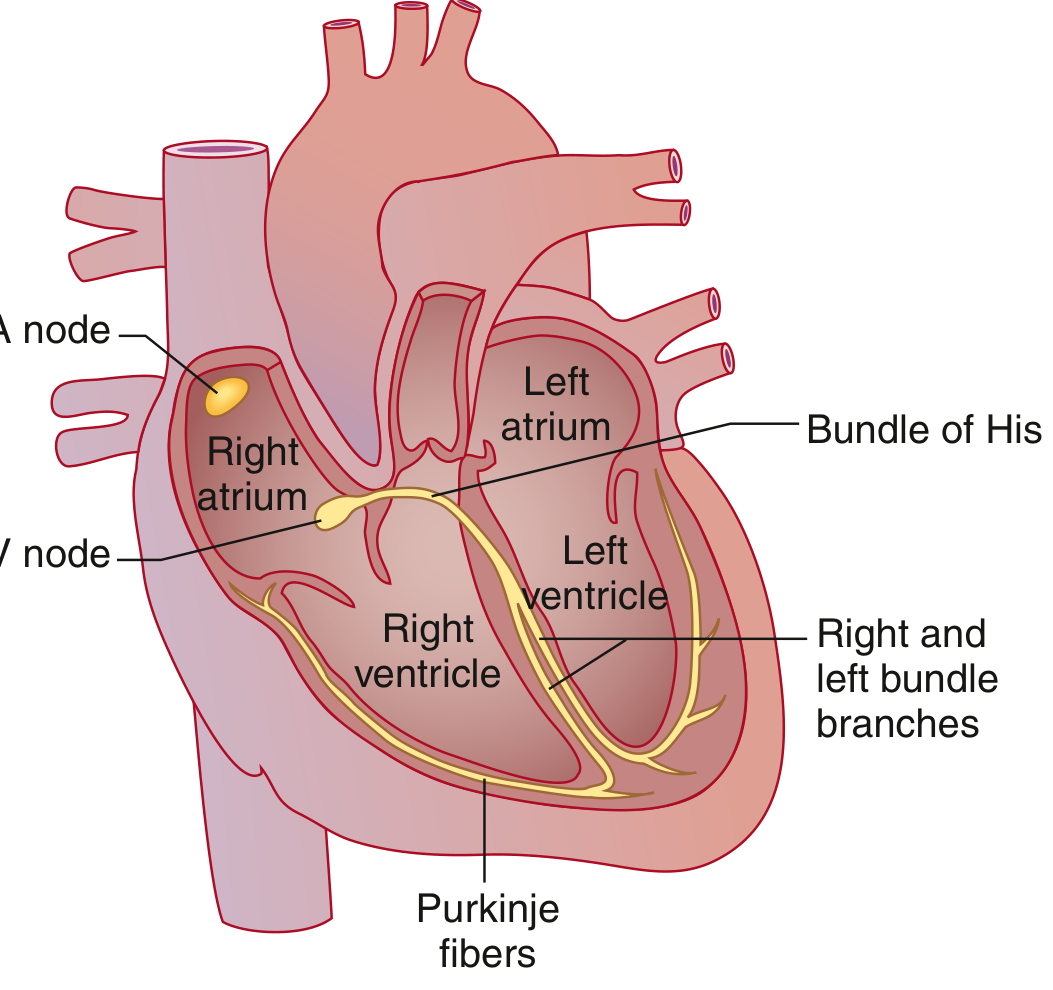
Every heartbeat follows this exact path:
- SA node (sinoatrial node) - the natural pacemaker, sits in the right atrium. It fires first.
- Electricity spreads across both atria → atria squeeze (atrial contraction).
- Signal arrives at the AV node (between atria and ventricles) → it deliberately slows down (a safety pause).
- Signal travels down the Bundle of His → splits into right and left bundle branches → fans out into Purkinje fibers.
- Both ventricles contract together, pumping blood to the lungs and body.
- The ventricles recover (repolarize) and get ready for the next beat.
(Goldman-Cecil Medicine; Miller's Anesthesia)
Step 2 - The Waves on an ECG and What They Mean
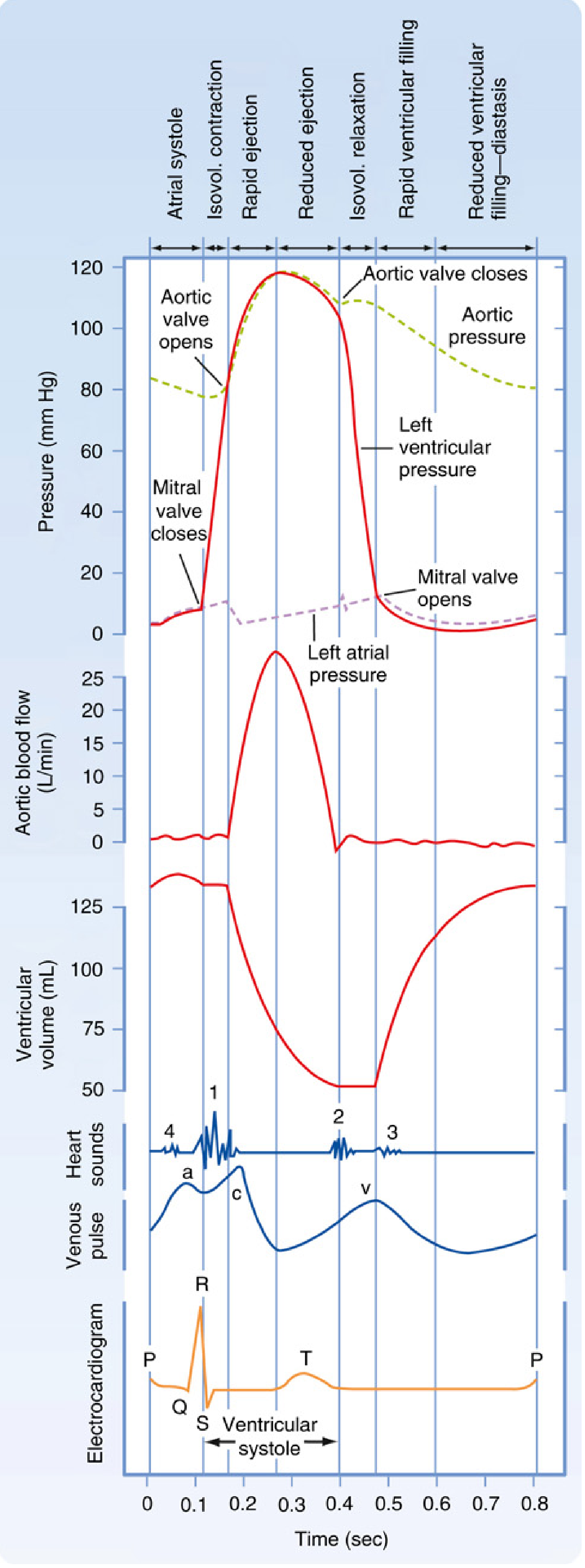
Each heartbeat draws this pattern on paper:
| Wave / Segment | What It Represents | Normal Duration |
|---|---|---|
| P wave | Atria depolarize (fire) → atria contract | < 0.12 sec (3 small boxes) |
| PR interval | Time from atria firing to ventricles firing (AV node delay) | 0.12 - 0.20 sec (3-5 large boxes) |
| QRS complex | Ventricles depolarize → ventricles contract | < 0.12 sec (3 small boxes) |
| ST segment | Pause between ventricular contraction and recovery | Flat = normal (on the baseline) |
| T wave | Ventricles repolarize (recover/reset) | Smooth, upright hump |
| QT interval | Total ventricular electrical activity (fire + recover) | < 0.44 sec (QTc) |
| U wave | Late ventricular repolarization (not always seen) | Small bump after T |
Simple memory trick: "P fires atria. QRS fires ventricles. T resets ventricles."
(Guyton & Hall Textbook of Medical Physiology; Goldman-Cecil Medicine)
Step 3 - The Systematic 6-Step Reading Approach
When you pick up an ECG, always go through these steps in order. Never skip around.
1. Rate - How Fast Is the Heart Beating?
Quick method: Count the large boxes between two consecutive R waves (the tallest peak), then divide 300 by that number.
| Boxes between R waves | Heart Rate |
|---|---|
| 1 box | 300 bpm |
| 2 boxes | 150 bpm |
| 3 boxes | 100 bpm |
| 4 boxes | 75 bpm |
| 5 boxes | 60 bpm |
| 6 boxes | 50 bpm |
- Normal: 60-100 bpm
- Bradycardia: < 60 bpm (too slow)
- Tachycardia: > 100 bpm (too fast)
(Harriet Lane Handbook)
2. Rhythm - Is the Beat Regular?
- Are the R-R intervals (distance between peaks) equal throughout?
- Is every QRS preceded by a P wave?
- Is every P wave followed by a QRS?
- Sinus rhythm = P wave before every QRS, P upright in leads I and aVF. This is normal.
- Irregular rhythm with no visible P waves = think atrial fibrillation.
3. Axis - Which Direction Is the Electrical Wave Going?
The QRS axis tells you whether the heart's electrical wave travels in the correct direction through the ventricles.
- Look at leads I and aVF.
- Both positive (pointing up) = normal axis (~0° to +90°)
- Lead I positive, aVF negative = left axis deviation (can mean left bundle branch block, LVH)
- Lead I negative, aVF positive = right axis deviation (can mean RVH, pulmonary embolism)
4. Intervals - Are the Timing Gaps Normal?
| Interval | What to Check | Abnormal Finding |
|---|---|---|
| PR interval | 0.12-0.20 sec | Long = heart block; Short = WPW syndrome |
| QRS duration | < 0.12 sec | Wide = bundle branch block or ventricular origin |
| QTc | ≤ 0.44 sec | Long QT = risk of fatal arrhythmia (Torsades) |
(Harriet Lane Handbook)
5. P Wave - Is Atrial Activity Normal?
- Should be small, rounded, and upright in most leads.
- Normal height < 3 mm, duration < 0.09 sec.
- Tall, peaked P in lead II = right atrial enlargement ("P pulmonale").
- Broad, notched P in lead II = left atrial enlargement ("P mitrale").
- No P waves at all = atrial fibrillation or junctional rhythm.
6. QRS and ST-T Changes - Is the Heart Muscle in Trouble?
This is where you look for the big emergencies:
| Finding | Think of |
|---|---|
| ST elevation (above baseline) | Heart attack (STEMI) - call for help immediately |
| ST depression | Ischemia (poor blood flow), NSTEMI |
| Inverted T waves | Ischemia, ventricular strain |
| Wide QRS (> 0.12 sec) | Bundle branch block, ventricular tachycardia |
| Tall R in V1, deep S in V6 | Right ventricular hypertrophy |
| Tall R in V5/V6, deep S in V1 | Left ventricular hypertrophy |
| Peaked tall T waves | Hyperkalemia (high potassium - dangerous) |
| Tiny voltages everywhere | Pericardial effusion, obesity, hypothyroidism |
Step 4 - Common Rhythms Made Simple
| Rhythm | What You See | Key Feature |
|---|---|---|
| Normal sinus rhythm | Regular, P before every QRS, rate 60-100 | All steps look normal |
| Sinus tachycardia | Same but rate > 100 | Fast but organized |
| Sinus bradycardia | Same but rate < 60 | Slow but organized |
| Atrial fibrillation | No P waves, irregular R-R | Irregularly irregular |
| Atrial flutter | "Sawtooth" baseline, rate ~150 | Regular, no true P waves |
| 1st degree heart block | PR interval > 0.20 sec | Prolonged PR, otherwise normal |
| 2nd degree block (Mobitz I) | PR gets longer and longer, then QRS drops | "Wenckebach" pattern |
| 3rd degree (complete) block | P waves and QRS completely unrelated | P and QRS march independently |
| Ventricular tachycardia (VT) | Wide QRS, fast rate > 100, no P waves | Emergency |
| Ventricular fibrillation (VF) | Chaotic, no recognizable waves | Cardiac arrest |
Quick Summary Checklist
When reading any ECG, ask these 6 questions in order:
- Rate - Fast, slow, or normal?
- Rhythm - Regular? P before every QRS?
- Axis - Lead I and aVF both positive?
- Intervals - PR, QRS, and QTc within normal limits?
- P wave - Normal shape and size?
- QRS / ST-T - Any widening, ST changes, or T wave abnormalities?
If all six are normal, the ECG is normal. If any one step is abnormal, that's your finding.
Sources: Guyton & Hall Textbook of Medical Physiology; Goldman-Cecil Medicine; Miller's Anesthesia (10th ed.); Harriet Lane Handbook (23rd ed.)
Create a quick-reference PDF guide of ECG abnormalities for bedside use
Reading File
Reading File
Good. Now let me set up the workspace and write the PDF generation script:
Running Command
ls -la /home/daytona/workspace/ 2>/dev/null || echo "workspace not found"
Running Command
mkdir -p /home/daytona/workspace/ecg-guide && python3 -c "import reportlab; print('reportlab OK')"
Writing File
~/ecg-guide/generate_ecg_guide.py
"""
ECG Quick-Reference Bedside Guide - PDF Generator
Uses reportlab to create a clean, color-coded, print-ready PDF.
"""

from reportlab.lib.pagesizes import A4
from reportlab.lib import colors
from reportlab.lib.units import mm, cm
from reportlab.lib.styles import getSampleStyleSheet, ParagraphStyle
from reportlab.lib.enums import TA_CENTER, TA_LEFT, TA_RIGHT
from reportlab.platypus import (
    SimpleDocTemplate, Paragraph, Spacer, Table, TableStyle,
    HRFlowable, PageBreak, KeepTogether
)
from reportlab.platypus.flowables import Flowable
from reportlab.graphics.shapes import Drawing, Rect, String, Line, Polygon
from reportlab.graphics import renderPDF
from reportlab.graphics.shapes import Drawing, Path
import os

OUTPUT = "/home/daytona/workspace/ecg-guide/ECG_Quick_Reference.pdf"

# ── Colour palette ──────────────────────────────────────────────────────────
RED        = colors.HexColor("#C0392B")
ORANGE     = colors.HexColor("#E67E22")
YELLOW_BG  = colors.HexColor("#FFF9E6")
GREEN      = colors.HexColor("#1E8449")
GREEN_LIGHT= colors.HexColor("#EAF5EA")
BLUE       = colors.HexColor("#1A5276")
BLUE_LIGHT = colors.HexColor("#EBF5FB")
PURPLE     = colors.HexColor("#6C3483")
PURPLE_LIGHT=colors.HexColor("#F5EEF8")
GREY_DARK  = colors.HexColor("#2C3E50")
GREY_MED   = colors.HexColor("#566573")
GREY_LIGHT = colors.HexColor("#F2F3F4")
WHITE      = colors.white
RED_LIGHT  = colors.HexColor("#FDEDEC")
ORANGE_LIGHT=colors.HexColor("#FEF9E7")
TEAL       = colors.HexColor("#117A65")
TEAL_LIGHT = colors.HexColor("#E8F8F5")
HEADER_BG  = colors.HexColor("#1A5276")

PAGE_W, PAGE_H = A4

# ── Styles ───────────────────────────────────────────────────────────────────
base = getSampleStyleSheet()

def S(name, parent="Normal", **kw):
    """Create a named paragraph style."""
    return ParagraphStyle(name, parent=base[parent], **kw)

TITLE_STYLE = S("Title2", "Normal",
    fontSize=22, textColor=WHITE, alignment=TA_CENTER,
    fontName="Helvetica-Bold", spaceAfter=2, leading=26)

SUBTITLE_STYLE = S("Subtitle2", "Normal",
    fontSize=10, textColor=colors.HexColor("#AED6F1"),
    alignment=TA_CENTER, fontName="Helvetica", spaceAfter=4)

SECTION_HEADER = S("SH", "Normal",
    fontSize=11, textColor=WHITE, fontName="Helvetica-Bold",
    alignment=TA_LEFT, leading=14, spaceAfter=4, spaceBefore=6)

CELL_BOLD = S("CB", "Normal",
    fontSize=9, textColor=GREY_DARK, fontName="Helvetica-Bold", leading=12)

CELL_NORMAL = S("CN", "Normal",
    fontSize=8.5, textColor=GREY_DARK, fontName="Helvetica", leading=11)

CELL_RED = S("CR", "Normal",
    fontSize=8.5, textColor=RED, fontName="Helvetica-Bold", leading=11)

CELL_GREEN = S("CG", "Normal",
    fontSize=8.5, textColor=GREEN, fontName="Helvetica-Bold", leading=11)

CELL_BLUE = S("CBL", "Normal",
    fontSize=8.5, textColor=BLUE, fontName="Helvetica-Bold", leading=11)

CELL_ORANGE = S("CO", "Normal",
    fontSize=8.5, textColor=ORANGE, fontName="Helvetica-Bold", leading=11)

CAPTION = S("Cap", "Normal",
    fontSize=7.5, textColor=GREY_MED, fontName="Helvetica-Oblique",
    alignment=TA_CENTER, leading=10)

FOOTNOTE = S("FN", "Normal",
    fontSize=7, textColor=GREY_MED, fontName="Helvetica", leading=9)

MINI_BOLD = S("MB", "Normal",
    fontSize=8, textColor=GREY_DARK, fontName="Helvetica-Bold", leading=10)

MINI_NORMAL = S("MN", "Normal",
    fontSize=8, textColor=GREY_DARK, fontName="Helvetica", leading=10)

ALERT_RED = S("AR", "Normal",
    fontSize=9, textColor=RED, fontName="Helvetica-Bold",
    alignment=TA_CENTER, leading=12)

# ── Helper: coloured section banner ─────────────────────────────────────────
class ColorBanner(Flowable):
    def __init__(self, text, bg_color, text_color=WHITE, height=18, font_size=10):
        Flowable.__init__(self)
        self.text = text
        self.bg = bg_color
        self.tc = text_color
        self.bh = height
        self.fs = font_size
        self.width = PAGE_W - 2*cm

    def draw(self):
        c = self.canv
        c.setFillColor(self.bg)
        c.roundRect(0, 0, self.width, self.bh, 3, fill=1, stroke=0)
        c.setFillColor(self.tc)
        c.setFont("Helvetica-Bold", self.fs)
        c.drawString(6, 4, self.text)

    def wrap(self, availWidth, availHeight):
        self.width = availWidth
        return availWidth, self.bh + 3


# ── ECG waveform sketch ───────────────────────────────────────────────────────
class ECGWaveform(Flowable):
    """Draws a schematic P-QRS-T waveform with labels."""
    def __init__(self, width=160, height=55):
        Flowable.__init__(self)
        self._w = width
        self._h = height

    def wrap(self, aw, ah):
        return self._w, self._h

    def draw(self):
        c = self.canv
        w, h = self._w, self._h
        baseline = h * 0.38

        # Grid lines (light)
        c.setStrokeColor(colors.HexColor("#DDEEFF"))
        c.setLineWidth(0.4)
        for x in range(0, int(w)+1, 10):
            c.line(x, 0, x, h)
        for y in range(0, int(h)+1, 10):
            c.line(0, y, w, y)

        # Waveform path
        c.setStrokeColor(BLUE)
        c.setLineWidth(1.6)
        p = c.beginPath()

        # Isoelectric start
        p.moveTo(0, baseline)
        p.lineTo(18, baseline)

        # P wave (small bump)
        p.curveTo(20, baseline, 22, baseline + 10, 24, baseline + 10)
        p.curveTo(26, baseline + 10, 28, baseline, 30, baseline)

        # PR segment flat
        p.lineTo(40, baseline)

        # Q dip
        p.lineTo(44, baseline - 5)

        # R spike
        p.lineTo(50, baseline + 30)

        # S dip
        p.lineTo(56, baseline - 8)

        # J point / ST segment
        p.lineTo(68, baseline)

        # T wave (smooth hump)
        p.curveTo(72, baseline, 78, baseline + 14, 82, baseline + 14)
        p.curveTo(86, baseline + 14, 92, baseline, 95, baseline)

        # Isoelectric tail
        p.lineTo(w, baseline)

        c.drawPath(p, stroke=1, fill=0)

        # Labels
        c.setFont("Helvetica-Bold", 6.5)
        c.setFillColor(BLUE)
        # P
        c.drawCentredString(24, baseline + 13, "P")
        # Q
        c.drawCentredString(44, baseline - 11, "Q")
        # R
        c.drawCentredString(50, baseline + 33, "R")
        # S
        c.drawCentredString(57, baseline - 13, "S")
        # T
        c.drawCentredString(82, baseline + 17, "T")
        # Baseline arrow label
        c.setFillColor(GREY_MED)
        c.setFont("Helvetica", 6)
        c.drawString(2, baseline + 2, "isoelectric")

        # Brackets for intervals
        c.setStrokeColor(GREY_MED)
        c.setLineWidth(0.6)
        # PR interval bracket
        bry = 4
        c.line(18, bry, 40, bry)
        c.line(18, bry, 18, bry+3)
        c.line(40, bry, 40, bry+3)
        c.setFont("Helvetica", 5.5)
        c.setFillColor(GREY_MED)
        c.drawCentredString(29, bry+4, "PR 0.12-0.20s")

        # QRS bracket
        c.line(40, bry+10, 68, bry+10)
        c.line(40, bry+10, 40, bry+13)
        c.line(68, bry+10, 68, bry+13)
        c.drawCentredString(54, bry+14, "QRS <0.12s")

        # QT bracket
        c.line(40, 1, 95, 1)
        c.line(40, 1, 40, 4)
        c.line(95, 1, 95, 4)


# ── Build document ────────────────────────────────────────────────────────────
def build_pdf():
    doc = SimpleDocTemplate(
        OUTPUT,
        pagesize=A4,
        leftMargin=1*cm, rightMargin=1*cm,
        topMargin=1.2*cm, bottomMargin=1.2*cm,
        title="ECG Quick Reference - Bedside Guide",
        author="Orris Medical"
    )

    story = []

    # ── PAGE 1 ────────────────────────────────────────────────────────────────

    # ── Header banner ─────────────────────────────────────────────────────────
    header_data = [[
        Paragraph("<font color='white' size='18'><b>ECG Quick Reference</b></font><br/>"
                  "<font color='#AED6F1' size='9'>Bedside Guide to ECG Abnormalities</font>",
                  S("H", "Normal", leading=22, alignment=TA_LEFT)),
        Paragraph("<font color='white' size='8'>For clinical use at point of care<br/>"
                  "Always correlate with clinical context</font>",
                  S("H2", "Normal", leading=11, alignment=TA_RIGHT, textColor=WHITE))
    ]]
    header_tbl = Table(header_data, colWidths=[12*cm, 7*cm])
    header_tbl.setStyle(TableStyle([
        ("BACKGROUND", (0,0), (-1,-1), HEADER_BG),
        ("VALIGN", (0,0), (-1,-1), "MIDDLE"),
        ("LEFTPADDING", (0,0), (0,0), 12),
        ("RIGHTPADDING", (-1,-1), (-1,-1), 10),
        ("TOPPADDING", (0,0), (-1,-1), 10),
        ("BOTTOMPADDING", (0,0), (-1,-1), 10),
        ("ROUNDEDCORNERS", [4,4,4,4]),
    ]))
    story.append(header_tbl)
    story.append(Spacer(1, 6))

    # ── Waveform + quick lookup row ───────────────────────────────────────────
    wf_cell = [
        Paragraph("<b>Normal ECG Waveform</b>", CELL_BOLD),
        Spacer(1, 4),
        ECGWaveform(width=170, height=60),
        Spacer(1, 3),
        Paragraph("P=atrial depol. | QRS=ventricular depol. | T=ventricular repol.", CAPTION),
    ]

    intervals_data = [
        [Paragraph("<b>Normal Intervals</b>", MINI_BOLD), ""],
        [Paragraph("PR interval", MINI_NORMAL), Paragraph("<b>0.12 - 0.20 s</b>", MINI_BOLD)],
        [Paragraph("QRS duration", MINI_NORMAL), Paragraph("<b>< 0.12 s</b>", MINI_BOLD)],
        [Paragraph("QTc (Bazett)", MINI_NORMAL), Paragraph("<b>< 0.44 s (M)  < 0.46 s (F)</b>", MINI_BOLD)],
        [Paragraph("P wave height", MINI_NORMAL), Paragraph("<b>< 2.5 mm</b>", MINI_BOLD)],
        [Paragraph("P wave duration", MINI_NORMAL), Paragraph("<b>< 0.12 s</b>", MINI_BOLD)],
        [Paragraph("Normal HR", MINI_NORMAL), Paragraph("<b>60 - 100 bpm</b>", MINI_BOLD)],
    ]
    intervals_tbl = Table(intervals_data, colWidths=[3.8*cm, 4.5*cm])
    intervals_tbl.setStyle(TableStyle([
        ("SPAN", (0,0), (-1,0)),
        ("BACKGROUND", (0,0), (-1,0), BLUE_LIGHT),
        ("BACKGROUND", (0,1), (-1,-1), WHITE),
        ("ROWBACKGROUNDS", (0,1), (-1,-1), [WHITE, GREY_LIGHT]),
        ("BOX", (0,0), (-1,-1), 0.5, colors.HexColor("#BDC3C7")),
        ("INNERGRID", (0,0), (-1,-1), 0.3, colors.HexColor("#BDC3C7")),
        ("TOPPADDING", (0,0), (-1,-1), 3),
        ("BOTTOMPADDING", (0,0), (-1,-1), 3),
        ("LEFTPADDING", (0,0), (-1,-1), 5),
    ]))

    rate_data = [
        [Paragraph("<b>Rate Formula (300 Rule)</b>", MINI_BOLD), ""],
        [Paragraph("R-R = 1 box", MINI_NORMAL), Paragraph("<b>300 bpm</b>", CELL_RED)],
        [Paragraph("R-R = 2 boxes", MINI_NORMAL), Paragraph("<b>150 bpm</b>", CELL_RED)],
        [Paragraph("R-R = 3 boxes", MINI_NORMAL), Paragraph("<b>100 bpm</b>", CELL_ORANGE)],
        [Paragraph("R-R = 4 boxes", MINI_NORMAL), Paragraph("<b>75 bpm</b>", CELL_GREEN)],
        [Paragraph("R-R = 5 boxes", MINI_NORMAL), Paragraph("<b>60 bpm</b>", CELL_GREEN)],
        [Paragraph("R-R = 6 boxes", MINI_NORMAL), Paragraph("<b>50 bpm</b>", CELL_BLUE)],
    ]
    rate_tbl = Table(rate_data, colWidths=[3.8*cm, 2.6*cm])
    rate_tbl.setStyle(TableStyle([
        ("SPAN", (0,0), (-1,0)),
        ("BACKGROUND", (0,0), (-1,0), BLUE_LIGHT),
        ("ROWBACKGROUNDS", (0,1), (-1,-1), [WHITE, GREY_LIGHT]),
        ("BOX", (0,0), (-1,-1), 0.5, colors.HexColor("#BDC3C7")),
        ("INNERGRID", (0,0), (-1,-1), 0.3, colors.HexColor("#BDC3C7")),
        ("TOPPADDING", (0,0), (-1,-1), 3),
        ("BOTTOMPADDING", (0,0), (-1,-1), 3),
        ("LEFTPADDING", (0,0), (-1,-1), 5),
    ]))

    top_row = Table(
        [[wf_cell, intervals_tbl, rate_tbl]],
        colWidths=[7.2*cm, 9*cm, 2.9*cm + 3*mm]  # total ~19.1cm for A4 margins
    )
    top_row.setStyle(TableStyle([
        ("VALIGN", (0,0), (-1,-1), "TOP"),
        ("LEFTPADDING", (0,0), (-1,-1), 4),
        ("RIGHTPADDING", (0,0), (-1,-1), 4),
    ]))
    story.append(top_row)
    story.append(Spacer(1, 5))

    # ── SECTION 1: RHYTHMS ────────────────────────────────────────────────────
    story.append(ColorBanner("1  RHYTHM ABNORMALITIES", BLUE, height=16, font_size=9))
    story.append(Spacer(1, 3))

    rhythm_headers = [
        Paragraph("<b>Rhythm</b>", CELL_BOLD),
        Paragraph("<b>Rate</b>", CELL_BOLD),
        Paragraph("<b>P Waves</b>", CELL_BOLD),
        Paragraph("<b>QRS</b>", CELL_BOLD),
        Paragraph("<b>Key Feature</b>", CELL_BOLD),
        Paragraph("<b>Action</b>", CELL_BOLD),
    ]

    rhythms = [
        ["Sinus Tachycardia", ">100", "Normal, 1:1", "Narrow", "Regular; P before every QRS", "Find cause (pain, fever, hypovolaemia)"],
        ["Sinus Bradycardia", "<60", "Normal, 1:1", "Narrow", "Regular; P before every QRS", "Monitor; atropine if symptomatic"],
        ["Atrial Fibrillation", "Variable", "Absent (wavy baseline)", "Narrow (usually)", "Irregularly irregular R-R", "Rate/rhythm control; anticoagulate"],
        ["Atrial Flutter", "~150", "Sawtooth (F waves)", "Narrow", "Regular; 2:1 or 4:1 block", "Rate control; cardioversion"],
        ["SVT", "150-250", "Hidden in QRS/T", "Narrow", "Abrupt onset/offset", "Vagal manoeuvres; adenosine 6mg IV"],
        ["1st Degree AV Block", "Normal", "Normal", "Narrow", "PR > 0.20 s", "Monitor; usually benign"],
        ["2nd Degree (Mobitz I)", "Normal", "Normal", "Narrow", "PR lengthens, then QRS drops (Wenckebach)", "Monitor; cardiology if symptomatic"],
        ["2nd Degree (Mobitz II)", "Slow", "Normal", "Wide (often)", "Constant PR, sudden QRS drop", "Pacing; high risk of progression"],
        ["3rd Degree (Complete)", "30-60", "P and QRS unrelated", "Wide", "Complete dissociation", "Pacing urgently"],
        ["Ventricular Tachycardia", ">100", "Often hidden", "WIDE > 0.12s", "Monomorphic wide complex", "Amiodarone; DC cardioversion if unstable"],
        ["Ventricular Fibrillation", "N/A", "None", "Chaotic", "No organised activity - cardiac arrest", "CPR + immediate defibrillation"],
        ["Torsades de Pointes", ">200", "None visible", "WIDE, twisting", "Polymorphic VT; long QTc preceding", "Magnesium 2g IV; correct QT triggers"],
    ]

    rhythm_rows = [rhythm_headers]
    for i, r in enumerate(rhythms):
        row_style = CELL_RED if r[0] in ["Ventricular Fibrillation", "Ventricular Tachycardia", "Torsades de Pointes", "3rd Degree (Complete)"] else CELL_NORMAL
        action_style = CELL_RED if r[0] in ["Ventricular Fibrillation", "Ventricular Tachycardia", "Torsades de Pointes", "3rd Degree (Complete)"] else CELL_NORMAL
        rhythm_rows.append([Paragraph(r[0], row_style)] + [Paragraph(x, CELL_NORMAL) for x in r[1:5]] + [Paragraph(r[5], action_style)])

    rhythm_tbl = Table(rhythm_rows, colWidths=[3.4*cm, 1.6*cm, 3.5*cm, 2.2*cm, 5.0*cm, 3.4*cm])
    ts = TableStyle([
        ("BACKGROUND", (0,0), (-1,0), BLUE),
        ("TEXTCOLOR", (0,0), (-1,0), WHITE),
        ("FONTNAME", (0,0), (-1,0), "Helvetica-Bold"),
        ("FONTSIZE", (0,0), (-1,0), 8),
        ("ROWBACKGROUNDS", (0,1), (-1,-1), [WHITE, GREY_LIGHT]),
        ("BACKGROUND", (0,10), (-1,10), RED_LIGHT),   # VF
        ("BACKGROUND", (0,9), (-1,9), RED_LIGHT),    # VT
        ("BACKGROUND", (0,11), (-1,11), RED_LIGHT),  # TdP
        ("BACKGROUND", (0,8), (-1,8), ORANGE_LIGHT), # 3rd degree
        ("BOX", (0,0), (-1,-1), 0.5, colors.HexColor("#BDC3C7")),
        ("INNERGRID", (0,0), (-1,-1), 0.3, colors.HexColor("#D5D8DC")),
        ("TOPPADDING", (0,0), (-1,-1), 3),
        ("BOTTOMPADDING", (0,0), (-1,-1), 3),
        ("LEFTPADDING", (0,0), (-1,-1), 4),
        ("VALIGN", (0,0), (-1,-1), "TOP"),
    ])
    rhythm_tbl.setStyle(ts)
    story.append(rhythm_tbl)
    story.append(Spacer(1, 5))

    # ── SECTION 2: ST CHANGES (ISCHAEMIA) ─────────────────────────────────────
    story.append(ColorBanner("2  ST-SEGMENT & T-WAVE CHANGES  (ISCHAEMIA / INFARCTION)", RED, height=16, font_size=9))
    story.append(Spacer(1, 3))

    st_headers = [
        Paragraph("<b>Finding</b>", CELL_BOLD),
        Paragraph("<b>Definition</b>", CELL_BOLD),
        Paragraph("<b>Leads Involved</b>", CELL_BOLD),
        Paragraph("<b>Diagnosis / Cause</b>", CELL_BOLD),
        Paragraph("<b>Immediate Action</b>", CELL_BOLD),
    ]
    st_rows = [st_headers]
    st_data = [
        ["ST Elevation", ">1mm in limb leads; >2mm in chest leads", "Contiguous leads (territory)", "STEMI - ACS, coronary occlusion", "EMERGENCY: Activate cath lab, aspirin, heparin"],
        ["Diffuse ST Elevation", ">1mm in most leads (concave/saddle)", "All/most leads; PR depression", "Pericarditis", "NSAIDs, colchicine; echo to r/o effusion"],
        ["ST Elevation V1-V4", ">2mm V1-V2; right bundle morphology", "Right precordial leads", "Brugada syndrome", "Avoid Na-channel blockers; electrophysiology referral"],
        ["ST Depression", ">0.5mm horizontal/downsloping", "Any leads", "NSTEMI / Unstable Angina / Ischaemia", "ACS protocol; anticoagulation, troponins serial"],
        ["Reciprocal ST depression", "ST depression opposite to ST elevation", "Mirror of infarct territory", "Confirms STEMI territory", "Supports STEMI diagnosis"],
        ["T wave inversion", "Inverted T in >/=2 contiguous leads", "Anterior, lateral, or inferior", "Ischaemia, PE, LVH strain, Wellens'", "Serial ECGs; troponins; echo"],
        ["Wellens' pattern", "Biphasic (type A) or deep inverted (type B) T in V2-V3", "V2-V3", "Critical LAD stenosis (pre-infarction)", "Urgent cardiology; avoid stress test"],
        ["Hyperacute T waves", "Tall, broad, peaked T waves; early STEMI sign", "Contiguous leads", "Early/hyperacute STEMI", "Serial ECGs q15min; treat as ACS"],
        ["J wave (Osborn wave)", "Positive deflection at J point", "Inferior and lateral leads", "Hypothermia; hypercalcaemia", "Rewarm patient; check calcium"],
    ]
    for r in st_data:
        action_style = CELL_RED if "EMERGENCY" in r[4] or "Urgent" in r[4] else CELL_NORMAL
        st_rows.append([Paragraph(r[0], CELL_BOLD)] + [Paragraph(x, CELL_NORMAL) for x in r[1:4]] + [Paragraph(r[4], action_style)])

    st_tbl = Table(st_rows, colWidths=[3.4*cm, 4.2*cm, 3.6*cm, 4.2*cm, 3.7*cm])
    st_tbl.setStyle(TableStyle([
        ("BACKGROUND", (0,0), (-1,0), RED),
        ("TEXTCOLOR", (0,0), (-1,0), WHITE),
        ("FONTNAME", (0,0), (-1,0), "Helvetica-Bold"),
        ("FONTSIZE", (0,0), (-1,0), 8),
        ("ROWBACKGROUNDS", (0,1), (-1,-1), [WHITE, GREY_LIGHT]),
        ("BACKGROUND", (0,1), (-1,1), RED_LIGHT),   # STEMI row highlight
        ("BOX", (0,0), (-1,-1), 0.5, colors.HexColor("#BDC3C7")),
        ("INNERGRID", (0,0), (-1,-1), 0.3, colors.HexColor("#D5D8DC")),
        ("TOPPADDING", (0,0), (-1,-1), 3),
        ("BOTTOMPADDING", (0,0), (-1,-1), 3),
        ("LEFTPADDING", (0,0), (-1,-1), 4),
        ("VALIGN", (0,0), (-1,-1), "TOP"),
    ]))
    story.append(st_tbl)
    story.append(Spacer(1, 5))

    # ── STEMI Territory Table ─────────────────────────────────────────────────
    story.append(ColorBanner("2a  STEMI TERRITORY LOCALISATION", colors.HexColor("#922B21"), height=15, font_size=8.5))
    story.append(Spacer(1, 3))

    territory_data = [
        [Paragraph("<b>Territory</b>", CELL_BOLD), Paragraph("<b>Leads with ST elevation</b>", CELL_BOLD),
         Paragraph("<b>Artery (usually)</b>", CELL_BOLD), Paragraph("<b>Reciprocal changes in</b>", CELL_BOLD)],
        ["Inferior", "II, III, aVF", "RCA (or LCx)", "I, aVL"],
        ["Anterior", "V1-V4", "LAD", "II, III, aVF (sometimes)"],
        ["Lateral", "I, aVL, V5-V6", "LCx", "II, III, aVF"],
        ["Anterolateral", "I, aVL, V1-V6", "LAD (large) or LCx", "II, III, aVF"],
        ["Posterior*", "Tall R + ST depression V1-V3", "RCA or LCx", "None (mirror image)"],
        ["Right ventricle", "ST elevation in V3R-V4R", "Proximal RCA", "Inferior leads elevated too"],
        ["Septal", "V1-V2", "Septal perforators of LAD", "Variable"],
    ]
    ter_tbl = Table(territory_data, colWidths=[3.0*cm, 4.5*cm, 3.8*cm, 3.8*cm])
    ter_tbl.setStyle(TableStyle([
        ("BACKGROUND", (0,0), (-1,0), colors.HexColor("#922B21")),
        ("TEXTCOLOR", (0,0), (-1,0), WHITE),
        ("FONTNAME", (0,0), (-1,0), "Helvetica-Bold"),
        ("FONTSIZE", (0,0), (-1,0), 8),
        ("ROWBACKGROUNDS", (0,1), (-1,-1), [WHITE, GREY_LIGHT]),
        ("BOX", (0,0), (-1,-1), 0.5, colors.HexColor("#BDC3C7")),
        ("INNERGRID", (0,0), (-1,-1), 0.3, colors.HexColor("#D5D8DC")),
        ("FONTSIZE", (0,1), (-1,-1), 8),
        ("FONTNAME", (0,1), (-1,-1), "Helvetica"),
        ("TOPPADDING", (0,0), (-1,-1), 3),
        ("BOTTOMPADDING", (0,0), (-1,-1), 3),
        ("LEFTPADDING", (0,0), (-1,-1), 5),
    ]))
    story.append(ter_tbl)
    story.append(Paragraph("* Posterior STEMI: apply V7-V9 leads to confirm; ST elevation in posterior leads confirms.", FOOTNOTE))
    story.append(Spacer(1, 5))

    # ── PAGE BREAK ────────────────────────────────────────────────────────────
    story.append(PageBreak())

    # ── PAGE 2 MINI-HEADER ────────────────────────────────────────────────────
    story.append(Paragraph(
        "<font color='white'><b>ECG Quick Reference  |  Page 2</b></font>",
        S("PH", "Normal", fontSize=8, textColor=WHITE, alignment=TA_RIGHT,
          backColor=HEADER_BG, leading=12, spaceBefore=0, spaceAfter=4,
          leftPadding=6, rightPadding=6, topPadding=3, bottomPadding=3)
    ))
    story.append(Spacer(1, 4))

    # ── SECTION 3: CONDUCTION ABNORMALITIES ───────────────────────────────────
    story.append(ColorBanner("3  CONDUCTION ABNORMALITIES", PURPLE, height=16, font_size=9))
    story.append(Spacer(1, 3))

    cond_headers = [
        Paragraph("<b>Abnormality</b>", CELL_BOLD),
        Paragraph("<b>QRS Width</b>", CELL_BOLD),
        Paragraph("<b>Key ECG Features</b>", CELL_BOLD),
        Paragraph("<b>Clinical Significance</b>", CELL_BOLD),
    ]
    cond_data = [
        ["LBBB (Left Bundle Branch Block)", "WIDE > 0.12s", "Broad notched R in I, V5-V6 ('M' shape); deep S in V1; no septal Q in I", "New LBBB = treat as STEMI equivalent. Old LBBB: use Sgarbossa criteria"],
        ["RBBB (Right Bundle Branch Block)", "WIDE > 0.12s", "RSR' in V1 ('M' shape); broad S in I, V5-V6 ('W'); normal septal Q", "New RBBB: suspect PE or anterior MI. Isolated RBBB often benign"],
        ["Left Anterior Fascicular Block (LAFB)", "Normal", "Left axis deviation; small Q in I, aVL; small R in II, III, aVF", "May indicate structural heart disease; benign alone"],
        ["Left Posterior Fascicular Block (LPFB)", "Normal", "Right axis deviation; small R in I, aVL; small Q in II, III, aVF", "Rare; r/o RVH, PE, lateral MI first"],
        ["Bifascicular block", "WIDE", "RBBB + LAFB (left axis) or RBBB + LPFB (right axis)", "High risk of progression to complete heart block; consider pacing"],
        ["Pre-excitation (WPW)", "Normal/borderline", "Short PR < 0.12s; delta wave (slurred upstroke); wide QRS", "Accessory pathway; avoid AV nodal agents in AF/flutter; ablation"],
        ["Incomplete RBBB", "0.10-0.12s", "RSR' in V1 but QRS < 0.12s", "Often normal variant (young, athletes); evaluate in context"],
    ]
    cond_rows = [cond_headers]
    for r in cond_data:
        cond_rows.append([Paragraph(r[0], CELL_BOLD), Paragraph(r[1], CELL_NORMAL),
                          Paragraph(r[2], CELL_NORMAL), Paragraph(r[3], CELL_NORMAL)])

    cond_tbl = Table(cond_rows, colWidths=[4.5*cm, 2.5*cm, 6.5*cm, 5.6*cm])
    cond_tbl.setStyle(TableStyle([
        ("BACKGROUND", (0,0), (-1,0), PURPLE),
        ("TEXTCOLOR", (0,0), (-1,0), WHITE),
        ("FONTNAME", (0,0), (-1,0), "Helvetica-Bold"),
        ("FONTSIZE", (0,0), (-1,0), 8),
        ("ROWBACKGROUNDS", (0,1), (-1,-1), [WHITE, PURPLE_LIGHT]),
        ("BOX", (0,0), (-1,-1), 0.5, colors.HexColor("#BDC3C7")),
        ("INNERGRID", (0,0), (-1,-1), 0.3, colors.HexColor("#D5D8DC")),
        ("TOPPADDING", (0,0), (-1,-1), 3),
        ("BOTTOMPADDING", (0,0), (-1,-1), 3),
        ("LEFTPADDING", (0,0), (-1,-1), 4),
        ("VALIGN", (0,0), (-1,-1), "TOP"),
        ("FONTSIZE", (0,1), (-1,-1), 8),
    ]))
    story.append(cond_tbl)
    story.append(Spacer(1, 5))

    # ── SECTION 4: ELECTROLYTE / METABOLIC ───────────────────────────────────
    story.append(ColorBanner("4  ELECTROLYTE & METABOLIC CHANGES", TEAL, height=16, font_size=9))
    story.append(Spacer(1, 3))

    elec_headers = [
        Paragraph("<b>Condition</b>", CELL_BOLD),
        Paragraph("<b>ECG Changes (in order of severity)</b>", CELL_BOLD),
        Paragraph("<b>Key Sign / Mnemonic</b>", CELL_BOLD),
        Paragraph("<b>Action</b>", CELL_BOLD),
    ]
    elec_data = [
        ["Hyperkalaemia", "Tall peaked T waves (K+>5.5) → flat P wave, widened QRS (K+>7) → sine wave, VF (K+>9)", "Peaked T = first sign; sine wave = pre-arrest", "IV calcium gluconate, insulin/dextrose, salbutamol, kayexalate, dialysis"],
        ["Hypokalaemia", "Flat/inverted T, prominent U wave (may merge with T), ST depression, wide QRS in severe", "Prominent U wave (after T) in V2-V3", "IV/PO KCl replacement; correct Mg2+"],
        ["Hypercalcaemia", "Short QT interval, shortened ST segment, wide T wave, PR prolongation", "Short QT + short ST = hypercalcaemia", "IV fluids, furosemide, bisphosphonates; treat cause"],
        ["Hypocalcaemia", "Prolonged QT (long ST segment specifically); no change in T wave morphology", "Long QT with normal T wave shape", "IV calcium gluconate; replete Mg, Vit D"],
        ["Hypermagnesaemia", "PR prolongation, widened QRS, tall peaked T; may resemble hyperkalaemia", "Seen in preeclampsia treatment", "Stop Mg infusion; IV calcium gluconate"],
        ["Hypomagnesaemia", "Prolonged QT, flat T waves, prominent U waves; predisposes to Torsades", "Triggers Torsades de Pointes", "IV MgSO4 2g; replace K+ simultaneously"],
        ["Hypothermia", "Bradycardia, Osborn (J) waves, prolonged PR/QRS/QT, AF, VF risk", "Osborn J wave at J point = pathognomonic", "Rewarm; handle patient gently (VF risk)"],
        ["Digoxin toxicity", "Scooping of ST segment ('Salvador Dali moustache'), short QT, bradycardia, heart block", "Downsloping ST depression - therapeutic; dysrhythmia = toxic", "Check digoxin level; digibind if severe"],
    ]
    elec_rows = [elec_headers]
    for r in elec_data:
        elec_rows.append([Paragraph(r[0], CELL_BOLD)] + [Paragraph(x, CELL_NORMAL) for x in r[1:]])

    elec_tbl = Table(elec_rows, colWidths=[3.8*cm, 6.5*cm, 4.0*cm, 4.8*cm])
    elec_tbl.setStyle(TableStyle([
        ("BACKGROUND", (0,0), (-1,0), TEAL),
        ("TEXTCOLOR", (0,0), (-1,0), WHITE),
        ("FONTNAME", (0,0), (-1,0), "Helvetica-Bold"),
        ("FONTSIZE", (0,0), (-1,0), 8),
        ("ROWBACKGROUNDS", (0,1), (-1,-1), [WHITE, TEAL_LIGHT]),
        ("BOX", (0,0), (-1,-1), 0.5, colors.HexColor("#BDC3C7")),
        ("INNERGRID", (0,0), (-1,-1), 0.3, colors.HexColor("#D5D8DC")),
        ("TOPPADDING", (0,0), (-1,-1), 3),
        ("BOTTOMPADDING", (0,0), (-1,-1), 3),
        ("LEFTPADDING", (0,0), (-1,-1), 4),
        ("VALIGN", (0,0), (-1,-1), "TOP"),
        ("FONTSIZE", (0,1), (-1,-1), 8),
    ]))
    story.append(elec_tbl)
    story.append(Spacer(1, 5))

    # ── SECTION 5: HYPERTROPHY ────────────────────────────────────────────────
    story.append(ColorBanner("5  CHAMBER ENLARGEMENT & HYPERTROPHY", ORANGE, height=16, font_size=9))
    story.append(Spacer(1, 3))

    hyp_headers = [
        Paragraph("<b>Condition</b>", CELL_BOLD),
        Paragraph("<b>ECG Criteria</b>", CELL_BOLD),
        Paragraph("<b>Associated Findings</b>", CELL_BOLD),
        Paragraph("<b>Clinical Cause</b>", CELL_BOLD),
    ]
    hyp_data = [
        ["LVH (Left Ventricular Hypertrophy)",
         "Sokolow-Lyon: SV1 + RV5/V6 > 35mm\nCornell: RaVL + SV3 > 28mm (M) / 20mm (F)",
         "ST depression + T inversion in V5-V6 (strain pattern); axis deviation",
         "Hypertension, aortic stenosis, HCM"],
        ["RVH (Right Ventricular Hypertrophy)",
         "Dominant R in V1 (R > S); right axis deviation; S wave in V5-V6",
         "ST depression V1-V3; P pulmonale",
         "Pulmonary hypertension, mitral stenosis, cor pulmonale, PE"],
        ["LAE (Left Atrial Enlargement)",
         "P mitrale: broad, notched P (> 0.12s) in II; biphasic P in V1 (negative terminal component)",
         "Bifid P wave in lead II",
         "Mitral stenosis/regurgitation, LVH, heart failure"],
        ["RAE (Right Atrial Enlargement)",
         "P pulmonale: tall peaked P (> 2.5mm) in II, III, aVF",
         "Tall P wave in inferior leads",
         "COPD, pulmonary hypertension, tricuspid disease"],
    ]
    hyp_rows = [hyp_headers]
    for r in hyp_data:
        hyp_rows.append([Paragraph(r[0], CELL_BOLD)] + [Paragraph(x, CELL_NORMAL) for x in r[1:]])

    hyp_tbl = Table(hyp_rows, colWidths=[4.2*cm, 5.8*cm, 4.5*cm, 4.6*cm])
    hyp_tbl.setStyle(TableStyle([
        ("BACKGROUND", (0,0), (-1,0), ORANGE),
        ("TEXTCOLOR", (0,0), (-1,0), WHITE),
        ("FONTNAME", (0,0), (-1,0), "Helvetica-Bold"),
        ("FONTSIZE", (0,0), (-1,0), 8),
        ("ROWBACKGROUNDS", (0,1), (-1,-1), [WHITE, ORANGE_LIGHT]),
        ("BOX", (0,0), (-1,-1), 0.5, colors.HexColor("#BDC3C7")),
        ("INNERGRID", (0,0), (-1,-1), 0.3, colors.HexColor("#D5D8DC")),
        ("TOPPADDING", (0,0), (-1,-1), 3),
        ("BOTTOMPADDING", (0,0), (-1,-1), 3),
        ("LEFTPADDING", (0,0), (-1,-1), 4),
        ("VALIGN", (0,0), (-1,-1), "TOP"),
        ("FONTSIZE", (0,1), (-1,-1), 8),
    ]))
    story.append(hyp_tbl)
    story.append(Spacer(1, 5))

    # ── SECTION 6: MISCELLANEOUS PATTERNS ─────────────────────────────────────
    story.append(ColorBanner("6  MISCELLANEOUS PATTERNS", GREEN, height=16, font_size=9))
    story.append(Spacer(1, 3))

    misc_data = [
        [Paragraph("<b>Pattern</b>", CELL_BOLD), Paragraph("<b>ECG Finding</b>", CELL_BOLD),
         Paragraph("<b>Diagnosis</b>", CELL_BOLD), Paragraph("<b>Action</b>", CELL_BOLD)],
        ["Saddle-shaped ST elevation (all leads)", "Diffuse ST up, PR depression, no reciprocal changes", "Pericarditis", "NSAIDs + colchicine; echo"],
        ["Electrical alternans", "Beat-to-beat alternating QRS amplitude/axis", "Cardiac tamponade", "EMERGENCY: Pericardiocentesis"],
        ["S1Q3T3 pattern", "Large S wave I, Q wave III, inverted T III", "Pulmonary embolism (classic but not sensitive)", "CT pulmonary angiogram; anticoagulate"],
        ["Sinus arrest / pause", "No P wave; long pause > 2x normal P-P interval", "SA node dysfunction / sick sinus syndrome", "Pacing if symptomatic"],
        ["Low voltage ECG", "All QRS amplitudes < 5mm in limb leads AND < 10mm in precordial", "Effusion, obesity, COPD, hypothyroidism, infiltrative disease", "Echo; treat cause"],
        ["LQTS (Long QT)", "QTc > 0.44s (M) / 0.46s (F); predisposes to TdP", "Congenital, drugs (quinolones, macrolides, antipsychotics), electrolytes", "Stop causative drugs; magnesium; consider beta-blocker / ICD"],
        ["SQTS (Short QT)", "QTc < 0.33s; tall peaked T waves, short ST", "Congenital; hypercalcaemia, digoxin", "Cardiology referral; ICD if congenital"],
        ["Epsilon wave", "Small positive deflection after QRS in V1-V3", "Arrhythmogenic RV Cardiomyopathy (ARVC)", "Cardiology; echo/MRI; ICD"],
        ["Early repolarisation", "J-point elevation with notch/slur at end of QRS; ST concave up", "Often benign (athletes); rarely arrhythmic in inferior leads", "Assess clinical context; consider Holter"],
        ["Dextrocardia", "Inverted P and QRS in lead I; decreasing R-wave V1-V6", "Dextrocardia (or lead reversal)", "Check arm leads reversal first; CXR"],
    ]
    misc_rows = []
    for i, r in enumerate(misc_data):
        if i == 0:
            misc_rows.append(r)
        else:
            action_style = CELL_RED if "EMERGENCY" in r[3] else CELL_NORMAL
            misc_rows.append([Paragraph(r[0], CELL_BOLD)] + [Paragraph(x, CELL_NORMAL) for x in r[1:3]] + [Paragraph(r[3], action_style)])

    misc_tbl = Table(misc_rows, colWidths=[4.5*cm, 5.5*cm, 4.2*cm, 4.9*cm])
    misc_tbl.setStyle(TableStyle([
        ("BACKGROUND", (0,0), (-1,0), GREEN),
        ("TEXTCOLOR", (0,0), (-1,0), WHITE),
        ("FONTNAME", (0,0), (-1,0), "Helvetica-Bold"),
        ("FONTSIZE", (0,0), (-1,0), 8),
        ("ROWBACKGROUNDS", (0,1), (-1,-1), [WHITE, GREEN_LIGHT]),
        ("BACKGROUND", (0,2), (-1,2), RED_LIGHT),  # Tamponade
        ("BOX", (0,0), (-1,-1), 0.5, colors.HexColor("#BDC3C7")),
        ("INNERGRID", (0,0), (-1,-1), 0.3, colors.HexColor("#D5D8DC")),
        ("TOPPADDING", (0,0), (-1,-1), 3),
        ("BOTTOMPADDING", (0,0), (-1,-1), 3),
        ("LEFTPADDING", (0,0), (-1,-1), 4),
        ("VALIGN", (0,0), (-1,-1), "TOP"),
        ("FONTSIZE", (0,1), (-1,-1), 8),
    ]))
    story.append(misc_tbl)
    story.append(Spacer(1, 5))

    # ── SECTION 7: SYSTEMATIC READING CHECKLIST ───────────────────────────────
    story.append(ColorBanner("7  SYSTEMATIC READING CHECKLIST", GREY_DARK, height=16, font_size=9))
    story.append(Spacer(1, 3))

    checklist_data = [
        ["STEP", "ASK", "NORMAL", "ABNORMAL = THINK"],
        ["1. RATE", "Boxes between R waves?", "60-100 bpm", "Tachy >100 / Brady <60"],
        ["2. RHYTHM", "Regular? P before every QRS?", "Sinus: regular, P:QRS = 1:1", "Irregular = AF, ectopics, block"],
        ["3. AXIS", "Leads I and aVF both positive?", "Both positive = normal (0 to +90)", "LAD: I(+) aVF(-) | RAD: I(-) aVF(+)"],
        ["4. P WAVE", "Shape, size, duration?", "Rounded, <2.5mm, <0.12s", "Tall=RAE | Broad/notched=LAE | Absent=AF"],
        ["5. PR INTERVAL", "Length from P start to QRS start?", "0.12-0.20s (3-5 small boxes)", "Long=heart block | Short=WPW"],
        ["6. QRS DURATION", "Is QRS narrow or wide?", "<0.12s (3 small boxes)", "Wide: BBB, VT, hyperkalaemia, drugs"],
        ["7. QRS MORPHOLOGY", "Q waves? R progression V1-V6?", "No pathological Q; R grows V1-V6", "Path Q=infarct | Poor R prog=anterior MI"],
        ["8. ST SEGMENT", "Above or below baseline?", "On isoelectric line (J point)", "Elevation=STEMI/pericarditis | Depression=ischaemia"],
        ["9. T WAVES", "Upright? Symmetrical?", "Upright in most leads; asymmetric", "Inversion=ischaemia | Peaked=hyperkalaemia"],
        ["10. QT INTERVAL", "QTc using Bazett formula?", "M <0.44s | F <0.46s", "Long QT=drugs, electrolytes, congenital"],
        ["11. U WAVES", "Small hump after T wave?", "Absent or small in V2-V3", "Prominent U=hypokalaemia/hypomagnesaemia"],
    ]

    checklist_rows = []
    for i, row in enumerate(checklist_data):
        if i == 0:
            checklist_rows.append([Paragraph(f"<b>{x}</b>", CELL_BOLD) for x in row])
        else:
            checklist_rows.append([
                Paragraph(row[0], CELL_BOLD),
                Paragraph(row[1], CELL_NORMAL),
                Paragraph(row[2], CELL_GREEN),
                Paragraph(row[3], CELL_RED),
            ])

    checklist_tbl = Table(checklist_rows, colWidths=[3.5*cm, 4.8*cm, 4.4*cm, 6.4*cm])
    checklist_tbl.setStyle(TableStyle([
        ("BACKGROUND", (0,0), (-1,0), GREY_DARK),
        ("TEXTCOLOR", (0,0), (-1,0), WHITE),
        ("FONTNAME", (0,0), (-1,0), "Helvetica-Bold"),
        ("FONTSIZE", (0,0), (-1,0), 8),
        ("ROWBACKGROUNDS", (0,1), (-1,-1), [WHITE, GREY_LIGHT]),
        ("BOX", (0,0), (-1,-1), 0.5, colors.HexColor("#BDC3C7")),
        ("INNERGRID", (0,0), (-1,-1), 0.3, colors.HexColor("#D5D8DC")),
        ("TOPPADDING", (0,0), (-1,-1), 3),
        ("BOTTOMPADDING", (0,0), (-1,-1), 3),
        ("LEFTPADDING", (0,0), (-1,-1), 4),
        ("VALIGN", (0,0), (-1,-1), "TOP"),
        ("FONTSIZE", (0,1), (-1,-1), 8),
    ]))
    story.append(checklist_tbl)
    story.append(Spacer(1, 4))

    # ── Footer ─────────────────────────────────────────────────────────────────
    story.append(HRFlowable(width="100%", thickness=0.5, color=GREY_MED))
    story.append(Spacer(1, 3))
    footer_data = [[
        Paragraph("Sources: Guyton & Hall Medical Physiology | Goldman-Cecil Medicine | "
                  "Miller's Anesthesia 10e | Harriet Lane Handbook 23e | Braunwald's Heart Disease",
                  FOOTNOTE),
        Paragraph("Orris Medical  |  For educational use. Always verify with senior clinician.",
                  S("FNR", "Normal", fontSize=7, textColor=GREY_MED,
                    fontName="Helvetica-Oblique", alignment=TA_RIGHT, leading=9))
    ]]
    footer_tbl = Table(footer_data, colWidths=[12*cm, 7.1*cm])
    footer_tbl.setStyle(TableStyle([("VALIGN", (0,0), (-1,-1), "TOP")]))
    story.append(footer_tbl)

    # ── Build ─────────────────────────────────────────────────────────────────
    doc.build(story)
    print(f"PDF saved: {OUTPUT}")


if __name__ == "__main__":
    build_pdf()
Running Command
cd /home/daytona/workspace/ecg-guide && python3 generate_ecg_guide.py 2>&1
Running Command
ls -lh /home/daytona/workspace/ecg-guide/ECG_Quick_Reference.pdf
The PDF is generated and ready. Here's your download:
ECG Quick Reference
PDF Document · PDF
Here's what's inside the 2-page A4 guide:
Page 1
- Schematic ECG waveform (P-QRS-T) with labelled intervals drawn from scratch
- Normal intervals reference table (PR, QRS, QTc, P wave)
- 300-rule quick heart rate calculator
- Section 1 - Rhythms: 12 rhythm abnormalities (sinus tachy/brady, AF, flutter, SVT, all degrees of heart block, VT, VF, Torsades) - color-coded red for life-threatening ones
- Section 2 - ST/T changes: 9 patterns including STEMI, pericarditis, Brugada, Wellens', Osborn waves
- Section 2a - STEMI territory localisation: 8 territories with culprit artery and reciprocal leads
Page 2
- Section 3 - Conduction: LBBB, RBBB, LAFB, LPFB, bifascicular block, WPW
- Section 4 - Electrolytes/metabolic: Hyperkalaemia, hypokalaemia, hypo/hypercalcaemia, hypo/hypermagnesaemia, hypothermia, digoxin toxicity
- Section 5 - Chamber enlargement: LVH (Sokolow-Lyon + Cornell criteria), RVH, LAE, RAE
- Section 6 - Miscellaneous: Pericarditis, tamponade, PE (S1Q3T3), low voltage, long/short QT, epsilon wave, early repolarisation, dextrocardia
- Section 7 - Systematic 11-step checklist: Rate to U waves with normal vs. abnormal at a glance
This is a shared conversation. Sign in to Orris to start your own chat.