
Knee arthrodesis. Distance is clamps
Reading File
Knee arthrodesis involves fusing the tibia and femur. In external fixation frames (like the Charnley or Hoffmann type), the distance between clamps (pin-to-pin or clamp-to-bone distance) is a key technical parameter affecting frame rigidity and union rates.
Searching sources...
Finding Sources
Finding Sources
Reading File
Finding Sources
Finding Sources
Finding Sources
The Charnley clamp section in Rockwood and Green's is exactly what we need. Let me read both that section and the Campbell's Charnley technique.
Reading File
Reading File
Now let me read the Rockwood & Green section on external fixator frame mechanics (bone-bar distance) more specifically, and also look for the Charnley clamp dimensions:
Reading File
Finding Sources
Loading Image
Finding Sources
Now let me look for the specific clamp distance details - this is likely in older orthopedic texts. Let me search for it in a more targeted way:
Finding Sources
Searching the Web
knee arthrodesis Charnley clamp distance between clamps measurement technique
Reading Web Page
https://pmc.ncbi.nlm.nih.gov/articles/PMC11584295
Finding Sources
Searching the Web
knee arthrodesis external fixator "distance between clamps" OR "inter-clamp distance" pins tibia femur
Excellent - the Orthofix PDF and the biomechanics PDF contain the key data. Let me also fetch the Campbell's diagram of the triangular frame configurations.
Loading Image
Finding Sources
I now have comprehensive information to give a thorough answer. Let me compile everything.
Knee Arthrodesis - Distance Between Clamps (External Fixator / Charnley Technique)
The question refers to the Charnley compression clamp technique for knee arthrodesis - specifically the significance of the distance between the clamps (femoral and tibial clamps) on either side of the fusion site.
The Charnley Compression Clamp - Overview
Charnley and Baker (1952) reported 98.5% union using compression clamps in 67 patients - still considered an excellent, cost-effective method. The device consists of two pin-and-clamp assemblies: one in the distal femur and one in the proximal tibia, connected by threaded rods that allow progressive compression to be applied across the fusion site.
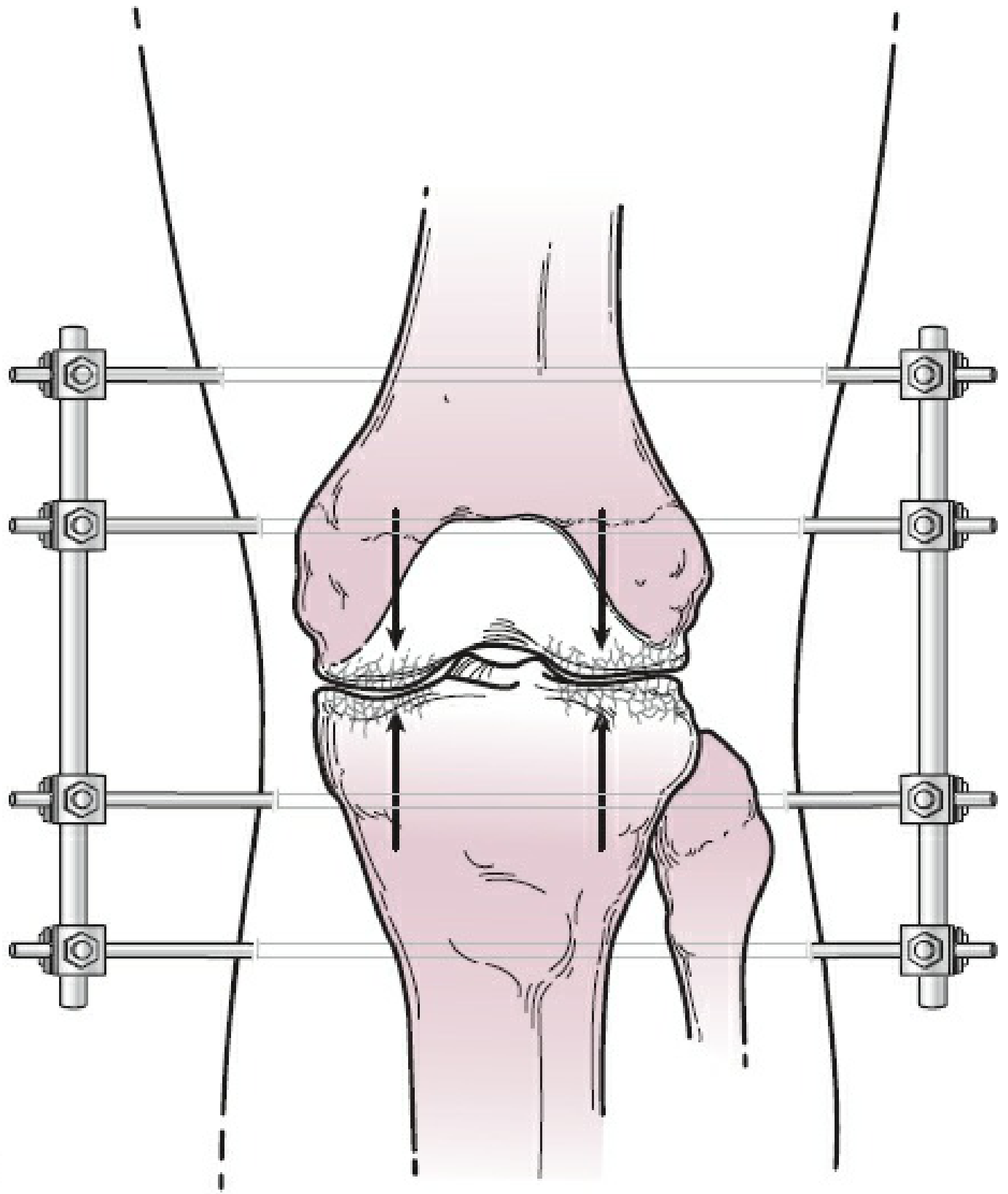
External fixator frame for knee arthrodesis - note the bilateral clamp arrangement with pins through distal femur and proximal tibia (Rockwood & Green's Fractures in Adults, 10th Ed)
Distance Between Clamps - Clinical and Biomechanical Significance
The inter-clamp distance (the span between the femoral clamp and tibial clamp) is a key determinant of construct stability. This must be distinguished from two related measurements:
| Measurement | Definition | Significance |
|---|---|---|
| Inter-clamp (pin group) distance | Distance between the femoral and tibial pin groups | Controls moment arm; closer = more rigid at fusion site |
| Bone-to-bar distance | Perpendicular distance from bone surface to the connecting rod/bar | Shorter = significantly stiffer frame |
| Pin spread within each fragment | Distance between individual pins within femur or tibia | Greater spread = more rigid individual fragment fixation |
Key Biomechanical Rules
From Rockwood & Green's Fractures in Adults (10th Ed, 2025) and the biomechanics literature:
"Pin number, pin separation, and pin proximity to the fracture site, as well as bone-bar distance and the diameter of the pins and connecting bars, all influence the final mechanical stability of the external fixator frame."
- Rockwood & Green's, p.405
The classic experimental data (Burny, Podolsky & Chao) showed:
- Decreasing the bone-to-sidebar distance from 80 mm to 25 mm significantly increased bending stiffness in all loading modes
- Increasing the spread between pins within the same fragment from 44 mm to 90 mm also significantly increased stiffness
- The most stable unilateral frame uses a short bone-rod distance combined with wide pin spread within each fragment
For the Orthofix system used in knee arthrodesis: when the fixator is sited more than 4 cm from the bone, use of 3 screws per clamp is advisable to minimize screw flexion (vs. 2 screws per clamp for upper limb or closer applications).
Charnley's Technique - Specific Steps
From Campbell's Operative Orthopaedics (15th Ed, 2026), TECHNIQUE 9.1:
- Distal femur and proximal tibia bone cuts are made to achieve apposition with the knee in 0-15° flexion, 5-8° valgus, 10° external rotation
- Compression pins are inserted in femur and tibia
- Tighten the clamps so that a compression load of 45 kg is attained
- If using a multiple-pin biplanar fixator: place 3 parallel transfixation pins through distal femur and 3 through upper tibia
- A triangular frame configuration can also be used with 6.5-mm half-pins at 45° angles to the AP and ML planes - this provides the most rigid stability and permits early weight bearing
A more recent study (PMC11584295) using Charnley's clamps confirmed:
- Dunham's pins (4-4.5 mm, serrated) inserted in femur and tibia
- Fusion position: 5° valgus, neutral extension, 3° external rotation
- 5 mm compression provided by the clamps on each side
- Clamps removed at ~3 months if clinical/radiological union confirmed
Practical Guidelines for Clamp Positioning
| Parameter | Recommendation |
|---|---|
| Bone-to-bar distance | As short as possible; < 4 cm preferred |
| Screws per clamp | 2 if bone-bar < 4 cm; 3 if > 4 cm |
| Pin placement from joint line | At least 14 mm distal to joint line (tibia) to avoid joint penetration |
| Compression applied | ~45 kg (Charnley/Campbell's) or 5 mm per side |
| Cast supplement | Long leg cast incorporating clamp for 6-8 weeks, then cylinder cast |
| Total immobilization | ~12-16 weeks total to solid fusion |
Summary
In knee arthrodesis with the Charnley (or similar) compression clamp:
- The distance between the two clamps should be minimized to reduce the lever arm and increase construct rigidity at the fusion site
- The bone-to-bar distance should be kept under ~4 cm; beyond this, a third pin per clamp is needed
- 5 mm compression per side is applied at the time of surgery with a target load of ~45 kg
- Frame rigidity depends on: (1) short bone-to-bar distance, (2) wide pin spread within each fragment, (3) adequate pin diameter, and (4) number of pins per clamp
Sources: Campbell's Operative Orthopaedics 15th Ed (2026), p. 6254-6272 | Rockwood & Green's Fractures in Adults 10th Ed (2025), p. 401-405 | Bailey & Love's Short Practice of Surgery 28th Ed, p. 4555-4557
This is a shared conversation. Sign in to Orris to start your own chat.