
What is the significance of microalbuminuria in diabetes mellitus and hypertension explain me with cocneot
Reading File
Now let me search the medical library for microalbuminuria content in parallel:
Finding Sources
Finding Sources
Finding Sources
Good results. Let me now read the key sections from the most relevant textbooks in parallel:
Reading File
Reading File
Reading File
Reading File
Now let me get more specific content on the stages, mechanisms, and cardiovascular significance:
Reading File
Finding Sources
Finding Sources
Reading File
Finding Sources
I now have rich content from multiple authoritative textbooks. Let me also fetch the key images for the mortality and survival charts:
Loading Image
Loading Image
Searching PubMed
microalbuminuria cardiovascular risk diabetes hypertension
I now have comprehensive, authoritative content from multiple major textbooks with images. Let me compile the full answer.
Microalbuminuria in Diabetes Mellitus and Hypertension
What is Microalbuminuria?
Microalbuminuria (now more precisely called "moderately increased albuminuria" under the 2012 KDIGO classification) refers to urinary albumin excretion between 30 and 300 mg per 24 hours, or an albumin-to-creatinine ratio (ACR) of 30-300 mg/g on a spot urine sample. Below 30 mg/24h is normoalbuminuria, and above 300 mg/24h is macroalbuminuria (severely increased albuminuria).
| Category | 24-hr Albumin | ACR (mg/g) |
|---|---|---|
| Normal (A1) | < 30 mg | < 30 |
| Microalbuminuria / Moderately increased (A2) | 30-300 mg | 30-300 |
| Macroalbuminuria / Severely increased (A3) | > 300 mg | > 300 |
To confirm true microalbuminuria, two of three collections over 3-6 months should be abnormal, because values can be transiently elevated by exercise, fever, UTI, or poor glycemic control.
- The Washington Manual of Medical Therapeutics (KDIGO A-staging definition)
- Creasy & Resnik's Maternal-Fetal Medicine, p. 1735
Pathophysiology: How Does Microalbuminuria Develop?
In Diabetes Mellitus
The glomerular filtration barrier normally prevents albumin from leaking into the urine. This barrier has three layers:
- Fenestrated endothelium - negatively charged, repels albumin
- Glomerular basement membrane (GBM) - charge and size selectivity
- Podocyte foot processes with the slit diaphragm
In diabetes, chronic hyperglycemia drives several harmful mechanisms:
- Glomerular hyperfiltration - early diabetes increases renal blood flow and GFR by up to 50%, causing mechanical stress on the filtration barrier
- Advanced glycation end-products (AGEs) - modify GBM proteins, reducing its charge barrier and increasing permeability
- Activation of PKC (protein kinase C) - increases VEGF, causing glomerular endothelial dysfunction
- Mesangial expansion - accumulation of matrix material narrows capillary lumen
- GBM thickening - up to 3x normal after 10 years of diabetes, impairing selective filtration
- Angiotensin II, TGF-β, VEGF, endothelin - cytokines that drive fibrosis and podocyte loss
As the glomerular barrier breaks down, albumin (molecular weight 69 kDa) leaks through in small amounts - this is the microalbuminuria stage.
Goldman-Cecil Medicine, Stage II Diabetic Nephropathy; Comprehensive Clinical Nephrology, 7th Ed.
In Hypertension
Elevated systemic blood pressure transmits increased hydrostatic pressure into the glomerular capillaries ("glomerular hypertension"). This:
- Stretches the filtration barrier mechanically
- Damages endothelial cells - causing endothelial dysfunction
- Stimulates mesangial cell proliferation and matrix expansion
- Activates the renin-angiotensin-aldosterone system (RAAS), which further constricts the efferent arteriole, worsening glomerular pressure
This is why microalbuminuria occurs in hypertension without diabetes as well, though it is less specific in type 2 DM because hypertension is already so prevalent in that population.
"Microalbuminuria is a more specific sign of diabetic nephropathy in type 1 diabetes than in type 2 diabetes because of the high incidence of hypertension, which itself may lead to microalbuminuria, in the latter." - Goldman-Cecil Medicine
The Four Stages of Diabetic Nephropathy
| Stage | Characteristic | Albumin Excretion | GFR | Blood Pressure |
|---|---|---|---|---|
| I | Hyperfiltration, renal hypertrophy | Normal (transient micro possible) | Elevated (up to +50%) | Normal (T1D) |
| II | Fixed microalbuminuria, GBM thickening, mesangial expansion | 30-300 mg/day | Normal or elevated | Normal or mildly elevated |
| III | Overt nephropathy, macroalbuminuria | > 300 mg/day (>500 mg total protein) | Begins to fall | Rising in T1D; difficult to control in T2D |
| IV | Advanced nephropathy, ESRD progression | Heavy/nephrotic range (>3.5 g/day) | Progressively declining | Systemic hypertension present |
Stage II is the critical intervention window - approximately 30% of type 1 diabetic patients reach this stage after a median of 10 years of diabetes, and the majority will progress to overt nephropathy (Stage III) within 5-7 years without intervention.
Goldman-Cecil Medicine, p. 3950-3962
Significance of Microalbuminuria
1. Earliest Marker of Diabetic Kidney Disease (DKD)
Microalbuminuria appears before any serum creatinine rise and before GFR falls. It is the first clinically detectable signal that glomerular injury is occurring. The DCCT (type 1 DM) and UKPDS (type 2 DM) trials both confirmed that development and progression of microalbuminuria tracks with glycemic control.
"The earliest clinical finding of diabetic kidney disease is microalbuminuria, which may occur at a time when renal histology is essentially normal." - Fuster and Hurst's The Heart, 15th Edition
2. Predictor of Progression to Macroalbuminuria and ESRD
If untreated, microalbuminuria progresses to macroalbuminuria and eventually ESRD. This risk is substantially modified by:
- Blood pressure control
- RAAS blockade (ACE inhibitors / ARBs)
- Glycemic control
3. Cardiovascular Risk Marker - The Most Clinically Important Significance
This is the concept that extends microalbuminuria's importance far beyond the kidney. Microalbuminuria is a marker of systemic endothelial dysfunction, not just glomerular injury. The glomerulus is simply where it is measured - but the underlying disease is diffuse vascular.
Microalbuminuria in patients with diabetes and/or hypertension predicts:
- Increased atherosclerosis
- Increased risk of myocardial infarction and stroke
- Higher total cardiovascular mortality
- Increased platelet aggregation
- Elevated CRP (systemic inflammation)
- Dyslipidemia
The graph below from a prospective 5-year study of 328 patients with type 2 DM shows a clear dose-response relationship between albuminuria and all-cause mortality:
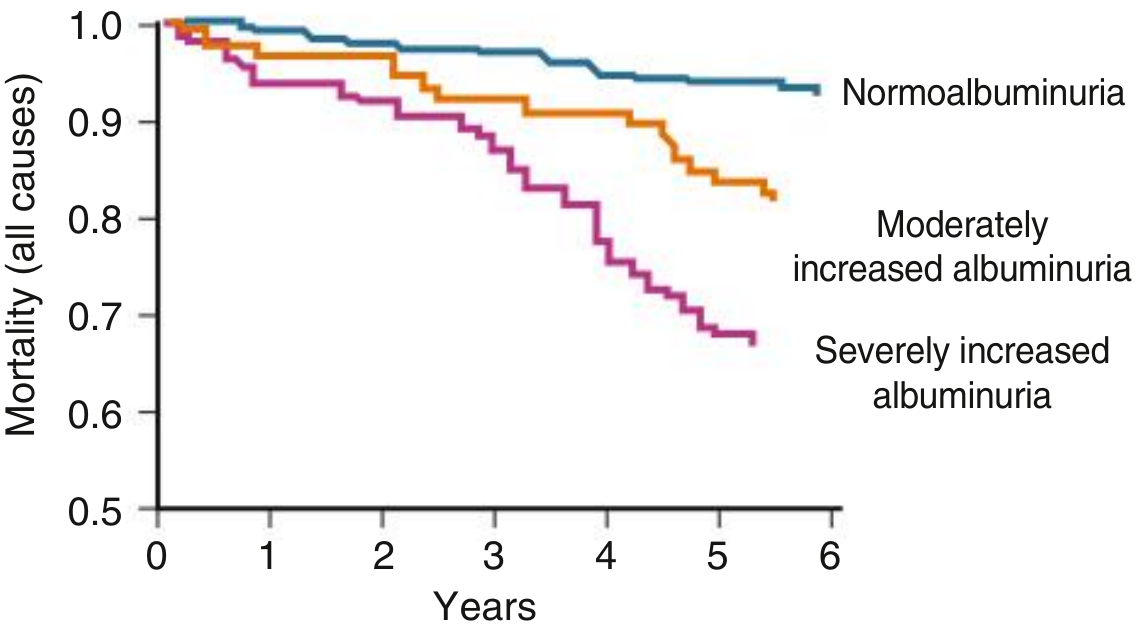
Fig: Influence of microalbuminuria and macroalbuminuria on mortality in NIDDM patients. From Gall MA et al., Diabetes, 1995. - Comprehensive Clinical Nephrology, 7th Ed.
The PREVEND study similarly demonstrated that even high-normal albumin excretion (UAE ≥16.2 mg/24h, i.e., below the traditional microalbuminuria threshold) predicts worse cardiovascular event-free survival.
4. Marker of Generalized Endothelial Dysfunction
Albuminuria likely reflects a "leaky vessel" state throughout the body - not just the kidney. The glomerular endothelium is highly sensitive, so it leaks albumin first, but the same endothelial injury is happening in coronary, cerebral, and peripheral vessels simultaneously. This explains the strong cardiovascular signal.
Pathologic structural changes seen on electron microscopy at this stage:
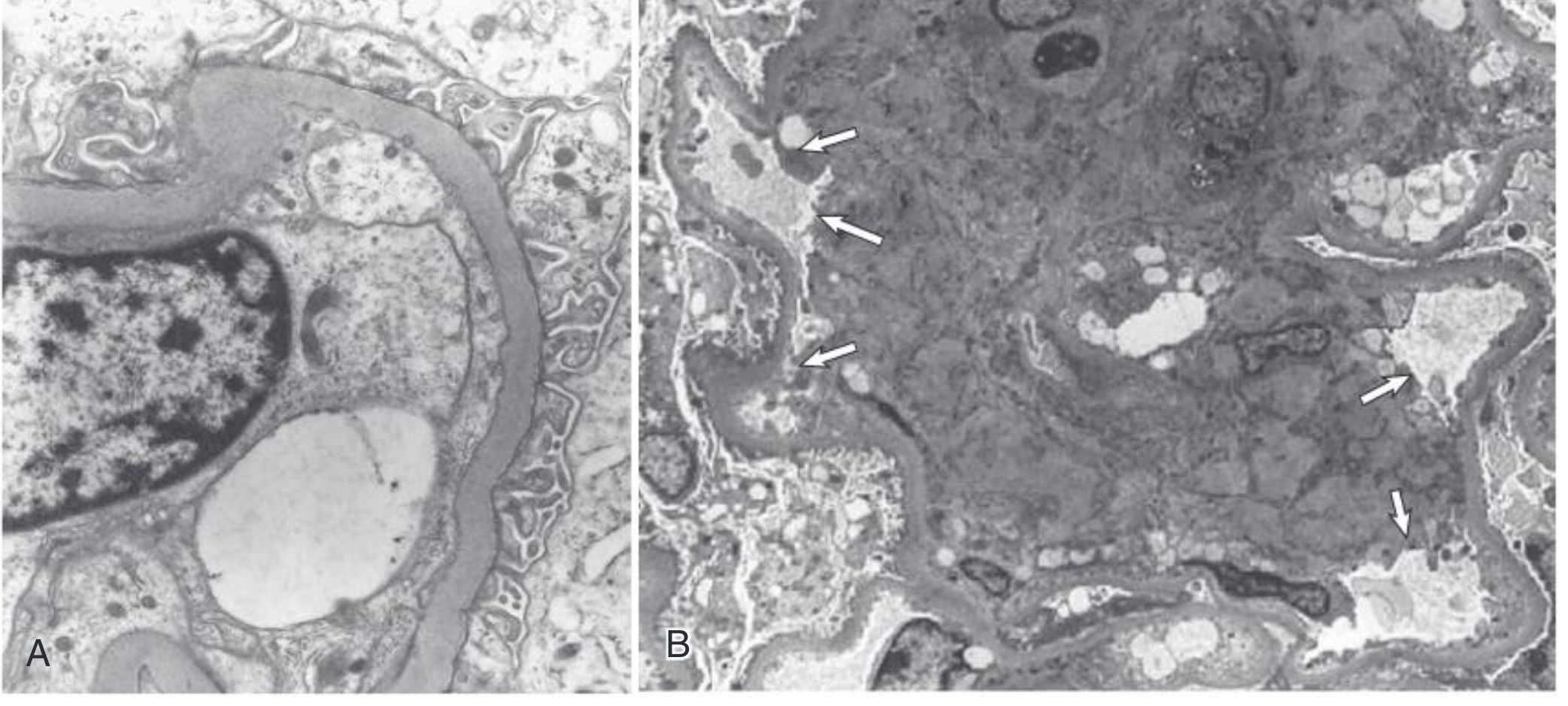
Fig: Electron Microscopy of Structural Changes in Diabetic Nephropathy. (A) Diffusely thickened GBMs. (B) Mesangial expansion encroaching on capillary spaces. - Comprehensive Clinical Nephrology, 7th Ed.
Treatment: Why Microalbuminuria is an Actionable Target
The detection of microalbuminuria triggers specific, proven interventions:
1. RAAS Blockade (ACE Inhibitors / ARBs)
The cornerstone of treatment. These agents:
- Dilate the efferent arteriole preferentially, reducing intraglomerular pressure
- Block angiotensin II-mediated TGF-β activation and fibrosis
- Have renoprotective effects independent of blood pressure lowering
Key trials:
- RENAAL trial: ARB (losartan) in type 2 DM + overt nephropathy - 25% reduction in serum creatinine doubling, 28% reduction in ESRD
- IDNT trial: Irbesartan 33% reduction in creatinine doubling vs placebo
- ROADMAP trial: Olmesartan caused a 23% delay in onset of microalbuminuria in hypertensive type 2 DM patients
Current recommendations (KDIGO):
- Type 1 DM + hypertension + albuminuria: ACE inhibitors preferred
- Type 2 DM + hypertension + microalbuminuria: ACE inhibitors or ARBs
- Type 2 DM + hypertension + macroalbuminuria (>300 mg): ARBs (based on RENAAL/IDNT)
"Overall, the current recommendations are to treat patients with type 1 diabetes, hypertension, and albuminuria with ACE inhibitors, while in patients with type 2 diabetes, hypertension and microalbuminuria should be treated with either ACE inhibitors or ARBs." - Brenner and Rector's The Kidney
2. Glycemic Control
Tight glycemic control (HbA1c <7%) can reverse microalbuminuria and slow progression. Both the DCCT and UKPDS demonstrated this. Data also suggest a "metabolic memory" effect - early good control confers lasting benefit even if control worsens later.
3. Blood Pressure Control
Target BP <130/80 mmHg in patients with DM + albuminuria. Nighttime hypertension (non-dipping pattern) is particularly associated with nephropathy progression (as shown in Knudsen et al., Diabetologia 2009).
4. Lifestyle and Other Measures
- Low-protein diet (reduces glomerular hyperfiltration)
- Smoking cessation (smoking independently accelerates nephropathy)
- Statin therapy (addresses co-existing dyslipidemia)
- SGLT2 inhibitors and GLP-1 agonists - newer agents with proven renoprotective effects beyond glucose lowering (a 2026 meta-analysis [PMID: 40982219] confirms GLP-1 receptor agonists reduce renal outcomes including albuminuria)
Summary Concept Map
DIABETES (hyperglycemia)           HYPERTENSION
        |                                  |
  AGEs, PKC, RAAS activation        Intraglomerular
  Glomerular hyperfiltration    →   hypertension
        |                                  |
        └──────────────┬───────────────────┘
                       ↓
         GLOMERULAR ENDOTHELIAL DYSFUNCTION
         + GBM thickening + Mesangial expansion
                       ↓
              MICROALBUMINURIA (30-300 mg/day)
                       ↓
         ┌─────────────┼──────────────┐
         ↓             ↓              ↓
    Renal signal    Systemic      Intervention
    (DKD Stage II)  CV risk       window:
    → ESRD if       (MI, stroke,  ACE-i / ARB
    untreated       mortality)    + BP/glucose control
Key Teaching Points:
- Microalbuminuria = earliest reversible stage of diabetic/hypertensive kidney disease
- It is a systemic endothelial marker, not just a kidney finding - it predicts cardiovascular death
- In type 1 DM it is more specific for DKD; in type 2 DM, hypertension itself can cause it, making interpretation harder
- Confirmed by 2 of 3 samples over 3-6 months (rule out transient causes)
- Treatment with RAAS blockade can regress microalbuminuria and prevent progression to ESRD
- Both DCCT and UKPDS confirmed glycemic control prevents/delays microalbuminuria
This is a shared conversation. Sign in to Orris to start your own chat.