
Provide a shortnotes on Disconnection syndrome
Reading File
Now let me search the medical library for disconnection syndrome content, and run parallel searches.
Finding Sources
Finding Sources
Good findings. Let me now read the most relevant sections from the neurology textbooks.
Reading File
Reading File
Reading File
Now let me get more content on specific disconnection syndromes - conduction aphasia and other specific types, plus Geschwind's original concept.
Reading File
Finding Sources
Finding Sources
Now let me get the Adams & Victor section on disconnection syndromes and the Principles of Neural Science content for historical context.
Reading File
Reading File
I have excellent content. Let me now fetch the brain diagram image for alexia without agraphia and also get the Geschwind original concept from Principles of Neural Science.
Loading Image
Reading File
I now have comprehensive material to write detailed short notes on Disconnection Syndrome. Let me compile this into a well-structured answer.
Disconnection Syndrome
Definition and Concept
Disconnection syndrome refers to a group of neurological deficits that arise not from destruction of a cortical gray matter "center," but from interruption of white matter tracts (association, commissural, or projection fibers) that connect functionally distinct cortical regions. The affected areas themselves remain intact, but the loss of their interconnection produces a characteristic clinical picture.
The concept was formalized by Norman Geschwind (1965), who drew on Dejerine's 19th-century work and Wernicke's predictive model of language to argue that many classical neurological syndromes were best understood as disconnections rather than focal cortical destructions.
Adams and Victor's Principles of Neurology: "The anatomic basis for most of these so-called disconnection syndromes is only partly defined. The concept is an interesting one and emphasizes the importance of afferent, intercortical, and efferent connections of the language mechanisms."
Anatomical Basis
The white matter tracts most commonly implicated include:
| Tract | Function | Syndrome if Disrupted |
|---|---|---|
| Arcuate fasciculus | Connects Wernicke's area to Broca's area | Conduction aphasia |
| Splenium of corpus callosum | Transfers visual information between hemispheres | Alexia without agraphia |
| Anterior corpus callosum | Transfers motor/praxis commands from left to right hemisphere | Anterior disconnection syndrome |
| Left auditory white matter | Connects bilateral Heschl gyri to Wernicke's area | Pure word deafness |
| Entire corpus callosum (surgically divided) | Interhemispheric integration | Split-brain / callosal syndrome |
Classic Disconnection Syndromes
1. Conduction Aphasia (Arcuate Fasciculus Disconnection)
The prototype disconnection syndrome, originally predicted by Wernicke and elaborated by Geschwind.
- Lesion: Arcuate fasciculus (deep to the supramarginal gyrus, superior temporal-parietal region); often also involves left supramarginal gyrus or superior temporal cortex
- Mechanism: Broca's and Wernicke's areas are intact, but their connection is severed
- Features:
- Fluent spontaneous speech with literal (phonemic) paraphasias
- Severely impaired repetition (disproportionate to other deficits - the hallmark)
- Relatively preserved auditory comprehension
- Impaired reading aloud; variable writing deficits
- Patient is aware of own errors; successive self-correction attempts often fail
- ± Left limb apraxia, mild right hemiparesis, right hemisensory loss
- Cause: Embolic occlusion of parietal or posterior temporal branch of the MCA
Bradley and Daroff's Neurology: "Conduction aphasia has been advanced as a classical disconnection syndrome. Wernicke originally postulated that a lesion disconnecting the Wernicke and Broca areas would produce this syndrome. Geschwind later pointed to the arcuate fasciculus..."
2. Alexia Without Agraphia (Pure Alexia / Posterior Disconnection)
The first callosal disconnection syndrome described (Dejerine, 1892).
- Lesion: Left medial occipital cortex (left visual cortex destroyed) + splenium of the corpus callosum (right visual cortex disconnected from left language areas)
- Mechanism: Left occipital lobe lesion causes right homonymous hemianopia. Splenial damage prevents visual information reaching the right occipital cortex from transferring to the left hemisphere's language centers. The patient is effectively "word-blind."
- Features:
- Cannot read (even their own handwriting) - acquired "letter blindness"
- Writing is preserved (hence "without agraphia")
- Can understand words spelled aloud
- Speech, naming, repetition, and comprehension intact
- Often has right homonymous hemianopia
- ± Color anomia
- Cause: Left posterior cerebral artery occlusion
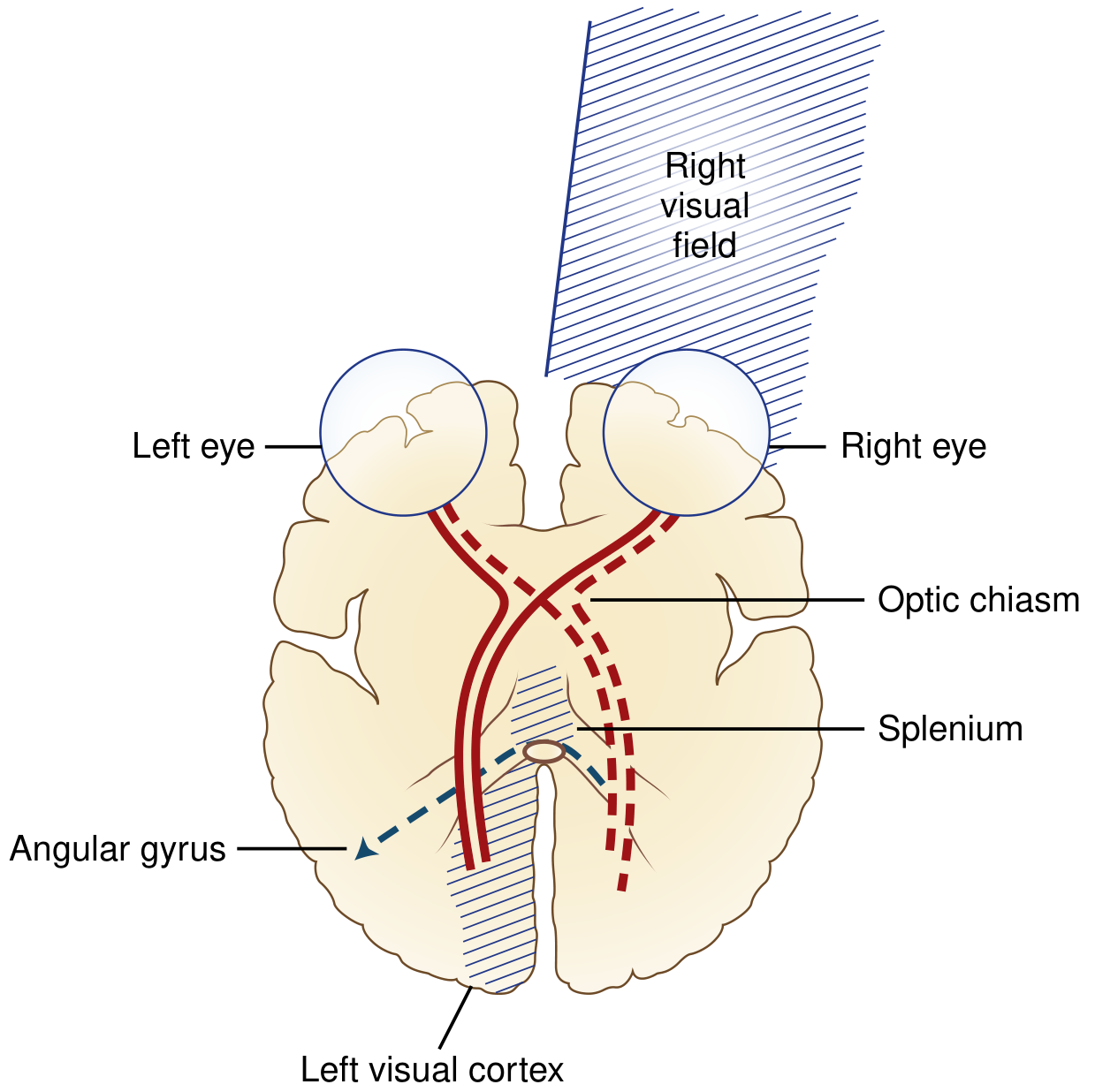
The right visual field's information (normally processed by left occipital cortex) is lost due to the occipital infarct. Right visual cortex can still see but cannot relay to left language areas because the splenium is destroyed.
3. Anterior Disconnection Syndrome
- Lesion: Anterior corpus callosum (from anterior cerebral artery occlusion)
- Mechanism: Right hemisphere is deprived of verbal/motor commands from left hemisphere
- Features:
- Left-hand apraxia (left hand cannot execute verbal commands)
- Cannot name objects placed in left hand (unilateral tactile anomia)
- Right-hand constructional apraxia
- Left-sided agraphia (cannot write with left hand)
4. Callosal (Split-Brain) Syndrome
Seen after surgical corpus callosotomy (done for intractable epilepsy) or from trauma/infarction of the entire corpus callosum.
The interhemispheric disconnection does not affect most daily living activities but produces specific deficits when tested:
- Double hemianopia: On confrontation testing, the patient fails to point to stimuli in each hemifield depending on which hand is used
- Left hemialexia: Cannot read words flashed to the left visual field only
- Unilateral tactile anomia: Cannot name objects palpated by the left hand (kept out of view)
- Left-hand agraphia: Cannot write with the left hand
- Left-hand ideomotor apraxia: Cannot perform pantomimed commands with left hand
- Alien hand sign: Left hand acts independently, even oppositionally, from the patient's volition - results from combined callosal + mesial frontal damage
- Right-hand constructional apraxia: Left hand clearly outperforms right hand in copying designs
Localization in Clinical Neurology: "The interhemispheric disconnection does not interfere with most activities of daily living but becomes apparent in the failure, by a left hemisphere-dominant individual, to perform tasks such as [naming objects in the left visual hemifield, imitating hand positions, naming objects palpated by the left hand...]"
5. Pure Word Deafness
- Lesion: Bilateral temporal lesions isolating Wernicke's area from both primary auditory cortices (Heschl gyri), OR a unilateral left temporal lesion placed to disconnect Wernicke's area from auditory input of both hemispheres
- Features:
- Isolated loss of auditory comprehension and repetition
- Hearing for pure tones and non-verbal sounds intact
- Speech, naming, reading, writing intact
- "Word-deaf" but not deaf
Bradley and Daroff's Neurology: "Pure word deafness is thus an example of a 'disconnection syndrome,' in which the deficit results from loss of white matter connections rather than of gray matter language centers."
Summary Table
| Syndrome | Key Tract Severed | Hallmark Deficit | Preserved |
|---|---|---|---|
| Conduction aphasia | Arcuate fasciculus | Repetition | Comprehension, fluency |
| Alexia without agraphia | Splenium + left occipital | Reading | Writing, speech |
| Anterior disconnection | Anterior corpus callosum | Left-hand apraxia/agraphia | Speech, right-hand praxis |
| Split-brain syndrome | Entire corpus callosum | Intermanual transfer; alien hand | Daily ADLs largely intact |
| Pure word deafness | Auditory to Wernicke connection | Auditory word comprehension | Pure tone hearing, speech, reading |
Key Points to Remember
- Disconnection ≠ cortical destruction - the "centers" are intact; it is the white matter highways between them that are damaged.
- Corpus callosum is the most common site - vascular (PCA or ACA territory), surgical callosotomy, or trauma.
- Alexia without agraphia = left PCA territory stroke (left occipital + splenium). The paradox of not being able to read one's own writing is pathognomonic.
- Conduction aphasia = repetition is the worst modality; comprehension is relatively spared. Arcuate fasciculus + supramarginal gyrus.
- Alien hand sign points to callosal + mesial frontal damage (specifically mid-callosum).
- Congenital agenesis of the corpus callosum does NOT produce the same disconnection symptoms as acquired/lesional interruption - presumably because compensatory subcortical pathways develop.
Sources: Bradley and Daroff's Neurology in Clinical Practice; Adams and Victor's Principles of Neurology, 12th ed.; Localization in Clinical Neurology, 8th ed.; Kaplan & Sadock's Comprehensive Textbook of Psychiatry; Principles of Neural Science (Kandel), 6th ed.
Create a summary PDF of disconnection syndromes for clinical reference
Reading File
Running Command
ls -la /home/daytona/workspace/ 2>/dev/null || echo "workspace does not exist"
Running Command
mkdir -p /home/daytona/workspace/disconnection-syndrome && python3 -c "import reportlab; print('reportlab OK')" && python3 -c "from reportlab.platypus import SimpleDocTemplate; print('platypus OK')"
Writing File
~/disconnection-syndrome/generate_pdf.py
from reportlab.lib.pagesizes import A4
from reportlab.lib import colors
from reportlab.lib.styles import getSampleStyleSheet, ParagraphStyle
from reportlab.lib.units import mm, cm
from reportlab.platypus import (
    SimpleDocTemplate, Paragraph, Spacer, Table, TableStyle,
    HRFlowable, KeepTogether
)
from reportlab.lib.enums import TA_CENTER, TA_LEFT, TA_JUSTIFY
from reportlab.platypus import PageBreak

OUTPUT = "/home/daytona/workspace/disconnection-syndrome/Disconnection_Syndromes_Clinical_Reference.pdf"

# ── Colour palette ──────────────────────────────────────────────
NAVY      = colors.HexColor("#1a2a4a")
TEAL      = colors.HexColor("#0d6e8a")
LIGHT_BG  = colors.HexColor("#eef5f8")
ACCENT    = colors.HexColor("#c0392b")
TABLE_HDR = colors.HexColor("#0d6e8a")
TABLE_ALT = colors.HexColor("#f0f7fa")
WHITE     = colors.white
DARK_TXT  = colors.HexColor("#1a1a2e")
MID_GREY  = colors.HexColor("#5a6a7a")

W, H = A4

# ── Styles ───────────────────────────────────────────────────────
styles = getSampleStyleSheet()

def S(name, **kw):
    return ParagraphStyle(name, **kw)

cover_title = S("CoverTitle",
    fontSize=28, leading=34, textColor=WHITE,
    fontName="Helvetica-Bold", alignment=TA_CENTER, spaceAfter=6)

cover_sub = S("CoverSub",
    fontSize=13, leading=17, textColor=colors.HexColor("#cfe8f0"),
    fontName="Helvetica", alignment=TA_CENTER, spaceAfter=4)

cover_tag = S("CoverTag",
    fontSize=9, leading=12, textColor=colors.HexColor("#a0c4d8"),
    fontName="Helvetica-Oblique", alignment=TA_CENTER)

section_title = S("SectionTitle",
    fontSize=14, leading=18, textColor=WHITE,
    fontName="Helvetica-Bold", alignment=TA_LEFT,
    spaceBefore=14, spaceAfter=6,
    backColor=NAVY,
    leftIndent=-14, rightIndent=-14,
    borderPad=5)

subsec = S("SubSec",
    fontSize=11, leading=14, textColor=TEAL,
    fontName="Helvetica-Bold",
    spaceBefore=10, spaceAfter=3,
    borderPad=2)

body = S("Body",
    fontSize=9.5, leading=14, textColor=DARK_TXT,
    fontName="Helvetica", alignment=TA_JUSTIFY,
    spaceAfter=5)

bullet = S("Bullet",
    fontSize=9.5, leading=13, textColor=DARK_TXT,
    fontName="Helvetica", leftIndent=12, bulletIndent=4,
    spaceBefore=1, spaceAfter=1)

note_style = S("Note",
    fontSize=8.5, leading=12, textColor=MID_GREY,
    fontName="Helvetica-Oblique",
    leftIndent=10, spaceBefore=4, spaceAfter=6,
    backColor=LIGHT_BG, borderPad=5)

key_point = S("KeyPoint",
    fontSize=9.5, leading=13, textColor=DARK_TXT,
    fontName="Helvetica",
    leftIndent=12, bulletIndent=4,
    spaceBefore=2, spaceAfter=2)

footer_style = S("Footer",
    fontSize=7.5, leading=10, textColor=MID_GREY,
    fontName="Helvetica", alignment=TA_CENTER)

page_num_style = S("PageNum",
    fontSize=8, textColor=MID_GREY,
    fontName="Helvetica", alignment=TA_CENTER)

# ── Canvas callbacks ─────────────────────────────────────────────
def on_page(canvas, doc):
    canvas.saveState()
    # Top rule
    canvas.setStrokeColor(TEAL)
    canvas.setLineWidth(2)
    canvas.line(14*mm, H - 10*mm, W - 14*mm, H - 10*mm)
    # Bottom bar
    canvas.setFillColor(NAVY)
    canvas.rect(0, 0, W, 12*mm, fill=1, stroke=0)
    # Footer text
    canvas.setFillColor(WHITE)
    canvas.setFont("Helvetica", 7)
    canvas.drawCentredString(W/2, 4*mm,
        "Disconnection Syndromes | Clinical Neurology Reference  |  Sources: Bradley & Daroff, Adams & Victor, Localization in Clinical Neurology")
    # Page number
    canvas.setFillColor(colors.HexColor("#a0c4d8"))
    canvas.setFont("Helvetica-Bold", 8)
    canvas.drawRightString(W - 14*mm, 4*mm, f"Page {doc.page}")
    canvas.restoreState()

def cover_page_cb(canvas, doc):
    """Full-colour cover page."""
    canvas.saveState()
    # Navy background
    canvas.setFillColor(NAVY)
    canvas.rect(0, 0, W, H, fill=1, stroke=0)
    # Teal accent strip
    canvas.setFillColor(TEAL)
    canvas.rect(0, H*0.38, W, 6*mm, fill=1, stroke=0)
    canvas.rect(0, H*0.62, W, 6*mm, fill=1, stroke=0)
    # Bottom band
    canvas.setFillColor(colors.HexColor("#0a1929"))
    canvas.rect(0, 0, W, 28*mm, fill=1, stroke=0)
    # Source note
    canvas.setFillColor(colors.HexColor("#7aadcc"))
    canvas.setFont("Helvetica", 7.5)
    canvas.drawCentredString(W/2, 10*mm,
        "Sources: Bradley & Daroff's Neurology  |  Adams & Victor's Principles of Neurology  |"
        "  Localization in Clinical Neurology  |  Kaplan & Sadock's Psychiatry  |  Kandel's Principles of Neural Science")
    canvas.restoreState()

# ── Helper builders ──────────────────────────────────────────────
def hr(color=TEAL, width=0.5):
    return HRFlowable(width="100%", thickness=width, color=color, spaceAfter=4, spaceBefore=4)

def sec(text):
    return [
        Spacer(1, 4*mm),
        Table([[Paragraph(text, section_title)]],
              colWidths=[W - 28*mm],
              style=TableStyle([
                  ("BACKGROUND", (0,0), (-1,-1), NAVY),
                  ("TOPPADDING",   (0,0), (-1,-1), 6),
                  ("BOTTOMPADDING",(0,0), (-1,-1), 6),
                  ("LEFTPADDING",  (0,0), (-1,-1), 10),
              ])),
        Spacer(1, 3*mm),
    ]

def subsection(text):
    return [Paragraph(text, subsec)]

def para(text):
    return [Paragraph(text, body)]

def bul(items):
    out = []
    for item in items:
        out.append(Paragraph(f"<bullet>\u2022</bullet> {item}", bullet))
    return out

def note(text):
    return [Paragraph(f"<i>{text}</i>", note_style)]

def keypoints(items):
    out = [Paragraph("<b>Key Points</b>", subsec)]
    for i, item in enumerate(items, 1):
        out.append(Paragraph(f"<bullet><b>{i}.</b></bullet> {item}", key_point))
    return out

# ── CONTENT ──────────────────────────────────────────────────────
story = []

# ===== COVER PAGE =====
from reportlab.platypus import BaseDocTemplate, Frame, PageTemplate

# We'll use SimpleDocTemplate and fake the cover with a big table
story.append(Spacer(1, 42*mm))
story.append(Paragraph("DISCONNECTION", cover_title))
story.append(Paragraph("SYNDROMES", cover_title))
story.append(Spacer(1, 8*mm))
story.append(Paragraph("Clinical Neurology Reference", cover_sub))
story.append(Spacer(1, 4*mm))
story.append(Paragraph(
    "A concise evidence-based summary for clinical practice, examinations and ward rounds",
    cover_tag))
story.append(Spacer(1, 60*mm))
story.append(Paragraph(
    "Norman Geschwind (1965) | Dejerine (1892) | Wernicke (1874)",
    cover_tag))
story.append(PageBreak())

# ===== PAGE 1: DEFINITION & BACKGROUND =====
story += sec("1.  DEFINITION AND CONCEPTUAL BACKGROUND")

story += para(
    "A <b>disconnection syndrome</b> is a neurological deficit arising from interruption of white matter "
    "tracts that connect functionally distinct cortical or subcortical regions, rather than from "
    "destruction of the cortical 'centers' themselves. The affected gray matter remains structurally "
    "intact, but loss of connectivity produces a characteristic clinical picture."
)

story += para(
    "The concept was systematized by <b>Norman Geschwind (1965)</b> building on 19th-century work by "
    "<b>Dejerine (1892)</b> - who described alexia without agraphia - and <b>Wernicke (1874)</b>, who "
    "predicted conduction aphasia from theoretical disconnection of his sensory speech area from "
    "Broca's motor speech area."
)

story += note(
    '"The anatomic basis for most of these so-called disconnection syndromes is only partly defined. '
    'The concept emphasizes the importance of afferent, intercortical, and efferent connections of '
    'the language mechanisms." - Adams & Victor\'s Principles of Neurology, 12th ed.'
)

story += subsection("White Matter Tracts Most Commonly Implicated")

tract_data = [
    ["Tract", "Function", "Syndrome if Disrupted"],
    ["Arcuate fasciculus", "Connects Wernicke's to Broca's area", "Conduction aphasia"],
    ["Splenium of corpus callosum", "Transfers visual info between hemispheres", "Alexia without agraphia"],
    ["Anterior corpus callosum", "Transfers motor/praxis commands L→R hemisphere", "Anterior disconnection syndrome"],
    ["Left auditory white matter", "Connects bilateral Heschl gyri to Wernicke's area", "Pure word deafness"],
    ["Entire corpus callosum", "Interhemispheric integration (all modalities)", "Split-brain / Callosal syndrome"],
]

col_w = [(W - 28*mm) * p for p in [0.28, 0.40, 0.32]]
t = Table(tract_data, colWidths=col_w, repeatRows=1)
t.setStyle(TableStyle([
    ("BACKGROUND",    (0,0), (-1,0),  TABLE_HDR),
    ("TEXTCOLOR",     (0,0), (-1,0),  WHITE),
    ("FONTNAME",      (0,0), (-1,0),  "Helvetica-Bold"),
    ("FONTSIZE",      (0,0), (-1,0),  9),
    ("BACKGROUND",    (0,1), (-1,-1), WHITE),
    ("ROWBACKGROUNDS",(0,1), (-1,-1), [WHITE, TABLE_ALT]),
    ("FONTNAME",      (0,1), (-1,-1), "Helvetica"),
    ("FONTSIZE",      (0,1), (-1,-1), 8.5),
    ("TEXTCOLOR",     (0,1), (-1,-1), DARK_TXT),
    ("ALIGN",         (0,0), (-1,-1), "LEFT"),
    ("VALIGN",        (0,0), (-1,-1), "MIDDLE"),
    ("TOPPADDING",    (0,0), (-1,-1), 5),
    ("BOTTOMPADDING", (0,0), (-1,-1), 5),
    ("LEFTPADDING",   (0,0), (-1,-1), 6),
    ("GRID",          (0,0), (-1,-1), 0.4, colors.HexColor("#c8dce8")),
    ("ROUNDEDCORNERS",(0,0), (-1,-1), 2),
]))
story.append(t)
story.append(Spacer(1, 4*mm))

# ===== PAGE 2: CONDUCTION APHASIA =====
story += sec("2.  CONDUCTION APHASIA")

story += subsection("Pathophysiology")
story += para(
    "The <b>prototype disconnection syndrome</b>. Wernicke's and Broca's areas are intact, but "
    "the white matter bridge connecting them - the <b>arcuate fasciculus</b> - is severed. Wernicke "
    "predicted this syndrome theoretically in 1874 before it was clinically demonstrated; Geschwind "
    "later localized it to the arcuate fasciculus and its deep parietal course."
)

story += subsection("Lesion Site")
story += bul([
    "Arcuate fasciculus (deep to supramarginal gyrus, superior temporal-parietal region)",
    "Usually also involves left supramarginal gyrus and/or superior temporal cortex",
    "Vascular territory: parietal or posterior temporal branch of the left MCA (typically embolic occlusion)",
    "Cortex and subcortical white matter in upper bank of the left Sylvian fissure",
])

story += subsection("Clinical Features")
ca_data = [
    ["Feature", "Finding"],
    ["Spontaneous speech", "Fluent, with literal (phonemic) paraphasias; frequent hesitation for self-correction"],
    ["Repetition", "SEVERELY impaired - hallmark; disproportionate to other deficits"],
    ["Auditory comprehension", "Relatively preserved (better than Wernicke's aphasia)"],
    ["Naming", "Moderately impaired"],
    ["Reading aloud", "Impaired (shares same phonological difficulty as repetition)"],
    ["Reading comprehension", "Largely intact"],
    ["Writing", "Variable; often mildly impaired"],
    ["Self-awareness", "Patient painfully aware of own errors; successive corrections often fail"],
    ["Associated signs", "± Left limb apraxia, mild right hemiparesis, right hemisensory loss, ± right hemianopia"],
]
col_ca = [(W - 28*mm) * p for p in [0.28, 0.72]]
t2 = Table(ca_data, colWidths=col_ca, repeatRows=1)
t2.setStyle(TableStyle([
    ("BACKGROUND",    (0,0), (-1,0),  TABLE_HDR),
    ("TEXTCOLOR",     (0,0), (-1,0),  WHITE),
    ("FONTNAME",      (0,0), (-1,0),  "Helvetica-Bold"),
    ("FONTSIZE",      (0,0), (-1,0),  9),
    ("ROWBACKGROUNDS",(0,1), (-1,-1), [WHITE, TABLE_ALT]),
    ("FONTNAME",      (0,1), (-1,-1), "Helvetica"),
    ("FONTSIZE",      (0,1), (-1,-1), 8.5),
    ("FONTNAME",      (1,2), (1,2),   "Helvetica-Bold"),
    ("TEXTCOLOR",     (1,2), (1,2),   ACCENT),
    ("ALIGN",         (0,0), (-1,-1), "LEFT"),
    ("VALIGN",        (0,0), (-1,-1), "MIDDLE"),
    ("TOPPADDING",    (0,0), (-1,-1), 5),
    ("BOTTOMPADDING", (0,0), (-1,-1), 5),
    ("LEFTPADDING",   (0,0), (-1,-1), 6),
    ("GRID",          (0,0), (-1,-1), 0.4, colors.HexColor("#c8dce8")),
]))
story.append(t2)

story += note(
    '"Conduction aphasia has been advanced as a classical disconnection syndrome. Wernicke originally '
    'postulated that a lesion disconnecting the Wernicke and Broca areas would produce this syndrome. '
    'Geschwind later pointed to the arcuate fasciculus." - Bradley & Daroff\'s Neurology in Clinical Practice'
)

# ===== PAGE 3: ALEXIA WITHOUT AGRAPHIA =====
story += sec("3.  ALEXIA WITHOUT AGRAPHIA  (Pure Alexia / Posterior Disconnection)")

story += subsection("Historical Note")
story += para(
    "First described by <b>Dejerine in 1892</b> - the earliest callosal disconnection syndrome on record. "
    "The paradox: a patient who can write perfectly but cannot read even their own writing."
)

story += subsection("Pathophysiology")
story += para(
    "Left posterior cerebral artery (PCA) occlusion produces two simultaneous lesions: "
    "(1) <b>Left occipital cortex infarction</b> - destroys the left visual cortex, causing right "
    "homonymous hemianopia. All visual input must now enter via the right occipital cortex. "
    "(2) <b>Splenium of corpus callosum infarction</b> - severs the callosal fibers that normally "
    "transfer visual information from the right occipital cortex to the left hemisphere language areas "
    "(angular gyrus). Result: language cortices are 'word-blind' - they receive no visual input at all."
)

story += subsection("Clinical Features")
awa_data = [
    ["Feature", "Finding"],
    ["Reading", "Impossible - cannot read words, sentences, or own handwriting"],
    ["Writing", "NORMAL - the defining paradox of this syndrome"],
    ["Spontaneous speech", "Intact"],
    ["Repetition", "Intact"],
    ["Auditory comprehension", "Intact"],
    ["Naming", "± Impaired, especially for colors (color anomia)"],
    ["Visual field", "Right homonymous hemianopia (virtually always present)"],
    ["Letter-by-letter reading", "Some patients can slowly identify single letters"],
    ["Verbal spelling", "Can understand words spelled aloud to them"],
]
col_awa = [(W - 28*mm) * p for p in [0.30, 0.70]]
t3 = Table(awa_data, colWidths=col_awa, repeatRows=1)
t3.setStyle(TableStyle([
    ("BACKGROUND",    (0,0), (-1,0),  TABLE_HDR),
    ("TEXTCOLOR",     (0,0), (-1,0),  WHITE),
    ("FONTNAME",      (0,0), (-1,0),  "Helvetica-Bold"),
    ("FONTSIZE",      (0,0), (-1,0),  9),
    ("ROWBACKGROUNDS",(0,1), (-1,-1), [WHITE, TABLE_ALT]),
    ("FONTNAME",      (0,1), (-1,-1), "Helvetica"),
    ("FONTSIZE",      (0,1), (-1,-1), 8.5),
    ("FONTNAME",      (1,2), (1,2),   "Helvetica-Bold"),
    ("TEXTCOLOR",     (1,2), (1,2),   ACCENT),
    ("ALIGN",         (0,0), (-1,-1), "LEFT"),
    ("VALIGN",        (0,0), (-1,-1), "MIDDLE"),
    ("TOPPADDING",    (0,0), (-1,-1), 5),
    ("BOTTOMPADDING", (0,0), (-1,-1), 5),
    ("LEFTPADDING",   (0,0), (-1,-1), 6),
    ("GRID",          (0,0), (-1,-1), 0.4, colors.HexColor("#c8dce8")),
]))
story.append(t3)

story += note(
    "Mechanism mnemonic: The right eye's nasal field and left eye's temporal field both project to "
    "the right occipital cortex (intact). This cortex CAN see - but cannot 'tell' the left language "
    "areas what it sees because the splenial bridge is destroyed."
)

# ===== PAGE 4: ANTERIOR + CALLOSAL SYNDROMES =====
story += sec("4.  ANTERIOR DISCONNECTION SYNDROME")

story += subsection("Lesion")
story += para(
    "<b>Anterior corpus callosum</b> - typically from anterior cerebral artery (ACA) occlusion "
    "causing anterior callosal infarction. The right hemisphere is deprived of verbal commands and "
    "praxis programs originating in the left hemisphere."
)

story += subsection("Clinical Features")
story += bul([
    "<b>Left-hand ideomotor apraxia</b> - left hand cannot execute verbal commands (e.g., 'wave goodbye', 'pretend to hammer')",
    "<b>Left-hand agraphia</b> - cannot write with the left hand",
    "<b>Unilateral tactile anomia</b> - cannot name objects palpated by the left hand (kept out of view)",
    "<b>Right-hand constructional apraxia</b> - right hand is clearly outperformed by left hand in copying designs",
    "Speech, reading, auditory comprehension, and right-hand functions remain intact",
])

story.append(Spacer(1, 4*mm))

story += sec("5.  SPLIT-BRAIN SYNDROME  (Callosal / Interhemispheric Disconnection)")

story += subsection("Context")
story += para(
    "Seen after surgical <b>corpus callosotomy</b> (for intractable epilepsy) or from trauma/infarction "
    "of the entire corpus callosum. Most activities of daily living are unaffected. Deficits "
    "emerge only on specific testing."
)

story += subsection("Clinical Features")
sb_data = [
    ["Sign", "Description", "Mechanism"],
    ["Double hemianopia", "Fails to point to stimuli in each hemifield depending on which hand is used", "Visual transfer lost between hemispheres"],
    ["Left hemialexia", "Cannot read words flashed exclusively to the left visual hemifield", "Right occipital input cannot reach left language areas"],
    ["Unilateral tactile anomia", "Cannot name objects palpated by the left hand (out of view)", "Left-hand somatosensory input cannot access left language areas"],
    ["Left-hand agraphia", "Cannot write with the left hand", "Left hand motor cortex lacks verbal programming"],
    ["Left ideomotor apraxia", "Cannot pantomime commands with left hand; can with right", "Left praxis programs cannot cross to right motor cortex"],
    ["Alien hand sign", "Left hand acts independently of the patient's volition, may oppose right hand", "Callosal + mesial frontal damage; mid-corpus callosum lesion"],
    ["Right-hand constructional apraxia", "Left hand outperforms right hand in copying complex designs", "Right hemisphere visuospatial superiority unmasked"],
]
col_sb = [(W - 28*mm) * p for p in [0.25, 0.40, 0.35]]
t4 = Table(sb_data, colWidths=col_sb, repeatRows=1)
t4.setStyle(TableStyle([
    ("BACKGROUND",    (0,0), (-1,0),  TABLE_HDR),
    ("TEXTCOLOR",     (0,0), (-1,0),  WHITE),
    ("FONTNAME",      (0,0), (-1,0),  "Helvetica-Bold"),
    ("FONTSIZE",      (0,0), (-1,0),  8.5),
    ("ROWBACKGROUNDS",(0,1), (-1,-1), [WHITE, TABLE_ALT]),
    ("FONTNAME",      (0,1), (-1,-1), "Helvetica"),
    ("FONTSIZE",      (0,1), (-1,-1), 8),
    ("ALIGN",         (0,0), (-1,-1), "LEFT"),
    ("VALIGN",        (0,0), (-1,-1), "MIDDLE"),
    ("TOPPADDING",    (0,0), (-1,-1), 5),
    ("BOTTOMPADDING", (0,0), (-1,-1), 5),
    ("LEFTPADDING",   (0,0), (-1,-1), 6),
    ("GRID",          (0,0), (-1,-1), 0.4, colors.HexColor("#c8dce8")),
]))
story.append(t4)

story += note(
    '"The interhemispheric disconnection does not interfere with most activities of daily living but '
    'becomes apparent in the failure, by a left hemisphere-dominant individual, to perform tasks such '
    'as naming an object briefly presented to the left hemifield..." - Localization in Clinical Neurology, 8th ed.'
)

# ===== PAGE 5: PURE WORD DEAFNESS =====
story += sec("6.  PURE WORD DEAFNESS")

story += subsection("Lesion")
story += para(
    "Bilateral temporal lesions that isolate <b>Wernicke's area from both primary auditory cortices "
    "(Heschl gyri)</b>. Less commonly, a strategically placed unilateral left temporal lesion that "
    "disconnects Wernicke's area from bilateral auditory input."
)

story += subsection("Clinical Features")
story += bul([
    "<b>Isolated loss of auditory comprehension and repetition</b>",
    "Hearing for pure tones and non-verbal sounds (environmental sounds, music) is intact",
    "Speech output, naming, reading, and writing are preserved",
    "Patient is 'word-deaf' but not deaf",
    "Most cases have some mild paraphasic speech errors",
])

story += note(
    '"Pure word deafness is thus an example of a disconnection syndrome, in which the deficit results '
    'from loss of white matter connections rather than of gray matter language centers." - Bradley & Daroff\'s Neurology'
)

story.append(Spacer(1, 3*mm))

# ===== PAGE 6: TRANSCORTICAL APHASIAS (brief) =====
story += sec("7.  TRANSCORTICAL APHASIAS  (Isolation Syndromes)")

story += para(
    "Transcortical aphasias result from lesions that <b>isolate the perisylvian language areas</b> "
    "(Broca's + Wernicke's + arcuate fasciculus) from the surrounding cortex, while sparing the core "
    "language network itself. The key feature is <b>preserved repetition</b> (the Broca-arcuate-Wernicke "
    "loop is intact), contrasting with impaired spontaneous speech or comprehension."
)

tc_data = [
    ["Type", "Spontaneous Speech", "Comprehension", "Repetition", "Lesion"],
    ["Transcortical Motor (TCMA)", "Non-fluent, reduced", "Intact", "INTACT", "Anterior to Broca's area\n(ACA territory, SMA)"],
    ["Transcortical Sensory (TCSA)", "Fluent, echolalic, paraphasic", "Impaired", "INTACT", "Posterior to Wernicke's area\n(PCA / watershed)"],
    ["Mixed Transcortical\n(Isolation syndrome)", "Non-fluent; echolalia", "Impaired", "INTACT", "Watershed zone infarction\n(bilateral; hypoperfusion)"],
]
col_tc = [(W - 28*mm) * p for p in [0.22, 0.19, 0.16, 0.14, 0.29]]
t5 = Table(tc_data, colWidths=col_tc, repeatRows=1)
t5.setStyle(TableStyle([
    ("BACKGROUND",    (0,0), (-1,0),  TABLE_HDR),
    ("TEXTCOLOR",     (0,0), (-1,0),  WHITE),
    ("FONTNAME",      (0,0), (-1,0),  "Helvetica-Bold"),
    ("FONTSIZE",      (0,0), (-1,0),  8.5),
    ("ROWBACKGROUNDS",(0,1), (-1,-1), [WHITE, TABLE_ALT]),
    ("FONTNAME",      (0,1), (-1,-1), "Helvetica"),
    ("FONTSIZE",      (0,1), (-1,-1), 8),
    ("FONTNAME",      (3,1), (3,3),   "Helvetica-Bold"),
    ("TEXTCOLOR",     (3,1), (3,3),   TEAL),
    ("ALIGN",         (0,0), (-1,-1), "LEFT"),
    ("VALIGN",        (0,0), (-1,-1), "MIDDLE"),
    ("TOPPADDING",    (0,0), (-1,-1), 5),
    ("BOTTOMPADDING", (0,0), (-1,-1), 5),
    ("LEFTPADDING",   (0,0), (-1,-1), 6),
    ("GRID",          (0,0), (-1,-1), 0.4, colors.HexColor("#c8dce8")),
]))
story.append(t5)

# ===== PAGE 7: MASTER COMPARISON TABLE =====
story += sec("8.  MASTER COMPARISON TABLE")

master_data = [
    ["Syndrome", "Key Tract Severed", "Hallmark Deficit", "What is PRESERVED", "Vascular Territory"],
    ["Conduction Aphasia",
     "Arcuate fasciculus\n(+ supramarginal gyrus)",
     "Repetition (severe)",
     "Comprehension,\nfluent speech",
     "Parietal/post-temporal\nbranch of left MCA"],
    ["Alexia without Agraphia\n(Pure Alexia)",
     "Splenium of CC\n+ left occipital cortex",
     "Reading (all modalities)",
     "Writing, speech,\ncomprehension",
     "Left PCA\n(posterior territory)"],
    ["Anterior Disconnection",
     "Anterior corpus callosum",
     "Left-hand apraxia\n& agraphia",
     "Speech, right-hand\nfunctions",
     "Anterior cerebral\nartery (ACA)"],
    ["Split-Brain / Callosal\nSyndrome",
     "Entire corpus callosum\n(surgical or traumatic)",
     "Intermanual transfer;\nalien hand sign",
     "Most ADLs;\nright-hand language tasks",
     "Surgical callosotomy\nor bilateral infarcts"],
    ["Pure Word Deafness",
     "Auditory cortex to\nWernicke's area connection",
     "Auditory word\ncomprehension + repetition",
     "Pure tone hearing,\nspeech, reading, writing",
     "Bilateral temporal\n(HTN/emboli)"],
    ["Transcortical Aphasias",
     "Perisylvian isolation\n(surrounding cortex cut off)",
     "Speech or comprehension\n(type-dependent)",
     "Repetition\n(distinguishing feature)",
     "Watershed zones;\nACA/PCA border"],
]
col_m = [(W - 28*mm) * p for p in [0.18, 0.20, 0.18, 0.19, 0.25]]
t6 = Table(master_data, colWidths=col_m, repeatRows=1)
t6.setStyle(TableStyle([
    ("BACKGROUND",    (0,0), (-1,0),  NAVY),
    ("TEXTCOLOR",     (0,0), (-1,0),  WHITE),
    ("FONTNAME",      (0,0), (-1,0),  "Helvetica-Bold"),
    ("FONTSIZE",      (0,0), (-1,0),  8),
    ("ROWBACKGROUNDS",(0,1), (-1,-1), [WHITE, TABLE_ALT]),
    ("FONTNAME",      (0,1), (-1,-1), "Helvetica"),
    ("FONTSIZE",      (0,1), (-1,-1), 7.5),
    ("FONTNAME",      (0,1), (0,-1),  "Helvetica-Bold"),
    ("TEXTCOLOR",     (0,1), (0,-1),  NAVY),
    ("ALIGN",         (0,0), (-1,-1), "LEFT"),
    ("VALIGN",        (0,0), (-1,-1), "MIDDLE"),
    ("TOPPADDING",    (0,0), (-1,-1), 5),
    ("BOTTOMPADDING", (0,0), (-1,-1), 5),
    ("LEFTPADDING",   (0,0), (-1,-1), 5),
    ("GRID",          (0,0), (-1,-1), 0.4, colors.HexColor("#b0ccdc")),
]))
story.append(t6)

story.append(Spacer(1, 5*mm))

# ===== KEY POINTS =====
story += sec("9.  KEY CLINICAL POINTS")

story += keypoints([
    "<b>Disconnection ≠ cortical destruction.</b> The 'centers' are structurally intact; it is the white matter highways between them that are disrupted.",
    "<b>Alexia without agraphia</b> = pathognomonic of left PCA territory stroke (left occipital cortex + splenium). The paradox of writing but not reading one's own writing is clinically unmistakable.",
    "<b>Conduction aphasia</b>: repetition is the WORST modality; comprehension is relatively spared. Think: arcuate fasciculus damage.",
    "<b>Alien hand sign</b> = callosal + mesial frontal damage (specifically mid-portion of corpus callosum). The left hand 'has a mind of its own.'",
    "<b>Preserved repetition</b> distinguishes transcortical aphasias (isolation syndromes) from Broca's and Wernicke's aphasia.",
    "<b>Congenital agenesis of the corpus callosum</b> does NOT produce the same disconnection symptoms as acquired lesional interruption - compensatory subcortical pathways develop before birth.",
    "<b>Pure word deafness</b>: the patient hears environmental sounds normally but cannot decode spoken words - 'speech sounds like a foreign language.'",
    "Surgical corpus callosotomy produces a <b>transient</b> disconnection syndrome initially (mutism, apathy, left-hand apraxia) that largely resolves, leaving only specific inter-hemispheric transfer deficits.",
    "The locale of a lesion that causes loss of a language function does <b>not</b> automatically localize that language function itself (Hughlings Jackson's warning).",
])

story.append(Spacer(1, 6*mm))
story += note(
    "Sources: Bradley & Daroff's Neurology in Clinical Practice | Adams & Victor's Principles of Neurology, 12th ed. | "
    "Localization in Clinical Neurology, 8th ed. | Kaplan & Sadock's Comprehensive Textbook of Psychiatry | "
    "Kandel's Principles of Neural Science, 6th ed."
)

# ── Build PDF ─────────────────────────────────────────────────────
doc = SimpleDocTemplate(
    OUTPUT,
    pagesize=A4,
    rightMargin=14*mm,
    leftMargin=14*mm,
    topMargin=16*mm,
    bottomMargin=18*mm,
    title="Disconnection Syndromes - Clinical Reference",
    author="Orris Medical AI",
    subject="Clinical Neurology",
)

# We need two different page templates: cover vs inner
# SimpleDocTemplate uses one callback; we handle it with a flag trick
class SmartDoc(SimpleDocTemplate):
    def handle_pageBegin(self):
        super().handle_pageBegin()

doc.build(
    story,
    onFirstPage=cover_page_cb,
    onLaterPages=on_page,
)

print(f"PDF created: {OUTPUT}")
Running Command
python3 /home/daytona/workspace/disconnection-syndrome/generate_pdf.py 2>&1
Running Command
ls -lh /home/daytona/workspace/disconnection-syndrome/Disconnection_Syndromes_Clinical_Reference.pdf
Your clinical reference PDF is ready:
Disconnection Syndromes Clinical Reference
PDF Document · PDF
What's inside the PDF (9 sections, ~8 pages):
| Section | Content |
|---|---|
| Cover page | Full navy/teal design with title and historical attributions |
| 1. Definition & Background | Concept, Geschwind/Dejerine/Wernicke history; white matter tract table |
| 2. Conduction Aphasia | Pathophysiology, arcuate fasciculus, full clinical features table (repetition highlighted) |
| 3. Alexia Without Agraphia | PCA mechanism, splenium-occipital explanation, clinical table with the writing paradox |
| 4. Anterior Disconnection | ACA territory, left-hand apraxia/agraphia features |
| 5. Split-Brain / Callosal Syndrome | Alien hand, hemialexia, tactile anomia - full features table |
| 6. Pure Word Deafness | Bilateral auditory disconnection; 'word-deaf not deaf' |
| 7. Transcortical Aphasias | Isolation syndromes; preserved repetition as the key differentiator |
| 8. Master Comparison Table | All syndromes side-by-side: tract, hallmark deficit, preserved function, vascular territory |
| 9. Key Clinical Points | 9 high-yield exam/ward points including the Hughlings Jackson warning |
This is a shared conversation. Sign in to Orris to start your own chat.