
Ovarian cycle Explain for 5 marks
Reading File
Searching sources...
Finding Sources
Reading File
Reading File
Reading File
Reading File
Loading Image
Reading File
Reading File
Here is a thorough 5-mark answer on the Ovarian Cycle:
The Ovarian Cycle
The ovarian cycle is the series of monthly events in the ovary driven by pituitary gonadotropins (FSH and LH) that results in the release of a mature ovum and the preparation of the reproductive tract for potential fertilisation. It averages 28 days and consists of three phases.
1. Follicular Phase (Days 1-13)
At the beginning of each cycle, FSH (and to a lesser extent LH) from the anterior pituitary stimulates 6-12 primordial follicles to begin growing. Each primordial follicle contains an immature oocyte surrounded by a single layer of granulosa cells.
Sequence of follicle development:
- Primary follicle - ovum enlarges 2-3x; granulosa cells proliferate into multiple layers
- Antral (secondary) follicle - granulosa cells secrete estrogen-rich follicular fluid, forming an antrum; theca cells (interna and externa) develop around the follicle
- Dominant follicle selection - around day 6, one follicle becomes dominant; the rising estrogen it produces suppresses FSH via negative feedback, causing the remaining follicles to undergo atresia (apoptosis)
- Mature (Graafian) follicle - reaches ~1.0-1.5 cm diameter by day 13
The two-cell, two-gonadotropin model underlies estrogen production: LH stimulates theca interna cells to produce androgens (androstenedione, testosterone), which are then aromatised to estradiol by granulosa cells under FSH stimulation.
2. Ovulation (Day 14)
Rising estradiol from the dominant follicle reaches a critical threshold (~200 pg/mL sustained for ~36 hours), switching from negative to positive feedback on the hypothalamus and pituitary. This triggers a LH surge (6-10 fold rise, peaking ~16 hours before ovulation) along with a smaller FSH surge.
LH surge causes:
- Release of proteolytic enzymes from lysosomes in the theca externa, digesting the follicular wall
- Prostaglandin secretion causing local vasodilation and increased vascular permeability
- These combined effects lead to follicle swelling, stigma degeneration, and rupture
The ovum is expelled with its surrounding corona radiata (granulosa cells) into the peritoneal cavity and is swept into the fallopian tube by the fimbriae.
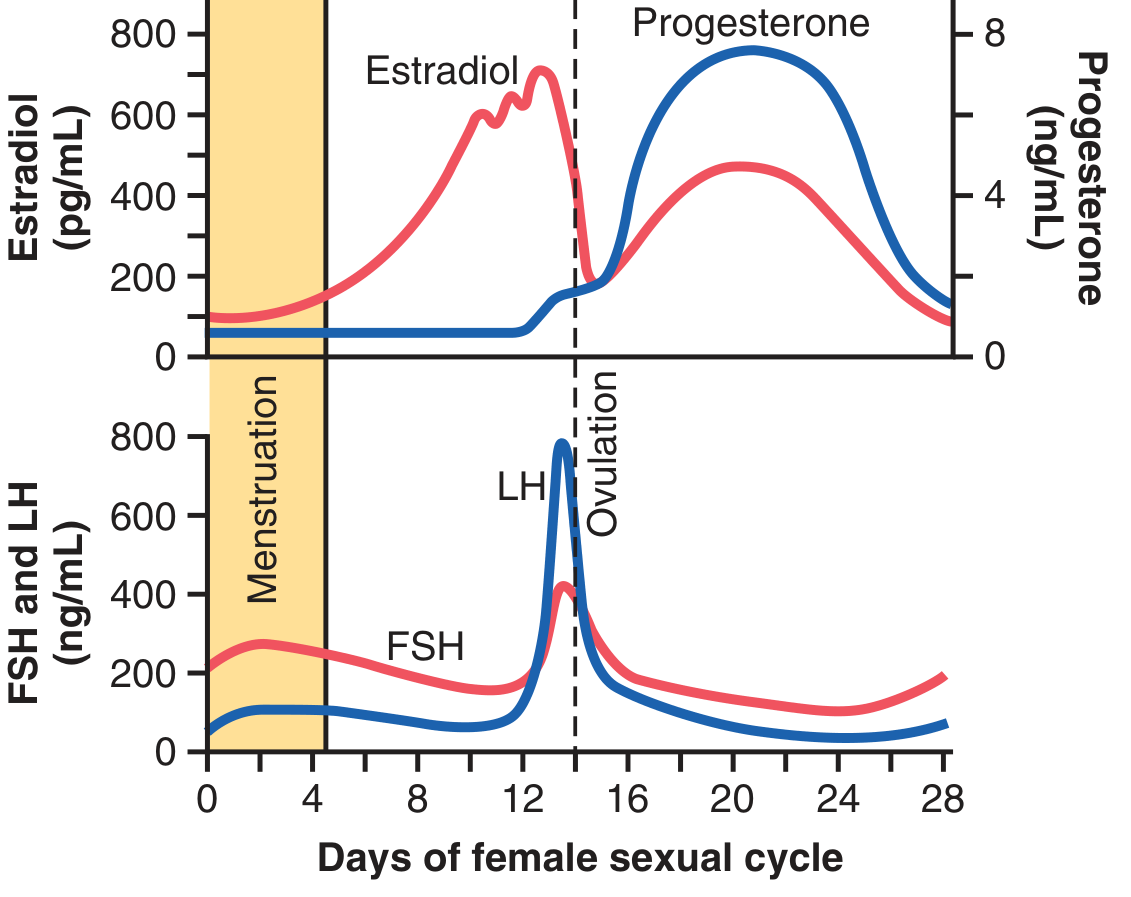
Hormone levels across the 28-day female sexual cycle - note the LH surge at day 14 triggering ovulation.
3. Luteal Phase (Days 15-28)
After expulsion of the ovum, residual granulosa and theca interna cells undergo luteinisation (under the continuing influence of LH):
- Cells enlarge, accumulate yellowish lipid inclusions, and form the corpus luteum
- The corpus luteum is richly vascularised (requires VEGF) and reaches ~1.5 cm in diameter by days 7-8 post-ovulation
- It secretes large amounts of progesterone and moderate amounts of estrogen (plus small amounts of inhibin)
If fertilisation does NOT occur:
- The corpus luteum degenerates (~day 24-25), becoming the corpus albicans (a scar)
- Progesterone and estrogen fall sharply
- This removes negative feedback, allowing FSH to rise and a new cycle to begin
- Withdrawal of progesterone/estrogen causes endometrial shedding (menstruation)
If fertilisation OCCURS:
- The trophoblast secretes human chorionic gonadotropin (hCG), which mimics LH and rescues the corpus luteum
- The corpus luteum persists and continues secreting progesterone to maintain the endometrium until the placenta takes over (~weeks 8-12)
Summary Table
| Phase | Days | Key Events | Dominant Hormone |
|---|---|---|---|
| Follicular | 1-13 | Follicle growth, dominant follicle selection | Estradiol |
| Ovulation | ~14 | LH surge, follicle rupture, ovum release | LH surge |
| Luteal | 15-28 | Corpus luteum formation and function | Progesterone |
Key point for exams: The LH surge is the single most important trigger for ovulation - without it, ovulation will not occur even in the presence of adequate FSH. The cycle length may vary (20-45 days), but it is always the follicular phase that varies in length, while the luteal phase remains relatively constant at ~14 days.
(Sources: Guyton & Hall Textbook of Medical Physiology; Ganong's Review of Medical Physiology)
This is a shared conversation. Sign in to Orris to start your own chat.