
Management of hypertension
"hypertension" AND "management" AND "guidelines"
hypertension management algorithm treatment
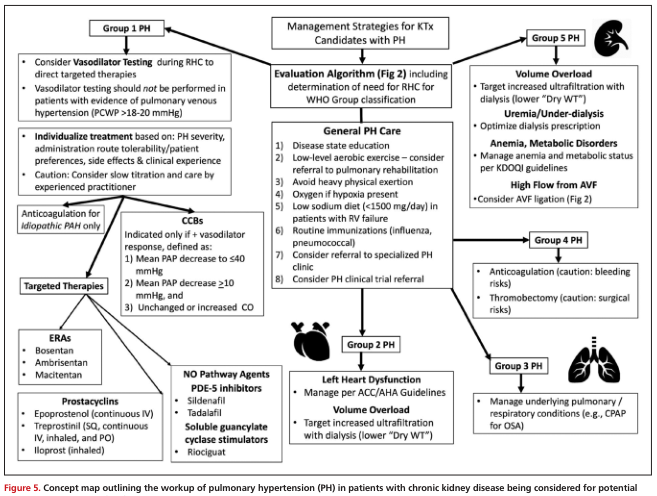
Summary : This figure presents a concept map outlining the management strategies and workup for pulmonary hypertension (PH) in patients with chronic kidney disease (CKD) being considered for kidney transplantation (KTx). It details evaluation algorithms, general PH care, and targeted therapies, organized by WHO PH group classification. flowchart: # Nodes : • Management Strategies for KTx Candidates with PH (central rectangle) • Group 1 PH (rectangle) – Consider Vasodilator Testing during RHC to direct targeted therapies – Individualize treatment based on PH severity, administration route, patient preferences, side effects, clinical experience – Caution: slow titration and care by experienced practitioner – Anticoagulation for Idiopathic PAH only – Targeted Therapies: • CCBs (criteria for use listed) • ERAs: Bosentan, Ambrisentan, Macitentan • Prostacyclins: Epoprostenol (IV), Treprostinil (SQ, IV, PO), Iloprost (inhaled) • NO Pathway Agents: PDE-5 inhibitors (Sildenafil, Tadalafil), Soluble guanylate cyclase stimulators (Riociguat) • Evaluation Algorithm (Fig 2) including determination of need for RHC for WHO Group classification (rectangle) • General PH Care (rectangle) – Disease state education – Low-level aerobic exercise, consider pulmonary rehab – Avoid heavy physical exertion – Oxygen if hypoxia present – Low sodium diet (<1500 mg/day) in RV failure – Routine immunizations (influenza, pneumococcal) – Consider referral to specialized PH clinic – Consider PH clinical trial referral • Group 2 PH (rectangle) – Left Heart Dysfunction: Manage per ACC/AHA Guidelines – Volume Overload: Target increased ultrafiltration with dialysis (lower “Dry WT”) • Group 3 PH (rectangle) – Manage underlying pulmonary/respiratory conditions (e.g., CPAP for OSA) • Group 4 PH (rectangle) – Anticoagulation (caution: bleeding risks) – Thrombectomy (caution: surgical risks) • Group 5 PH (rectangle) – Volume Overload: Target increased ultrafiltration with dialysis (lower “Dry WT”) – Uremia/Under-dialysis: Optimize dialysis prescription – Anemia, Metabolic Disorders: Manage anemia/metabolic status per KDOQI guidelines – High Flow from AVF: Consider AVF ligation (Fig 2) # Connectors : • Central node “Management Strategies for KTx Candidates with PH” branches to: – Group 1 PH – Evaluation Algorithm (Fig 2) – General PH Care – Group 2 PH – Group 3 PH – Group 4 PH – Group 5 PH • Group 1 PH node contains sub-branches for Vasodilator Testing, Individualized Treatment, Anticoagulation, and Targeted Therapies. • Targeted Therapies node further branches to CCBs, ERAs, Prostacyclins, NO Pathway Agents. • Group 5 PH node contains sub-branches for Volume Overload, Uremia/Under-dialysis, Anemia/Metabolic Disorders, High Flow from AVF. # Layout : • Central node at top center, with six main branches radiating outward for each PH group and general care. • Sub-nodes and therapy options are nested under their respective group nodes. • Flow is hierarchical, with decision points and therapy options clearly separated by group classification. # Analysis : • The figure provides a comprehensive, group-based approach to PH management in CKD patients considered for KTx. • Group 1 PH receives the most detailed targeted therapy options, including vasodilator testing and multiple drug classes. • General PH care recommendations apply across all groups, emphasizing education, exercise, diet, and immunization. • Volume overload and dialysis optimization are highlighted for Groups 2 and 5, reflecting CKD-specific concerns. • Anticoagulation and thrombectomy are reserved for Group 4 PH, with cautions noted. • The map visually organizes complex decision-making, ensuring tailored management based on PH group and CKD context.
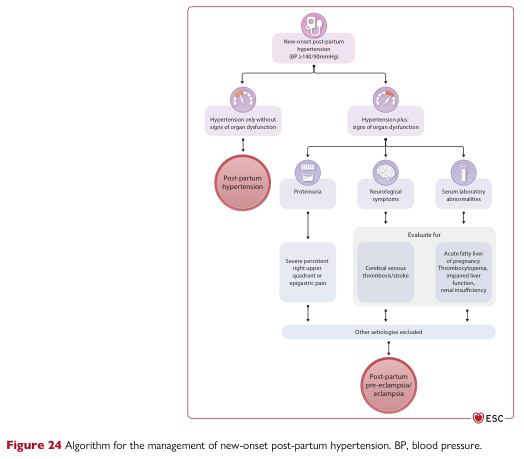
Summary : This flowchart presents an algorithm for the management of new-onset post-partum hypertension, outlining the diagnostic and decision-making process based on the presence or absence of organ dysfunction and associated symptoms or laboratory findings. flowchart: # Nodes : • Start (rounded rectangle): "New-onset post-partum hypertension (BP ≥140/90 mmHg)" • Decision (rounded rectangle): "Hypertension only without signs of organ dysfunction" • Decision (rounded rectangle): "Hypertension plus signs of organ dysfunction" • Process (circle): "Post-partum hypertension" • Process (rounded rectangle): "Proteinuria" • Process (rounded rectangle): "Neurological symptoms" • Process (rounded rectangle): "Serum laboratory abnormalities" • Process (rounded rectangle): "Severe persistent right upper quadrant or epigastric pain" • Process (rounded rectangle): "Evaluate for" – "Cerebral venous thrombosis/stroke" – "Acute fatty liver of pregnancy, Thrombocytopenia, impaired liver function, renal insufficiency" • Process (rounded rectangle): "Other aetiologies excluded" • End (circle): "Post-partum pre-eclampsia/eclampsia" # Connectors : • The initial node splits into two branches: – Left: "Hypertension only without signs of organ dysfunction" → "Post-partum hypertension" – Right: "Hypertension plus signs of organ dysfunction" → three parallel branches: ◦ "Proteinuria" → "Severe persistent right upper quadrant or epigastric pain" ◦ "Neurological symptoms" → "Evaluate for cerebral venous thrombosis/stroke" ◦ "Serum laboratory abnormalities" → "Evaluate for acute fatty liver of pregnancy, Thrombocytopenia, impaired liver function, renal insufficiency" • All three right-side branches converge at "Other aetiologies excluded" → "Post-partum pre-eclampsia/eclampsia" # Layout : • Top-down hierarchical structure. • Initial decision splits into two main branches (left: without organ dysfunction, right: with organ dysfunction). • Right branch further splits into three parallel symptom/lab findings, each with its own evaluation step, then reconverges. # Analysis : • The flowchart distinguishes between simple post-partum hypertension and more severe cases with organ dysfunction. • Presence of proteinuria, neurological symptoms, or laboratory abnormalities prompts further evaluation for specific complications. • If other causes are excluded, a diagnosis of post-partum pre-eclampsia/eclampsia is made. • The algorithm provides a clear, stepwise approach to guide clinicians in the assessment and management of post-partum hypertension.
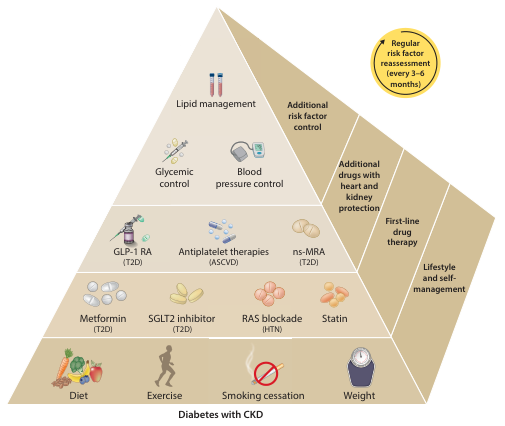
Summary : This figure presents a pyramid-based treatment algorithm for managing diabetes in patients with chronic kidney disease (CKD), highlighting a stepwise approach from lifestyle interventions to advanced pharmacological therapies, with regular risk factor reassessment every 3–6 months. pyramid diagram: # Overall Structure : • The diagram is a pyramid divided into horizontal layers, each representing a different level of intervention for diabetes with CKD. • The left side of the pyramid shows the progression from lifestyle/self-management at the base to additional risk factor control at the apex. • The right side labels the layers as "Lifestyle and self-management," "First-line drug therapy," "Additional drugs with heart and kidney protection," and "Additional risk factor control." • A yellow circle at the top right states: "Regular risk factor reassessment (every 3–6 months)." # Lifestyle and Self-Management (Base Layer) : • Diet (depicted with fruits and vegetables) • Exercise (person running) • Smoking cessation (cigarette with a red cross) • Weight (scale) # First-Line Drug Therapy (Second Layer) : • Metformin (T2D) (white pills) • SGLT2 inhibitor (T2D) (yellow pills) • RAS blockade (HTN) (red pills) • Statin (orange pills) # Additional Drugs with Heart and Kidney Protection (Third Layer) : • GLP-1 RA (T2D) (injector pen) • Antiplatelet therapies (ASCVD) (blue pills) • ns-MRA (T2D) (beige pills) # Additional Risk Factor Control (Fourth Layer) : • Glycemic control (insulin syringe and glucose meter) • Blood pressure control (blood pressure cuff) • Lipid management (test tubes) # Design Encodings : • Each intervention is represented with a relevant icon (food, exercise, pills, medical devices). • The pyramid structure visually prioritizes foundational lifestyle changes, followed by pharmacological interventions. • Acronyms: T2D (Type 2 Diabetes), HTN (Hypertension), ASCVD (Atherosclerotic Cardiovascular Disease), ns-MRA (non-steroidal Mineralocorticoid Receptor Antagonist), GLP-1 RA (Glucagon-like Peptide-1 Receptor Agonist). # Analysis : • The pyramid visually emphasizes the importance of lifestyle and self-management as the foundation for diabetes and CKD care. • Pharmacological therapies are layered above lifestyle interventions, with first-line drugs followed by additional agents for heart and kidney protection. • The apex focuses on controlling additional risk factors, suggesting a comprehensive, multi-modal approach. • The regular risk factor reassessment (every 3–6 months) highlights the need for ongoing monitoring and adjustment of therapy. • The structure suggests a stepwise escalation of care, starting with lifestyle, then adding medications as needed for optimal management.
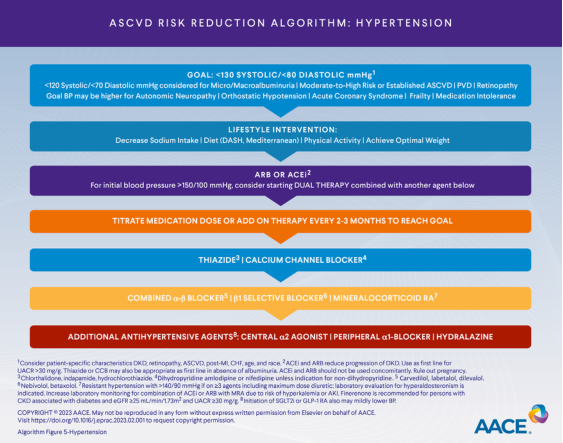
Summary : This flowchart presents the ASCVD (Atherosclerotic Cardiovascular Disease) risk reduction algorithm for hypertension management, outlining stepwise goals, interventions, and medication options. flowchart: # Nodes : • GOAL: <130 SYSTOLIC/<80 DIASTOLIC mmHg (rectangle, blue) • LIFESTYLE INTERVENTION: Decrease Sodium Intake | Diet (DASH, Mediterranean) | Physical Activity | Achieve Optimal Weight (rectangle, blue) • ARB OR ACE: For initial blood pressure >150/100 mmHg, consider starting DUAL THERAPY combined with another agent below (rectangle, purple) • TITRATE MEDICATION DOSE OR ADD ON THERAPY EVERY 2-3 MONTHS TO REACH GOAL (rectangle, orange) • THIAZIDE | CALCIUM CHANNEL BLOCKER (rectangle, blue) • COMBINED α-β BLOCKER | β1 SELECTIVE BLOCKER | MINERALOCORTICOID RA (rectangle, orange) • ADDITIONAL ANTIHYPERTENSIVE AGENTS: CENTRAL α2 AGONIST | PERIPHERAL α1-BLOCKER | HYDRALAZINE (rectangle, red) # Connectors : • Top-down linear flow from goal setting, lifestyle intervention, initial medication choice, titration, and escalation to additional agents. • ARB/ACE node includes a branch for dual therapy if initial BP is >150/100 mmHg. • Medication escalation proceeds in order: thiazide/calcium channel blocker → combined blockers/mineralocorticoid RA → additional antihypertensive agents. # Layout : • Vertically stacked rectangles, each representing a step in the algorithm. • Colour-coded sections: blue for goals/lifestyle/first-line agents, purple for ARB/ACE, orange for titration/combination, red for additional agents. • Footnotes and references are included at the bottom for clinical context and special considerations. # Analysis : • The algorithm emphasizes a stepwise approach: starting with lifestyle changes, then progressing to medication based on blood pressure severity and response. • Dual therapy is recommended for very high initial BP (>150/100 mmHg). • Medication titration and escalation are structured, with clear options for combination and additional agents. • Colour coding visually separates intervention types and escalation steps. • The flowchart provides a comprehensive, guideline-based pathway for hypertension management in ASCVD risk reduction.
Management of Hypertension
Definition and Classification (2017 ACC/AHA Guidelines)
| Category | Systolic BP | Diastolic BP |
|---|---|---|
| Normal | < 120 mmHg | < 80 mmHg |
| Elevated | 120-129 mmHg | < 80 mmHg |
| Stage 1 HTN | 130-139 mmHg | 80-89 mmHg |
| Stage 2 HTN | ≥ 140 mmHg | ≥ 90 mmHg |
| Hypertensive Crisis | > 180 mmHg | > 120 mmHg |
Initial Evaluation
-
Primary vs. secondary hypertension - Most patients have primary (essential) hypertension. Secondary causes (renal artery stenosis, primary hyperaldosteronism, pheochromocytoma, obstructive sleep apnea, thyroid disease) should be excluded when there are clinical clues.
-
Cardiovascular risk factor burden - Modifiable factors (smoking, obesity, dyslipidemia, physical inactivity) and non-modifiable factors (age, sex, family history) inform BP targets and drug selection.
-
End-organ damage - Assess for LVH, retinopathy, proteinuria, CKD, prior stroke/MI. Presence shifts management from primary to secondary prevention.
Blood Pressure Targets
| Clinical Setting | Target BP |
|---|---|
| General population | < 130/80 mmHg |
| CKD with diabetes or proteinuria >1 g/24h | < 130/80 mmHg |
| Older adults | Individualized; start low, go slow |
| High ASCVD risk | < 130/80 mmHg |
Note: The drive toward ever-lower targets may not apply to patients with CKD who often lack autoregulation to maintain GFR at low perfusion pressures. If kidney function declines acutely when therapy is intensified, consider reducing antihypertensive burden.
Step 1 - Lifestyle Modifications (Non-Pharmacologic)
| Intervention | Recommendation | Approximate SBP Reduction |
|---|---|---|
| Weight reduction | Maintain BMI 18.5-24.9 | 5-20 mmHg per 10 kg lost |
| DASH diet | Rich in fruits, vegetables, low-fat dairy; reduced saturated fat | 8-14 mmHg |
| Sodium restriction | < 100 mmol/day (2300 mg sodium) | 2-8 mmHg |
| Aerobic exercise | ≥ 30 min/day, most days of the week | 5-8 mmHg |
| Dynamic resistance training | 90-150 min/week, 3 sets/exercise | ~4 mmHg |
| Alcohol moderation | ≤ 2 drinks/day (men); ≤ 1 drink/day (women) | 2-4 mmHg |
| Smoking cessation | Reduces overall CV risk significantly | - |
Step 2 - Pharmacologic Therapy
When to Start Medications
- BP remains above goal despite adequate lifestyle modification
- Stage 2 HTN (BP > 140/90): consider initiating pharmacotherapy at diagnosis alongside lifestyle changes
- Stage 1 HTN + ASCVD risk ≥ 10% or established CVD: treat pharmacologically
Five Major Drug Classes (First-Line)
- Examples: lisinopril, ramipril, enalapril
- Mechanism: block conversion of angiotensin I → II; reduce efferent arteriolar constriction and intraglomerular pressure
- Compelling indications: heart failure, post-MI, diabetic nephropathy, CKD with proteinuria
- Side effects: dry cough (10-15%), hyperkalemia, angioedema; can precipitate AKI in bilateral renal artery stenosis
- Do not combine with ARBs (increased harm without added benefit)
- Examples: losartan, valsartan, telmisartan
- Mechanism: block AT1 receptor; same renoprotective benefits as ACEi; no cough
- Preferred over ACEi when cough occurs; also first-line in proteinuric CKD and diabetic nephropathy
- Dihydropyridines (amlodipine, nifedipine): vasodilators; effective in Black patients; good for isolated systolic HTN in elderly
- Non-dihydropyridines (diltiazem, verapamil): also slow heart rate; useful if tachycardia co-exists
- Side effects: peripheral edema (dihydropyridines), constipation (verapamil), heart block (non-DHP)
- Examples: hydrochlorothiazide (HCTZ), chlorthalidone, indapamide
- Chlorthalidone preferred over HCTZ due to longer half-life and stronger cardiovascular outcome data
- Mechanism: reduce sodium/water reabsorption in distal tubule
- Side effects: hypokalemia, hyperuricemia, hyponatremia, hyperglycemia
- Effective in elderly, isolated systolic HTN, Black patients
- Examples: metoprolol, bisoprolol, carvedilol (combined α-β)
- Not first-line for uncomplicated HTN in most guidelines
- Compelling indications: post-MI, heart failure with reduced EF, rate control in AF, angina
- Side effects: fatigue, bronchospasm (avoid in asthma), sexual dysfunction, masking hypoglycemia
Additional (Second-Line) Agents
| Drug Class | Examples | Notes |
|---|---|---|
| Mineralocorticoid Receptor Antagonists | Spironolactone, eplerenone | Excellent for resistant HTN; monitor K⁺ |
| Central α₂-agonists | Clonidine (patch preferred), guanfacine | Useful in dialysis patients; clonidine oral prone to rebound HTN |
| Peripheral α₁-blockers | Doxazosin, prazosin | Useful in men with BPH; risk of orthostatic hypotension |
| Direct vasodilators | Hydralazine, minoxidil | Reserved for resistant HTN; hydralazine used in pregnancy |
| Loop diuretics | Furosemide | Used when thiazides ineffective (CKD, heart failure) |
Step 3 - Combination Therapy
- Allows lower doses of each agent (fewer side effects)
- Provides complementary mechanisms
- Simplifies adherence with fixed-dose combinations
- ACEi/ARB + CCB (the CCB edema may be reduced by the ACEi)
- ACEi/ARB + thiazide (diuretic reduces hyperkalemia risk; additive BP reduction)
- CCB + thiazide
- ACEi + ARB (dual RAS blockade: increased harm, no added benefit)
- ACEi/ARB + potassium-sparing diuretics without careful K⁺ monitoring
Resistant Hypertension
Before labeling "resistant":
- Rule out medication nonadherence (up to 50% of referred patients; urine drug metabolite testing may help)
- Rule out white coat hypertension (use 24-hour ABPM)
- Ensure correct BP measurement technique
- Review interfering substances: NSAIDs, oral contraceptives, decongestants, steroids, licorice, stimulants
Management of Resistant HTN:
- Optimize diuretic therapy (often undertreated; switch to chlorthalidone or add loop diuretic if CKD)
- Add spironolactone (25-50 mg/day) - very effective in true resistant HTN; often reflects primary hyperaldosteronism
- Consider renal denervation (RDN): SPYRAL ON/OFF-MED and RADIANCE-HTN SOLO trials show significant 24-hour ABPM reductions with ultrasound/radiofrequency ablation using Spyral catheter technology
- Baroreceptor activation therapy (BAT): carotid stimulation device lowers BP by reducing sympathetic output; surgical implantation required; not FDA-approved for HTN
Hypertensive Urgency and Emergency
| Urgency | Emergency | |
|---|---|---|
| BP | > 180/120 mmHg | > 180/120 mmHg |
| End-organ damage | Absent | Present (encephalopathy, AKI, aortic dissection, acute pulmonary edema, NSTEMI, eclampsia) |
| Setting | Outpatient/ER | ICU |
| Rate of BP reduction | Gradual (24-48 h) | 25% reduction in first hour; then cautious further reduction |
| Route | Oral | IV (labetalol, nicardipine, clevidipine, nitroprusside, hydralazine) |
Special Populations
Hypertension in CKD
- Target: < 130/80 mmHg if tolerated
- First-line: ACEi or ARB (renoprotective via reduction of intraglomerular hypertension)
- Monitor: serum creatinine, eGFR, potassium; a GFR decline < 30% of baseline is acceptable and may reflect reduced glomerular hypertension
- SGLT2 inhibitors: increasingly used for both renoprotection and CV benefit even in CKD Stage 4
- Do not discontinue RAS inhibitors solely based on modest eGFR drop; discontinuation is associated with higher mortality and CV events
Hypertension in Pregnancy
- Avoid ACEi/ARBs (teratogenic)
- First-line agents: labetalol, nifedipine (extended release), methyldopa
- Severe HTN (≥ 160/110): treat urgently IV labetalol or hydralazine
- Consider eclampsia/pre-eclampsia with any new neurological symptoms, proteinuria, or lab abnormalities
Hypertension in the Elderly
- High risk of orthostatic hypotension - always check standing BP
- Start at lowest dose; titrate slowly
- Combination therapy often necessary; two-thirds of elderly require ≥ 2 agents
- Avoid: high-dose diuretics, centrally acting agents that worsen cognitive function
Hypertension in Black Patients
- Thiazide diuretics and CCBs tend to be more effective as monotherapy
- RAS inhibitors less effective as monotherapy but are indicated when proteinuria or diabetes co-exists
- Combination of thiazide + CCB or ACEi + CCB is particularly effective
Medication Adherence
- Prescribe once-daily or fixed-dose combination formulations
- Use generic, low-cost agents
- Address side effects proactively (patients are unlikely to continue treatment for an asymptomatic disease if side effects are intolerable)
- Educate patients on the silent nature of hypertension and the importance of long-term control
- Assess socioeconomic barriers, depression, and patient beliefs
Summary Algorithm
↓ Measure BP correctly (seated, rested, 2 readings)
↓ Classify: Normal / Elevated / Stage 1 / Stage 2
↓ Assess: CV risk factors + End-organ damage + Secondary causes
↓ Set BP target (usually <130/80 mmHg)
↓ Start: Lifestyle modifications (all patients)
↓ Add pharmacotherapy if:
   - Stage 2 HTN (≥140/90)
   - Stage 1 + ASCVD risk ≥10% or established CVD
↓ First-line agents: ACEi or ARB, CCB, Thiazide diuretic
   - Monotherapy: 12-15/8-10 mmHg reduction expected
↓ If BP >20/10 above goal → start DUAL THERAPY
↓ Titrate every 2-4 weeks; Add agents for inadequate response
↓ Add spironolactone/MRA for resistant HTN
↓ Consider device therapy (RDN, BAT) for true resistant cases
- NKF Primer on Kidney Diseases, 8th ed. (Cohen & Townsend, Chapter 64)
- Braunwald's Heart Disease, 11th ed. (Chapter 26)
- Harrison's Principles of Internal Medicine, 22nd ed. (2025)
- 2025 AHA/ACC Hypertension Guideline (PMID: 40811516) - most current comprehensive US guideline