
Notes on fissure
Fissure can refer to several different things in medicine and anatomy - I want to make sure I cover the right one in depth.
Asking for Preferences
Which type of fissure do you want notes on?
Fissure can refer to several different things in medicine and anatomy - I want to make sure I cover the right one in depth.
Reading File
Finding Sources
Finding Sources
Searching PubMed
"anal fissure" AND treatment
Reading File
Reading File
Reading File
Notes on Anal Fissure (Fissure-in-Ano)
(I've taken this as the classic surgical topic - let me know if you meant lung fissures, cerebral sulci, or another type instead.)
Definition
An anal fissure is a linear/elliptical tear in the anoderm (squamous epithelium of the anal canal), extending from the anal verge proximally toward (but usually not beyond) the dentate line - Sabiston Textbook of Surgery, p. 1828.
Etiology / Pathophysiology
- Usually caused by trauma from passage of a hard stool or from prolonged diarrhoea; also anal receptive intercourse or anal trauma.
- The tear causes spasm of the internal anal sphincter → this raises anal canal pressure → reduces blood flow to the anoderm (relative ischaemia).
- This sets up a self-perpetuating pain-spasm-ischaemia cycle that prevents healing and converts an acute fissure into a chronic one - Schwartz's Principles of Surgery, p. 2454.
Site
- Posterior midline - most common (~75-90%), because this area has the poorest blood supply.
- Anterior midline - 10-15%, more frequent in females (e.g., post-partum).
- Off-midline/lateral fissures (<1-2%) are considered atypical and raise suspicion of an underlying disease: Crohn's disease, anal/rectal cancer, tuberculosis, HIV, syphilis, chlamydia (LGV), chancroid, HSV, CMV, or leukaemia - Bailey & Love's Short Practice of Surgery, p. 620.
Acute vs Chronic
| Feature | Acute fissure | Chronic fissure (>6-8 weeks) |
|---|---|---|
| Appearance | Shallow superficial tear | Ulcer with heaped-up edges |
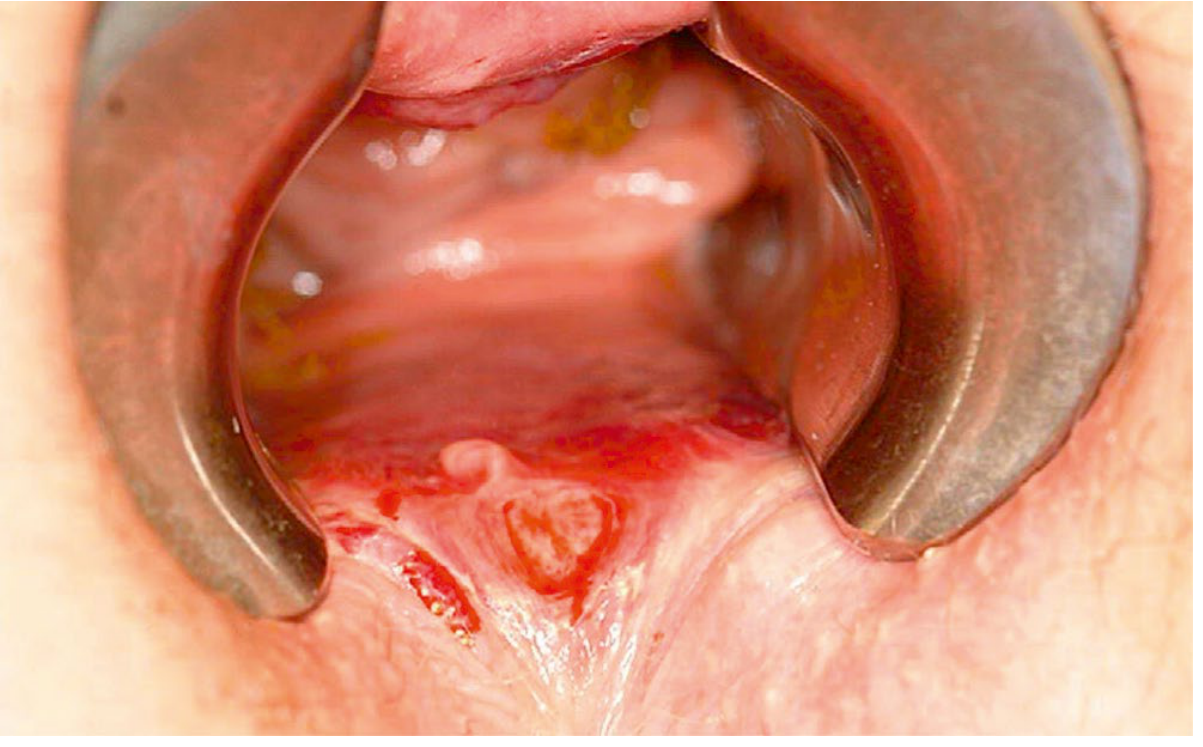
| Base | Clean | Exposed white fibers of internal sphincter |
| Associated findings | None | Sentinel pile (skin tag) distally + hypertrophied anal papilla proximally |
| Pain | Severe, sharp | Persistent but often less severe |
Clinical Features
- Sharp, severe pain on defecation - classically described as "passing glass/razor blades," followed by a dull throbbing ache/spasm lasting minutes to hours.
- Bright-red bleeding - streaks on stool or toilet paper.
- Mucus discharge, constipation (patients avoid defecation due to fear of pain, worsening constipation - a vicious cycle).
- Chronic cases: weight loss from avoided oral intake, dread of bowel movements.
Diagnosis
- Usually clinical, from history and gentle separation of the buttocks to visualize the fissure/sentinel tag.
- Digital rectal exam and anoscopy are often deferred because of pain.
- If diagnosis is uncertain, atypical location, or malignancy suspected → examination under anaesthesia (EUA) with biopsy and culture to exclude Crohn's, TB, STIs, SCC.
Management
1. Conservative (first-line - heals most acute and many chronic fissures)
- High-fibre diet, stool softeners, adequate water intake (bulk stool, reduce trauma).
- Warm sitz baths - relieve pain in >90% of acute fissures.
- Topical local anaesthetics (e.g., 2% lidocaine jelly).
- Biofeedback if excessive straining/dyssynergic defecation.
2. Chemical (pharmacological) sphincterotomy - if conservative measures fail
- Glyceryl trinitrate (GTN) 0.2% ointment, applied 2-3x/day - nitric oxide donor relaxes internal sphincter. Cure rate ~50%; limited by headache.
- Diltiazem 2% (topical, or oral) - calcium channel blocker; similar efficacy to GTN, fewer side effects.
- Nifedipine - alternative calcium channel blocker.
- Botulinum toxin (10-100 units) injected into internal sphincter - blocks acetylcholine release at the neuromuscular junction, reducing sphincter pressure. Temporary incontinence in up to 10%. Efficacy similar to other medical therapies.
3. Surgical - for chronic fissures refractory to medical therapy
- Lateral internal sphincterotomy (LIS) - procedure of choice. Divides part of the internal anal sphincter to break the spasm-ischaemia cycle.
- Anal dilatation - historically used but largely abandoned due to uncontrolled sphincter injury and risk of incontinence.
- Fissurectomy +/- botulinum toxin/flap - used in select chronic/refractory cases.
Summary Box (exam-style)
- Acute or chronic linear ulcer, usually posterior midline of anal canal.
- Ectopic (lateral) site → suspect Crohn's, TB, HIV, STI, malignancy.
- Symptoms: pain on defecation, bright-red bleeding, mucus discharge, constipation.
- Pathophysiology: hard stool → tear → sphincter spasm → ischaemia → non-healing.
- Treatment ladder: fibre/sitz baths → topical GTN/diltiazem or Botox → lateral internal sphincterotomy.
Recent Evidence (PubMed, last 2 years - systematic reviews/meta-analyses)
These broadly support the textbook approach but are worth noting for current comparative efficacy data:
- A 2025 systematic review comparing surgical vs conservative approaches (diltiazem, nifedipine, sphincterotomy, botulinum toxin) confirms sphincterotomy has higher healing rates but more risk of incontinence than pharmacologic options (PMID: 41493321).
- A 2025 review found combined botulinum toxin + fissurectomy improves healing rates in chronic anal fissure compared to either alone (PMID: 39350497).
- A 2024 meta-analysis of RCTs found lateral internal sphincterotomy has higher healing rates than botulinum toxin for chronic fissure, though botulinum toxin carries less risk of incontinence (PMID: 39579232).
These findings are consistent with, and refine, the textbook management ladder above - no contradiction to flag.
If you actually meant a different "fissure" (e.g., pulmonary fissures - oblique/horizontal fissures dividing lung lobes, cerebral fissures like the longitudinal/lateral/central sulci, or fissures of the skull like petrotympanic/orbital fissures), let me know and I'll pull dedicated notes on that instead.
This is a shared conversation. Sign in to Orris to start your own chat.