
Lymphadenopathy detailed
Reading File
Now I'll search across multiple angles simultaneously — headings, paragraphs, images, recent evidence, and web.
Finding Sources
Finding Sources
Searching PubMed
lymphadenopathy diagnosis management
Searching Images
lymphadenopathy lymph node anatomy regions
Now I'll read the most authoritative sources — Harrison's, Goldman-Cecil, and Sabiston — in parallel:
Reading File
Reading File
Reading File
Excellent data from Harrison's. Now I'll read more of Harrison's for the causes table, node characteristics, and workup, plus Grainger radiology content:
Reading File
Reading File
Finding Sources
Now read more Harrison's for node characteristics, laboratory evaluation, and biopsy criteria:
Reading File
Finding Sources
I now have excellent comprehensive content. Let me compile a thorough, well-structured response.
Loading Image
Loading Image
Loading Image
I now have comprehensive material to write a detailed, well-structured answer. Here it is:
Lymphadenopathy — Detailed Overview
1. Definition & Normal Node Parameters
Lymphadenopathy refers to enlargement of one or more lymph nodes beyond accepted normal dimensions. Lymph nodes are bean-shaped secondary lymphoid organs distributed along lymphatic vessels; they typically measure <1 cm in diameter and function to filter lymph and mount immune responses to antigens.
What is "normal"?
- Soft, flat submandibular nodes <1 cm — often palpable in healthy children and young adults
- Inguinal nodes up to 2 cm — may be normal in adults
- Any supraclavicular or scalene node enlargement is always abnormal
— Harrison's Principles of Internal Medicine 22E, p. 520
2. Pathophysiology of Node Enlargement
Lymph nodes consist of B and T lymphocytes, macrophages, and dendritic cells. Enlargement occurs via three principal mechanisms:
| Mechanism | Example |
|---|---|
| Reactive hyperplasia — proliferation of lymphoid elements in response to antigen | Viral URTIs, infectious mononucleosis |
| Neoplastic infiltration — replacement by malignant cells | Lymphoma, metastatic carcinoma |
| Infiltrative/storage — deposition of abnormal material | Gaucher's disease, amyloidosis |
Afferent lymphatics drain into the subcapsular sinus; efferent lymph exits at the hilum. The hilus is the anatomical point where blood vessels enter/leave. — Goldman-Cecil Medicine, p. 1771
3. Classification
By Distribution
| Type | Definition | Common Associations |
|---|---|---|
| Localized / Regional | Single anatomic area | Infection of draining region, metastatic cancer |
| Generalized | ≥3 non-contiguous node regions | EBV, CMV, HIV, SLE, leukemia, lymphoma |
By Duration
- Acute (<2 weeks)
- Subacute (2–6 weeks)
- Chronic (>6 weeks)
4. Etiology — Comprehensive Classification (Harrison's Table 70-1)
1. Infectious Diseases
Viral: EBV (infectious mononucleosis), CMV, HIV, viral hepatitis, herpes simplex, HHV-6, VZV, rubella, measles, adenovirus, herpesvirus-8
Bacterial: Streptococci, staphylococci, Bartonella henselae (cat-scratch disease), brucellosis, tularemia, plague, chancroid, tuberculosis, atypical mycobacteria, syphilis (primary & secondary), diphtheria, leprosy
Fungal: Histoplasmosis, coccidioidomycosis, paracoccidioidomycosis
Chlamydial: Lymphogranuloma venereum, trachoma
Parasitic: Toxoplasmosis, leishmaniasis, trypanosomiasis, filariasis
Rickettsial: Scrub typhus, rickettsialpox, Q fever
2. Immunologic / Autoimmune Diseases
- Rheumatoid arthritis, juvenile RA
- Mixed connective tissue disease
- Systemic lupus erythematosus (SLE)
- Dermatomyositis, Sjögren's syndrome
- Serum sickness
- Drug hypersensitivity: diphenylhydantoin, hydralazine, allopurinol, primidone, gold, carbamazepine
- Angioimmunoblastic lymphadenopathy
- Primary biliary cirrhosis, graft-vs-host disease
- Silicone-associated lymphadenopathy
- IgG4-related disease
- Immune reconstitution inflammatory syndrome (IRIS)
3. Malignant Diseases
- Hematologic: Hodgkin's disease, non-Hodgkin's lymphomas, acute/chronic lymphocytic leukemia, hairy cell leukemia, malignant histiocytosis, amyloidosis
- Metastatic: Carcinomas from breast, lung, GI tract, thyroid, melanoma, genitourinary cancers
4. Lipid Storage Diseases
Gaucher's, Niemann-Pick, Fabry, Tangier disease
5. Endocrine
Hyperthyroidism
6. Other
- Castleman's disease (giant lymph node hyperplasia)
- Sarcoidosis
- Dermatopathic lymphadenitis
- Kikuchi's disease (histiocytic necrotizing lymphadenitis)
- Rosai-Dorfman disease (sinus histiocytosis with massive lymphadenopathy)
- Kawasaki's disease (mucocutaneous lymph node syndrome)
- Histiocytosis X, Familial Mediterranean fever
- Congestive heart failure (passive congestion)
Key epidemiologic point: In primary care, >2/3 of patients with lymphadenopathy have nonspecific or viral causes. <1% have a malignancy. In referred patients, 84% had benign diagnoses; 16% had malignancy (lymphoma or metastatic adenocarcinoma). — Harrison's 22E
5. Clinical Assessment
History
Key points to elicit:
- Symptoms: Sore throat, cough, fever, night sweats, fatigue, weight loss, node pain
- Age: Children/young adults → mostly benign (viral URTIs, mono, toxoplasmosis); after age 50, malignancy incidence rises
- Exposures: Animal contact (cat-scratch disease), sexual history (STIs), travel (endemic mycoses, TB, leishmaniasis)
- Medications: Diphenylhydantoin and others can cause drug-induced lymphadenopathy
- Occupation, tobacco use (ENT exam essential in adults with cervical adenopathy + smoking)
Physical Examination
Node characteristics:
| Feature | Benign/Reactive | Malignant |
|---|---|---|
| Size | <1.0 cm² | >2.25 cm² (1.5×1.5 cm) — suspicious |
| Texture | Soft | Rubbery (lymphoma), hard (metastasis) |
| Tenderness | Usually tender (capsular stretch) | Often nontender |
| Mobility | Mobile | Fixed, matted (metastatic cancer) |
| Borders | Discrete | May be irregular or matted |
Lymphoma nodes tend to be large, discrete, symmetric, rubbery, firm, mobile, nontender. Metastatic nodes are often hard, nontender, fixed. — Harrison's 22E
Splenomegaly + lymphadenopathy → strongly suggests systemic illness: EBV mononucleosis, lymphoma, leukemia, SLE, sarcoidosis, toxoplasmosis, cat-scratch disease.
6. Regional Adenopathy — Anatomical Clues
| Region | Common Benign Causes | Malignant Causes |
|---|---|---|
| Occipital | Scalp infection | Melanoma |
| Preauricular | Conjunctival infections, cat-scratch | — |
| Cervical | URTIs, oral/dental lesions, EBV, viral | Head & neck cancer, breast, lung, thyroid |
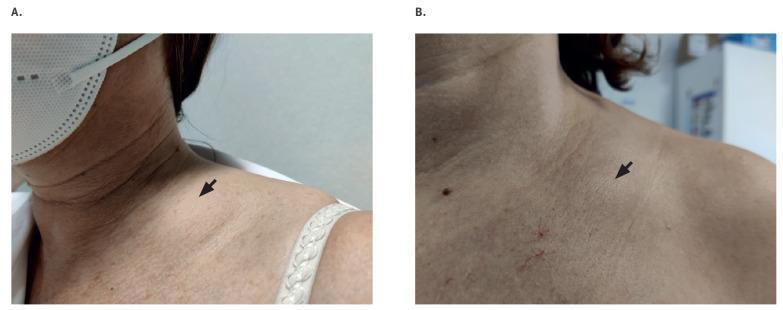
| Supraclavicular (always abnormal) | TB, sarcoidosis, toxoplasmosis | Lymphoma; lung/breast/testis/ovary cancers; Virchow's node (left supraclavicular) = GI primary |
| Axillary | Upper extremity infections/trauma | Melanoma, lymphoma, breast cancer |
| Inguinal | Lower extremity infections/trauma, STIs (LGV, syphilis, herpes, chancroid) | Lymphoma, rectal/genital/lower extremity (melanoma) cancer |
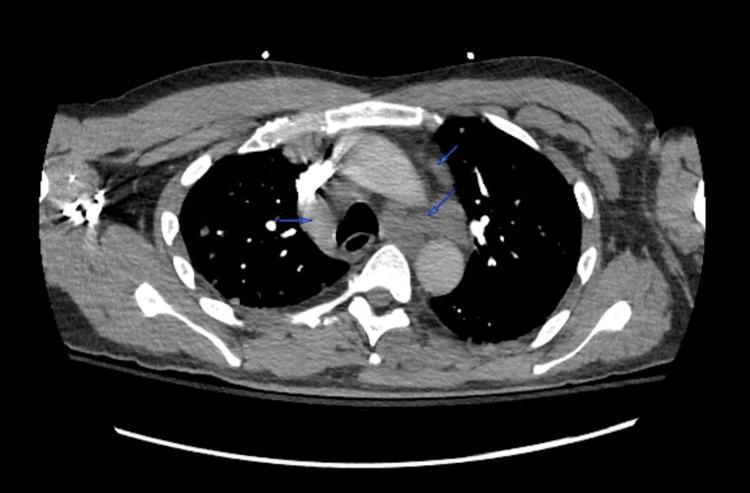
| Mediastinal | Sarcoidosis, histoplasmosis, TB | Lymphoma, lung/esophageal cancer |
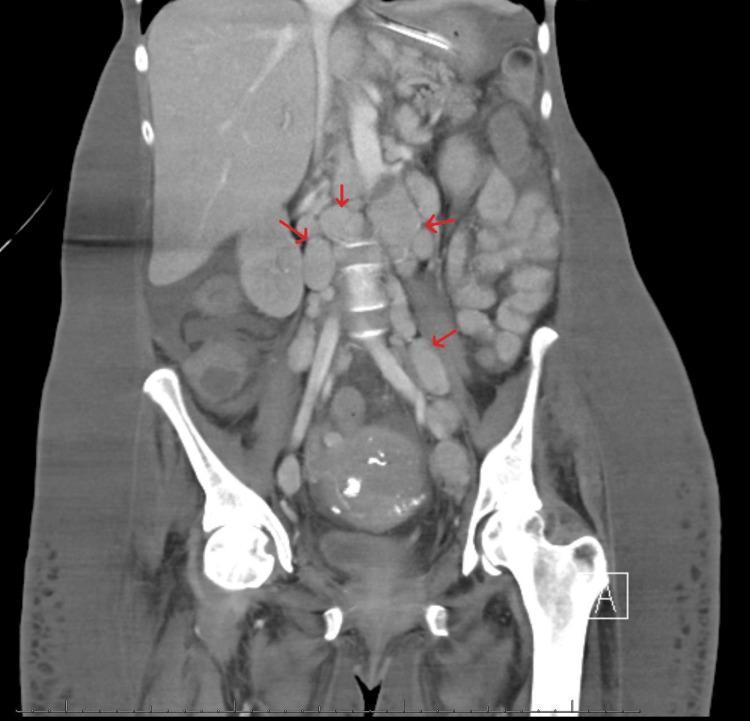
| Abdominal/Retroperitoneal | TB | Lymphoma, metastatic disease |
7. Imaging Findings
CT Chest — Mediastinal Lymphadenopathy
CT Abdomen — Retroperitoneal Lymphadenopathy
Clinical Photo — Supraclavicular Lymphadenopathy
Sarcoidosis — Radiographic Pattern (Grainger & Allison)
- Bilateral symmetrical hilar and paratracheal lymphadenopathy in ~70–80% of sarcoidosis patients
- Occasionally asymmetrical; unilateral in only 1–5%
- Nodes can calcify, sometimes in eggshell pattern (shared by silicosis and histoplasmosis)
- Nodal enlargement maximal on first radiograph; usually resolves within 6–12 months
- "Icing sugar" calcification pattern characteristic
8. Diagnostic Workup
Laboratory Tests
Guided by clinical suspicion; initial panel typically includes:
- CBC with differential — atypical lymphocytes (EBV/CMV), leukocytosis (bacterial), blasts (leukemia), cytopenias (lymphoma/leukemia)
- ESR, CRP, LDH
- Monospot / EBV serology, CMV IgM
- Throat culture (if pharyngitis present)
- HIV testing (generalized adenopathy)
- PPD/IGRA (TB exposure risk)
- ANA, RF (if autoimmune suspected)
- Serum protein electrophoresis
- Chest X-ray — mediastinal adenopathy, pulmonary infiltrates
Imaging
- Ultrasound: First line for superficial nodes — identifies necrosis, guides biopsy; nodes with central necrosis warrant immediate surgical attention
- CT chest/abdomen/pelvis: Staging, detecting non-palpable adenopathy; CT identifies nodes in mediastinum, retroperitoneum, and iliac chains
- PET-CT: Preferred for lymphoma staging and treatment response
- MRI: Useful for delineating lymphatic channels (e.g., cystic hygroma, pelvic nodes)
9. Indications for Lymph Node Biopsy
Size thresholds:
- Nodes ≤1.0 cm² (1×1 cm) → almost always benign; observe with exclusion of mono/toxoplasmosis
- >2 cm diameter in younger patients (9–25 y) → predictor of malignant or granulomatous disease
- >2.25 cm² (1.5×1.5 cm) → best cutoff to distinguish malignant/granulomatous from benign
Other indications for biopsy:
- Supraclavicular location (always abnormal)
- Fixed, nontender, progressively enlarging node
- Constitutional symptoms: night sweats, unexplained weight loss, fever (B symptoms)
- Mediastinal adenopathy on imaging
- Failure to resolve after 4–6 weeks of observation (or antibiotic therapy when appropriate)
- Splenomegaly without obvious cause
Biopsy type:
- Excisional biopsy preferred for lymphoma (fresh specimen, not formalin — enables flow cytometry, immunophenotyping, cytogenetics)
- Core needle biopsy — acceptable for some solid malignancies
- Fine-needle aspiration (FNA) — useful for rapid cytology but insufficient for lymphoma diagnosis
10. Specific Conditions — Key Features
Infectious Mononucleosis (EBV)
- Generalized lymphadenopathy + pharyngitis + fever + splenomegaly
- Atypical lymphocytes on smear; positive monospot; EBV IgM
- Posterior cervical > anterior cervical involvement
Tuberculosis / Atypical Mycobacteria
- Cervical nodes most common (scrofula)
- Nontuberculous mycobacteria: fluctuant nodes, violaceous overlying skin, positive AFB cultures, tuberculin skin test positive; surgical excision often required (most NTM resistant to standard chemotherapy)
Cat-Scratch Disease (Bartonella henselae)
- Painful regional adenopathy, self-limited
- Cat exposure history (not always present)
- Diagnosis: indirect immunofluorescence antibody (moderate specificity) or PCR of biopsy
- Usually resolves without treatment
Lymphoma
- Hodgkin's: rubbery, discrete, symmetric nodes; mediastinal involvement common; Reed-Sternberg cells on biopsy
- Non-Hodgkin's: more variable distribution; systemic symptoms less predictable; excisional biopsy + flow cytometry required
Metastatic Cancer
- Hard, nontender, fixed nodes
- Location guides primary: neck (head/neck, thyroid); axilla (breast, melanoma); supraclavicular (lung, GI, testis, ovary); inguinal (genitourinary, melanoma, rectal)
- Virchow's node (left supraclavicular): Troisier's sign → GI primary (gastric cancer most classic)
Sarcoidosis
- Bilateral hilar lymphadenopathy ± paratracheal nodes ± parenchymal disease
- Granulomas on biopsy (non-caseating)
- ACE level elevated in ~60%; hypercalcemia possible
Kawasaki Disease
- Cervical lymphadenopathy + fever >5 days, conjunctival injection, rash, oral changes, extremity changes
- Children <5 years most commonly affected
- Risk of coronary artery aneurysms
Kikuchi's Disease (Histiocytic Necrotizing Lymphadenitis)
- Young women, self-limited
- Tender cervical adenopathy + fever
- Histology: necrotic foci with histiocytes, no neutrophils
11. Approach Algorithm
Lymphadenopathy detected
        ↓
Localized or Generalized?
        ↓
History + Physical Exam + CBC, ESR, monospot, CXR
        ↓
Obvious cause found (viral URTI, dental) → Treat and observe 4–6 weeks
        ↓ (no resolution or high-risk features)
Size ≥2 cm? Fixed? Supraclavicular? B symptoms? Constitutional symptoms?
        ↓ YES → Biopsy (excisional preferred)
        ↓ NO  → Targeted workup (serology, TB testing, CT imaging)
Summary Table
| Feature | Benign/Reactive | Malignant |
|---|---|---|
| Age | Child / young adult | >50 years (higher risk) |
| Duration | <2 weeks | Weeks–months, progressive |
| Size | <1 cm | >2 cm |
| Texture | Soft, tender | Rubbery (lymphoma) or hard, fixed (mets) |
| Location | Cervical, inguinal | Supraclavicular always abnormal |
| Associated features | URTI, fever, pharyngitis | Night sweats, weight loss, fatigue |
| Resolution | Spontaneous within 4–6 weeks | Progressive |
Sources:
- Harrison's Principles of Internal Medicine 22E (2025) — Chapters 70 (Lymphadenopathy and Splenomegaly)
- Goldman-Cecil Medicine — Hematologic section
- Sabiston Textbook of Surgery — Neck masses, lymphadenopathy
- Grainger & Allison's Diagnostic Radiology — Sarcoidosis imaging
This is a shared conversation. Sign in to Orris to start your own chat.