


Detailed answers according to gautam biswas and Anil Aggrawal fmt textbook
ASPHYXIA - DEFINITION AND BASICS (Q11, Q12, Q13)
Definition of Asphyxia
- The brain uses 20% of total oxygen despite being only 1.4% of body weight
- In severe/fatal asphyxia, arterial pO2 falls to 20-40 mmHg
- Cessation of nerve cell function in the cerebral cortex starts after 8-15 seconds of total ischemia
- Irreparable cortical damage occurs after ~3 minutes; basal ganglia after 6-7 minutes; vagal centre after 9-10 minutes
- Thumb rule: "breathing stops within 20 seconds of cardiac arrest; heart stops within 20 minutes of stopping of breathing"
Types of Asphyxia (Classification) - Q12
- (a) Smothering - closure of external respiratory orifices by hand/cloth
- (b) Hanging, strangulation, throttling - external pressure on neck
- (c) Choking - foreign bodies in larynx/pharynx
- (d) Drowning - air passages filled with fluid
- (e) Traumatic asphyxia - external compression of chest/abdomen
Cardinal Signs of Asphyxia (Asphyxia Stigmata) - Q11, Q12
-
Cyanosis - Blue discolouration of skin and mucous membranes. Requires at least 5 gm% of reduced haemoglobin. Dependent on complete/substantial obstruction of the airway. After 24 hours, cyanosis may be due entirely to post-mortem changes.
-
Congestion - Visceral congestion is due to capillo-venous congestion resulting from susceptibility of capillaries to hypoxia. Dilatation of capillaries with stasis of blood. Systemic and pulmonary congestion with dilation of the right side of the heart.
-
Oedema - Pulmonary oedema. Petechial haemorrhages are due to rupture of distended capillaries during forced respiratory efforts.
-
Fluidity of blood - Blood remains fluid and dark in asphyxial deaths (due to release of fibrinolysins).
-
Tardieu's Spots (Petechial haemorrhages) - Subpleural, subpericardial, subconjunctival petechiae caused by raised intravenous pressure during forced respiratory efforts. Most important sign of asphyxia. Formed by rupture of capillaries under the serous membranes (pleura, pericardium, under the eyelids, conjunctivae, sclerae, and facial skin).
Q1: STRANGULATION - TYPES, THROTTLING AUTOPSY, LYNCHING
Types of Strangulation
-
Ligature Strangulation - A ligature is tightened around the neck by a force other than the weight of the body (external force). Almost always homicidal. The ligature mark is horizontal, transverse, complete, situated below the thyroid cartilage.
-
Manual Strangulation (Throttling) - Compression of neck by the hands/fingers of another person. Virtually all throttlings are homicidal. Suicide by throttling is impossible because when pressure causes unconsciousness, the hands relax.
-
Mugging (Arm-lock strangulation) - Compression of neck in the crook of the elbow or forearm
-
Garrotting - A cord or other ligature is passed around the neck from behind and tightened with a stick. Capital punishment in Spain.
-
Bansdola - A bamboo lever pressing on the neck or chest (Indian method of homicide).
External Autopsy Findings in Throttling
- Face: Marked congestion, cyanosis, oedema of face; facial flushing with intense petechiae
- Eyes: Petechiae in palpebral conjunctiva and sclera (more marked than in hanging); subconjunctival haemorrhage
- Tongue: Protrudes more than in hanging; may be bitten
- Ligature mark (if manual): Fingernail marks (crescentic abrasions) on neck from fingernails of the victim (defensive) or assailant. Oval/circular bruises from fingertips
- Lips: Cyanosed, bruised
- Froth: Blood-stained frothy discharge from mouth and nose
- Faecal and urinary incontinence
Internal Autopsy Findings in Throttling
- Neck dissection:
- Ecchymoses in subcutaneous tissue and neck muscles (very common)
- Fracture of thyroid cartilage (common - more common than in hanging)
- Fracture of cricoid cartilage
- Fracture of hyoid bone - hyoid bone fracture is MORE common in manual strangulation (throttling) than in hanging (because of direct manual compression)
- Damage to carotid vessels (intimal tears, dissection)
- Haemorrhage into the strap muscles of the neck
- Petechiae over the visceral pleura, pericardium, and epicardium (Tardieu's spots)
- Lungs: Congested, oedematous, waterlogged; petechial haemorrhages (Paltauf's spots equivalent)
- Brain: Congested, petechiae; cerebral oedema
- Heart: Right side dilated; blood dark and fluid
Lynching
Q2: DROWNING CASE (22-year-old married female found floating)
a) Who will hold Inquest?
- Magistrate Inquest (Executive Magistrate's Inquest) is held under Section 176 of the CrPC (now Section 196 of BNSS 2023) as the body has been found in water (suspicious circumstance) and the deceased was a young married woman within 7 years of marriage
- As she was married for 3 years (within 7 years), an inquest by Judicial Magistrate under Section 176(1A) CrPC (Section 196(3) BNSS 2023) is additionally mandated - this is mandatory for a married woman's death within 7 years of marriage to rule out dowry-related homicide
- Police inquest is also done under Section 174 CrPC (Section 194 BNSS)
b) Findings Indicating Cause of Death as Antemortem Drowning
- Fine, white, tenacious, leathery froth at mouth and nostrils (produced by agitation of air + water + mucus) - persistent and does not disappear on pressing
- Sand, grit, weeds, mud in hands or clenched in fist (cadaveric spasm - most reliable sign of antemortem drowning)
- Cutis anserina (goose skin) - contraction of arrector pili muscles
- Maceration of skin (washerwoman's skin)
- Waterlogged features, swollen, pale skin
- Eyes may be open
- Post-mortem lividity on the face and front of body (if prone position)
- Sand/debris on face, especially under fingernails (if she struggled)
- Lungs: Voluminous, overdistended, pale, waterlogged - with rib impressions on the surface; frothy fluid in airways
- Emphysema aquosum (over-inflation of lungs) - surest sign
- Oedema aquosum - waterlogged lungs weighing 700-1000g each
- Paltauf's spots - haemorrhagic spots under the visceral pleura (subpleural haemorrhages)
- Stomach contains water (in 70% cases) with debris matching the drowning medium
- Diatoms in lung, brain, bone marrow - proves antemortem drowning (diatoms only enter with blood circulation when heart is beating)
- Petechial haemorrhages on pleura and pericardium
c) Types of Drowning
-
Wet Drowning (Typical/Common): Water enters the lungs freely (~85% of cases). Death by asphyxia.
-
Dry Drowning (Atypical): No water enters the lungs because of intense reflex laryngospasm on contact of water with larynx. Death by asphyxia. Lungs are dry; no froth.
-
Secondary Drowning (Near-drowning/Post-immersion syndrome): Person appears to recover after resuscitation but dies hours/days later from pulmonary oedema, ARDS, metabolic acidosis, and electrolyte disturbances.
-
Immersion Syndrome (Hydrocution/Sudden death in water): Sudden death in water due to vagal inhibition/cardiac arrest from:
- Sudden immersion in cold water (cold shock)
- Hit of cold water on vagus nerve territory (back of neck, epigastrium)
- No water in lungs
- This is the "hydrocution" answer for Q6
d) Differentiation of Fresh Water vs. Sea Water Drowning by Lungs and Heart
| Feature | Fresh Water Drowning | Sea Water Drowning |
|---|---|---|
| Mechanism | Hypotonic water (NaCl 0.6%) absorbed rapidly into blood from alveoli | Hypertonic water (NaCl 3%) draws fluid from blood into alveoli |
| Blood | Diluted, haemodiluted | Concentrated, haemoconcentrated |
| Haemolysis | Marked haemolysis, haemoglobinaemia, haemoglobinuria | Minimal haemolysis |
| Blood volume | Increased (by up to 2.5 litres) | Decreased |
| Serum electrolytes | Na+, K+ decreased; Mg2+ may increase | Na+, K+ increased |
| Cardiac arrhythmia | Ventricular fibrillation (major cause of death) - within 3-5 min | Asphyxia primary cause; VF rare; death in 4-8 min |
| Pulmonary oedema | Due to fluid overload and surfactant destruction | Severe pulmonary oedema due to osmotic fluid shift |
| Lungs | Voluminous, pale, air-filled, lighter | Heavy, waterlogged, frothy, congested |
| Heart | Dilated right ventricle; acute heart failure from volume overload | Hemoconcentration but right heart still strained |
| Time to death | Faster (3-5 min) - death from VF | Slower (4-8 min) - more amenable to resuscitation |
| Surfactant | Destroyed/inactivated | Largely preserved |
| Aortic intima | Stained red (haemolysis) | Normal |
Q3: FRESHWATER POND (White leathery froth + weed in hand)
i) Wet Drowning vs Dry Drowning
| Feature | Wet Drowning | Dry Drowning |
|---|---|---|
| Incidence | ~85% of all drowning deaths | ~10-15% |
| Water in lungs | Present - large amount | Absent |
| Mechanism | Asphyxia from water filling alveoli | Laryngospasm - no water enters |
| Froth | Fine, white, tenacious froth at mouth/nostrils | Absent |
| Lungs on autopsy | Voluminous, waterlogged, rib impressions | Dry, deflated |
| Emphysema aquosum | Present | Absent |
| Diatoms in lungs | Present | May be absent or few |
| Cause of death | Asphyxia + electrolyte imbalance | Asphyxia from laryngospasm |
ii) External and Internal Post-Mortem Findings in Freshwater Drowning
- Fine, white, tenacious, leathery, persistent froth at mouth and nostrils (formed by mixture of air + water + mucus agitated by drowning efforts)
- Cadaveric spasm - hand clutching weeds/sand firmly (as in this case - weed firmly grasped in right hand) - most important sign of antemortem drowning; cannot be simulated posthumously
- Cutis anserina (goose skin) - due to contraction of arrector pili from cold water
- Washerwoman's skin (maceration) - skin becomes white, wrinkled, sodden; begins in 1-2 hours on palms and soles
- Eyes: open, slightly protruded
- Swollen, bloated face
- Postmortem lividity on face and front (if prone floating)
- Foam/froth may stain the surrounding area
- Emphysema aquosum - over-inflation, voluminous, pale, fill the chest cavity overlapping the heart, rib impressions on the surface (Schaukelunge - see-saw lung)
- Oedema aquosum - waterlogged lungs weighing 700-1000g each (normal ~350g)
- Frothy fluid in trachea and bronchi
- Paltauf's spots (Haemorrhagic spots/Spots of Paltauf) - pale, greyish-red subpleural haemorrhages due to rupture of overdistended alveoli
- Fresh water found in bronchi and alveoli
- Destruction of surfactant
- Mucosa of air passages congested
- Right side dilated (acute right heart failure from volume overload)
- Blood fluid and dark
- Aortic intima stained red (from haemolysis - specific to freshwater)
- Blood haemolysed and diluted
- Ventricular fibrillation (cause of death in freshwater)
- Congested with petechiae
- Cerebral oedema
- May contain water, sand, algae, aquatic plants (in 70% of antemortem drowning cases)
- Diatoms found in lungs, liver, spleen, kidneys, bone marrow
iii) Diatom Test - Medico-legal Significance and Practical Limitations
- Positive diatom test in bone marrow, brain, liver, or kidney is the strongest evidence of antemortem drowning
- Presence of diatoms in bone marrow (most important) - cannot occur by passive entry
- Species of diatoms can be matched with the water source to establish the scene of drowning
- Useful when the body is decomposed and other signs are absent
- The acid digestion technique (Pouring concentrated H2SO4 and HNO3 on tissues and examining residue) is used
- Diatoms may be absent if the water body has no diatoms (highly treated water, some rivers)
- Diatoms may be present in the atmosphere and can contaminate specimens during autopsy
- Diatoms may be swallowed before death (eating, drinking) - presence in stomach or upper airway does not confirm drowning
- Absence of diatoms does NOT rule out drowning
- Can be found in tissue of living persons due to food/air contamination
- Decomposition degrades tissues but not silica shells (still usable in decomposed bodies)
- Requires expert analysis - not widely available
- Species identification requires specialist knowledge
- Lab equipment and technique-dependent - risk of false positives
- Legal controversy over reliability as sole evidence
Q4 & Q14: SEA DROWNING CASE ANALYSIS
i) Cause of Death and Pathology
- Blood-stained persistent froth at mouth/nostrils (hallmark of drowning)
- Voluminous lungs with rib impressions (emphysema aquosum)
- Sand in secondary bronchioles on histopathology - proves deep penetration of water (antemortem breathing)
- Stomach contents: water, sand, identifiable food particles (rice - eaten 4 hours before, still identifiable, confirming drowning occurred within 4-6 hours of the meal)
- Sea water (3% NaCl) is hypertonic compared to blood
- When inhaled into alveoli, it draws fluid by osmosis from pulmonary capillaries INTO the alveoli
- This results in: severe pulmonary oedema, haemoconcentration, hypernatraemia, hypovolaemia
- Salts also pass into the bloodstream causing hyperelectrolytaemia
- Death occurs by asphyxia and pulmonary oedema (slower than freshwater - 4-8 min)
- The lungs fill with fluid drawn from blood - waterlogged, heavy, frothy
ii) Contribution of Injuries in Causing Death
- Pale yellow colour (not red/bleeding = postmortem)
- Nibbled/irregular margins - characteristic of animal activity
- Distribution on exposed projecting soft tissue areas (eyelids, lips, feet)
- Postmortem lividity absent suggests the body was floating face down
iii) Time Since Death
- Rice becomes unidentifiable (digested) in approximately 4-6 hours
- The woman reportedly ate 4 hours before swimming
- Identifiable rice still present suggests she died within 4-6 hours of the meal
- This is consistent with her swimming entry 4 hours after eating
- Maceration of skin (begins in 1-2 hours for palms/soles in water)
- Washerwoman's skin
- Gas formation and floating (takes 24-72 hours in warm water)
- Postmortem lividity patterns
Q5 & Q16: HANGING CASE (22-year-old female from ceiling)
Causes of Death in Hanging
- Asphyxia - Most common. Obstruction of airway (tongue base pushed against posterior pharyngeal wall). Obstruction of trachea.
- Venous congestion of brain - Compression of jugular veins prevents venous return. Most significant mechanism.
- Arterial ischaemia of brain - Compression of carotid arteries and vertebral arteries.
- Vagal inhibition (cardiac arrest) - Stimulation of carotid sinus reflex by the ligature causing vagal cardiac arrest.
- Fracture/dislocation of cervical vertebrae - In judicial hanging (long drop method) - fracture-dislocation at C2-C3. Injuries to the spinal cord. This is the cause of death in judicial hanging.
External Autopsy Findings in Hanging
- Ligature mark: Oblique, grooved, incomplete (does not completely encircle neck), situated above the thyroid cartilage, parchment-like, pale-yellowish or yellow-brown, hard, grooved; the furrow slopes upwards towards the knot. Inverted V-shape with apex at the knot.
- Face: Pale (not congested) if knot is at the side; congested if knot is at the front. Petechiae may or may not be present.
- Eyes: Slightly protruded; conjunctival congestion may be present
- Tongue: May protrude slightly, tip may be bitten
- Froth: Frothy saliva from mouth/nostrils (salivary dribble)
- Postmortem lividity: On legs and arms (the dependent parts in hanging position)
- Urinary and faecal incontinence (voiding at the time of death)
- Erection and seminal emission may occur in males
Internal Autopsy Findings in Hanging
- Groove in skin is pale, parchmented, hard; subcutaneous tissue under the groove is white, hard, glistening
- Haemorrhages in neck muscles (less common than strangulation)
- Fracture of hyoid bone - upper cornua (in complete hanging or judicial hanging; less common in partial hanging)
- Fracture of thyroid cartilage (rare in hanging compared to strangulation)
- Injury to carotid arteries - may see intimal tears, dissection (Amussat's sign) or periadventitial haemorrhage
- In judicial hanging: fracture-dislocation of C2-C3 vertebrae ("Hangman's fracture"), cord laceration
- Lungs: Congested, petechiae (Tardieu's spots on visceral pleura)
- Heart: Right side dilated, blood dark and fluid
- Brain: Congested, petechiae
Neck Incision Used in Autopsy of Hanging
- First, the brain is removed and the chest/abdomen are opened to drain all blood
- Then the neck dissection is done using a modified technique where the incision goes from mastoid process to mastoid process across the back of the neck
- This allows the neck soft tissues to be examined with minimal post-mortem engorgement
Materials to be Preserved at Autopsy of Hanging
- Blood (from femoral or subclavian vein) - for toxicology, BAC, drugs
- Urine - for drug screening
- Stomach contents (100-200 mL) - for toxicology
- Liver (100g) - for toxicology
- Viscera (small intestine, kidney, brain) - for toxicology
- Hair (root and cut end) - for drug history
- Nail clippings - for trace evidence
- Ligature material - to be sent with the body intact; pattern, width, material recorded
- Swabs from hands, neck area - for trace evidence
- In a female case: vaginal swabs for sexual assault evidence
- Histological sections from ligature mark, neck muscles, thyroid/hyoid
Sexual Asphyxia (Autoerotic Asphyxia)
- Victims are almost always young adult males
- Usually in the victim's own house (bedroom, bathroom, locked from inside)
- The method controls the degree of asphyxia - intended to be non-lethal
- Most common method: hanging with neck protected by padding between neck and ligature
- Person often found naked, partially naked, or in women's clothing (transvestism)
- Evidence of bondage (wrists/ankles tied), erotic literature, mirrors/cameras
- Semen emission may be present
- Old scars from previous episodes on the neck
- Death occurs accidentally when the mechanism fails
- Must be distinguished from suicidal hanging
Q6: KNOWN DRUNKARD FOUND WITH HEAD IN DRAIN (Face in water)
Probable Cause of Death
Autopsy Findings
- Froth at mouth and nostrils
- Lungs may show less emphysema aquosum than full submersion
- Stomach may contain drain water, debris
- Face: congested, petechiae
- Evidence of intoxication (smell of alcohol; BAC elevated)
Pathophysiology: Freshwater Drowning vs Saltwater Drowning (Summary)
- Hypotonic water crosses alveolar membrane into blood
- Blood volume increases (up to 2.5 L)
- Haemodilution + haemolysis → haemoglobinaemia, haemoglobinuria
- Surfactant destroyed → alveolar collapse → ventilation-perfusion mismatch
- Electrolytes: Na+, K+ fall; Mg2+ may rise
- Heart: ventricular fibrillation (from electrolyte imbalance) - death in 3-5 minutes
- Hypertonic water draws fluid from blood into alveoli
- Blood volume decreases → haemoconcentration, hypernatraemia
- Severe pulmonary oedema (fluid-filled lungs, waterlogged and heavy)
- Electrolytes: Na+, Cl- elevated
- Death by asphyxia (slower - 4-8 minutes)
- More amenable to resuscitation
- Sudden death in water without drowning
- Due to reflex vagal cardiac arrest
- Triggered by: sudden cold water shock, cold water on vagus nerve territory (back of neck, epigastrium - e.g., a dive)
- No water in the lungs (dry lungs)
- May explain deaths in swimming pools or bathing
- Associated with alcohol, exhaustion, or full stomach
Q7: THROTTLING vs HANGING - LIGATURE MARK, ETHICAL ISSUES, BNS
a) Nature and Manner of Death
| Feature | Hanging (Suicidal) | This Case |
|---|---|---|
| Ligature mark | Oblique, incomplete, above thyroid | Horizontal, complete, below thyroid |
| Level | Above thyroid cartilage | Below thyroid cartilage |
| Nature | Hard, pale, parchment-like | Consistent with ligature strangulation |
| Petechiae | Mild/absent | Fine petechial haemorrhages in palpebral conjunctivae - marked |
| Face | Pale | Deeply cyanosed |
- Crescentic abrasions on chin and cheek - fingernail marks (from victim's defensive struggle or assailant's grip)
- Linear vertical scratch marks on forearms - typical defence injuries
- Blood-stained viscid froth from nostrils - more typical of strangulation
b) Specialised Neck Dissection to Avoid Artefacts
- First remove the brain (allows skull blood to drain into the neck vessels)
- Open the chest and abdomen completely and reflect organs - allows blood to drain passively from neck
- Allow the body to lie for 30 minutes for blood to drain
- Then approach the neck from the standard Y-incision
- Dissect neck structures layer by layer from superficial to deep:
- Examine skin and subcutaneous fat first (haemorrhages, ligature mark)
- Dissect platysma and strap muscles separately
- Examine each muscle individually for haemorrhage
- Identify and examine hyoid bone (feel for fractures before removing)
- Examine thyroid and cricoid cartilages
- Open larynx and trachea
- Examine carotid arteries and jugular veins
- Never dissect the neck while the body is still hanging or before thoracic organs are removed
- Artefacts occur when the blood-engorged neck structures are cut while still filled with blood - resemble haemorrhages
- Petechiae in neck muscles can be artefactual if neck is not drained
- All agonal changes must be distinguished from antemortem injuries
c) Internal Findings Expected in Ligature Strangulation
- Neck muscles: Extensive haemorrhages in strap muscles (sternohyoid, sternothyroid, omohyoid) - very common
- Hyoid bone: Fracture possible (less common than in throttling but may occur)
- Thyroid cartilage: Fracture common in strangulation (more common than hanging)
- Cricoid cartilage: May be fractured
- Carotid arteries: Intimal tears rare (compared to hanging)
- Soft tissue: Ecchymoses under the ligature mark, oedematous tissues
- Lungs: Marked petechiae (Tardieu's spots), congested, oedematous
- Pericardium and epicardium: Petechial haemorrhages
- Brain: Congested, petechiae, cerebral oedema
- Eyes: Marked bilateral petechiae/haemorrhages in palpebral conjunctivae and sclera
d) Ethical Conflicts and Response to Family's Demand
- Medical confidentiality vs professional duty to report a suspicious death
- Family's pressure vs duty to truth and justice
- Fear of powerful person vs medical independence
- Duty to the living (family) vs duty to the deceased (proper investigation)
e) Relevant BNS Sections
- Section 103 (Murder) - if homicidal strangulation is confirmed
- Section 108 (Abetment of Suicide) - needs to be considered and ruled out
- Section 238 (Causing disappearance of evidence of offence) - if the husband destroyed/altered the scene
- Section 239 (Intentional omission to give information of offence) - relevant to anyone who knew
- Section 84 (Dowry death/Section 304B IPC equivalent) - if this is a dowry-related death within 7 years of marriage
- Do not issue death certificate - report to the CMO/hospital authority
- Inform the Police immediately - this is a medico-legal case
- Preserve the body intact with ligature material if present
- Document all findings in writing immediately - do not alter records
- Refuse all requests for anonymity or to shortcut the process
- Inform Magistrate under BNSS Section 196 (corresponding to 176 CrPC)
- Ensure the body is sent for formal medico-legal autopsy by a qualified forensic pathologist
Q8 & Q10: MALE 35 YRS, TRANSVERSE LIGATURE MARK, RIGOR MORTIS, NO LIGATURE MATERIAL
a) Probable Cause of Death
- Transverse ligature mark encircling the middle of the neck (strangulation - not hanging, which would be above thyroid and oblique)
- Faecal and urinary discharge from orifices (profound asphyxial signs - more marked in strangulation)
- Marked signs of asphyxia (bleeding from nostrils and ears, cyanosis)
- No ligature material found - strongly suggests homicide (the murderer removed it)
- All strangulations are virtually always homicidal
b) Time Since Death
- Rigor mortis appears: 1-2 hours after death (at normal temperature)
- Fully established rigor: approximately 6-12 hours after death
- Fully established and RETAINED at autopsy = rigor has not begun to pass off
- May (warm weather, ~30-35°C) - rigor develops faster and passes off faster in heat
- In warm weather (May), rigor is fully established in 6-8 hours and passes off in 24-36 hours
- If rigor is fully established and retained (not yet passing), time since death is approximately 12-24 hours
c) Probable Findings on Neck Dissection
- Subcutaneous haemorrhage under the ligature mark - ecchymoses in the subcutaneous fat (soft and reddish, unlike the white glistening tissue seen in hanging)
- Haemorrhages in strap muscles of the neck (very common in strangulation)
- Fracture of thyroid cartilage (common)
- Fracture of cricoid cartilage (possible)
- Hyoid bone fracture - upper cornua (possible; more common than in ligature strangulation than hanging)
- Intimal tears of common carotid artery (rare)
- Petechiae in neck muscles
- Oedema and haemorrhage in the submucosa of the larynx and trachea
- No marks of hanging - no oblique groove, no tearing
d) Tests from the Site of Ligature Mark
-
Histopathological examination (Vitality reaction):
- Sections from the ligature groove and its edges examined under microscope
- Antemortem mark shows: leucocytic infiltration, vascular congestion, red cell extravasation, inflammatory response
- Postmortem mark: no vital reaction
-
Enzyme histochemistry:
- Succinic dehydrogenase (SDH), lactate dehydrogenase (LDH), phosphatases activity raised in antemortem injuries
- Used to differentiate antemortem from postmortem ligature marks
-
Pattern/shape analysis:
- Width, depth, texture of the groove is matched with the suspected ligature material
- May help identify the ligature even in its absence
-
Swab from the groove:
- For DNA profiling - attacker's DNA may be present
- Trace evidence (fibres from ligature)
-
Impression evidence:
- Weave pattern of fabric may be impressed into the skin and photographed
Q9: DROWNING - DEFINITION, LUNG PATHOPHYSIOLOGY, ANTEMORTEM vs POSTMORTEM, HAEMORRHAGIC SPOTS
i) Define Drowning
ii) Pathophysiological Changes in Lungs and Blood in Freshwater Drowning
- Freshwater enters alveoli and is rapidly absorbed across alveolar membrane into the bloodstream (hypotonic - low NaCl 0.6%)
- This causes: overdistension then collapse of alveoli; destruction/inactivation of pulmonary surfactant
- Loss of surfactant causes alveolar collapse, decreased lung compliance, severe V/Q mismatch (up to 75% blood perfusing non-ventilated areas)
- Alveolar haemorrhage → Paltauf's spots
- Lungs are voluminous, pale, waterlogged (emphysema aquosum and oedema aquosum)
- Rapid haemodiluion - blood volume increases by up to 2.5 litres
- Haemolysis of red blood cells - haemoglobinaemia and haemoglobinuria
- Serum electrolytes disturbed: Na+, K+ reduced; K+ may rise acutely from haemolysis
- Blood becomes pink/red (haemolysed)
- Ventricular fibrillation - from electrolyte imbalance (hypokalaemia/hyperkalaemia) and myocardial hypoxia
- Death within 3-5 minutes
iii) Differentiating Antemortem Drowning from Postmortem Submersion
| Feature | Antemortem Drowning | Postmortem Submersion |
|---|---|---|
| Froth | Fine, white, tenacious, persistent froth at mouth/nostrils | Absent or scanty, easily removed |
| Cadaveric spasm | Hand may clutch weeds/sand | Absent |
| Cutis anserina | Present (goose skin) | Absent |
| Lungs | Voluminous, emphysema aquosum, Paltauf's spots | May appear waterlogged (hydrostatic lungs) but no Paltauf's spots |
| Diatoms | Present in bone marrow, brain, liver | Absent from bone marrow/liver (present only in airways passively) |
| Stomach | Water present in 70%; may contain debris matching drowning medium | Minimal water unless deeply submerged |
| PM lividity | May show patterned lividity from floating position | Depends on position |
| Washerwoman's skin | Develops from 1-2 hrs onwards | Present but slow |
| Injuries | Abrasions from struggling (ante/peri-mortem) | Postmortem injuries from aquatic animals (nibbled edges, pale yellow) |
| Oedema aquosum | Present | Hydrostatic lungs - passive water entry |
iv) Mechanism of Haemorrhagic Spots in Lungs in Hanging and Drowning
- During violent respiratory efforts against the inhaled fluid, forceful contractions of the diaphragm and chest muscles create extreme intrathoracic pressure fluctuations
- The alveoli and small subpleural vessels are overdistended and rupture
- Blood leaks under the visceral pleura → pale greyish-red spots (1-4 cm)
- These are specifically due to alveolar wall rupture + vascular disruption from overdistension
- During asphyxia with neck compression, the veins are obstructed but arteries continue to pump blood into the head and chest
- This causes marked rise in venous and capillary pressure
- Forced inspiratory efforts (against obstructed airway) create extreme negative intrathoracic pressure
- Subpleural, subpericardial, and subconjunctival capillaries rupture
- Small petechial haemorrhages (1-2 mm) form under serous membranes
- These are distinct from Paltauf's spots in being petechial in size
Q15: DROWNING - DEFINE, TYPES, PM FINDINGS, SUREST SIGN, OEDEMA AQUOSUM
Define Drowning
Types of Drowning
Post-Mortem Findings in Drowning Death
- Froth - fine, white, tenacious, persistent, leathery at mouth and nostrils
- Cadaveric spasm (hand clutching)
- Cutis anserina (goose skin)
- Maceration of skin (washerwoman's skin)
- Postmortem lividity on dependent parts
- Sand/mud/debris on body, in mouth
- Weeds/aquatic material
- Eyes slightly open
- Emphysema aquosum - lungs voluminous, overcrowded in thoracic cavity
- Oedema aquosum - waterlogged, heavy lungs with rib impressions
- Paltauf's spots - haemorrhagic subpleural spots
- Frothy fluid throughout airways (trachea, bronchi, bronchioles)
- Stomach: water in 70% cases
- Right heart dilated; blood fluid and dark
- Haemolysis (freshwater): aortic intima stained red
- Diatoms in lungs, liver, spleen, bone marrow
- Petechiae under epicardium and pleura (Tardieu's spots)
Surest Sign of Antemortem Drowning
Oedema Aquosum
Q16: SEXUAL ASSAULT + HANGING CASE (BMC)
i) Section of BNSS for Inquest
ii) Define Inquest
iii) Other Autopsies Besides Medico-Legal Autopsies
- Clinical (Hospital/Pathological) Autopsy - done for academic/diagnostic purposes with family consent
- Academic/Teaching Autopsy - for medical education
- Statutory Autopsy - done under specific legislation (e.g., aircraft accidents, workplace fatalities)
- Research Autopsy - for specific research purposes
iv) Mechanism of Tardieu's Spots (Petechial Haemorrhages)
v) Parchmentization
- Drying and desiccation of the abraded, depressed skin in the ligature groove
- The compressed, poorly vascularised skin dries rapidly
- Plasma is extruded from the compressed skin and evaporates
- The resultant dry, leathery appearance resembles parchment
- It can occur both antemortem and postmortem
- Postmortem parchmentization can occur within a few hours of death due to drying
vi) Viscera Preservation for FSL in Hanging with Sexual Assault
- Stomach with contents (250 mL) - in saturated salt solution or sealed container
- Small intestine (30 cm) - in salt solution
- Liver (100-200g) - in salt solution
- Kidney (one whole) - in salt solution
- Blood (50 mL from femoral/subclavian) - plain (for poisons/BAC) + fluoride-oxalate (for alcohol)
- Urine (50 mL if available) - in a sealed container
SHORT NOTES (5 & 4 Marks)
Hyoid Bone Fracture More Common in Throttling than Hanging
- The hyoid bone is a U-shaped bone at the base of tongue
- In throttling (manual strangulation): the fingers directly compress the neck structures, often gripping around the hyoid; direct pressure causes fracture - very common, especially in older persons (ossified hyoid)
- In hanging: the force is indirect (upward traction by body weight); hyoid is above the usual level of the ligature; fractures occur in judicial hanging (long drop) but are less common in suicidal/partial hanging
- The hyoid fractures at its greater cornua
Drowning in Fresh Water Causes Earlier Death than Salt Water
- Freshwater: death in 3-5 minutes - due to ventricular fibrillation from electrolyte imbalance and haemolysis
- Saltwater: death in 4-8 minutes - due to asphyxia (slower mechanism of osmotic fluid shift)
- Therefore freshwater drowning is more rapidly fatal
- Saltwater drowning is more amenable to resuscitation because there is more time
Partial Hanging Considered Suicidal Unless Proved Otherwise
- Partial hanging = body not fully suspended; feet/knees touch the ground
- A common misconception is that partial hanging cannot be suicidal
- Only 5-6 kg (weight of the head) is sufficient to compress neck veins and cause cerebral venous obstruction and death
- In practice, the majority of partial hangings ARE suicidal
- Homicidal partial hanging is possible but uncommon
- Rule: Always consider partial hanging as SUICIDAL unless there is definitive evidence of homicide
Ligature Mark May Be Absent in Hanging
- If the neck is protected by padding (scarf, collar, thick clothing) between the ligature and the skin
- In sexual asphyxia, padding is deliberately placed
- In rapid deaths from vagal inhibition (before asphyxia develops)
- Soft, wide ligatures (scarf, bedsheet) may leave minimal or no mark, especially if death was rapid
- In decomposed bodies, the mark may not be visible
- Important: Absence of ligature mark does NOT exclude hanging
Burking
- A form of homicidal mechanical asphyxia combining smothering + compression of chest
- Method: one person sits on the victim's chest (compressing the chest), while simultaneously covering the nose and mouth (smothering)
- Victim first intoxicated (with alcohol)
- No external marks of violence
- Autopsy findings are non-specific (petechiae, congestion) - may look like natural death
- Burke and Hare sold bodies to medical schools; Burke was convicted in 1828
Absence of Water in Stomach Does Not Exclude Drowning
- In 30% of drowning cases, no water is found in the stomach
- This is because:
- Laryngospasm (dry drowning) prevents water entry
- Rapid death before stomach filling
- Water may be absorbed from the stomach postmortem
- Dry drowning cases
- Therefore, absence of water in the stomach does NOT rule out drowning
Absence of Froth Does Not Rule Out Antemortem Drowning
- Froth may be absent in dry drowning (laryngospasm)
- If autopsy is delayed, froth dries up and disappears
- Rapid death before froth formation
- If artificial respiration was performed, froth is removed
- Therefore, absence of froth at autopsy does NOT exclude antemortem drowning
Create a Word document with case-wise answers for easy revision
ls -la /home/daytona/workspace/ && ls /home/daytona/skills/docx/
mkdir -p /home/daytona/workspace/fmt-asphyxia && ls /home/daytona/skills/docx/scripts/
~/fmt-asphyxia/create_doc.js
const {
Document, Packer, Paragraph, TextRun, Table, TableRow, TableCell,
HeadingLevel, AlignmentType, BorderStyle, WidthType, ShadingType,
VerticalAlign, PageBreak, UnderlineType
} = require('docx');
const fs = require('fs');
// Helper: Heading 1 (Chapter)
function h1(text) {
return new Paragraph({
text,
heading: HeadingLevel.HEADING_1,
spacing: { before: 300, after: 120 },
});
}
// Helper: Heading 2 (Question)
function h2(text) {
return new Paragraph({
text,
heading: HeadingLevel.HEADING_2,
spacing: { before: 240, after: 80 },
});
}
// Helper: Heading 3 (Sub-section)
function h3(text) {
return new Paragraph({
text,
heading: HeadingLevel.HEADING_3,
spacing: { before: 160, after: 60 },
});
}
// Helper: Bold paragraph
function boldPara(text) {
return new Paragraph({
children: [new TextRun({ text, bold: true })],
spacing: { before: 80, after: 40 },
});
}
// Helper: Normal paragraph
function para(text) {
return new Paragraph({
text,
spacing: { before: 60, after: 40 },
});
}
// Helper: Bullet point
function bullet(text, level = 0) {
return new Paragraph({
text,
bullet: { level },
spacing: { before: 40, after: 20 },
});
}
// Helper: numbered list
function numbered(text, level = 0) {
return new Paragraph({
text,
numbering: { reference: 'numbering', level },
spacing: { before: 40, after: 20 },
});
}
// Helper: mixed bold+normal
function mixedPara(parts) {
return new Paragraph({
children: parts.map(p =>
new TextRun(typeof p === 'string' ? { text: p } : p)
),
spacing: { before: 60, after: 40 },
});
}
// Helper: page break
function pageBreak() {
return new Paragraph({ children: [new PageBreak()] });
}
// Table helper
function makeTable(headers, rows, colWidths) {
return new Table({
width: { size: 9000, type: WidthType.DXA },
rows: [
new TableRow({
tableHeader: true,
children: headers.map((h, i) => new TableCell({
width: { size: colWidths ? colWidths[i] : Math.floor(9000 / headers.length), type: WidthType.DXA },
shading: { type: ShadingType.SOLID, color: '2E75B6', fill: '2E75B6' },
children: [new Paragraph({ children: [new TextRun({ text: h, bold: true, color: 'FFFFFF', size: 20 })] })],
verticalAlign: VerticalAlign.CENTER,
})),
}),
...rows.map((row, ri) => new TableRow({
children: row.map((cell, ci) => new TableCell({
width: { size: colWidths ? colWidths[ci] : Math.floor(9000 / headers.length), type: WidthType.DXA },
shading: ri % 2 === 0 ? { type: ShadingType.CLEAR, fill: 'FFFFFF' } : { type: ShadingType.SOLID, color: 'EBF3FB', fill: 'EBF3FB' },
children: [new Paragraph({ children: [new TextRun({ text: cell, size: 18 })] })],
})),
})),
],
});
}
// ===========================
// DOCUMENT CONTENT
// ===========================
const children = [
// TITLE PAGE
new Paragraph({
children: [new TextRun({ text: 'Chapter 5: Asphyxial Deaths', bold: true, size: 48, color: 'C00000' })],
alignment: AlignmentType.CENTER,
spacing: { before: 400, after: 100 },
}),
new Paragraph({
children: [new TextRun({ text: 'Detailed Answers for Revision', bold: true, size: 32, color: '2E75B6' })],
alignment: AlignmentType.CENTER,
spacing: { before: 100, after: 80 },
}),
new Paragraph({
children: [new TextRun({ text: 'Based on: Essentials of FMT (Anil Aggrawal) & Dikshit FMT (Gautam Biswas)', italics: true, size: 22, color: '595959' })],
alignment: AlignmentType.CENTER,
spacing: { before: 80, after: 600 },
}),
pageBreak(),
// =============================================
// SECTION A: DEFINITIONS & BASICS
// =============================================
h1('SECTION A: Definitions, Classification & Cardinal Signs'),
h2('Q11/Q12/Q13 — Define Asphyxia, Types & Cardinal Signs (Asphyxia Stigmata)'),
h3('Definition of Asphyxia'),
para('Asphyxia is a condition caused by interference with respiration, or due to lack of oxygen in respired air, due to which the organs and tissues are deprived of oxygen (together with failure to eliminate CO₂), causing unconsciousness or death.'),
mixedPara([{ text: 'Key Point: ', bold: true }, 'The term asphyxia indicates a MODE OF DYING, rather than a cause of death.']),
bullet('Brain uses 20% of total O₂ despite being only 1.4% of body weight'),
bullet('In severe/fatal asphyxia: arterial pO₂ falls to 20–40 mmHg'),
bullet('Cortical function ceases after 8–15 seconds of total ischemia'),
bullet('Irreparable cortical damage after ~3 minutes; basal ganglia after 6–7 min; vagal centre after 9–10 min'),
mixedPara([{ text: 'Thumb Rule: ', bold: true }, '"Breathing stops within 20 seconds of cardiac arrest; heart stops within 20 minutes of stopping of breathing"']),
h3('Classification of Asphyxia (Q12)'),
boldPara('I. MECHANICAL ASPHYXIA:'),
bullet('Smothering — closure of external respiratory orifices (nose/mouth) by hand/cloth'),
bullet('Hanging, Strangulation, Throttling — external pressure on neck'),
bullet('Choking — foreign bodies in larynx/pharynx'),
bullet('Drowning — air passages filled with fluid'),
bullet('Traumatic asphyxia — external compression of chest/abdomen'),
boldPara('II. PATHOLOGICAL ASPHYXIA — entry of O₂ prevented by disease'),
boldPara('III. TOXIC/CHEMICAL ASPHYXIA — O₂ utilization blocked (CO, HCN, nitrites)'),
boldPara('IV. ENVIRONMENTAL ASPHYXIA — reduced O₂ in atmosphere'),
h3('Cardinal Signs of Asphyxia (Asphyxia Stigmata)'),
mixedPara([{ text: 'Note: ', bold: true, color: 'C00000' }, 'These signs are NONSPECIFIC and may occur in deaths from other causes.']),
bullet('1. CYANOSIS — blue discolouration of skin/mucous membranes. Requires ≥5 gm% reduced haemoglobin. After 24 hrs may be entirely due to PM changes.'),
bullet('2. CONGESTION — visceral congestion from capillo-venous congestion due to hypoxic capillary dilatation. Right heart dilated.'),
bullet('3. OEDEMA — pulmonary oedema; petechial haemorrhages from forced respiratory efforts'),
bullet('4. FLUIDITY OF BLOOD — blood remains fluid and dark (from fibrinolysins released in asphyxia)'),
bullet('5. TARDIEU\'S SPOTS (Petechial haemorrhages) — MOST IMPORTANT SIGN. Subpleural, subpericardial, subconjunctival petechiae from raised intravenous pressure during forced respiratory efforts.'),
h3('Mechanism of Tardieu\'s Spots'),
para('During asphyxia → forced inspiratory efforts against obstructed airway → intense negative intrathoracic pressure + obstruction of neck veins → raised venous/capillary pressure → overdistension and rupture of subpleural/pericardial/conjunctival capillaries → small petechial haemorrhages (1–2 mm).'),
para('In hanging: on visceral pleura and epicardium. In drowning: lung haemorrhages (Paltauf\'s spots, different mechanism).'),
pageBreak(),
// =============================================
// SECTION B: HANGING
// =============================================
h1('SECTION B: Hanging'),
h2('Q5/Q16 — 22-Year-Old Female Found Hanging from Ceiling'),
h3('Causes of Death in Hanging'),
bullet('1. VENOUS CONGESTION OF BRAIN — compression of jugular veins → impaired venous return (most significant mechanism in incomplete/partial hanging)'),
bullet('2. ARTERIAL ISCHAEMIA — compression of carotid and vertebral arteries'),
bullet('3. ASPHYXIA — obstruction of airway (tongue pushed against posterior pharyngeal wall)'),
bullet('4. VAGAL INHIBITION (Cardiac arrest) — stimulation of carotid sinus reflex → sudden cardiac arrest'),
bullet('5. FRACTURE-DISLOCATION OF CERVICAL SPINE (C2-C3) — "Hangman\'s fracture" with spinal cord injury — cause of death in JUDICIAL HANGING (long drop method)'),
h3('External Autopsy Findings in Hanging'),
bullet('LIGATURE MARK: Oblique, grooved, INCOMPLETE (does not fully encircle neck), situated ABOVE thyroid cartilage, runs upwards towards the knot. Pale yellowish/yellow-brown, hard, parchment-like. Inverted V-shape with apex at the knot.'),
bullet('Face: Usually PALE (not congested) — distinguishes from strangulation. Petechiae may or may not be present.'),
bullet('Eyes: Slightly protruded; conjunctival congestion variable'),
bullet('Tongue: May protrude slightly; tip may be bitten'),
bullet('Saliva: Frothy saliva dribble from mouth/chin'),
bullet('PM Lividity: On legs and arms (dependent parts in hanging position)'),
bullet('Urinary and faecal incontinence — voiding at time of death'),
bullet('Erection and seminal emission may occur in males'),
h3('Internal Autopsy Findings in Hanging'),
boldPara('Neck Dissection:'),
bullet('Groove is pale, parchmented, hard; subcutaneous tissue under groove is white, hard, glistening'),
bullet('Haemorrhages in neck muscles (LESS common than in strangulation)'),
bullet('Fracture of hyoid bone — upper cornua (in judicial hanging; less in partial)'),
bullet('Thyroid cartilage fracture — RARE in hanging (vs. common in strangulation)'),
bullet('Injury to carotid arteries — intimal tears, periadventitial haemorrhage (Amussat\'s sign)'),
bullet('In judicial hanging: fracture-dislocation C2-C3, cord laceration'),
boldPara('Chest/Abdomen:'),
bullet('Lungs: Congested, Tardieu\'s spots on visceral pleura'),
bullet('Heart: Right side dilated; blood dark and fluid'),
bullet('Brain: Congested, petechiae'),
h3('Neck Incision Used in Autopsy of Hanging'),
para('The mastoid-to-mastoid (extended horizontal) incision is used. To avoid artefacts:'),
bullet('First, remove the brain and open chest/abdomen — drain all blood'),
bullet('Allow body to lie for 30 minutes for blood to drain passively from neck'),
bullet('PREFERRED: Suboccipital approach — scalp reflected backward; neck dissected from behind, layer by layer, after all blood drained'),
mixedPara([{ text: 'Goal: ', bold: true }, 'Avoid post-mortem engorgement of neck structures which can mimic antemortem haemorrhage (artefacts).']),
h3('Materials to be Preserved at Autopsy'),
bullet('Blood (50 mL from femoral/subclavian) — for BAC, toxicology, DNA'),
bullet('Urine (50 mL) — for drug screening'),
bullet('Stomach with contents (250 mL) — for toxicology'),
bullet('Small intestine (30 cm) — for toxicology'),
bullet('Liver (100–200 g) — for toxicology'),
bullet('Kidney (one whole) — for toxicology'),
bullet('Ligature material — sent intact to FSL; pattern, width, material recorded'),
bullet('Swabs from hands, neck — for trace evidence, DNA'),
bullet('In female case: vaginal swabs for sexual assault evidence'),
bullet('Hair (root + cut end) — for drug history'),
bullet('Nail clippings — for trace evidence'),
bullet('Histological sections from ligature mark, neck muscles, thyroid/hyoid'),
h3('Sexual Asphyxia (Autoerotic Asphyxia)'),
para('A form of paraphilia in which a person deliberately produces partial asphyxia (usually by hanging) to induce altered consciousness/hypoxia, believed to enhance sexual gratification.'),
boldPara('Features:'),
bullet('Almost always young adult males'),
bullet('Victim\'s own house, locked from inside (bedroom, bathroom, basement)'),
bullet('Neck protected by padding between ligature and skin'),
bullet('Person often naked, partially naked, or in women\'s clothing (transvestism)'),
bullet('Evidence of bondage (wrists/ankles tied), erotic literature, mirrors/cameras'),
bullet('Old scars from previous episodes on the neck'),
bullet('Semen emission may be present'),
bullet('Death is ACCIDENTAL when the mechanism fails'),
mixedPara([{ text: 'Distinguish from: ', bold: true }, 'Suicidal hanging — no padding, no erotic material, no transvestism']),
pageBreak(),
// =============================================
// SECTION C: STRANGULATION
// =============================================
h1('SECTION C: Strangulation & Throttling'),
h2('Q1 — Types of Strangulation, Throttling Autopsy Findings, Lynching'),
h3('Types of Strangulation'),
bullet('1. LIGATURE STRANGULATION — ligature tightened around neck by external force (not body weight). Almost always homicidal. Mark is horizontal, transverse, complete, below thyroid cartilage.'),
bullet('2. MANUAL STRANGULATION (THROTTLING) — compression by hands/fingers. Virtually all homicidal. Suicide impossible (hands relax on unconsciousness).'),
bullet('3. MUGGING (Arm-lock strangulation) — neck compressed in crook of elbow/forearm'),
bullet('4. GARROTTING — cord passed around neck from behind, tightened with a stick. Capital punishment in Spain.'),
bullet('5. BANSDOLA — bamboo lever pressing on neck or chest (Indian method of homicide)'),
h3('External Findings in Throttling'),
bullet('Face: Marked congestion, cyanosis, oedema, intense facial flushing'),
bullet('Eyes: Marked petechiae in palpebral conjunctiva and sclera (more marked than hanging)'),
bullet('Tongue: Protrudes more than in hanging; may be bitten'),
bullet('Neck: Fingernail marks (crescentic abrasions); oval/circular bruises from fingertips'),
bullet('Froth: Blood-stained frothy discharge from mouth and nose'),
bullet('Faecal and urinary incontinence'),
h3('Internal Findings in Throttling'),
bullet('Ecchymoses in subcutaneous tissue and neck muscles (VERY COMMON)'),
bullet('FRACTURE OF THYROID CARTILAGE — common'),
bullet('FRACTURE OF CRICOID CARTILAGE — possible'),
mixedPara([{ text: 'KEY EXAM POINT: ', bold: true, color: 'C00000' }, 'Hyoid bone fracture is MORE COMMON in THROTTLING than in hanging (due to direct manual compression)']),
bullet('Damage to carotid vessels (intimal tears, dissection)'),
bullet('Haemorrhage into strap muscles of the neck'),
bullet('Tardieu\'s spots over visceral pleura, pericardium, epicardium'),
bullet('Lungs: Congested, oedematous, waterlogged; petechial haemorrhages'),
bullet('Brain: Congested, petechiae, cerebral oedema'),
bullet('Heart: Right side dilated; blood dark and fluid'),
h3('Difference: Hanging vs Strangulation (Ligature Mark)'),
new Paragraph({ spacing: { before: 100, after: 100 } }),
makeTable(
['Feature', 'Hanging', 'Strangulation'],
[
['Shape of ligature mark', 'Oblique / V-shaped', 'Transverse / horizontal'],
['Completeness', 'INCOMPLETE (gap at knot)', 'COMPLETE (encircles fully)'],
['Level', 'ABOVE thyroid cartilage', 'BELOW thyroid cartilage'],
['Base of mark', 'Hard, pale, parchment-like', 'Soft and reddish'],
['Abrasions at edge', 'Uncommon', 'Quite common'],
['Neck muscle bruising', 'Not very common', 'Very common'],
['Subcutaneous tissue', 'White, hard, glistening', 'Ecchymosed under mark'],
['Hyoid bone fracture', 'Less common', 'More common (throttling)'],
['Thyroid cartilage fracture', 'RARE', 'COMMON'],
['Facial congestion/petechiae', 'PALE (less marked)', 'MARKED with petechiae'],
['Tongue protrusion', 'Less common', 'More common'],
['Asphyxial signs', 'Less marked', 'MORE marked'],
],
[2800, 3100, 3100]
),
new Paragraph({ spacing: { before: 100, after: 100 } }),
h3('Lynching'),
para('Lynching is a form of HOMICIDAL hanging in which a mob kills a person (usually by hanging) without any legal sanction. The person is usually suspended from a tree or lamp-post by a mob as a form of mob justice. The injuries include those of hanging PLUS additional evidence of assault (bruises, abrasions from beating by the mob before death).'),
pageBreak(),
// =============================================
// SECTION D: STRANGULATION CASE (Q7, Q8, Q10)
// =============================================
h1('SECTION D: Case-Based Strangulation Questions'),
h2('Q7 — 26-Year-Old Married Woman (PGME&R/SSKM Hospital)'),
para('Case: Continuous horizontal ligature mark LOW DOWN on neck below thyroid cartilage. Fine petechial haemorrhages in palpebral conjunctivae. Multiple crescentic abrasions on chin and cheek. Linear vertical scratch marks on forearms. Deeply cyanosed face with blood-stained viscid froth from nostrils. Husband (influential politician) requests anonymity and certification as suicidal hanging.'),
h3('a) Nature and Manner of Death (3 marks)'),
mixedPara([{ text: 'DIAGNOSIS: HOMICIDE by Ligature Strangulation (NOT suicidal hanging)', bold: true, color: 'C00000' }]),
boldPara('Evidence AGAINST suicidal hanging:'),
bullet('Ligature mark is HORIZONTAL and COMPLETE — characteristic of strangulation (not hanging where it is oblique and incomplete)'),
bullet('Mark is BELOW thyroid cartilage — typical of strangulation (hanging is ABOVE thyroid)'),
bullet('Deeply cyanosed face with marked petechiae — in typical hanging the face is PALE'),
boldPara('Evidence FOR homicide:'),
bullet('Crescentic abrasions on chin and cheek — fingernail marks from victim\'s defensive struggle or assailant\'s grip'),
bullet('Linear vertical scratch marks on forearms — DEFENCE INJURIES from trying to remove the ligature'),
bullet('Blood-stained viscid froth — more typical of strangulation'),
h3('b) Specialised Neck Dissection to Avoid Artefacts (4 marks)'),
bullet('Step 1: Remove brain first — this allows blood to drain from intracranial sinuses into neck vessels'),
bullet('Step 2: Fully open chest and abdomen, reflect organs — allows passive blood drainage from neck'),
bullet('Step 3: Allow body to rest 30 minutes for blood to drain before neck dissection'),
bullet('Step 4: Approach neck from mastoid-to-mastoid incision; dissect layer by layer'),
bullet('Step 5: Examine skin and subcutaneous fat (haemorrhages, ligature mark contour)'),
bullet('Step 6: Dissect platysma and strap muscles SEPARATELY, examine each muscle individually'),
bullet('Step 7: Identify hyoid bone — feel for fractures BEFORE removing'),
bullet('Step 8: Examine thyroid, cricoid cartilages; open larynx and trachea'),
bullet('Step 9: Examine carotid arteries and jugular veins'),
mixedPara([{ text: 'Key Artefact Prevention: ', bold: true }, 'Never dissect the neck while blood-engorged — cut engorged tissue mimics haemorrhages. Petechiae in neck muscles can be artefactual.']),
h3('c) Internal Findings Expected in this Type of Asphyxial Death (4 marks)'),
bullet('Neck muscles: Extensive haemorrhages in strap muscles (sternohyoid, sternothyroid, omohyoid)'),
bullet('Thyroid cartilage: Fracture COMMON in strangulation'),
bullet('Cricoid cartilage: May be fractured'),
bullet('Hyoid bone: Possible fracture of greater cornua'),
bullet('Soft tissue: Ecchymoses under the ligature mark; oedematous tissues'),
bullet('Lungs: Marked Tardieu\'s spots (petechial haemorrhages on visceral pleura), congested, oedematous'),
bullet('Pericardium and epicardium: Petechial haemorrhages'),
bullet('Brain: Congested, petechiae, cerebral oedema'),
bullet('Eyes: Marked bilateral petechiae in palpebral conjunctivae and sclera'),
bullet('Blood: Dark, fluid — due to fibrinolysis'),
h3('d) Ethical Conflicts & Communication Response (2 marks)'),
boldPara('Ethical Conflicts:'),
bullet('Medical independence vs pressure from influential person'),
bullet('Duty to truth/justice vs family\'s emotional distress'),
bullet('Professional duty to report vs fear of repercussions'),
boldPara('Response to the family:'),
para('"I empathise with your situation. However, as a registered medical practitioner and government servant, I am legally and professionally bound to record findings exactly as observed. The findings are not consistent with typical suicidal hanging. I cannot issue a death certificate without completing proper medico-legal procedure. This is my statutory duty under law — any interference constitutes a criminal offence. The autopsy will be conducted with full professional protocols."'),
h3('e) BNS Sections & Immediate Legal Duty (2 marks)'),
boldPara('Relevant BNS (Bharatiya Nyaya Sanhita) 2023 Sections:'),
bullet('Section 103 — Murder (if homicidal strangulation confirmed)'),
bullet('Section 238 — Causing disappearance of evidence of offence (if scene was tampered)'),
bullet('Section 239 — Intentional omission to give information of offence'),
bullet('Section 84 — Dowry death equivalent (young married woman within 7 years of marriage)'),
boldPara('Immediate Mandatory Legal Duties:'),
bullet('1. Do NOT issue death certificate'),
bullet('2. Inform Police immediately — this is a medico-legal case'),
bullet('3. Preserve the body intact'),
bullet('4. Document all findings in writing immediately'),
bullet('5. Refuse all requests for anonymity or bypassing procedure'),
bullet('6. Inform Magistrate under Section 196(3) BNSS (mandatory for married woman <7 years)'),
bullet('7. Send body for formal medico-legal autopsy by qualified forensic pathologist'),
pageBreak(),
h2('Q8/Q10 — 35-Year-Old Male, Transverse Ligature Mark, Rigor Mortis, Month of May'),
para('Case: Transverse ligature mark encircling the middle of neck. Bleeding from nostrils and ears. Faecal and urinary discharge. Marked signs of asphyxia. Rigor mortis fully established and RETAINED at autopsy. No ligature material found. Month of May.'),
h3('a) Probable Cause of Death (1 mark)'),
mixedPara([{ text: 'LIGATURE STRANGULATION — HOMICIDAL', bold: true, color: 'C00000' }]),
bullet('Transverse, complete ligature mark at middle of neck = strangulation pattern'),
bullet('No ligature material = removed by murderer — strongly suggests homicide'),
bullet('Faecal/urinary discharge + bleeding from nostrils/ears = profound asphyxial signs (more marked in strangulation)'),
mixedPara([{ text: 'Rule: ', bold: true }, 'Virtually all strangulations are homicidal. Suicide by strangulation is impossible.']),
h3('b) Probable Time Since Death (2 marks)'),
boldPara('Rigor Mortis Analysis (Month of May — hot weather, ~30–35°C):'),
bullet('Rigor appears: 1–2 hours after death'),
bullet('Fully established rigor: approximately 6–8 hours (faster in summer heat)'),
bullet('Passes off: 24–36 hours in hot weather'),
bullet('Fully established AND RETAINED = rigor has not begun to pass off yet'),
mixedPara([{ text: 'Estimated Time Since Death: ', bold: true }, '12–24 hours (rigor fully established but not yet resolving in May heat)']),
h3('c) Probable Findings on Neck Dissection (5 marks)'),
bullet('Subcutaneous haemorrhage under ligature mark — ecchymoses, soft and reddish (vs. white glistening in hanging)'),
bullet('Haemorrhages in strap muscles of the neck — very common in strangulation'),
bullet('FRACTURE OF THYROID CARTILAGE — common'),
bullet('FRACTURE OF CRICOID CARTILAGE — possible'),
bullet('Hyoid bone fracture of upper cornua — possible (more common than in hanging)'),
bullet('Petechiae in neck muscles'),
bullet('Oedema and haemorrhage in submucosa of larynx and trachea'),
bullet('Intimal tear of common carotid artery (rare)'),
mixedPara([{ text: 'Note: ', bold: true }, 'NO oblique groove/parchmented mark — this is NOT hanging.']),
h3('d) Tests from the Site of Ligature Mark (2 marks)'),
bullet('1. HISTOPATHOLOGICAL EXAMINATION (Vitality Reaction): Sections from groove and edges. Antemortem = leucocytic infiltration, vascular congestion, red cell extravasation, inflammatory response. Postmortem = no vital reaction.'),
bullet('2. ENZYME HISTOCHEMISTRY: Raised SDH, LDH, phosphatases activity in antemortem injuries. Differentiates antemortem from postmortem ligature marks.'),
bullet('3. PATTERN/SHAPE ANALYSIS: Width, depth, texture matched with suspected ligature material (can identify ligature even in its absence).'),
bullet('4. DNA SWAB from the groove: Attacker\'s DNA may be present. Trace fibres from ligature.'),
bullet('5. IMPRESSION EVIDENCE: Weave pattern of fabric impressed into skin — photographed and matched.'),
pageBreak(),
// =============================================
// SECTION E: DROWNING
// =============================================
h1('SECTION E: Drowning'),
h2('Q2 — 22-Year-Old Married Female Found Floating in River'),
h3('a) Who will Hold the Inquest? (1 mark)'),
bullet('Police Inquest under Section 194 BNSS (= old 174 CrPC)'),
bullet('Magistrate Inquest under Section 196 BNSS (= old 176 CrPC) — for suspicious/violent death'),
mixedPara([{ text: 'MOST IMPORTANT: ', bold: true, color: 'C00000' }, 'Since deceased was married for only 3 years (within 7 years of marriage), JUDICIAL MAGISTRATE inquest is MANDATORY under Section 196(3) BNSS to rule out dowry-related homicide.']),
h3('b) Findings Indicating Antemortem Drowning (5 marks)'),
boldPara('External Signs:'),
bullet('Fine, white, tenacious, leathery, PERSISTENT froth at mouth and nostrils — hallmark of drowning'),
bullet('CADAVERIC SPASM — hand tightly clutching weeds/sand — SUREST and most reliable sign of antemortem drowning (cannot be simulated posthumously)'),
bullet('Cutis anserina (goose skin) — contraction of arrector pili from cold water'),
bullet('Maceration/washerwoman\'s skin — begins 1–2 hours on palms and soles'),
bullet('Sand/debris in clenched fist, mouth, under fingernails'),
boldPara('Internal Signs:'),
bullet('Emphysema aquosum — voluminous, overdistended, pale lungs filling chest cavity'),
bullet('Oedema aquosum — waterlogged lungs weighing 700–1000g each (normal ~350g)'),
bullet('Rib impressions on lung surface'),
bullet('Paltauf\'s spots — haemorrhagic subpleural spots'),
bullet('Stomach contains water in 70% of cases (with debris matching drowning medium)'),
bullet('DIATOMS in bone marrow, brain, liver, kidney — proves antemortem drowning'),
bullet('Petechial haemorrhages on pleura and pericardium'),
h3('c) Types of Drowning (4 marks)'),
bullet('1. WET DROWNING (Typical/Common ~85%): Water enters lungs freely. Death by asphyxia + electrolyte imbalance.'),
bullet('2. DRY DROWNING (~10–15%): Intense reflex laryngospasm on water-larynx contact → no water enters lungs. Death by asphyxia. Dry lungs, no froth.'),
bullet('3. SECONDARY DROWNING (Near-drowning/Post-immersion syndrome): Person appears to recover after resuscitation but dies hours/days later from pulmonary oedema, ARDS, metabolic acidosis, electrolyte disturbances.'),
bullet('4. IMMERSION SYNDROME (Hydrocution): Sudden death in water due to VAGAL INHIBITION/cardiac arrest from cold shock. No water in lungs. May follow cold water on vagus territory (back of neck, epigastrium).'),
h3('d) Fresh Water vs Sea Water Drowning — Lungs and Heart (5 marks)'),
new Paragraph({ spacing: { before: 80, after: 80 } }),
makeTable(
['Feature', 'Fresh Water', 'Sea Water'],
[
['Water osmolarity', 'Hypotonic (NaCl 0.6%)', 'Hypertonic (NaCl 3%)'],
['Direction of fluid shift', 'Water absorbed FROM alveoli INTO blood', 'Fluid drawn FROM blood INTO alveoli'],
['Blood volume', 'INCREASED (up to +2.5 L)', 'DECREASED'],
['Blood', 'Haemodiluted, haemolysed', 'Haemoconcentrated'],
['Haemolysis', 'Marked (haemoglobinaemia, haemoglobinuria)', 'Minimal'],
['Serum electrolytes', 'Na+, K+ decreased', 'Na+, K+ increased'],
['Aortic intima', 'Stained RED (haemolysis)', 'Normal'],
['Cardiac arrhythmia', 'Ventricular fibrillation (MAJOR)', 'Rare VF; asphyxia primary'],
['Pulmonary oedema', 'From fluid overload + surfactant loss', 'Severe (osmotic fluid shift)'],
['Lungs', 'Voluminous, pale, air-filled', 'Heavy, waterlogged, frothy'],
['Surfactant', 'DESTROYED/inactivated', 'Largely preserved'],
['Time to death', 'FASTER: 3–5 min (VF)', 'SLOWER: 4–8 min'],
['Resuscitation', 'Less amenable', 'MORE amenable (slower process)'],
],
[2800, 3100, 3100]
),
new Paragraph({ spacing: { before: 100, after: 100 } }),
pageBreak(),
h2('Q3 — Adult Male from Freshwater Pond (White Leathery Froth + Weed in Hand)'),
h3('i) Wet Drowning vs Dry Drowning (2 marks)'),
new Paragraph({ spacing: { before: 80, after: 80 } }),
makeTable(
['Feature', 'Wet Drowning', 'Dry Drowning'],
[
['Incidence', '~85% of drowning deaths', '~10–15%'],
['Water in lungs', 'Present — large amount', 'ABSENT'],
['Mechanism', 'Asphyxia from water filling alveoli', 'Laryngospasm — no water enters'],
['Froth at mouth', 'Fine, white, tenacious', 'ABSENT'],
['Lungs at autopsy', 'Voluminous, waterlogged, rib impressions', 'Dry, deflated'],
['Emphysema aquosum', 'Present', 'Absent'],
['Diatoms in lungs', 'Present', 'May be absent/few'],
['Cause of death', 'Asphyxia + electrolyte imbalance', 'Asphyxia from laryngospasm'],
],
[2700, 3150, 3150]
),
new Paragraph({ spacing: { before: 100, after: 100 } }),
h3('ii) External and Internal PM Findings in Freshwater Drowning (5 marks)'),
boldPara('External Findings:'),
bullet('Fine, white, tenacious, leathery, PERSISTENT froth at mouth and nostrils'),
bullet('CADAVERIC SPASM — weed/sand firmly grasped in hand (as in this case) — MOST IMPORTANT antemortem sign'),
bullet('CUTIS ANSERINA (goose skin) — contraction of arrector pili from cold water'),
bullet('WASHERWOMAN\'S SKIN (maceration) — skin white, wrinkled, sodden; begins 1–2 hrs on palms/soles'),
bullet('Eyes: open, slightly protruded'),
bullet('Swollen, bloated face'),
bullet('Postmortem lividity on face/front (if prone floating)'),
boldPara('Internal Findings:'),
bullet('LUNGS — EMPHYSEMA AQUOSUM: over-inflation, voluminous, pale, overlapping the heart, rib impressions (Schaukelunge/see-saw lung)'),
bullet('OEDEMA AQUOSUM: Waterlogged lungs 700–1000g each'),
bullet('Frothy fluid in trachea and bronchi'),
bullet('PALTAUF\'S SPOTS: Pale, greyish-red subpleural haemorrhages from alveolar wall rupture'),
bullet('Fresh water in bronchi and alveoli; destruction of surfactant'),
bullet('HEART: Right side dilated (acute heart failure from volume overload); blood fluid and dark; aortic intima stained RED (haemolysis — specific to freshwater)'),
bullet('BRAIN: Congested, petechiae, cerebral oedema'),
bullet('STOMACH: May contain water, sand, algae, aquatic plants (70% of antemortem cases)'),
bullet('DIATOMS in lungs, liver, spleen, kidneys, bone marrow'),
h3('iii) Diatom Test — Medico-legal Significance & Practical Limitations (3 marks)'),
boldPara('What are Diatoms?'),
para('Microscopic unicellular algae with siliceous (silicon dioxide) shells (frustules) present in all natural water bodies.'),
boldPara('Principle:'),
para('When a LIVING person drowns (heart beating) → diatoms absorbed through alveolar capillary membrane → enter bloodstream → reach distant organs (bone marrow, liver, kidney, brain). In POSTMORTEM submersion → no circulation → diatoms only passively reach airways, NOT distant organs.'),
boldPara('Medico-legal Significance:'),
bullet('Positive diatoms in BONE MARROW, BRAIN, LIVER, KIDNEY = strongest evidence of antemortem drowning'),
bullet('Species can be matched with the water source — establishes scene of drowning'),
bullet('Useful when body is decomposed and other signs absent'),
bullet('Acid digestion technique: concentrated H₂SO₄ + HNO₃ on tissues; examine residue'),
boldPara('Practical Limitations:'),
bullet('1. Diatoms absent if water body has no diatoms (treated/purified water)'),
bullet('2. Atmospheric contamination during autopsy can give false positive'),
bullet('3. Can be found in tissues of living persons (food, air contamination)'),
bullet('4. ABSENCE of diatoms does NOT rule out drowning'),
bullet('5. Requires specialist expert analysis — not widely available'),
bullet('6. Species identification needs specialist knowledge'),
bullet('7. Risk of false positives from laboratory contamination'),
bullet('8. Swallowing before death (eating/drinking) — diatoms in stomach/upper airway do NOT confirm drowning'),
pageBreak(),
h2('Q4/Q14 — Female Recovered from Sea (BNSS/NRS/SANAKA)'),
para('Case: Pale yellowish abrasions with nibbled irregular edges around eyelids, mouth, neck, both feet. No PM lividity. Bluish discolouration right flank. Blood-stained persistent froth. Lungs voluminous with rib impressions. Stomach: water, sand, rice particles. Histopathology: sand in secondary bronchioles.'),
h3('i) Cause of Death and Pathology (2+4 marks)'),
mixedPara([{ text: 'CAUSE OF DEATH: ANTEMORTEM DROWNING (Wet type) in sea water', bold: true, color: 'C00000' }]),
boldPara('Evidence:'),
bullet('Blood-stained persistent froth — hallmark of drowning'),
bullet('Voluminous lungs with rib impressions — emphysema aquosum'),
bullet('Sand in secondary bronchioles (histopathology) — proves DEEP penetration of water; only occurs with antemortem breathing efforts'),
bullet('Stomach: water, sand, rice — confirms swallowing while conscious (antemortem)'),
boldPara('Pathology of Sea Water Drowning:'),
bullet('Sea water (3% NaCl) is HYPERTONIC relative to blood'),
bullet('Inhaled into alveoli → draws fluid by osmosis from pulmonary capillaries INTO alveoli'),
bullet('→ Severe pulmonary oedema + haemoconcentration + hypernatraemia + hypovolaemia'),
bullet('Salts from sea water also cross into bloodstream → hyperelectrolytaemia'),
bullet('Lungs become heavy, waterlogged, filled with drawn fluid'),
bullet('Death by asphyxia and pulmonary oedema — slower than freshwater (4–8 min)'),
h3('ii) Contribution of Injuries in Causing Death (4 marks)'),
mixedPara([{ text: 'The pale yellowish abrasions with nibbled irregular edges are POSTMORTEM injuries from AQUATIC ANIMALS (crabs, fish, marine creatures) — did NOT contribute to death.', bold: true }]),
boldPara('Evidence they are postmortem:'),
bullet('PALE YELLOW colour — not red/bleeding = no vital reaction = postmortem'),
bullet('NIBBLED/IRREGULAR margins — characteristic of animal predation activity'),
bullet('Distribution: exposed projecting soft tissue areas (eyelids, lips, feet) — typical of marine scavengers'),
bullet('Bluish discolouration right flank = postmortem lividity (body lying on right side after death)'),
bullet('No PM lividity on usual areas suggests body was floating face down in water'),
h3('iii) Time Since Death (1+4 marks)'),
boldPara('From stomach contents:'),
bullet('Rice becomes unidentifiable (digested) in approximately 4–6 hours'),
bullet('Identifiable rice still present → she died within 4–6 hours of eating'),
bullet('She reportedly entered water 4 hours after dinner → consistent with near-immediate drowning'),
boldPara('Other time estimation factors in a drowning case:'),
bullet('Washerwoman\'s skin (maceration): begins 1–2 hours on palms/soles'),
bullet('Rigor mortis progression (may be masked in water)'),
bullet('Gas formation and floating: 24–72 hours in warm seawater'),
bullet('Postmortem lividity distribution'),
pageBreak(),
h2('Q6 — Known Drunkard Found with Face in Drain'),
h3('Probable Cause of Death'),
bullet('PRIMARY: DROWNING — face submerged in drain water; complete submersion NOT necessary — nose and mouth submersion alone is sufficient'),
bullet('CONTRIBUTING: POSITIONAL ASPHYXIA — intoxicated person unable to raise head from restricted drain space'),
bullet('CONSIDER: HYDROCUTION (Immersion Syndrome) — vagal cardiac arrest from cold water contact'),
h3('Hydrocution / Immersion Syndrome'),
para('Sudden death in water due to REFLEX VAGAL CARDIAC ARREST (NOT drowning). Triggered by:'),
bullet('Sudden immersion of body in cold water (cold shock → sudden vagal discharge)'),
bullet('Cold water contact on vagus territory (back of neck, epigastrium — e.g., a dive)'),
bullet('Associated factors: alcohol, exhaustion, full stomach'),
bullet('No water in lungs (dry lungs)'),
bullet('May explain deaths in swimming pools, bathing, diving'),
mixedPara([{ text: 'Autopsy: ', bold: true }, 'Dry lungs, asphyxial signs (petechiae), no emphysema aquosum. BAC likely elevated in this case.']),
pageBreak(),
h2('Q9/Q11 — Drowning Definition, Pathophysiology, Antemortem vs PM, Haemorrhagic Spots'),
h3('i) Definition of Drowning'),
para('Drowning is a form of asphyxia due to aspiration of fluid into air-passages, caused by submersion in water or other fluid. It is a non-violent form of mechanical asphyxia. Complete submersion is NOT necessary — submersion of the nose and mouth alone for a sufficient period can cause death.'),
h3('ii) Pathophysiological Changes in Lungs and Blood in Freshwater Drowning'),
boldPara('Lungs:'),
bullet('Fresh water (hypotonic) crosses alveolar membrane → absorbed into bloodstream'),
bullet('Causes overdistension → then collapse of alveoli'),
bullet('DESTROYS/inactivates pulmonary surfactant → alveolar collapse → decreased compliance'),
bullet('Severe V/Q mismatch — up to 75% blood perfusing non-ventilated areas'),
bullet('Alveolar haemorrhage → Paltauf\'s spots'),
bullet('Lungs: voluminous, pale, waterlogged (emphysema aquosum + oedema aquosum)'),
boldPara('Blood Changes:'),
bullet('Rapid haemodilution — blood volume rises by up to 2.5 litres'),
bullet('HAEMOLYSIS — haemoglobinaemia and haemoglobinuria'),
bullet('Serum: Na+, K+ reduced; K+ may rise acutely from haemolysis'),
bullet('Blood becomes pink/red (haemolysed)'),
bullet('VENTRICULAR FIBRILLATION — from electrolyte imbalance + myocardial hypoxia'),
bullet('Death within 3–5 minutes'),
h3('iii) Antemortem Drowning vs Postmortem Submersion'),
new Paragraph({ spacing: { before: 80, after: 80 } }),
makeTable(
['Feature', 'Antemortem Drowning', 'Postmortem Submersion'],
[
['Froth', 'Fine, white, tenacious, persistent', 'Absent or easily removed'],
['Cadaveric spasm', 'Hand clutching weeds/sand', 'ABSENT'],
['Cutis anserina', 'PRESENT', 'Absent'],
['Lungs', 'Voluminous, emphysema aquosum, Paltauf\'s spots', 'Hydrostatic lungs — no Paltauf\'s spots'],
['Diatoms in bone marrow', 'PRESENT (circulated during life)', 'ABSENT (only in airways passively)'],
['Stomach contents', 'Water in 70%, debris matching medium', 'Minimal water'],
['Injuries', 'Antemortem abrasions from struggle', 'Postmortem nibbled/pale yellow from animals'],
['Oedema aquosum', 'Present', 'Hydrostatic water — simulate but no Paltauf\'s'],
],
[2600, 3200, 3200]
),
new Paragraph({ spacing: { before: 100, after: 100 } }),
h3('iv) Mechanism of Haemorrhagic Spots in Lungs in Hanging and Drowning (4 marks)'),
boldPara('PALTAUF\'S SPOTS (Drowning):'),
bullet('During violent respiratory efforts against inhaled fluid → forceful diaphragmatic/chest contractions'),
bullet('Create extreme intrathoracic pressure fluctuations'),
bullet('Alveoli and subpleural vessels are overdistended → RUPTURE'),
bullet('Blood leaks under visceral pleura → pale greyish-red spots (1–4 cm in size)'),
bullet('Due to alveolar wall rupture + vascular disruption from overdistension'),
boldPara('TARDIEU\'S SPOTS (Hanging/Strangulation):'),
bullet('Neck compression → jugular veins obstructed → arteries continue pumping blood into head/chest'),
bullet('Marked rise in venous and capillary pressure'),
bullet('Forced inspiratory efforts against obstructed airway → extreme negative intrathoracic pressure'),
bullet('Subpleural, subpericardial, conjunctival capillaries RUPTURE'),
bullet('Small PETECHIAL haemorrhages (1–2 mm) form under serous membranes'),
mixedPara([{ text: 'Distinction: ', bold: true }, 'Paltauf\'s spots are LARGER (1–4 cm), pale greyish-red, from alveolar rupture. Tardieu\'s spots are PETECHIAL (1–2 mm) from serosal capillary rupture.']),
pageBreak(),
h2('Q15 — Drowning: Definition, Types, PM Findings, Surest Sign, Oedema Aquosum'),
h3('Surest Sign of Antemortem Drowning'),
mixedPara([{ text: 'CLINICAL SUREST SIGN: CADAVERIC SPASM', bold: true, color: 'C00000' }, ' — hand tightly clutching weeds/sand/debris. Cannot be simulated or produced posthumously.']),
mixedPara([{ text: 'LABORATORY SUREST SIGN: DIATOMS IN BONE MARROW', bold: true, color: 'C00000' }, ' — most scientific confirmation of antemortem drowning.']),
h3('Oedema Aquosum'),
para('Oedema aquosum is the waterlogged condition of the lungs in drowning. The lungs are extremely voluminous, heavy, pale, waterlogged with rib impressions on their surface.'),
bullet('Each lung weighs 700–1000g (normal ~350g)'),
bullet('Occurs because of massive inhalation of water into alveoli combined with increased capillary permeability from hypoxia'),
bullet('A characteristic finding of WET drowning'),
bullet('One of the important signs of antemortem drowning'),
para('Distinguished from emphysema aquosum (over-inflation/air-trapping component) — though both coexist in typical drowning.'),
pageBreak(),
// =============================================
// SECTION F: Q16 SEXUAL ASSAULT + HANGING
// =============================================
h1('SECTION F: Q16 — Sexual Assault + Hanging Case (BMC)'),
para('Case: 19-year-old unmarried lady sexually assaulted in police custody → returned home → committed suicide by hanging from ceiling → ligature mark parchmentized → Tardieu\'s spots noted.'),
h3('i) Section of BNSS for Inquest in this Case'),
mixedPara([{ text: 'Section 196(3) BNSS 2023', bold: true, color: 'C00000' }, ' (= old Section 176(1A) CrPC) — mandates inquiry by a JUDICIAL MAGISTRATE for:',]),
bullet('Death of a woman within custody (police/judicial)'),
bullet('OR suspicious death of a woman → mandatory Magistrate inquiry'),
para('Police inquest also done under Section 194 BNSS (= old 174 CrPC).'),
h3('ii) Define Inquest'),
para('Inquest is a preliminary inquiry conducted into the cause and manner of a sudden, unnatural, suspicious, or violent death, by an authority appointed by law, to determine whether the death was natural, accidental, suicidal, or homicidal. It is NOT a trial.'),
h3('iii) Other Autopsies Besides Medico-Legal Autopsies'),
bullet('1. Clinical (Hospital/Pathological) Autopsy — for academic/diagnostic purposes with family consent'),
bullet('2. Academic/Teaching Autopsy — for medical education'),
bullet('3. Statutory Autopsy — under specific legislation (aircraft accidents, workplace fatalities)'),
bullet('4. Research Autopsy — for specific research purposes'),
h3('iv) Mechanism of Formation of Tardieu\'s Spots'),
para('(See Section A — Cardinal Signs above. Mechanism is same.)'),
h3('v) Parchmentization'),
para('Parchmentization (parchment-like appearance) = conversion of the ligature groove skin into a hard, dry, yellowish-brown, parchment-like material.'),
boldPara('Mechanism:'),
bullet('The compressed, poorly vascularised skin in the groove dries rapidly'),
bullet('Plasma is extruded from compressed skin and evaporates'),
bullet('Drying and desiccation of the abraded, depressed skin in the groove'),
bullet('Can occur BOTH antemortem AND postmortem'),
bullet('Postmortem parchmentization can occur within a few hours of death due to drying'),
para('Significance: A parchmentized mark (even if postmortem) is specific to a ligature groove and is NOT produced by other postmortem changes.'),
h3('vi) Viscera Preservation Protocol for FSL — Hanging + Sexual Assault Case'),
boldPara('Standard Viscera (for toxicology — in saturated common salt solution, NOT formalin):'),
bullet('Stomach with contents — 250 mL'),
bullet('Small intestine — 30 cm'),
bullet('Liver — 100–200 g'),
bullet('Kidney — one whole'),
bullet('Blood — 50 mL from femoral/subclavian (plain for poisons + fluoride-oxalate for alcohol)'),
bullet('Urine — 50 mL (sealed container)'),
boldPara('For Sexual Assault (no preservative — sent fresh in sterile containers):'),
bullet('Vaginal swabs — high and low vaginal (for semen, DNA, STIs)'),
bullet('Cervical swab — for sperm motility'),
bullet('External genital swabs'),
bullet('Anal swabs (if relevant)'),
bullet('Nail clippings — for attacker\'s DNA and skin'),
bullet('Pubic hair combings — for foreign hair/fibres'),
boldPara('For Hanging Investigation:'),
bullet('Ligature material — sent INTACT to FSL (do not cut or wash)'),
bullet('Histological sections from ligature groove, neck muscles — in 10% FORMALIN'),
bullet('Brain (whole if possible) — in 10% formalin for histology'),
mixedPara([{ text: 'RULE: ', bold: true }, 'Chemical examination samples → saturated NaCl solution. Histology samples → 10% formalin. DNA/biological samples → NO preservative, fresh/sterile.']),
pageBreak(),
// =============================================
// SECTION G: SHORT NOTES
// =============================================
h1('SECTION G: Short Notes (5 & 4 Mark Points)'),
h2('Hyoid Bone Fracture More Common in Throttling than Hanging'),
bullet('Hyoid is a U-shaped bone at the base of tongue, above thyroid cartilage'),
bullet('In THROTTLING: fingers directly compress neck → direct pressure on hyoid → fracture VERY COMMON (especially in ossified hyoid of older persons); fractures the greater cornua'),
bullet('In HANGING: force is indirect (upward traction by body weight); hyoid usually above the ligature level; fracture occurs in JUDICIAL hanging (long drop) but LESS COMMON in suicidal/partial hanging'),
mixedPara([{ text: 'EXAM RULE: ', bold: true, color: 'C00000' }, 'Hyoid fracture > THROTTLING. Thyroid cartilage fracture > STRANGULATION. Fracture-dislocation C2-C3 > JUDICIAL HANGING.']),
h2('Fresh Water Drowning Causes Earlier Death than Salt Water Drowning'),
bullet('Freshwater: death in 3–5 minutes — from VENTRICULAR FIBRILLATION (electrolyte imbalance + haemolysis)'),
bullet('Sea water: death in 4–8 minutes — from ASPHYXIA (osmotic fluid shift is slower)'),
bullet('Freshwater is more rapidly fatal; saltwater MORE AMENABLE TO RESUSCITATION'),
mixedPara([{ text: 'Mechanism: ', bold: true }, 'In freshwater → blood volume overloads heart → VF → rapid death. In seawater → pulmonary oedema builds gradually → asphyxia → slower death.']),
h2('Partial Hanging Considered Suicidal Unless Proved Otherwise'),
bullet('Partial hanging = body NOT fully suspended; feet/knees/buttocks touch ground'),
bullet('Common misconception: partial hanging cannot be suicidal'),
bullet('Weight of head ALONE (5–6 kg) is sufficient to compress neck veins → cerebral venous obstruction → death'),
bullet('MAJORITY of partial hangings in practice ARE suicidal'),
bullet('Homicidal partial hanging is possible but uncommon'),
mixedPara([{ text: 'RULE: ', bold: true, color: 'C00000' }, 'Consider ALL partial hangings as SUICIDAL unless there is definitive evidence of homicide.']),
h2('Ligature Mark May be Absent in Hanging'),
bullet('If neck protected by padding (scarf, collar, thick clothing) between ligature and skin'),
bullet('In sexual asphyxia — padding is deliberately placed'),
bullet('Rapid death from vagal inhibition before asphyxia develops (no mark time)'),
bullet('Soft, wide ligatures (scarf, bedsheet) may leave minimal/no mark, especially if death was rapid'),
bullet('In decomposed bodies — mark may not be visible'),
mixedPara([{ text: 'RULE: ', bold: true }, 'ABSENCE of ligature mark does NOT exclude hanging.']),
h2('Burking'),
bullet('Named after BURKE and HARE (1820s, Edinburgh — supplied bodies for dissection)'),
bullet('Definition: Homicidal mechanical asphyxia = SMOTHERING + COMPRESSION OF CHEST simultaneously'),
bullet('Method: One person sits on victim\'s chest (prevents breathing); simultaneously covers nose and mouth (smothering). Victim first intoxicated with alcohol.'),
bullet('No external marks of violence'),
bullet('Autopsy: nonspecific (petechiae, congestion) — may mimic natural death'),
bullet('Burke was convicted in 1828; Hare turned King\'s evidence'),
h2('Absence of Water in Stomach Does Not Exclude Drowning'),
bullet('In ~30% of drowning cases, NO water found in stomach'),
bullet('Reasons: Laryngospasm (dry drowning), rapid death before stomach fills, water absorbed postmortem'),
mixedPara([{ text: 'RULE: ', bold: true }, 'Absence of water in stomach does NOT rule out drowning.']),
h2('Absence of Froth Does Not Rule Out Antemortem Drowning'),
bullet('Absent in DRY DROWNING (laryngospasm)'),
bullet('Autopsy delay → froth dries up and disappears'),
bullet('Rapid death before froth formation'),
bullet('After artificial respiration — froth is removed'),
mixedPara([{ text: 'RULE: ', bold: true }, 'Absence of froth does NOT exclude antemortem drowning.']),
pageBreak(),
// =============================================
// QUICK REFERENCE SUMMARY
// =============================================
h1('QUICK REFERENCE: Key Differentiating Points'),
h2('Hanging vs Strangulation — One-Line Points'),
bullet('Ligature mark OBLIQUE + INCOMPLETE = HANGING'),
bullet('Ligature mark HORIZONTAL + COMPLETE = STRANGULATION'),
bullet('Mark ABOVE thyroid = HANGING; BELOW thyroid = STRANGULATION'),
bullet('Face PALE = HANGING; Face CONGESTED + Petechiae = STRANGULATION/THROTTLING'),
bullet('Hyoid fracture MORE COMMON = THROTTLING'),
bullet('Thyroid cartilage fracture MORE COMMON = STRANGULATION'),
bullet('C2–C3 fracture-dislocation = JUDICIAL HANGING'),
bullet('VIRTUALLY ALL THROTTLINGS = HOMICIDAL'),
bullet('VIRTUALLY ALL HANGINGS = SUICIDAL'),
h2('Drowning — Key One-Liners'),
bullet('Cadaveric spasm (clutching weeds) = SUREST antemortem sign'),
bullet('Diatoms in bone marrow = BEST laboratory proof of antemortem drowning'),
bullet('Absence of water in stomach ≠ rules out drowning'),
bullet('Absence of froth ≠ rules out drowning'),
bullet('Complete submersion NOT necessary for drowning'),
bullet('Freshwater death: 3–5 min (VF); Seawater death: 4–8 min (asphyxia)'),
bullet('Paltauf\'s spots = DROWNING; Tardieu\'s spots = HANGING/STRANGULATION'),
bullet('Oedema aquosum = waterlogged lungs 700–1000g; Emphysema aquosum = overdistended lungs'),
h2('BNS 2023 Quick Reference'),
new Paragraph({ spacing: { before: 80, after: 80 } }),
makeTable(
['BNS Section', 'Old CrPC', 'Relevance'],
[
['Section 194', '174 CrPC', 'Police Inquest'],
['Section 196', '176 CrPC', 'Magistrate Inquest'],
['Section 196(3)', '176(1A) CrPC', 'MANDATORY Judicial Magistrate for married woman / custody death'],
['Section 103', '302 IPC', 'Murder'],
['Section 84', '304B IPC', 'Dowry Death'],
['Section 238', '201 IPC', 'Causing disappearance of evidence'],
['Section 239', '202 IPC', 'Intentional omission to give information of offence'],
],
[2200, 2000, 4800]
),
new Paragraph({ spacing: { before: 100 } }),
new Paragraph({
children: [new TextRun({ text: '— End of Revision Document —', bold: true, italics: true, color: '595959', size: 20 })],
alignment: AlignmentType.CENTER,
spacing: { before: 400 },
}),
];
const doc = new Document({
numbering: {
config: [{
reference: 'numbering',
levels: [{
level: 0,
format: 'decimal',
text: '%1.',
alignment: AlignmentType.LEFT,
style: { paragraph: { indent: { left: 720, hanging: 360 } } },
}],
}],
},
styles: {
paragraphStyles: [
{
id: 'Heading1',
name: 'Heading 1',
run: { bold: true, size: 32, color: 'C00000' },
paragraph: { spacing: { before: 360, after: 160 } },
},
{
id: 'Heading2',
name: 'Heading 2',
run: { bold: true, size: 26, color: '2E75B6' },
paragraph: { spacing: { before: 280, after: 120 } },
},
{
id: 'Heading3',
name: 'Heading 3',
run: { bold: true, size: 22, color: '375623' },
paragraph: { spacing: { before: 200, after: 80 } },
},
],
},
sections: [{
properties: {
page: {
margin: { top: 720, right: 720, bottom: 720, left: 900 },
},
},
children,
}],
});
Packer.toBuffer(doc).then(buffer => {
fs.writeFileSync('/home/daytona/workspace/fmt-asphyxia/Asphyxial_Deaths_Revision.docx', buffer);
console.log('Document created successfully!');
}).catch(err => {
console.error('Error:', err);
process.exit(1);
});
cd /home/daytona/workspace/fmt-asphyxia && node create_doc.js 2>&1
python3 /home/daytona/skills/docx/scripts/office/validate.py /home/daytona/workspace/fmt-asphyxia/Asphyxial_Deaths_Revision.docx 2>&1
ls -lh /home/daytona/workspace/fmt-asphyxia/Asphyxial_Deaths_Revision.docx && python3 -c " import zipfile with zipfile.ZipFile('/home/daytona/workspace/fmt-asphyxia/Asphyxial_Deaths_Revision.docx', 'r') as z: names = z.namelist() print('Files in docx:', names[:10]) print('Total files:', len(names)) "
Asphyxial Deaths Revision
Word Document · DOCX
| Section | Contents |
|---|---|
| A — Definitions & Basics | Asphyxia definition, full classification, all 5 cardinal signs, Tardieu's spot mechanism |
| B — Hanging | Causes of death, external/internal PM findings, neck incision technique, preserved materials, sexual asphyxia |
| C — Strangulation & Throttling | All 5 types, throttling autopsy findings (external + internal), Hanging vs Strangulation comparison table |
| D — Case-Based Strangulation | Q7 (SSKM/PGME&R): throttling vs hanging diagnosis, neck dissection, BNS sections, ethics - Q8/Q10 (Rampurhat): cause, time since death, neck dissection, tests |
| E — Drowning | Q2 (inquest, antemortem signs, types, freshwater vs seawater table), Q3 (wet vs dry, diatom test), Q4/Q14 (sea drowning case), Q6 (hydrocution), Q9/Q11 (pathophysiology, Paltauf's vs Tardieu's spots comparison table), Q15 (oedema aquosum) |
| F — Q16 (BMC) | BNSS sections, inquest definition, other autopsies, Tardieu's spots, parchmentization, viscera preservation protocol |
| G — Short Notes + Quick Reference | All short note topics + one-liner key differentiating points + BNS quick reference table |
Make a visual diagram showing autopsy findings comparison
A detailed forensic medicine educational comparison diagram titled "Autopsy Findings Comparison: Asphyxial Deaths" showing four columns for Hanging, Strangulation/Throttling, Drowning (Freshwater), and Drowning (Seawater). Each column has a distinct color header (deep red for hanging, dark blue for strangulation, teal for freshwater drowning, navy for seawater drowning). Each column lists autopsy findings organized into sections: HANGING (red column): - Ligature Mark: Oblique, incomplete, above thyroid, pale parchment-like - Face: PALE, less congested - Petechiae: Mild/absent - Neck muscles: White, hard, glistening subcutaneous tissue - Hyoid fracture: Less common - Thyroid cartilage: RARE fracture - C2-C3: Fracture in judicial hanging - Lungs: Tardieu's spots, congested - Carotid: Intimal tears possible - Saliva dribble: Present STRANGULATION/THROTTLING (blue column): - Ligature Mark: Horizontal, complete, below thyroid, soft reddish - Face: MARKED CONGESTION + cyanosis - Petechiae: MARKED in conjunctiva - Neck muscles: ECCHYMOSED, bruised - Hyoid fracture: MORE COMMON (throttling) - Thyroid cartilage: COMMON fracture - Fingernail marks: Crescentic abrasions - Lungs: Marked Tardieu's spots - Asphyxial signs: More marked - Tongue: Protrudes more FRESHWATER DROWNING (teal column): - Froth: Fine white tenacious persistent - Cadaveric spasm: Hand clutching weeds - Cutis anserina: Goose skin - Lungs: Emphysema aquosum, Paltauf's spots, rib impressions, 700-1000g - Blood: Haemolysed, pink, diluted - Aortic intima: Stained RED - Heart: Right side dilated, VF cause of death - Stomach: Water in 70% - Diatoms: In bone marrow - Death: 3-5 minutes (faster) SEAWATER DROWNING (navy column): - Froth: Blood-stained persistent - Lungs: Heavy waterlogged, severe pulmonary oedema - Blood: Haemoconcentrated, hypernatraemia - Aortic intima: Normal - Heart: Asphyxia primary - Stomach: Water + sand + debris - Diatoms: In bone marrow - Death: 4-8 minutes (slower, more amenable to resuscitation) - Fluid shift: FROM blood INTO alveoli At the bottom, a KEY DIFFERENCES box in yellow highlights: - Paltauf's spots = DROWNING (large, grey-red, alveolar rupture) - Tardieu's spots = HANGING/STRANGULATION (petechial, 1-2mm, serosal capillary rupture) - Cadaveric spasm = SUREST sign of antemortem drowning - Diatoms in bone marrow = LABORATORY proof of antemortem drowning Clean medical textbook infographic style with clear typography, icons for each section (rope icon for hanging, hand icon for throttling, water droplet for drowning), color-coded borders, white background, professional layout suitable for medical exam revision
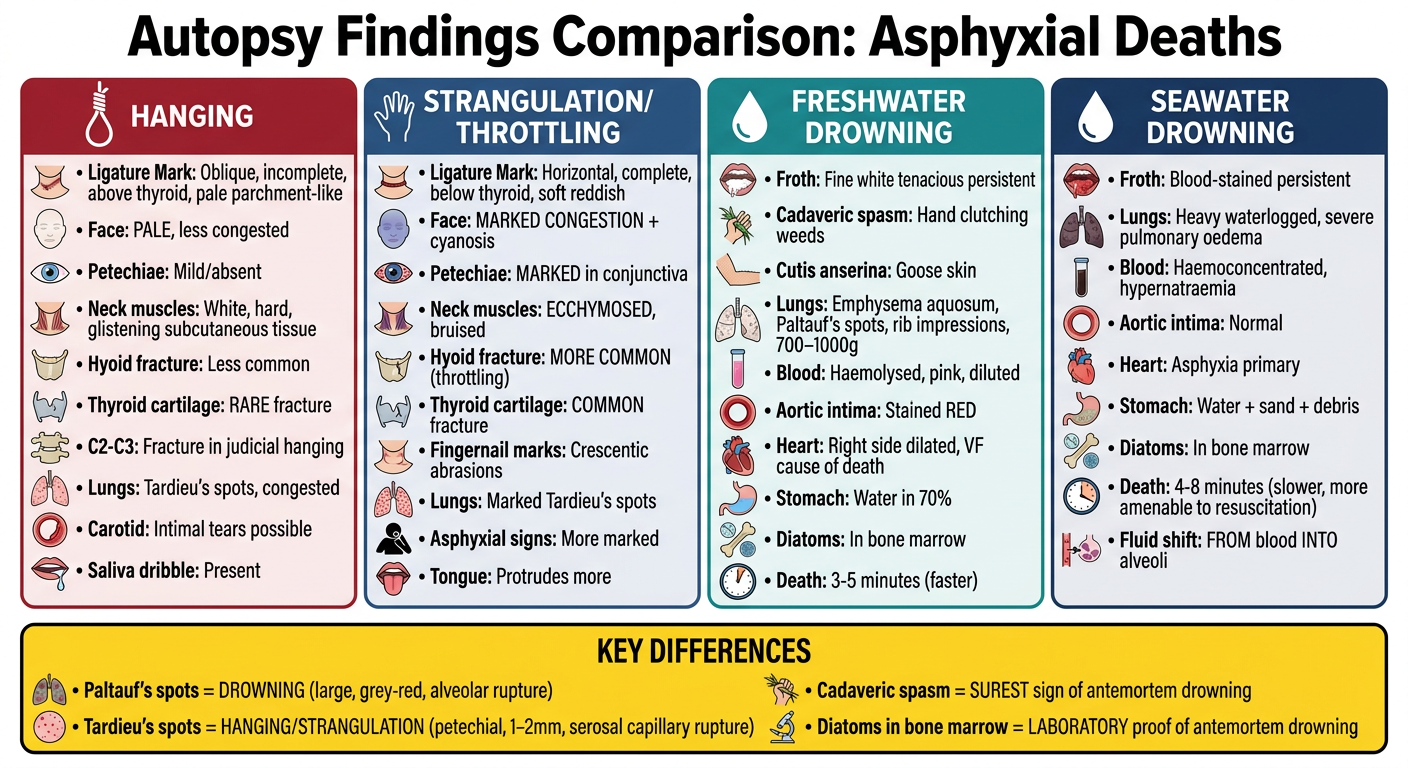
- Ligature mark: Oblique + incomplete = Hanging vs Horizontal + complete = Strangulation
- Face: Pale = Hanging vs Congested + petechiae = Strangulation/Throttling
- Paltauf's spots (large, grey-red) = Drowning vs Tardieu's spots (petechial, 1-2mm) = Hanging/Strangulation
- Aortic intima stained RED = Freshwater (haemolysis) vs Normal = Seawater
- Death in 3-5 min = Freshwater (VF) vs 4-8 min = Seawater (asphyxia)
- Cadaveric spasm (clutching weeds) = surest clinical sign of antemortem drowning
- Diatoms in bone marrow = best laboratory proof of antemortem drowning