

Convert these pictures into diagram
A clean educational diagram titled "Dewey's Modification of Angle's Classification of Malocclusion". Organized into two main sections: SECTION 1 (top): "Class I Modifications of Dewey" with a blue header bar. Five rows, each with a type label and description: - Type 1: Class I malocclusion with bunched or crowded anterior teeth - Type 2: Class I with protrusive maxillary incisors - Type 3: Class I malocclusion with anterior crossbite - Type 4: Class I molar relation with posterior crossbite - Type 5: The permanent molar has drifted mesially due to early extraction of second deciduous molar or second premolar SECTION 2 (bottom): "Class III Modifications of Dewey" with a blue header bar. Three rows: - Type 1: The upper and lower dental arches when viewed separately are in normal alignment. But when the arches are made to occlude the patient shows an edge to edge incisor alignment - Type 2: The mandibular incisors are crowded and are in lingual relation to the maxillary incisors - Type 3: The maxillary incisors are crowded and are in crossbite in relation to the mandibular anteriors White background, professional medical/dental textbook style, clear typography, alternating row shading, bold type numbers in blue
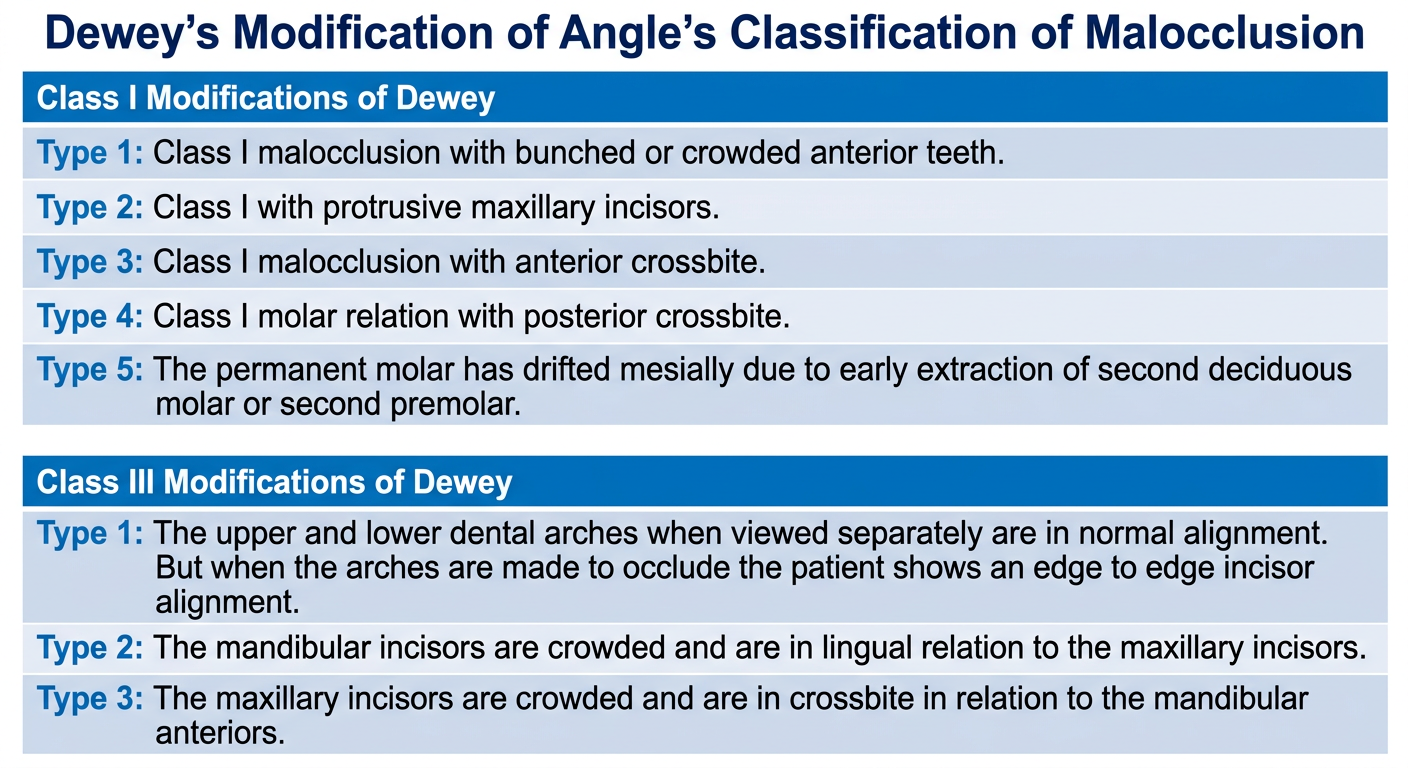
- Type 1 - Crowded/bunched anterior teeth
- Type 2 - Protrusive maxillary incisors
- Type 3 - Anterior crossbite
- Type 4 - Posterior crossbite (Class I molar relation)
- Type 5 - Mesially drifted permanent molar (due to early extraction of 2nd deciduous molar or 2nd premolar)
- Type 1 - Normal arches individually, but edge-to-edge incisor alignment on occlusion
- Type 2 - Crowded mandibular incisors in lingual relation to maxillary incisors
- Type 3 - Crowded maxillary incisors in crossbite relative to mandibular anteriors